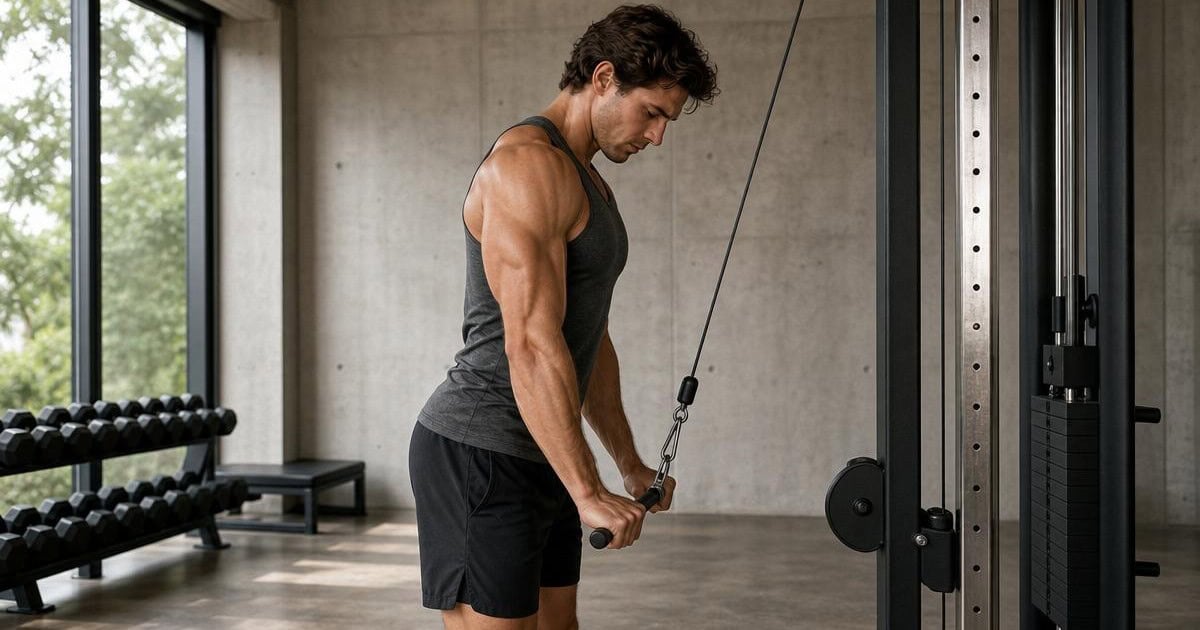
Cable tricep training produces real triceps growth through the unique mechanical advantage that cable resistance offers: constant tension throughout the entire range of motion that drives both hypertrophy and the stretched-position loading that the triceps respond to most strongly. The format works particularly well for triceps because the muscle has three heads (long, lateral, medial) that benefit from different angles and grip variations, and cable machines offer the angle versatility that drives complete tricep development. Most lifters who consistently train cable tricep work 1 to 2 times per week alongside compound pressing movements see measurable arm growth, improved tricep peak development, and better lockout strength on bench press and overhead press within 8 to 12 weeks. The combination of overhead extensions for long-head emphasis, pushdowns for general mass, kickbacks for isolation, and reverse grip work for medial head produces broader tricep development than any single training modality alone.
Below are ten effective cable tricep exercises that cover long-head emphasis (overhead extension, kneeling extension, high pulley extension), general mass work (pushdown, skull crusher, lying extension), isolation (kickback, single-arm pushdown), medial head work (reverse grip pushdown), and unique multi-angle work (crossover extension). Together they form a complete cable tricep program that hits all three tricep heads from multiple angles. A 25 to 35-minute session pulled from this list, performed 1 to 2 times per week, produces strong tricep development that complements compound pressing work.
Cable Overhead Tricep Extension Straight Bar

The Cable Overhead Tricep Extension with Straight Bar performs overhead extensions facing away from the cable column with a straight bar attachment. The overhead position places the long head of the triceps in a fully stretched position for maximum loading.
For cable tricep training, the overhead extension is the most direct long-head loading exercise. The long head contributes most to overall tricep mass and is best developed with stretched-position work. Run it for 3 to 4 sets of 10 to 12 reps as primary long-head work in any cable tricep session.
Set the cable pulley at the lowest position and attach a straight bar. Stand facing away from the cable with the bar in both hands behind the head, elbows pointing up. Keep the elbows pinned in position. Extend the arms by straightening the elbows, raising the bar overhead and slightly forward. Lower under control until the bar returns behind the head with elbows fully bent. Maintain elbow position throughout.
Cable Kickback

The Cable Kickback performs a tricep kickback with cable resistance instead of a dumbbell. The cable maintains constant tension that dumbbell kickbacks lose at the top, producing better tricep activation throughout the entire range.
For cable tricep training, the kickback isolates the lateral and long heads of the triceps with constant tension. The pattern is one of the most effective tricep isolation exercises with cables. Run it for 3 sets of 12 to 15 reps per arm as tricep isolation work.
Set the cable pulley at the lowest position with a single handle. Stand sideways to the cable, hinge forward at the hips with a flat back, and grip the handle with the arm closest to the cable. Pin the elbow against the side with the upper arm parallel to the floor. Extend the arm by straightening the elbow until the arm is fully extended back. Lower under control. Switch arms between sets.
Cable Reverse Grip Pushdown

The Cable Reverse Grip Pushdown performs tricep pushdowns with an underhand (supinated) grip. The reverse grip emphasizes the medial head of the triceps, which contributes to lower-arm thickness and gives the tricep the horseshoe appearance.
For cable tricep training, the reverse grip pushdown is the most direct medial head loading exercise. The medial head contributes to tricep thickness near the elbow. Run it for 3 sets of 10 to 12 reps as medial head work.
Set the cable pulley at a high position with a straight bar attachment. Stand facing the cable with feet shoulder-width and grip the bar with palms facing up (underhand grip). Keep elbows pinned to the sides. Extend the arms down by straightening the elbows. Squeeze the triceps hard at the bottom. Return under control. Use lighter weights than overhand pushdowns because the reverse grip is mechanically weaker.
Cable Incline Skull Crusher

The Cable Incline Skull Crusher performs lying tricep extensions on an incline bench with cable resistance. The incline angle and cable tension combine to produce strong tricep loading through the full range.
For cable tricep training, the incline skull crusher produces strong combined long-head and lateral head loading. The pattern hits the triceps with constant cable tension across a stretched-position movement. Run it for 3 sets of 10 to 12 reps as primary tricep mass work.
Set up an incline bench (45 to 60 degrees) about 3 feet from a low cable pulley with a straight bar attachment. Lie back on the bench with the head end facing the cable. Reach overhead and grip the bar with arms extended toward the pulley. Keep the elbows fixed in position. Bend the elbows to lower the bar toward the forehead. Extend the arms back to starting position by straightening the elbows.
Cable One Arm Tricep Pushdown
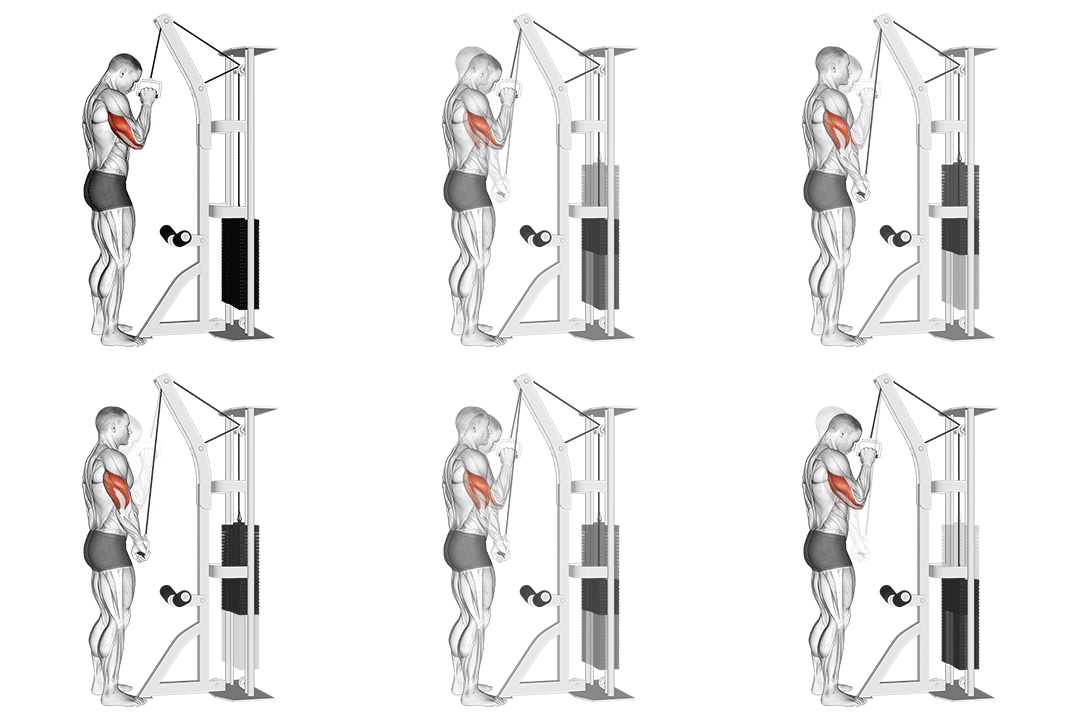
The Cable One Arm Tricep Pushdown performs single-arm pushdowns with a single handle attachment. The unilateral movement allows greater range of motion and addresses left-right strength imbalances.
For cable tricep training, the one-arm pushdown produces strong tricep isolation with greater range of motion than two-arm variants. The pattern hits all three tricep heads through full extension. Run it for 3 sets of 10 to 12 reps per arm as tricep isolation work.
Set the cable pulley at a high position with a single handle attachment. Stand facing the cable and grip the handle with one hand using a neutral or overhand grip. Pin the elbow at the side. Extend the arm down by straightening the elbow, pulling the handle to the hip. Squeeze the tricep at the bottom. Return under control. Switch arms between sets.
Cable Bent Over Single Arm Kickback

The Cable Bent Over Single Arm Kickback performs single-arm tricep kickbacks while bent over at the hips with cable resistance. The bent-over position increases tricep loading by aligning the resistance with the kickback motion.
For cable tricep training, the bent-over kickback produces strong tricep isolation with constant cable tension. The pattern hits the lateral and long heads through full extension. Run it for 3 sets of 12 to 15 reps per arm as tricep isolation finishing work.
Set the cable pulley at the lowest position with a single handle. Stand sideways to the cable and hinge forward at the hips with a flat back. Grip the handle with the arm farther from the cable. Pin the elbow against the side with the upper arm parallel to the floor. Extend the arm by straightening the elbow until the arm is fully extended back behind the body. Hold briefly at peak contraction. Lower under control.
Cable Lying Triceps Extension

The Cable Lying Triceps Extension performs lying skull crushers using cable resistance from below. The lying position eliminates lower back strain and the cable tension stays constant throughout the entire range.
For cable tricep training, the lying tricep extension produces strong combined long-head and lateral head loading. The pattern hits the triceps with constant cable tension across the full range. Run it for 3 sets of 10 to 12 reps as primary tricep mass work.
Set the cable pulley at the lowest position with a straight bar attachment. Lie flat on a bench positioned with the head end facing the cable column. Reach overhead and grip the bar with arms extended toward the pulley above the head. Keep the elbows fixed in position. Bend the elbows to lower the bar toward the forehead. Extend the arms back to starting position by straightening the elbows.
Cable Kneeling Triceps Extension

The Cable Kneeling Triceps Extension performs overhead extensions in a kneeling position using a rope attachment. The kneeling position eliminates lower body involvement and isolates the triceps fully.
For cable tricep training, the kneeling overhead extension produces strong long-head loading with isolated form. The pattern hits the long head through the stretched overhead position. Run it for 3 sets of 10 to 12 reps as long head emphasis work.
Set the cable pulley at a high position with a rope attachment. Kneel on the floor facing away from the cable column. Reach overhead and grip the rope with both hands. Keep the elbows pointing forward and pinned in position. Extend the arms by straightening the elbows, pulling the rope forward and slightly up. Pull the rope ends apart at full extension for peak contraction. Lower under control.
Cable Standing Crossover Overhead Tricep Extension

The Cable Standing Crossover Overhead Tricep Extension performs overhead extensions using two cable columns simultaneously, with the cables crossing in front of the body. The pattern produces unique multi-angle loading that targets all three tricep heads.
For cable tricep training, the crossover extension produces strong all-three-heads loading. The pattern hits the triceps from a unique angle that single-cable extensions can not match. Run it for 3 sets of 10 to 12 reps as advanced tricep variation work.
Set both cable pulleys to high positions with single handles. Stand between two cable columns. Grip each handle with the opposite arm so the cables cross in front of the body. Extend both arms forward and slightly up by straightening the elbows. The crossing cables produce unique tension. Lower under control while maintaining elbow position.
Cable High Pulley Overhead Tricep Extension

The Cable High Pulley Overhead Tricep Extension performs overhead extensions with the cable set high and the body facing away. The pattern combines stretched-position long-head loading with the constant-tension advantage of cables.
For cable tricep training, the high pulley overhead extension is one of the most effective long-head loading exercises. The pattern hits the long head through both stretched position and constant tension. Run it for 3 sets of 10 to 12 reps as long-head emphasis work.
Set the cable pulley at a high position with a rope attachment. Stand facing away from the cable column with the rope held overhead in both hands, palms facing each other. Pin the elbows in position pointing forward. Bend the elbows to lower the rope behind the head, feeling a deep stretch in the long head. Extend the arms back to starting by straightening the elbows. Squeeze the triceps at the top.
How To Program These Workouts
A productive cable tricep session pulls 4 to 6 exercises from the list above based on training goals. A common mass-building session: cable overhead extension (long head), cable lying extension (mass), cable pushdown (lateral head), cable kickback (isolation). A balanced three-heads session: cable overhead extension (long head), cable reverse grip pushdown (medial head), cable kickback (lateral head). Run mass-building work for 3 to 4 sets of 8 to 12 reps, isolation work for 3 sets of 10 to 12 reps per arm, and medial or long-head emphasis work for 3 sets of 10 to 15 reps. Total session covers 14 to 18 working sets focused on tricep development.
Train cable tricep work 1 to 2 times per week as part of broader pushing-day or arm-day programming. The triceps are a moderate-sized muscle that recovers reasonably quickly but accumulates fatigue from compound pressing work (bench press, overhead press, dips) that already activates them substantially. Most successful programs schedule cable tricep work either: 1) at the end of a chest or shoulder day (after compound presses), 2) on a dedicated arm day with biceps, or 3) twice per week with light volume on one day and heavier focused work on the other. Keep tricep training time under 30 to 35 minutes per session.
For broader tricep programming, see our how to build bigger triceps and best cable workouts for arms. For specific tricep work, see our best long head tricep exercises.
Final Thoughts
The best cable tricep workouts deliver real triceps growth through the unique advantage of constant tension that cables provide throughout the entire extension range. The combination of long-head emphasis through overhead extensions, general mass work through pushdowns and skull crushers, isolation through kickbacks, and medial head work through reverse grip pushdowns covers all three tricep heads and produces broader arm growth than dumbbell or barbell extensions alone. For lifters who want measurable tricep size and lockout strength improvements, want to break through plateaus in arm growth, or want to add variety to their tricep training, dedicated cable tricep work is one of the most effective options available.
Stay focused on form quality and elbow position. The most common cable tricep training mistakes include letting the elbows drift forward during extensions (which reduces tricep isolation and recruits the front delts) and using too much weight (which forces body english and compromises form). The fix: pin the elbows in position throughout each rep, focus on isolating the elbow flexion movement, and use weights light enough to maintain strict form across the full set. Quality reps with appropriate weights produce stronger tricep growth than ego-driven heavy weights with sloppy form.
Frequently Asked Questions
Are cable tricep extensions better than dumbbell extensions?
They serve complementary roles. Cable extensions produce constant tension throughout the entire range of motion, which dumbbells can not match (dumbbell tension drops at certain points). Dumbbells produce more stabilizer recruitment. Most successful tricep programs include both: dumbbells for foundational mass work and cables for constant-tension variation, isolation, and finishing work.
How often should I train triceps with cables?
One to two cable tricep sessions per week works for most lifters. The triceps recover reasonably quickly but accumulate fatigue from compound pressing work (bench press, overhead press, dips). Most successful programs include cable tricep work either at the end of a pressing day, on a dedicated arm day, or twice per week with one heavier session and one lighter pump-focused session.
What’s the best cable attachment for tricep work?
Different attachments serve different purposes. The straight bar produces standard tricep loading and is best for primary mass work. The rope works best for overhead extensions and pushdowns where the spreading-apart action increases peak contraction. The single handle works for unilateral and kickback variations. The V-bar attachment produces neutral grip pushdowns. Most successful programs include 2 to 3 different attachments across a session.
Should I do cable tricep work before or after compound pressing?
After compound pressing in most cases. The triceps are heavily recruited during bench press, overhead press, and dips, and pre-fatiguing them with cable extensions compromises compound lifting performance. Most successful programs do compound pressing first (bench, OHP, dips), then move to direct tricep work. The exception is dedicated arm days where triceps and biceps are the primary focus.
Which cable tricep exercise builds the most mass?
Cable overhead extensions build the most overall tricep mass through long-head emphasis. The long head is the largest of the three tricep heads and contributes most to tricep size. Most successful tricep programs include some form of overhead extension as a primary mass exercise. Other strong mass-builders include cable lying extensions and the cable incline skull crusher.