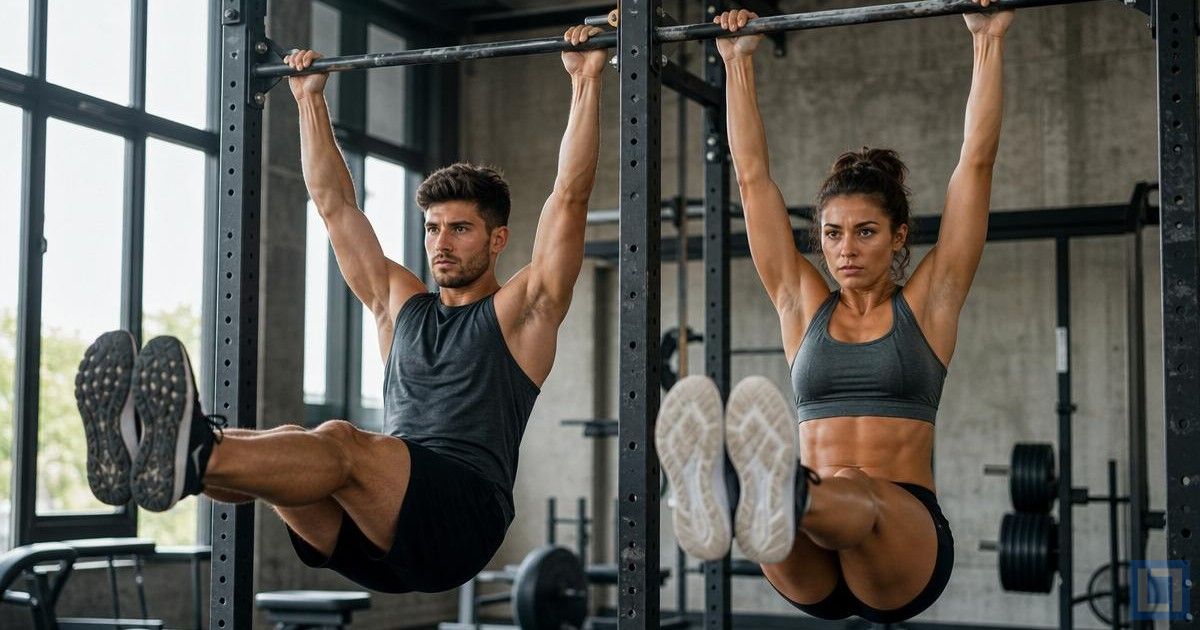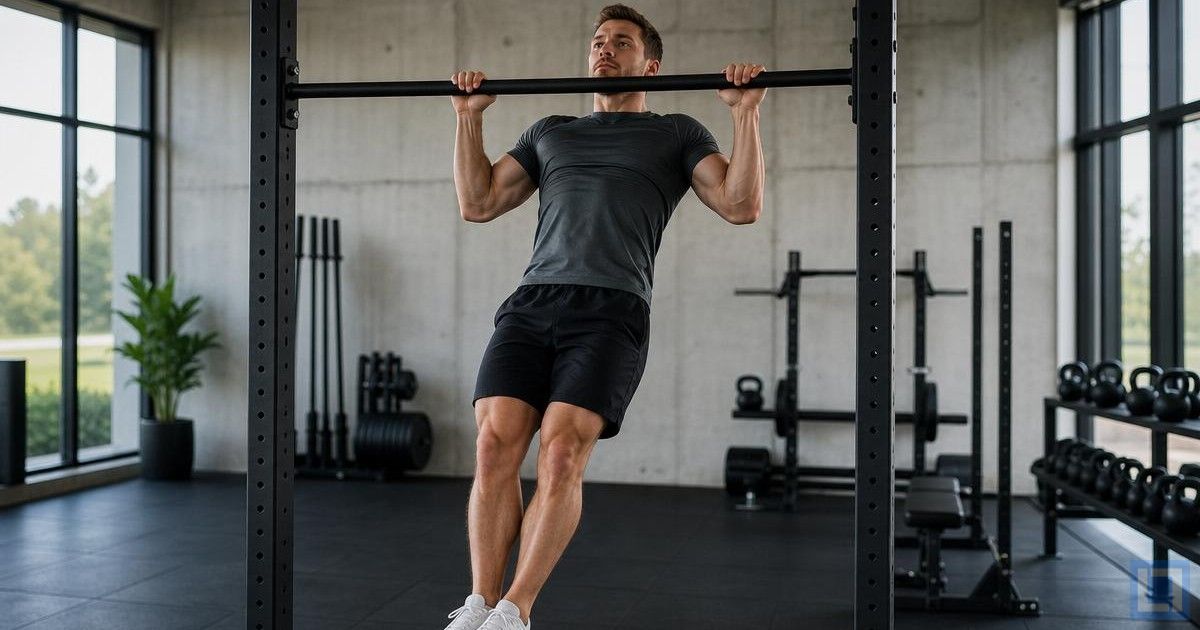
Pull-up bar training produces real upper-body strength, muscle development, and grip strength through equipment that fits in any doorway, garage, or pull-up tower. The format works particularly well because the pull-up bar enables an enormous range of progressively harder exercises (from beginner pull-ups through advanced muscle-ups and one-arm pull-ups) using just the body weight as resistance. The combination of pulling exercises (pull-ups, chin-ups in various grips), advanced variations (archer, commando, muscle-up), isometric holds (top hold), and hanging core work (leg raises, knees-to-elbows) covers every major upper-body and core function with a single piece of equipment.
Below are ten effective pull-up bar exercises that cover foundational pulling (pull-up, chin-up, wide-grip, close-grip), advanced unilateral and combined work (archer pull-up, commando pull-up, muscle-up), isometric strength (top pull-up hold), and hanging core training (hanging leg raise, hanging knees-to-elbows). Together they form a complete pull-up bar training program that scales from beginner to advanced. A 30 to 45-minute session pulled from this list produces strong upper-body and core stimulus.
Pull Up

The Pull Up grips an overhead bar with palms facing away and pulls the body up until the chin clears the bar. The exercise is the foundational pull-up bar movement and the cornerstone of any productive pull-up bar program.
For pull-up bar training, the standard pull-up is non-negotiable. The pattern hits the lats, mid-back, biceps, and forearms simultaneously through bilateral pulling mechanics. Run them for 4 to 5 sets of 5 to 10 reps as the foundational pull exercise in every pull-up bar session.
Hang from an overhead bar with palms facing away (overhand grip), hands shoulder-width apart. Pull the body up by driving the elbows down and back until the chin clears the bar. Lower under control to a full hang. Avoid kipping or swinging.
Chin Up

The Chin Up grips an overhead bar with palms facing the body (underhand grip) and pulls the body up until the chin clears the bar. The reverse grip emphasizes the biceps more heavily than overhand pull-ups.
For pull-up bar training that emphasizes bicep development, the chin-up produces stronger bicep loading than any other bodyweight exercise. The pattern combines pulling with bicep peak contraction at the top. Run it for 3 to 4 sets of 6 to 10 reps as combined back and bicep work.
Hang from an overhead bar with palms facing the body (underhand grip), hands shoulder-width apart. Pull the body up by driving the elbows down until the chin clears the bar. Squeeze the biceps at the top. Lower under control to a full hang.
Wide Grip Pull Up

The Wide Grip Pull Up performs pull-ups with hands wider than shoulder-width on the bar. The wider grip emphasizes the lats more directly by reducing bicep contribution.
For pull-up bar training that targets lat width, the wide-grip pull-up is one of the most direct lat-builders that exists. The wider grip biases loading toward the lats over the surrounding muscles. Run it for 3 to 4 sets of 6 to 8 reps as primary lat width work.
Hang from an overhead bar with palms facing away and hands wider than shoulder-width (roughly 1.5 times shoulder-width). Pull the body up by driving the elbows down and back, focusing on lat contraction. Continue until the chin clears the bar. Lower under control.
Close Grip Pull-up

The Close Grip Pull-up performs pull-ups with hands placed close together on the bar. The narrower grip allows greater range of motion and produces strong bicep involvement alongside lat work.
For pull-up bar training with closer grip variety, the close-grip pull-up provides a different angle of pulling than wide variations. The narrower grip engages the biceps more heavily. Run it for 3 sets of 6 to 10 reps as variation work.
Hang from an overhead bar with palms facing away and hands placed close together (shoulder-width or narrower). Pull the body up by driving the elbows down and back. Continue until the chin clears the bar. The closer grip produces a slightly different pulling angle than wide variations.
Commando Pull Up

The Commando Pull Up grips the bar with one hand in front and one behind, alternating sides on each rep so the head moves alongside the bar with each pull. The pattern adds rotational and unilateral demand to the standard pull-up.
For advanced pull-up bar training, the commando pull-up produces unique loading that combines pulling strength with rotational core demand. The pattern requires significant existing pull-up strength to perform safely. Run it for 3 sets of 5 to 8 reps per side as advanced pull work.
Grip the bar with hands close together, one hand facing forward and one facing backward (split grip). Pull the body up while turning the head to one side so it passes alongside the bar. Lower under control. On the next rep, turn the head to the opposite side. Alternate sides.
Archer Pull-up

The Archer Pull-up performs pull-ups with most of the body weight loaded on one arm at a time, with the other arm extended out to the side for balance. The pattern produces near-unilateral pulling loading.
For advanced pull-up bar training, the archer pull-up is one of the most direct unilateral pulling exercises that exists. The pattern produces 70 to 80 percent unilateral loading without requiring full one-arm pull-up strength. Run it for 3 sets of 4 to 6 reps per side as advanced pull work.
Hang from an overhead bar with hands significantly wider than shoulder-width. Pull toward one hand by bending that elbow while keeping the other arm relatively straight (acting as a brace). The body angles toward the working side. Lower under control. Pull toward the opposite side on the next rep.
Muscle Up

The Muscle Up combines a pull-up with a transition over the bar into a dip position, ending with arms locked out above the bar. The exercise is one of the most demanding bodyweight upper-body movements that exists.
For advanced pull-up bar training, the muscle-up is the gold standard advanced bodyweight upper-body exercise. The pattern requires significant pulling strength, transition technique, and dipping strength. Most lifters need 12+ strict pull-ups before attempting muscle-ups. Run it for 3 sets of 3 to 6 reps as advanced full upper-body work.
Hang from an overhead bar with palms facing away. Pull up explosively while leaning the chest over the bar in a transition motion. Push the body up over the bar into a dip position with arms locked out. Lower under control through the transition back to a hang.
Top Pull-Up Hold
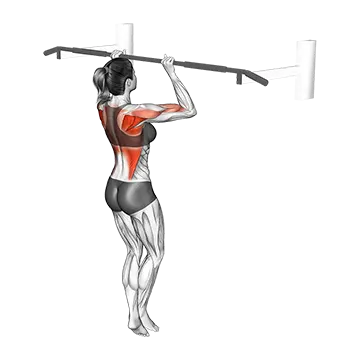
The Top Pull-Up Hold pulls the body up to the top position of a pull-up and holds isometrically with the chin above the bar. The isometric loading produces strong pulling-position strength specific to the contracted pull-up position.
For pull-up bar training that builds pulling strength, the top hold develops the isometric strength specific to the contracted position. The pattern translates to faster strict pull-up progression and stronger lock-off positions for muscle-ups. Run it for 3 to 4 sets of 10 to 30-second holds as accessory pull-up work.
Pull the body up to the top of a pull-up position with the chin above the bar. Hold the position isometrically while bracing the lats and core. Lower under control when the position breaks down. Use a stool or jump-up if needed to reach the start position.
Hanging Leg Raise

The Hanging Leg Raise hangs from an overhead bar and lifts the legs up in front of the body to roughly horizontal or higher. The pattern produces extreme abdominal demand combined with grip and shoulder stability work.
For pull-up bar training that includes core work, the hanging leg raise is one of the most demanding direct core exercises that exists. The pattern hits the lower abs and hip flexors with significant loading. Run it for 3 sets of 8 to 12 reps as primary hanging core work.
Hang from an overhead bar with overhand grip, arms fully extended. Lift the legs up in front of the body to roughly horizontal, contracting the abs hard at the top. Lower under control without swinging. Avoid using momentum.
Hanging Knees to Elbows

The Hanging Knees to Elbows hangs from a bar and lifts the knees toward the elbows by curling the spine and contracting the abs. The pattern is the progression toward toes-to-bar and produces extreme abdominal demand.
For advanced hanging core work, the knees-to-elbows produces stronger ab loading than standard hanging knee raises. The pattern hits the entire rectus abdominis and hip flexors. Run it for 3 sets of 6 to 10 reps as advanced hanging core work.
Hang from an overhead bar with overhand grip, arms fully extended. Lift the knees up toward the elbows while curling the spine and contracting the abs. The knees should touch (or come very close to) the elbows at the top. Lower under control.
How To Program These Workouts
A productive pull-up bar session pulls six to eight exercises from the list above. A balanced session includes one foundational pull (pull-up), one chin-up variation (chin-up or close-grip pull-up), one wide-grip variation (wide-grip pull-up), one advanced exercise (archer, commando, or muscle-up), one isometric hold (top hold), and one hanging core exercise (hanging leg raise or knees-to-elbows). Run foundational pulls for 4 to 5 sets of 5 to 10 reps; advanced variations for 3 sets of 4 to 8 reps; isometric holds for 3 to 4 sets of 10 to 30 seconds; hanging core for 3 sets of 6 to 12 reps.
Train pull-up bar sessions 2 to 3 times per week. The bodyweight format produces moderate joint stress, which allows higher frequency than barbell-heavy programs. Most lifters do well with 2 to 3 dedicated pull-up bar sessions per week alongside lower-body and other body part training. Advanced practitioners often train pull-up bar work daily as part of broader calisthenics programs, but most lifters do better with 2 to 3 focused sessions weekly.
For broader programming, see our best calisthenics workouts and best at home calisthenics workouts. For specific pull-up technique, see our how to do a pull up.
Final Thoughts
The best pull-up bar workouts deliver real upper-body and core development through bodyweight training that scales from beginner to advanced through progressive variations. The combination of foundational pulling, advanced variations, isometric holds, and hanging core work covers every major upper-body and core function with a single piece of equipment. For lifters who want serious upper-body training without complex gym setups, want to add pull-up bar work to existing programs, or need effective home gym training in minimal space, this format is one of the most effective options available.
Stay focused on strict form throughout every rep. The most common pull-up bar training mistake is using kipping or swinging momentum to complete more reps, which significantly reduces the actual strength stimulus and increases shoulder injury risk. The fix: every rep should start from a full hang with arms straight and end with the chin (or chest for muscle-ups) clearly above the bar, both motions controlled. Strict reps build strength faster than higher kipping rep counts because each rep loads the muscles fully through the entire range of motion.
Frequently Asked Questions
Are pull-up bar workouts effective?
Yes, very effectively. The pull-up bar enables an enormous range of progressively harder exercises (from beginner pull-ups through advanced muscle-ups and one-arm pull-ups) using just body weight. The combination of pulling exercises, advanced variations, isometric holds, and hanging core work covers every major upper-body and core function. Most lifters who consistently do pull-up bar work see meaningful upper-body and core development within 8 to 12 weeks.
How often should I do pull-up bar workouts?
Two to three times per week works for most lifters. The bodyweight format produces moderate joint stress, which allows higher frequency than barbell-heavy programs. Most successful programs include 2 to 3 dedicated pull-up bar sessions per week alongside lower-body and other body part training. Advanced practitioners often train pull-up bar work daily as part of broader calisthenics programs.
How do I progress pull-up bar workouts?
Most lifters progress through three primary methods: increasing reps (from 3 to 12+ per set), adding harder variations (pull-up → wide-grip → archer → one-arm), and adding load (weighted vest, weight plate from a dip belt). The combination of all three methods produces sustainable progression for years of consistent training. Most advanced practitioners eventually progress to one-arm pull-ups and weighted muscle-ups.
What if I can’t do a pull-up?
Beginners can build pull-up strength through three approaches: assisted pull-ups (resistance band looped around the foot for assistance), negative pull-ups (jump up and lower slowly), or inverted rows (horizontal pulling at lower body weight loading). Most beginners can build to 1 to 2 strict pull-ups within 4 to 8 weeks of dedicated practice. The progression from no pull-ups to 5+ strict pull-ups typically takes 8 to 16 weeks for most lifters.
Pull-up bar or lat pulldown machine?
Pull-ups produce slightly stronger development than lat pulldowns through bodyweight loading and full-body bracing. However, lat pulldowns allow adjustable loading that beginners need to build initial pulling strength. Most successful programs include both: pull-ups as the primary heavy compound and lat pulldowns for additional volume at adjustable loads. Lifters with home pull-up bars can use bands for assistance and weight vests for added load.