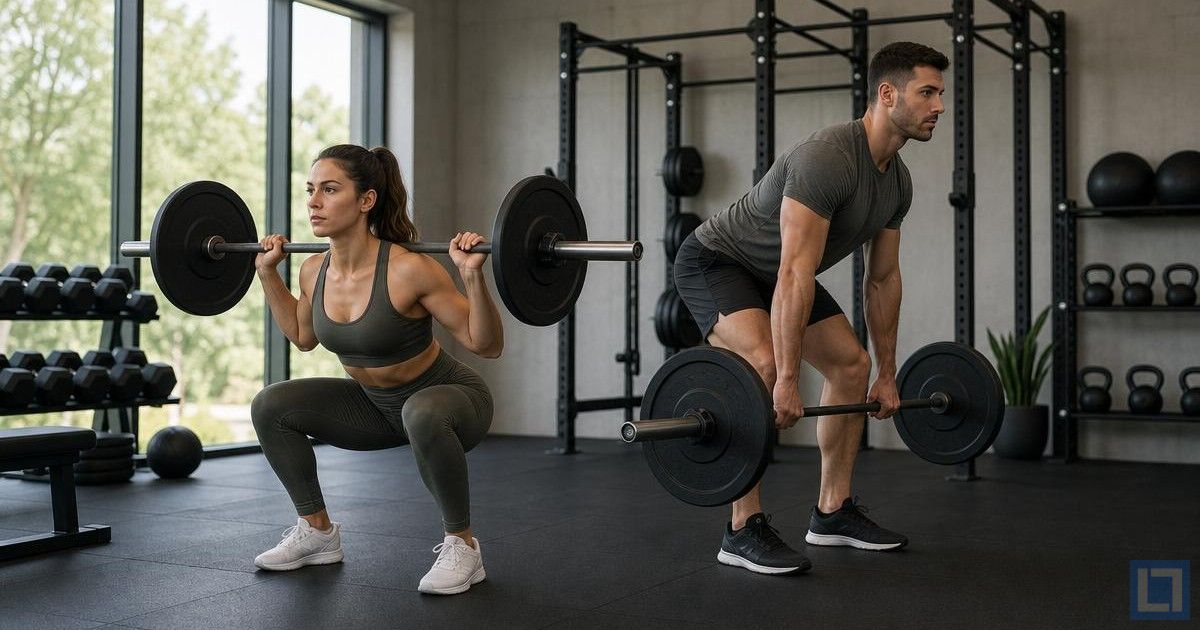
Barbell leg training produces the strongest lower-body strength and mass development possible in any training format. The bilateral barbell loading allows heavier total weight than dumbbells, kettlebells, or bodyweight exercises, which means progressive overload happens faster and produces stronger development per training session. The combination of foundational compound lifts (back squat, front squat, deadlift) and accessory work (Romanian deadlifts, hip thrusts, lunges) covers every major lower-body function and produces the kind of leg strength and mass that defines serious training.
Below are ten effective barbell leg exercises that cover bilateral squatting (back squat, front squat), pulling (conventional deadlift, Romanian deadlift, stiff-legged deadlift), unilateral work (walking lunge, split squat), glute-focused training (hip thrust, glute bridge), and calf development (standing calf raise). Together they form a complete barbell leg training program that produces real lower-body development for years of consistent practice.
Barbell Squat

The Barbell Squat (back squat) holds a barbell across the upper back and squats down by bending at the hips and knees. The exercise is the foundational barbell leg compound and the strongest single mass-builder for the entire lower body.
For barbell leg training, the back squat is the cornerstone exercise. No other single exercise produces as much total leg development per rep as the heavy back squat. The combination of bilateral heavy loading, full-body bracing demand, and quad/glute/hamstring activation drives broader leg development than any other movement. Run it for 4 to 5 sets of 5 to 8 reps as the primary leg exercise.
Set up under a barbell on a squat rack with the bar across the upper back, hands gripping the bar wider than shoulder-width. Step back to clear the rack. Stand with feet shoulder-width and toes pointed slightly out. Squat down by sitting the hips back while bending the knees, keeping the chest tall. Drive back to standing through the whole foot.
Barbell Front Squat

The Barbell Front Squat holds a barbell across the front of the shoulders (in a clean grip or cross-arm position) and squats down. The front-loaded position emphasizes the quads more heavily than back squats and demands strong upright torso position.
For quad-emphasized barbell training, the front squat is one of the most effective compound exercises that exists. The front-loaded position shifts loading from the hips/glutes (where back squats emphasize) to the quads, which produces stronger quad development per rep. Run it for 3 to 4 sets of 6 to 10 reps as the primary quad-focused barbell exercise.
Set up under a barbell on a squat rack with the bar resting across the front of the shoulders, fingertips holding the bar lightly with elbows pointing forward. Step back to clear the rack. Squat down by sitting the hips back while bending the knees, keeping the chest tall and elbows up. Drive back to standing.
Barbell Deadlift

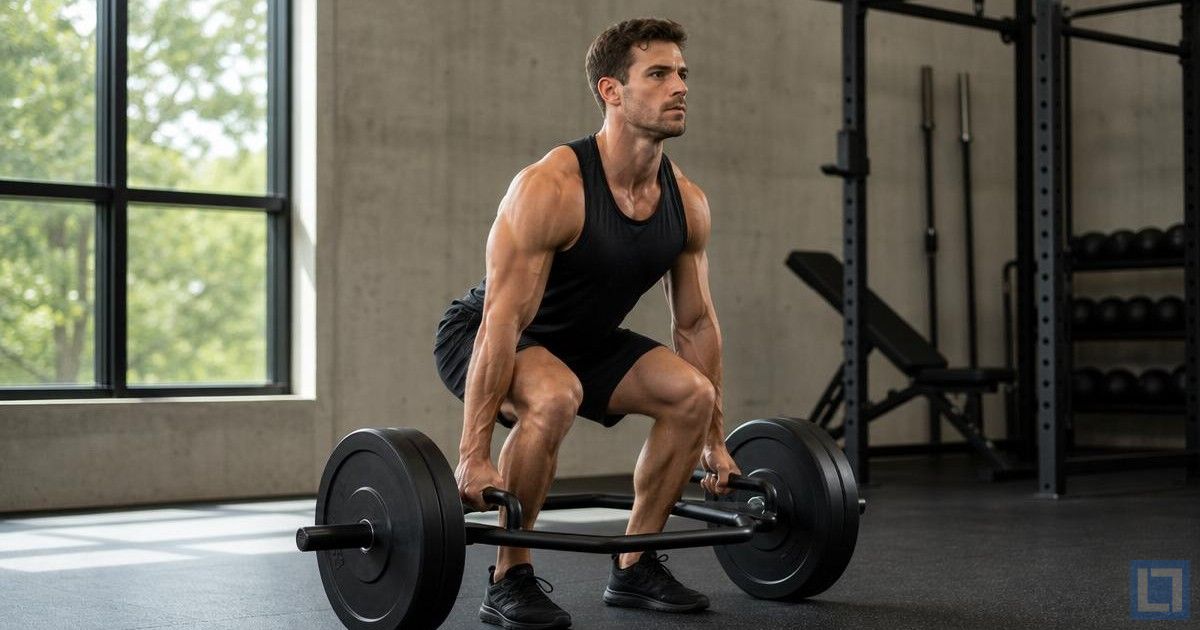
The Barbell Deadlift starts with the barbell on the floor and lifts it to standing position by hinging at the hips and extending through the legs. The exercise loads the entire posterior chain (hamstrings, glutes, lower back, traps) plus produces significant quad activation during the initial drive.
The deadlift is the most foundational lower-body pull in any barbell program. While primarily a posterior chain exercise, the initial drive off the floor activates the quads heavily, which makes it a complete leg exercise that complements squats. Run it for 4 to 5 sets of 3 to 6 reps as the primary heavy pulling exercise.
Stand with feet hip-width with the barbell over the middle of the feet. Hinge at the hips and bend the knees to grip the bar with shoulder-width grip. Drive through the legs and pull the bar up close to the body until standing fully upright. Reverse the motion under control. Reset before each rep.
Barbell Romanian Deadlift

The Barbell Romanian Deadlift starts standing with the barbell at hip level and hinges at the hips with a slight knee bend, lowering the bar in a controlled motion before driving the hips forward to stand. The exercise targets the hamstrings and glutes heavily through the hip-hinge motion.
For hamstring development, the Romanian deadlift is one of the most effective exercises that exists. The hip-hinge pattern emphasizes the hamstrings and glutes more heavily than conventional deadlifts because the knees stay relatively straight throughout. Run it for 3 to 4 sets of 8 to 12 reps as primary hamstring work.
Stand tall holding a barbell at hip level with shoulder-width grip. Hinge at the hips with a slight knee bend, lowering the bar in a path close to the legs until the hamstrings stretch. Drive the hips forward to stand back up. Keep the back flat throughout.
Barbell Walking Lunge
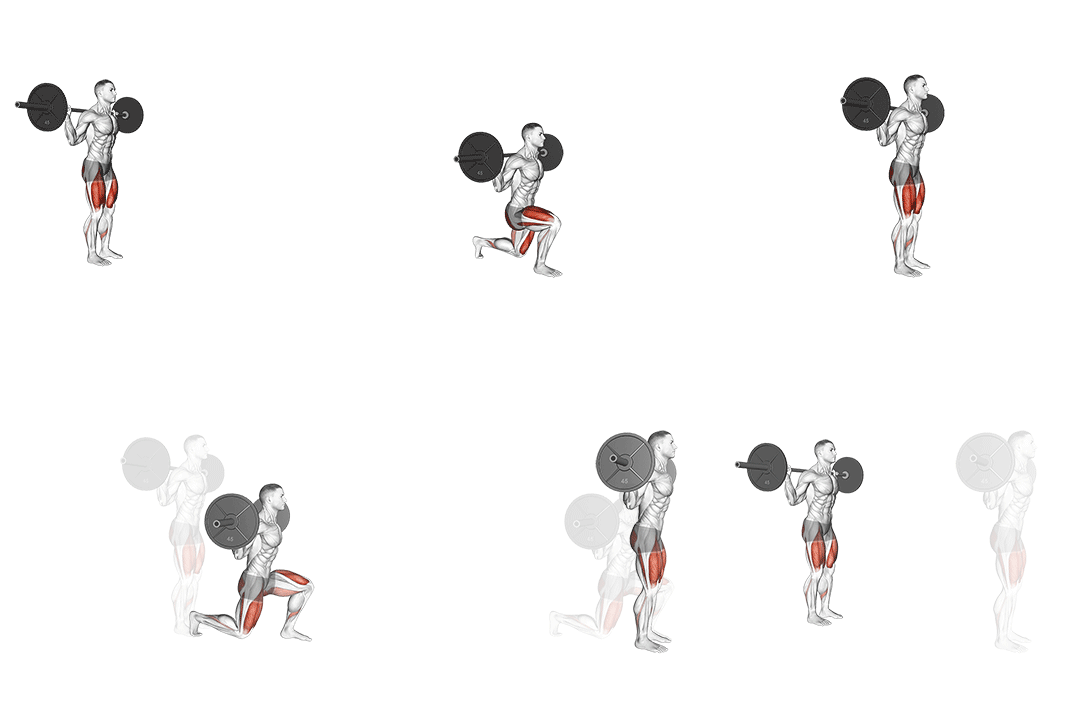
The Barbell Walking Lunge performs walking lunges while holding a barbell across the upper back. The walking pattern adds dynamic loading to the unilateral lunge motion, which produces stronger glute and quad development than static lunges.
For unilateral barbell leg training, the walking lunge is one of the most demanding exercises that exists. The combination of walking motion, barbell loading, and unilateral leg work produces broader athletic development than bilateral squatting alone. Run it for 3 to 4 sets of 8 to 10 reps per leg.
Set up under a barbell on a squat rack with the bar across the upper back. Step back to clear the rack. Step forward into a long lunge stance, lowering the back knee toward the floor while bending the front knee. Drive through the front foot to step the back foot forward into the next lunge. Continue walking forward.
Barbell Hip Thrust

The Barbell Hip Thrust sets up with the upper back resting on a bench and a barbell across the hips, then drives the hips up by squeezing the glutes hard. The exercise produces stronger glute loading than nearly any other lower-body exercise.
For glute development, the barbell hip thrust is the gold standard. No other exercise produces as much glute activation per rep, and the loading capability is substantial (advanced lifters work with 300+ pounds). Run it for 3 to 4 sets of 6 to 10 reps as the primary glute exercise. Combine with squats and deadlifts for complete posterior development.
Set up with the upper back resting on a bench and feet planted shoulder-width on the floor. Place a barbell across the hips (use a pad for comfort). Drive the hips up by squeezing the glutes hard at the top. Lower under control. Hold the top position briefly on each rep to maximize glute contraction.
Barbell Glute Bridge
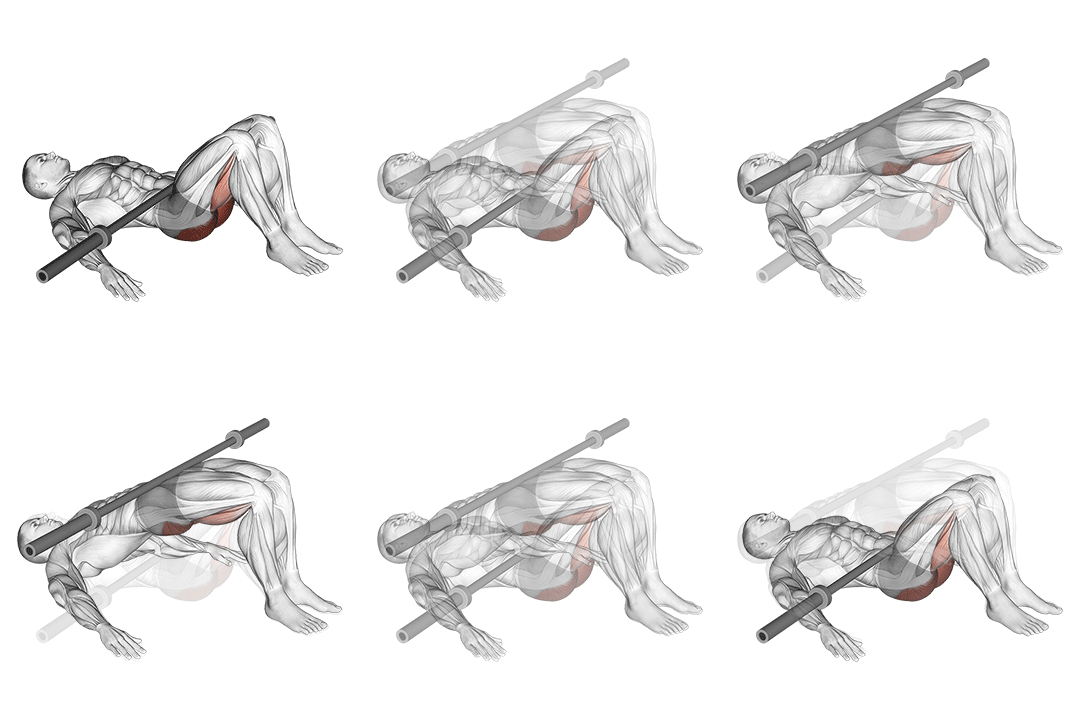
The Barbell Glute Bridge lies flat on the floor with knees bent and a barbell across the hips, then drives the hips up by squeezing the glutes hard. The exercise is similar to the hip thrust but performed on the floor rather than with the upper back elevated.
For glute training without a bench, the barbell glute bridge produces strong glute loading using only floor space and a barbell. The reduced range of motion compared to hip thrusts makes it slightly less productive for glute development but still highly effective. Run it for 3 sets of 8 to 12 reps.
Lie flat on the floor with knees bent and feet planted shoulder-width. Place a barbell across the hips (use a pad for comfort). Drive the hips up by squeezing the glutes hard at the top. Lower under control. The motion is smaller than a hip thrust because the upper body is on the floor rather than elevated.
Barbell Stiff Legged Deadlift
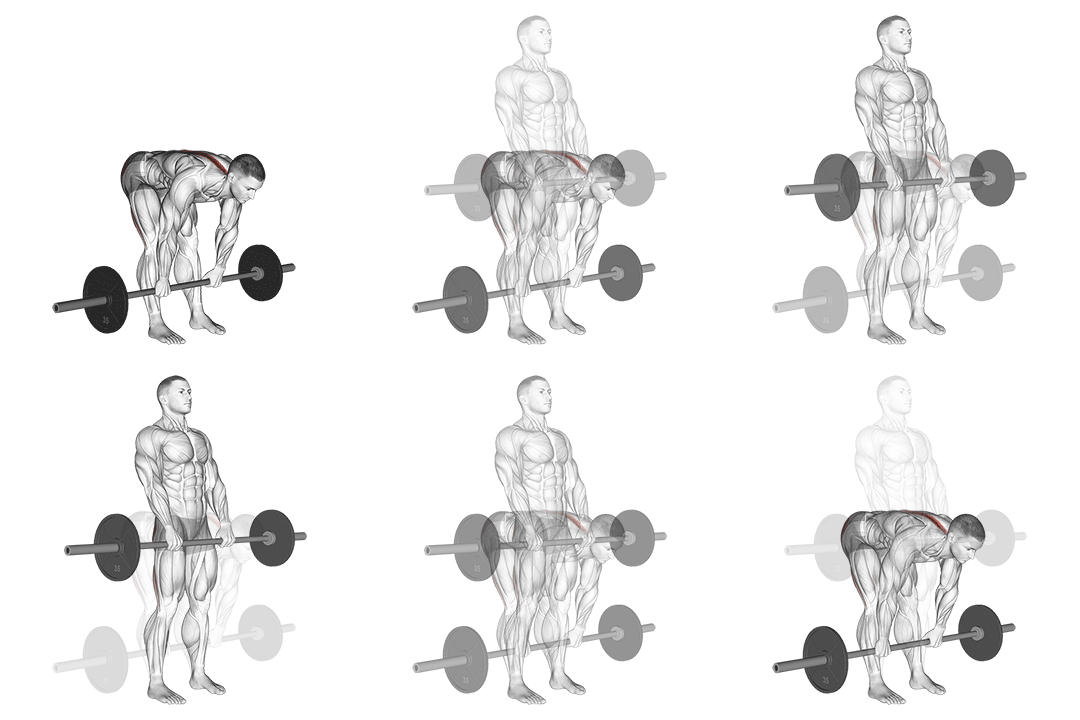
The Barbell Stiff Legged Deadlift performs the deadlift motion with the legs nearly straight throughout the rep. The reduced knee bend forces the hamstrings to do more of the work compared to conventional deadlifts.
For hamstring isolation in barbell training, the stiff-legged deadlift produces stronger hamstring loading than conventional deadlifts. The pattern complements Romanian deadlifts by emphasizing slightly different angles of the hip hinge. Run it for 3 sets of 8 to 12 reps as accessory hamstring work.
Stand with feet hip-width holding a barbell at hip level. Keep the legs nearly straight with only a slight knee bend. Hinge at the hips, lowering the bar toward the floor in a path close to the legs. Reverse the motion to stand back up by driving the hips forward.
Barbell Standing Calf Raise

The Barbell Standing Calf Raise holds a barbell across the upper back and rises onto the toes by extending through the ankles. The bilateral barbell loading produces stronger calf strength stimulus than dumbbell or bodyweight variations.
For calf development in barbell programs, the standing calf raise is the foundational exercise. The bilateral barbell loading allows heavier total weight than dumbbell variations, which produces stronger calf development per rep. Run it for 3 to 4 sets of 12 to 20 reps with full range of motion.
Set up under a barbell on a squat rack with the bar across the upper back. Step back to clear the rack. Stand with feet hip-width on the floor or with the balls of the feet on a small block. Rise up onto the toes by extending through the ankles. Lower under control until the heels descend below the start position (if using a block).
Barbell Split Squat

The Barbell Split Squat sets up in a split stance with one foot forward and one back, then lowers straight down by bending both knees while holding a barbell across the upper back. The static stance allows higher loads than walking lunges while still producing unilateral leg loading.
For unilateral barbell training that allows heavier loading, the split squat is one of the most effective exercises that exists. The static stance eliminates the dynamic walking motion of lunges, which allows lifters to focus on the unilateral leg loading without balance demand. Run it for 3 to 4 sets of 6 to 10 reps per leg.
Set up under a barbell on a squat rack with the bar across the upper back. Take a long split stance with one foot forward and one back. Drop straight down by bending both knees, lowering the back knee toward the floor. Drive back to the start through the front foot. Complete all reps on one leg before switching.
How To Program These Workouts
A productive barbell leg session pulls five to seven exercises from the list above. A balanced session includes one heavy primary squat (back squat or front squat), one heavy pull (deadlift or Romanian deadlift), one unilateral exercise (split squat or walking lunge), one glute-focused exercise (hip thrust), and one accessory exercise (calf raise or stiff-legged deadlift). Run primary work for 4 to 5 sets of 3 to 6 reps; secondary work for 3 to 4 sets of 6 to 10 reps; accessory work for 3 sets of 8 to 12 reps.
Train barbell legs 1 to 2 times per week. The lower body recovers within 72 hours of heavy training, but the high systemic demand of heavy squatting and deadlifting means barbell leg work compounds with all other training. Most well-designed programs include one heavy lower-body day plus one moderate lower-body day per week, with appropriate rest between. Beginners can start with one focused leg day per week and progress to two as training volume tolerance increases.
For broader programming, see our best compound exercises for strength and best powerlifting program. For more leg training, see our best dumbbell leg workouts.
Final Thoughts
The best barbell leg workouts deliver the strongest possible lower-body strength and mass development through bilateral barbell loading and progressive compound movements. The combination of squats, deadlifts, hip thrusts, lunges, and accessory work covers every major lower-body function and produces the kind of leg development that defines serious lifters. For lifters with access to a barbell and squat rack, barbell leg training is one of the most effective lower-body training options available.
Stay focused on form quality at heavier loads. The most common barbell leg training mistake is chasing weight increases through form breakdown rather than building strength through strict reps. The fix: prioritize strict full-range form over rep PRs and weight PRs. A heavy back squat done with knees caving inward produces less benefit than a moderate-weight back squat done with strict form. Lifters who maintain strict form at heavy loads produce stronger long-term gains and stay injury-free longer than those who chase numbers at any cost.
Frequently Asked Questions
Can I build big legs with just barbell exercises?
Yes, very effectively. Barbell training is the most efficient single training modality for lower-body development. The combination of heavy compound lifts (squats, deadlifts) and progressive accessory work produces real leg development for years of consistent practice. Most lifters with serious leg development built it primarily through barbell training, with dumbbell and machine work serving as accessory complements rather than primary training tools.
How often should I train barbell legs?
1 to 2 times per week works for most lifters. The lower body recovers within 72 hours of heavy training. Most successful programs include one heavy lower-body day plus one moderate lower-body day per week. Beginners often do well with one focused leg day per week initially, progressing to two days as training volume tolerance increases over 6 to 12 months.
Squat or deadlift first?
Most lifters do better with squats first, then deadlifts in the same session, because squats demand significant quad and glute work that benefits from being fresh while deadlifts demand significant lower-back work that fatigues across exercises. However, some programs (5×5, conjugate) split squats and deadlifts to different days to allow heavy work on both without compounding fatigue. Whichever lift is your primary focus should usually go first in any session.
Do I need a squat rack for barbell leg workouts?
Yes for back squats and front squats, since loading and unloading barbells weighing significant total weight is impractical without a rack. Deadlifts, Romanian deadlifts, and stiff-legged deadlifts can be performed without a rack since the barbell starts on the floor. A complete barbell leg training setup typically includes a squat rack, barbell, plates, and a flat bench (for hip thrusts). This setup covers all the exercises in this list.
How heavy should I squat?
Beginner-level: bodyweight on the bar for 5 reps. Intermediate-level: 1.5x bodyweight for 5 reps. Advanced-level: 2x bodyweight or more for 5 reps. The progression takes 12 to 36 months for most lifters depending on starting strength, training experience, and consistency. Most lifters can hit 1.5x bodyweight squats within 18 to 24 months of consistent training. The key is consistent training over months and years, not chasing aggressive single-session PRs.