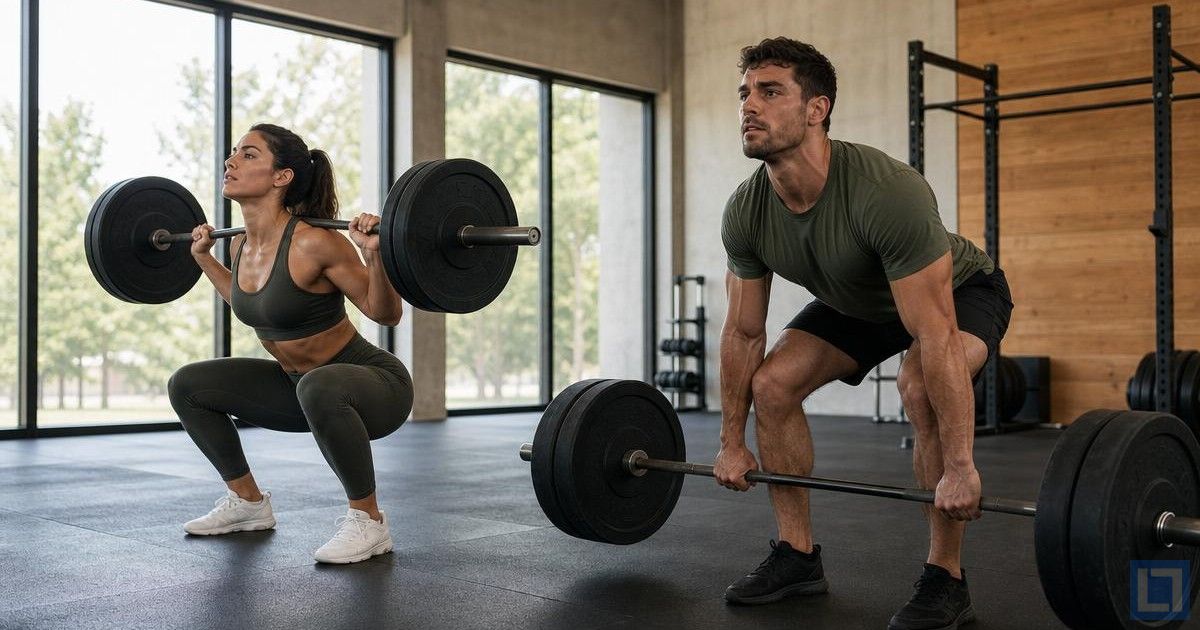
Powerlifting is the simplest and most measurable strength sport that exists. Three lifts (the squat, bench press, and deadlift) decide everything; everything else is assistance work that supports those three. The best powerlifting program respects that hierarchy: heavy work on the competition lifts is the priority, and accessory lifts exist to make the main lifts stronger.
Below are the ten essential lifts that form the foundation of any serious powerlifting program. The first three are the competition lifts. The other seven are the assistance lifts that build the muscle groups and movement patterns the main lifts depend on.
Barbell Squat

The Barbell Squat is the cornerstone of any powerlifting program. With a barbell across the upper back, you squat to roughly parallel depth or below, then drive back to standing. It is one of the three competition lifts in powerlifting and the foundation of total-body strength.
No serious strength program runs without heavy squatting. The bilateral compound load builds the quads, glutes, hamstrings, and lower back as a coordinated unit, and the technique demands transfer directly to the deadlift and overhead pressing patterns. Train it 1 to 2 times per week in the 3 to 6 rep range with progressively heavier loads over months.
Set the bar across the upper back, brace the core hard, and break at the hips and knees together. Squat to parallel depth or below. Drive up by pushing through the whole foot. The bar path stays directly over the mid-foot throughout the lift; if it drifts forward, the lift will fail at heavy loads.
Barbell Bench Press

The Barbell Bench Press is the second of the three powerlifting competition lifts. Lying flat on a bench, you lower the bar to the chest under control and press it back to lockout. It is the foundation of upper-body strength and the most-tested measure of pressing power.
The competition bench press requires a paused rep at the chest, which makes the lift considerably harder than the typical gym bench press where the bar bounces off the chest. Powerlifters train the pause at the chest from the beginning to make the competition standard the default. Run it for 4 to 5 sets in the 3 to 6 rep range as the primary upper-body lift.
Plant the feet flat with the legs creating tension to drive into the bar. Pull the shoulder blades together hard and arch the upper back slightly. Lower the bar under control to the lower chest. Pause briefly, then drive the bar up and slightly back toward the face for the strongest pressing line.
Barbell Deadlift

The Barbell Deadlift is the third of the three powerlifting competition lifts. Standing in front of a loaded barbell, you grip the bar, drive through the floor, and pull the bar to standing position with knees and hips locked out. It is the most direct test of full-body pulling strength.
The deadlift produces more total-body strength gain per rep than any other exercise that exists. The recruitment patterns hit the entire posterior chain (lower back, glutes, hamstrings) along with the upper back, traps, and grip. Train it 1 time per week in the 3 to 5 rep range; deadlifts recover slowly compared to other compounds, and twice-weekly heavy deadlift training burns most lifters out within a few months.
Position the bar over the mid-foot. Grip the bar just outside the legs. Set the back flat with shoulders slightly in front of the bar. Drive through the floor by pushing the legs straight, keeping the bar close to the body throughout the entire pull. Lock out by squeezing the glutes hard at the top.
Barbell Bent Over Row

The Barbell Bent Over Row hinges at the hips with a barbell in the hands and rows the bar to the lower chest or upper abdomen. It is the most effective horizontal pull for total back development and one of the most common assistance exercises in any powerlifting program.
Strong rowing strength supports the deadlift directly: the same muscles (lats, mid-back, lower back) that bent rows train are the muscles that hold the back rigid during heavy deadlifts. Rows also balance the heavy pressing volume that powerlifting programs accumulate. Run them for 3 to 4 sets in the 6 to 10 rep range.
Hinge at the hips with a flat back and a slight knee bend. Pull the bar to the lower chest or upper abdomen, squeezing the shoulder blades together at the top. Lower under control. Keep the back flat and the knees stable; do not use leg drive or body sway to move the bar.
Barbell Standing Military Press

The Barbell Standing Military Press is the king of vertical pressing. Standing with a barbell at the shoulders, you press it overhead to lockout while keeping the body rigid. The standing version requires significant core and glute engagement on top of pure pressing strength.
The military press is the strongest assistance for the bench press in any powerlifting program. The triceps, front delts, and upper chest all get heavy work, and the standing position trains total-body bracing that transfers directly to heavier squats and bench presses. Run it for 3 to 4 sets in the 5 to 8 rep range.
Brace the core hard before unracking the bar. Press the bar in a slight arc around the head, ending with the bar directly over the crown. Keep the rib cage stacked over the pelvis throughout to avoid arching backward. Lower under control to the front of the shoulders.
Pull Up

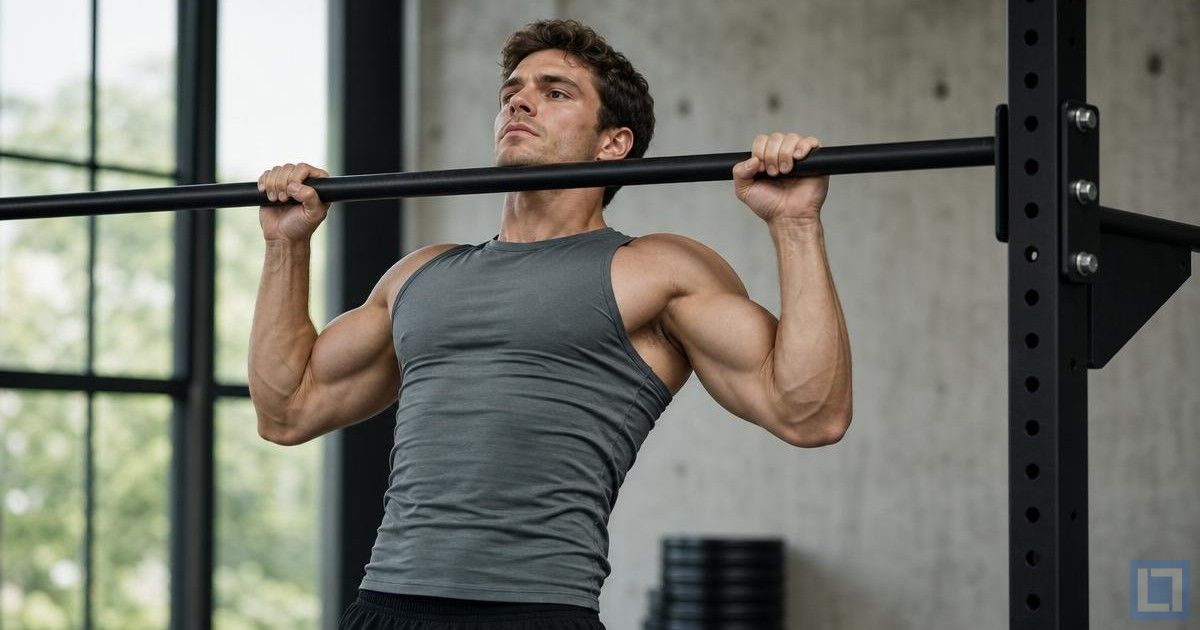
The Pull Up is the most direct measure of bodyweight pulling strength. Hanging from a bar with an overhand grip, you pull the body up until the chin clears the bar, then lower under control. It builds the lats, biceps, mid-back, and core simultaneously.
Pull-ups complement bent rows in any powerlifting program by adding vertical pulling alongside horizontal pulling. Both functions strengthen the back, but they hit slightly different muscle fibers. Adding weight via a dip belt or a dumbbell between the feet keeps the exercise progressing for years past basic bodyweight reps.
Hang fully at the bottom with arms straight. Drive the elbows down and back to pull the chest toward the bar. Lower under control to a full hang and reset. Add weight once you can do clean sets of 8 to 10 reps with bodyweight.
Barbell Romanian Deadlift

The Barbell Romanian Deadlift is a hip-hinge variation performed by lowering the bar from the standing position rather than pulling from the floor. It targets the hamstrings, glutes, and lower back through a deeper stretch than conventional deadlifts.
The RDL is one of the most valuable assistance lifts for the conventional deadlift. The deeper hamstring stretch builds the muscle fiber recruitment patterns that improve the deadlift lockout and the early pull off the floor. Run it for 3 sets in the 6 to 10 rep range on a non-deadlift day.
Hinge at the hips while keeping a slight knee bend. Lower the bar in a path close to the legs until the hamstrings stretch. Drive the hips forward to stand back up. Keep the back flat throughout; the spine should not round under the load.
Barbell Curl

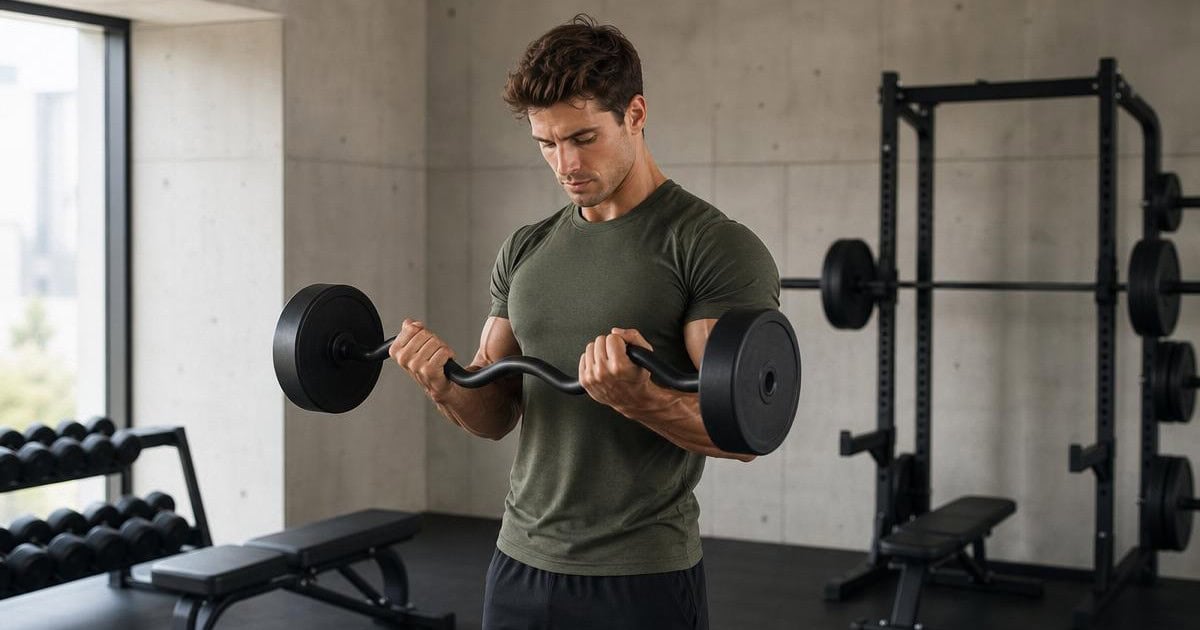
The Barbell Curl is the most effective bicep mass-builder. Standing with a barbell in both hands at the thighs, you curl the bar up toward the shoulders. The barbell allows heavier loading than dumbbells and produces a strong contraction at the top.
Powerlifting programs include direct arm work for two reasons. First, strong biceps support the deadlift grip and hold during heavy pulls. Second, balanced arm development reduces injury risk during heavy pressing and pulling. Run it for 3 sets in the 8 to 12 rep range.
Keep the elbows pinned to the sides through the entire rep. Avoid swinging the bar up using body momentum. Lower under control to full extension between reps for a complete range of motion.
Barbell Lying Triceps Extension Skull Crusher

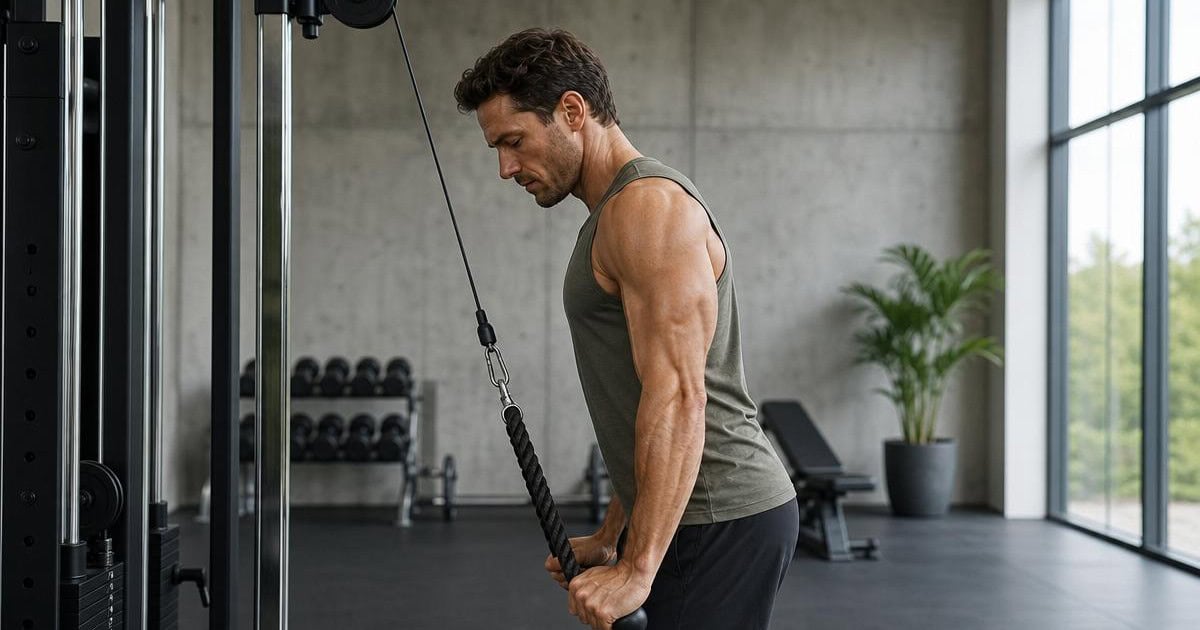
The Barbell Lying Triceps Extension (Skull Crusher) lies flat with a barbell held above the chest, then lowers the bar toward the forehead by bending the elbows. The exercise isolates the triceps directly through their extension function.
Strong triceps are the limiting factor for most lifters’ bench press at heavy loads. The lockout portion of the bench is pure tricep work, and bigger triceps mean a stronger lockout. Skull crushers load the triceps with significant weight in the function that matters most for bench press performance. Run them for 3 sets in the 8 to 12 rep range.
Lie on a flat bench with the barbell held above the chest with arms extended. Bend at the elbows to lower the bar toward the forehead, keeping the upper arms still and pointed at the ceiling. Press back to the start by extending the elbows. Use a moderate weight that allows clean reps.
Front Plank
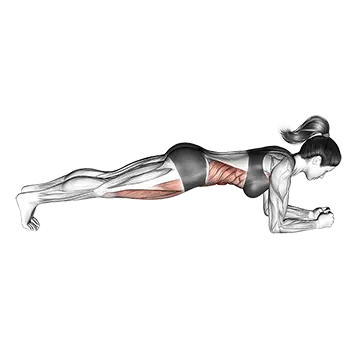
The Front Plank holds a forearm plank position with the body in a straight line from head to heels. It builds isometric core strength and teaches the trunk to brace under static load. Powerlifters use it as the primary core exercise because the bracing pattern transfers directly to heavy compound lifts.
Every heavy compound lift requires the core to brace and maintain spinal position under load. The plank teaches that bracing pattern in its purest form. Hold for 30 to 60-second sets with strict form rather than chasing two-minute holds with degraded position. Run 3 sets at the end of each session.
Set up on the forearms with elbows directly under the shoulders. Body straight from head to heels, hips not sagging or piking. Hold the position while breathing normally. End the set when form breaks down, not when a clock runs out.
How To Program These Workouts
A typical 4-day powerlifting program structures the week around the competition lifts: Monday squat, Tuesday bench, Thursday deadlift, Friday bench (lighter). Assistance work follows each main lift on the same day. Squats need RDL, lunge, or hamstring work as assistance. Bench needs military press, skull crusher, and rowing as assistance. Deadlift needs RDL, rowing, and pull-ups.
Run rep ranges progressively. Heavy compound work uses 3 to 6 reps for strength. Assistance lifts use 6 to 10 reps to build the muscle that supports stronger compound lifts. Rest periods stay long: 3 to 5 minutes between heavy sets, 2 to 3 minutes between assistance sets. Quality matters more than density; powerlifting is not conditioning work.
For more strength programming, see our best bro split workout and best upper lower split routine. For powerlifting-style assistance, browse our barbell exercises collection.
Final Thoughts
The best powerlifting program produces the strongest version of the lifter that genetics will allow. The path is simple but not easy: heavy compound work on the squat, bench, and deadlift, with focused assistance work that supports the main lifts. No magic programming, no rotating exercises every few weeks, no fancy techniques. Pick a starting weight, add load week by week, and let the numbers grow over months and years.
Track everything. Powerlifting is a numbers sport: every rep, every weight, every set. The lifters who consistently progress are the ones who keep meticulous training logs and treat each session as a measurable advance toward bigger lifts. Without tracking, progress slows to a crawl because there is no way to see whether the program is actually working.
Frequently Asked Questions
How many days per week should I train powerlifting?
Three to four days per week works for most lifters. The classic 3-day structure runs squat day, bench day, and deadlift day. The 4-day version adds a second bench day for additional pressing volume. Five and six-day programs exist for advanced competitors but typically require more recovery management than most recreational lifters can sustain.
What rep ranges should I use?
Heavy compound work uses 3 to 6 reps for strength building. Assistance lifts use 6 to 10 reps to build the muscle that supports the main lifts. Some programs add a higher-rep block (8 to 12 reps) every few months for muscle growth that translates to strength later. The 3 to 6 rep range is the daily bread of powerlifting programming.
Do I need to compete to follow a powerlifting program?
No. Powerlifting programming produces the strongest version of any lifter regardless of whether they ever compete. The structure (heavy compound focus, focused assistance, long rest periods, careful progression) builds maximum strength more efficiently than any other training approach. Plenty of recreational lifters follow powerlifting programming without ever stepping on a competition platform.
How long does it take to get strong with powerlifting?
Beginners often double their lifts within a year of consistent training. Intermediate progress slows but continues at meaningful rates for two to four years. Advanced gains come slowly, measured in pounds per year rather than per month. Most lifters who stay with serious training for five years build totals well above the recreational baseline.
What’s the difference between powerlifting and bodybuilding?
Powerlifting trains for maximum strength on three specific lifts. Bodybuilding trains for muscle growth and visible physique development. The training methods overlap (both use heavy compound work and high volume), but the goals differ. Powerlifters typically lift heavier with longer rest periods; bodybuilders use more variety, shorter rest, and more isolation work for muscle growth.