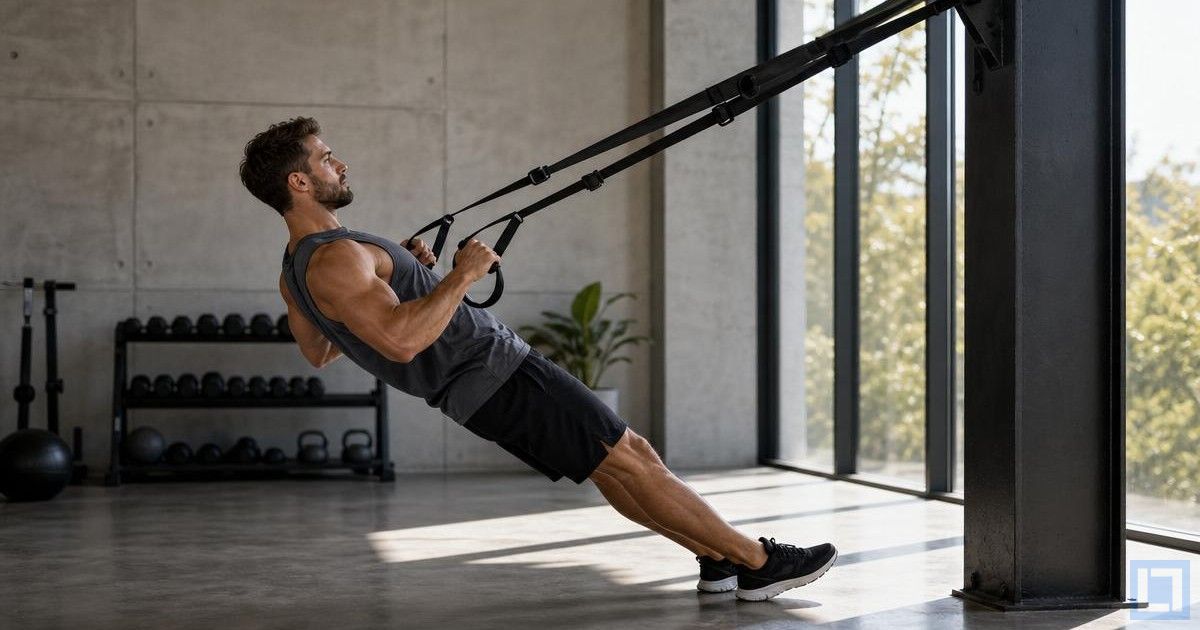
A suspension trainer is the closest thing to a gym you can hang from a doorframe. The best TRX workouts use just bodyweight, gravity, and the angle of your body to deliver legitimate strength training across every muscle group. The setup travels in a backpack, sets up in 30 seconds, and scales from beginner to advanced just by adjusting how far forward you stand.
Below are ten effective TRX exercises ranging from upper-body strength work like chin-ups and chest presses to brutal core demands like the suspended fallout and knee tuck. Together they cover most of what bodyweight training can accomplish, with the strap system filling in the gaps that pure bodyweight cannot reach.
Suspension Hammer Curl

The Suspension Hammer Curl grips the suspension straps with palms facing each other (hammer grip), then curls your body up by bending only at the elbows. The strap setup makes it a bodyweight curl that scales with the angle of your body — more horizontal makes it harder.
TRX bicep work is one of the more underrated benefits of owning a suspension trainer. It is hard to load a bicep curl heavy enough with bodyweight alone, but the strap setup lets the angle do the loading. Walking your feet forward turns a moderate curl into a brutal one.
Keep the elbows pinned out in front and lift only with the biceps. The grip stays neutral throughout. Lower under control rather than dropping back.
Ring Reverse Fly

The Ring Reverse Fly is a rear deltoid exercise performed gripping rings or TRX handles in an inverted row position, then pulling the rings apart with wide elbows in a fly motion. The bodyweight and ring instability hammer the often-neglected rear delts and mid-back.
Most lifters under-train rear delts compared to front delts because pressing exercises dominate everyone’s programs. Ring reverse flies fix that imbalance with no equipment beyond the suspension trainer. They directly target the muscles that pull the shoulders back into healthy posture.
Squeeze the shoulder blades together at the end of each rep. Keep the arms relatively straight and let the rings drift outward as you arc them. Avoid bending the elbows aggressively, which turns the move into a row.
Suspended Split Squat

The Suspended Split Squat is a Bulgarian split squat variation where the rear foot is elevated in a TRX strap or gymnastic ring. The suspended rear foot adds instability that the front leg has to fight throughout every rep, increasing hip and ankle demand.
Standard Bulgarian split squats are already brutal on the front leg. Suspending the rear foot turns the move into a balance exercise on top of that, which forces the smaller stabilizing muscles around the hip to work harder. The carryover to single-leg athletic movements is excellent.
Set up far enough from the strap that the front shin can stay vertical at the bottom. Drive through the front heel to stand. The rear foot is just for balance, not for pushing off, so resist the urge to push through it.
Suspended Abdominal Fallout

The Suspended Abdominal Fallout is one of the most powerful core moves available on a suspension trainer. The lifter grips the handles and slowly falls forward into a long body extension, forcing the entire core to brace against gravity. The straps make it a brutal anti-extension drill.
Most core exercises train trunk flexion. Fallouts train the opposite skill: keeping the spine from bending backward under load. That is the function the core actually performs during heavy squats, deadlifts, and overhead presses, which makes fallouts directly transferable to bigger lifts.
Move slowly. The further you fall forward, the harder it gets. Stop at whatever distance you can hold without your lower back arching. Pull yourself back to the start position with the core, not the arms.
Suspension Triceps Extension

The Suspension Triceps Extension, also called the TRX skull crusher, uses suspension straps gripped overhead. From an angled body position, you bend at the elbows to lower your head toward your hands, then push back to extension using the triceps.
The strap setup is uniquely good for tricep work because the resistance scales with body angle. Beginners stand more upright, advanced lifters walk their feet further forward to make the move significantly harder. That progression works without buying anything new.
Keep the elbows narrow and pointed forward. The hands should travel toward the back of the head, not the forehead. Move slowly to keep the triceps under tension throughout the rep.
Suspension Chin Up

The Suspension Chin Up grips the suspension straps with an underhand (supinated) grip and pulls your body up toward the handles. The supinated grip increases bicep involvement compared to a standard chin-up, while the suspended position adds stability demands the bar version doesn’t have.
For lifters working toward their first full bodyweight pull-up, suspension chin-ups are a strong stepping stone. The angle adjusts the load, and you can stay upright at first before walking your feet forward to progress. They also let you train pulling at home with no overhead bar required.
Keep the body straight and rigid throughout. Pull the chest toward the handles rather than just bending the elbows. Lower under control instead of dropping back.
Suspension Sumo Squat

The Suspension Sumo Squat is a wide-stance squat performed gripping suspension straps for assistance. The wide stance emphasizes the glutes and adductors, while the straps provide support that lets you sink deeper than you otherwise could.
Sumo squats hit the inner thighs and glutes harder than standard squats because the wide stance changes the leverage. The strap assistance makes deep depth accessible, which is where the glutes do the most work. It is a smart pick for anyone whose squat depth is currently limited by mobility or balance.
Toes turn out, knees track over the toes. Sit down between the heels, not back. Use the straps for balance, not as a primary load. The legs do the work.
Ring Chest Fly

The Ring Chest Fly is a bodyweight chest fly performed on rings or TRX handles. You face away from the anchor and arc your arms wide in a fly motion, then bring them back together. The rings provide just enough instability to recruit serious stabilizers in addition to the chest.
Bodyweight flies are uniquely productive because the body provides a smooth, scalable resistance that does not stop at the hardware’s capacity. Walking forward makes them harder; walking back makes them easier. That natural progression covers nearly any strength level.
Keep the elbows slightly bent throughout. Squeeze the chest hard at the top and resist the descent. The instability of the rings will magnify any form breakdown, so move slow and stay tight.
Suspension Chest Press

The Suspension Chest Press uses TRX or ring straps to perform a standing chest press. You face away from the anchor with the straps over your shoulders and press the handles forward. The angle of your body sets the difficulty.
This is essentially a moving push-up with the floor replaced by straps. The constant instability of the suspension forces the chest, shoulders, and core to work as one unit, which is exactly the kind of integrated training that carries over to real-world pushing strength.
Body stays straight and rigid like a plank. Press the handles forward together until the arms lock out. Walk the feet further forward to make the move harder, back to make it easier.
Suspended Reverse Crunch

The Suspended Reverse Crunch (TRX knee tuck) is a core exercise where you hold a plank position with feet in TRX straps and tuck your knees toward your chest. The suspended feet dramatically increase core demand compared to a floor-based reverse crunch.
The challenge here comes from holding the plank position the entire time. Standard reverse crunches let the lower back rest on the floor. The suspended version keeps the entire core working continuously, which makes a fairly basic-looking movement hammer the abs harder than expected.
Keep the hips level. Tuck the knees with control rather than swinging them forward. Resist letting the lower back round downward as you bring the knees in.
How To Program These Workouts
A typical TRX session pulls four to six exercises from the list above. A balanced session includes one upper-body push, one upper-body pull, one lower-body movement, and one or two core pieces. That structure works as either a standalone workout or as a finisher after heavier strength training.
Train two to four sessions per week with at least one rest day between heavier days. Progress comes from changing your body angle rather than adding weight: walk your feet further forward (or back, depending on the exercise) to make any movement harder over time.
For broader full-body programming, see our best full body calisthenics workout. To browse the full equipment library, explore our suspension trainer exercises collection.
Final Thoughts
The best TRX workouts deliver more than the equipment’s simplicity suggests. The combination of bodyweight load, instability, and adjustable angles produces serious strength training in every plane of motion the body can move through, with no plates or pin selectors required.
Start with the simpler movements like the chest press, sumo squat, and reverse crunch. Layer in chin-ups, fallouts, and split squats as your strength and stability improve. The same set of straps will keep you challenged for years.
Frequently Asked Questions
How often can I train with a TRX?
Three to five sessions per week works for most people. Suspension training tends to be slightly easier on the joints than free weights because the body controls the load rather than fixed bars, but the muscles still need rest days to grow. Alternate between heavy strength days and lighter conditioning days if you train more than three times per week.
Can a TRX replace the gym?
For beginners and intermediates, mostly yes. The TRX trains every major movement pattern: push, pull, hinge, squat, lunge, and core stabilization. Advanced lifters eventually hit a ceiling because adding load is faster than finding harder body angles, but that takes years of consistent training to reach.
What’s the difference between a TRX and gymnastic rings?
Functionally, very little. Both use suspended handles for bodyweight training. Rings are more demanding in stability because they swing freely; TRX straps connect at one anchor point and rotate together, making them slightly more stable. Most TRX exercises work on rings and vice versa.
How long should a TRX workout last?
Twenty to forty-five minutes is the sweet spot. Five minutes for warm-up, twenty to thirty minutes of work, and a short cooldown. Beyond that, fatigue tends to compromise form on the more demanding movements like fallouts and split squats.
Are TRX workouts good for building muscle?
Yes, especially for the upper body and core. The chest press, chin-up, fly, and curl variations all build real muscle when programmed with progressive overload (steeper body angles, slower tempo, or longer time under tension). Lower body hypertrophy is harder to drive with a TRX alone but still possible with split squats and sumo squats.