Suspension Chest Press

Description
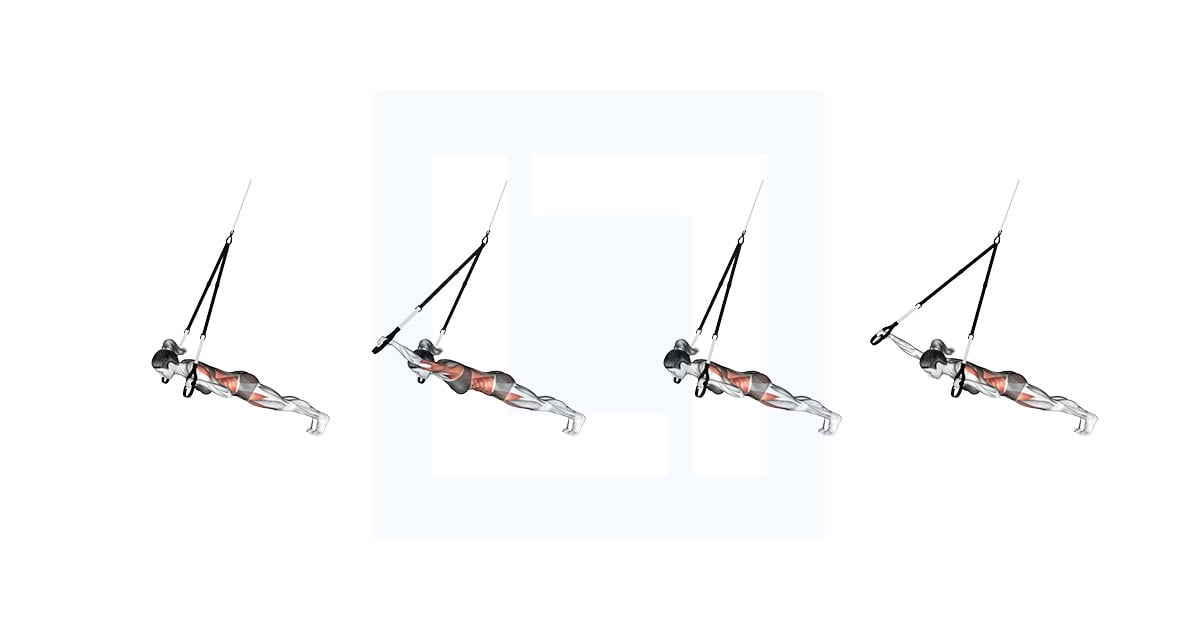
The suspension chest press uses TRX or gymnastic ring suspension straps to perform a standing chest press. You face away from the anchor with the straps over your shoulders and press the handles forward and apart simultaneously. The unstable suspension demands core engagement and shoulder stability.
Muscle Group
Equipment Required
Suspension Chest Press Instructions
- Set TRX straps or rings to a length where the handles reach your chest when standing.
- Face away from the anchor. Grip the handles and step forward into a high plank-like angle, body straight from heels to hands.
- The angle determines difficulty — more horizontal is harder.
- Brace your core. Keep your body in a straight line.
- Lower your chest forward by bending your elbows out to the sides at roughly 45 degrees.
- Lower until your hands are at your chest.
- Press back to lockout, controlling the unstable handles. Squeeze your chest and triceps.
- Maintain straight body line throughout. Use a more horizontal angle for more difficulty.
Suspension Chest Press Form & Visual

Suspension Chest Press Benefits
- Builds chest, triceps, and shoulders with bodyweight
- Heavy stabilizer engagement from instability
- Easy to scale by adjusting body angle
- Builds core engagement
- Trains shoulder stability
- Useful when no bench is available
Suspension Chest Press Muscles Worked
- Pectoralis major
- Triceps brachii
- Anterior deltoid
- Rotator cuff (stabilizer)
- Serratus anterior
- Core (heavy anti-rotation)
Suspension Chest Press Variations & Alternatives
- Suspended Push-Up
- Suspension Fly
- Standard Push-Up
- Cable Standing Chest Press
- Single-Arm Suspension Chest Press
- Suspender Chest Press
- Lever Chest Press
- Suspender One Leg Chest Press
- Suspender One Arm Chest Press
- Machine Inner Chest Press