
The pull up is one of the most rewarding exercises in strength training. It is also one of the hardest to learn, especially if you cannot do a single rep yet. This guide walks through how to do a pull up with proper form, then lays out a progression path from absolute beginner to advanced grip variations.
A clean pull up trains the lats, biceps, mid-back, forearms, and core all at once. It is the cleanest test of relative strength in the upper body, which is why every meaningful military, climbing, gymnastics, and combat sport program includes it. Whether you are working toward your first rep or trying to add reps to a current set, the path forward is the same: smart progression, strict form, and consistent practice.
Proper Pull Up Form

A pull up is a vertical pulling movement where you hang from an overhead bar and pull your body up until your chin clears the bar. The motion is driven primarily by the lats and biceps, with stabilization from the core, mid-back, and grip.
Set up by gripping the bar with both hands roughly shoulder-width apart, palms facing away (overhand grip). Hang fully with the arms straight at the bottom. From the dead hang, pull your chest toward the bar by driving the elbows down and back. Squeeze the lats hard and bring the chin over the bar at the top. Lower under control to a full hang and repeat.
Common mistakes to avoid: kipping or swinging the body to use momentum (this turns it into a different exercise), partial range of motion (chin must clear the bar at the top, arms must fully extend at the bottom), and shrugging the shoulders up at the start of the rep instead of leading with the lats.
Muscles Worked
The pull up is one of the most effective compound back exercises in existence. The lats are the primary mover, with significant contribution from the biceps, the rhomboids and middle traps, the rear delts, the forearms (for grip), and the core (for body stabilization throughout the rep).
Because the pull up is a closed-chain movement (your hands are fixed and your body moves), it trains the back muscles in coordination rather than in isolation. That carries over directly to climbing, throwing, and any pulling sport. It is also one of the few back exercises that simultaneously demands serious grip strength.
Pull Up Progression: From Beginner To First Rep
If you cannot do a pull up yet, the path forward is to gradually reduce the assistance on similar pulling movements until you can hang from the bar and pull yourself up unassisted. The progression below works for nearly anyone with the patience to follow it.
Step 1: Lying Lat Pulldown

Before tackling any vertical pulling at all, build the basic skill of activating the lats. The Lying Lat Pulldown lies on the floor face up and drives the elbows into the floor to lift the upper back, activating the lats without any equipment. It is a lat activation drill that teaches lat engagement.
Step 2: Seated Pull Up


The Seated Pull Up sits on the floor under a low bar and pulls yourself up by gripping the bar with an overhand grip. Your legs extend in front and your heels stay on the floor, providing assistance. It is a pull-up regression for beginners developing pulling strength.
Step 3: Bench Pull-Ups

The Bench Pull-ups place a bench under a pull-up bar and use it to support some of your bodyweight during pull-ups. You grip the bar, place one or both feet on the bench, and pull up with partial leg assistance. It is a simple pull-up regression that lets you actually start training pull-ups under load.
Step 4: Top Pull-Up Hold
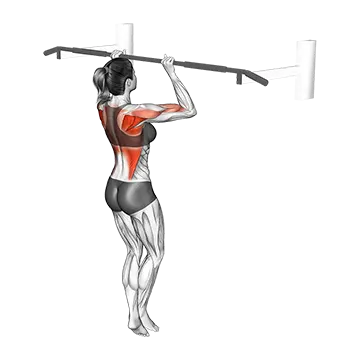
The Top Pull-Up Hold is an isometric pull-up performed at the top of the pull-up range. With the chin over the bar, the lats and biceps work to keep the body up while the grip and forearms work to keep the hands on the bar. Building strength at the top is one of the best ways to break through a pull-up plateau.
Step 5: Wide Seated Pull-Up
The Wide Seated Pull-Up is performed at a low pull-up bar with the feet planted on the floor in a long-seated or assisted position. The wide grip emphasizes the lats. It is useful for building toward a full hanging wide grip pull-up.
No Pull-Up Bar? Here Are Your Options
A doorway pull-up bar is an inexpensive purchase and the cleanest path to consistent pull-up training at home. But if you do not have one, there are workable substitutes that will still build pulling strength.
Seated Pull Up Between Chairs

The Seated Pull Up Between Chairs is a no-gym back move. The lifter places a sturdy bar across two chairs and sits underneath, then pulls the chest up to the bar. The seated start position scales the load and is great for beginners.
Pull Up with Bent Knee Between Chairs

The Pull Up with Bent Knee Between Chairs is a creative at-home pull up using two chairs to support a sturdy bar. Bending the knees lowers the bodyweight load and makes pull ups accessible to more lifters. As your strength improves, you straighten the legs to add resistance.
Pull Up Variations For Continued Progress
Once you have ten or so clean reps in the standard pull up, the path forward branches: harder grip variations, weighted pull ups, and gymnastics-skill movements like muscle-ups and front levers. The grip variations below are the most accessible next step for most lifters.
Brachialis Narrow Pull Ups

The Brachialis Narrow Pull Up is performed gripping parallel pull-up handles with palms facing each other (neutral grip) and hands close together. The narrow neutral grip places strong emphasis on the brachialis muscle, which sits underneath the biceps and contributes significantly to arm thickness when developed.
Hammer Grip Pull Up on Dip Cage
The Hammer Grip Pull Up on Dip Cage uses the parallel bars of a dip cage to perform pull ups with a neutral hammer grip. The grip places the wrists in a comfortable position and emphasizes the brachialis and lats. It is a strong pull variation, especially for lifters who find regular pull-ups bother their wrists or elbows.
How Often Should You Train Pull Ups?
Two to four sessions per week is a strong target for pull-up specific work, with at least one rest day between sessions. The lats, biceps, and forearms all need recovery time to grow stronger, and pull-ups load all three hard.
On training days, work for total reps rather than sets. If you can do five clean pull-ups in a row, the goal might be 25 total reps in the session, broken into five or six sets with sub-max reps each. As total reps go up, your max set will follow.
For broader back and pulling work, see our barbell workouts for back and best workouts for wider back guides.
Final Thoughts
Learning how to do a pull up takes patience, especially if you are starting from zero. The progression ladder above works because it builds the specific strength needed in small, achievable steps rather than asking the lats and biceps to suddenly produce a hanging full-body pull on day one.
Once you have your first rep, the work is far from over. Building from one rep to ten clean reps takes most lifters several months. Adding harder variations and weighted versions adds years of progression on top of that. Stay consistent, keep the form strict, and the pull-up will become one of the most reliable strength markers in your training.
Frequently Asked Questions
How long does it take to learn to do a pull up?
It varies widely based on starting strength, body weight, and training consistency. Lighter and stronger lifters often get their first pull-up within a few weeks of consistent practice. Heavier or weaker lifters may need three to six months. The key variable is consistency: training pulling movements two to four times per week reliably produces results.
Are pull ups or chin ups easier?
Chin ups are easier for most lifters. The underhand (supinated) grip on chin ups recruits the biceps more strongly than the overhand grip on pull ups, which adds significant pulling power. Many lifters can do chin ups before pull ups, then transition. Both are excellent exercises and most programs include both grips.
Should I use bands to assist pull ups?
Bands can be useful, but the seated and bench-assisted progressions in this guide are usually more effective for true beginners. Bands assist most at the bottom (where you are weakest) and least at the top (where you also need help). The seated and bench-assisted versions provide consistent assistance throughout the rep, which builds strength more evenly.
How many pull ups should I be able to do?
Standards vary by sex and body weight, but reasonable benchmarks for an average adult: 1-2 reps is beginner, 5-10 reps is intermediate, 10-15 reps is solid, and 15+ unbroken reps is advanced. Bodyweight matters significantly here. A 200-pound lifter doing 10 pull-ups is strength-equivalent to a 140-pound lifter doing 15.
Can pull ups build big lats?
Yes. Pull-ups are one of the most effective exercises for lat development, especially when performed with strict form and through a full range of motion. They are particularly effective for the lower lats, which are hard to target with most other exercises. Adding weight as you get stronger continues the growth stimulus.