At-home shoulder training requires a slightly different approach than gym-based programming because most home setups lack the cable and machine variety that produce shoulder isolation. The best at home shoulder workouts work around this by combining dumbbell pressing variations, resistance band exercises, bodyweight rotator cuff work, and mobility drills into complete shoulder programs that produce both size and joint health.
Below are ten effective at-home shoulder exercises that cover dynamic warm-up drills, band-based pressing and rotation work, dumbbell pressing variations, and bodyweight rotator cuff exercises. Together they form a complete shoulder training program that fits in any home gym with minimal equipment (a pair of dumbbells and a resistance band cover everything in this list).
Standing Shoulder Circling

The Standing Shoulder Circling stands tall and rotates the shoulders in large circles, first forward and then backward. The dynamic motion warms up the shoulder joint through the full range of motion and serves as the foundational warm-up drill in any at-home shoulder program.
For at-home shoulder training, shoulder circling is the foundational warm-up drill. The dynamic motion lubricates the shoulder joint and prepares the rotator cuff for heavier work. Run 10 forward and 10 backward circles before any pressing or pulling work.
Stand tall with arms relaxed at the sides. Roll the shoulders forward in large circles for 10 reps, then reverse direction and roll backward for 10 reps. Move slowly and deliberately rather than chasing speed. Feel the joint move through its full range.
Band Shoulder Press

The Band Shoulder Press stands on a resistance band with both feet and presses the band handles overhead from shoulder height to lockout. The band tension increases as the arms extend, which produces stronger loading at the lockout position than dumbbell pressing.
For at-home shoulder pressing, the band shoulder press is one of the most effective options that exists. The accommodating resistance pattern (lighter at the bottom, heavier at the top) trains the lockout position more heavily than constant-load variations, which produces stronger shoulder development. Run it for 3 to 4 sets of 10 to 12 reps.
Step on a resistance band with both feet, holding the band handles at shoulder height with palms facing forward. Press both handles up to lockout overhead, fighting the band tension throughout. Lower under control to the start.
Shoulder Circle

The Shoulder Circle extends the arms out to the sides and circles them in large arcs, first forward and then backward. The added arm extension creates larger ranges of motion than basic shoulder circling and produces stronger mobility benefits.
For deeper shoulder warming and mobility work, the arm circle progresses past basic shoulder circling. The increased range demand produces stronger mobility gains over time, particularly in the rotator cuff and shoulder capsule. Use it as the second warm-up drill after basic shoulder circling.
Extend the arms out to the sides at shoulder height. Make large forward circles with the arms for 10 to 15 reps, then reverse to backward circles for 10 to 15 reps. Start with smaller circles and progressively widen them as the shoulders warm up.
Band Standing External Shoulder Rotation

The Band Standing External Shoulder Rotation anchors a resistance band at elbow height and performs external rotation reps with the elbow tucked at the side. The exercise trains the rotator cuff (specifically the infraspinatus and teres minor) directly through their primary external rotation function.
For at-home shoulder health, direct rotator cuff work is essential. Most chronic shoulder problems trace back to weak rotator cuff muscles relative to the much stronger pressing muscles. Run it for 3 sets of 12 to 15 reps per side as warm-up or accessory work in any shoulder program.
Anchor a resistance band at elbow height. Stand sideways to the anchor with the elbow tucked at the side and bent at 90 degrees. Hold the band with the hand on the anchor side, pulling against the resistance to externally rotate the arm away from the body. Return under control. Keep the elbow tucked throughout.
Band Standing Internal Shoulder Rotation

The Band Standing Internal Shoulder Rotation anchors a resistance band at elbow height and performs internal rotation reps with the elbow tucked at the side. The exercise complements external rotation work by training the subscapularis (the front-of-shoulder rotator cuff muscle).
Internal rotation work balances the external rotation training that most shoulder programs emphasize. Both directions are essential for complete rotator cuff health; training only one direction produces imbalances that increase injury risk. Run it for 3 sets of 12 to 15 reps per side alongside external rotation work.
Anchor a resistance band at elbow height. Stand with the band side facing the anchor, elbow tucked and bent at 90 degrees. Hold the band with the inside hand, pulling against the resistance to internally rotate the arm across the body. Return under control. Keep the elbow tucked throughout.
Band Upright Shoulder External Rotation

The Band Upright Shoulder External Rotation anchors a resistance band overhead and performs external rotation with the arm at shoulder height (not at the side). The shoulder-height position trains the rotator cuff through a more functionally relevant range than elbow-tucked variations.
For lifters who feel comfortable with elbow-tucked rotator cuff work and want to progress, the upright variation moves the work into a more functional range. The exercise still targets the rotator cuff but through a position closer to the actual loading patterns of pressing and overhead movements. Run it for 3 sets of 12 to 15 reps per side.
Anchor a resistance band at shoulder height. Stand with the arm raised to shoulder height and the elbow bent at 90 degrees. Hold the band with the working hand, pulling against the resistance to externally rotate the arm. Return under control. Keep the upper arm parallel to the floor throughout.
Bent Over Shoulder Pendulum

The Bent Over Shoulder Pendulum hinges over from a standing position and lets the arm hang freely while moving in pendulum motions. The hanging position decompresses the shoulder joint and produces relief from chronic tension.
Pendulum exercises are one of the most underrated shoulder mobility drills that exist. The bent-over hanging position relieves the constant pull of gravity on the shoulder joint, which produces immediate relief from chronic shoulder tightness. Use it as a recovery drill between sets of heavier shoulder work or as a daily shoulder health habit.
Hinge over with one hand resting on a bench or chair for support. Let the opposite arm hang freely toward the floor. Move the hanging arm in small circles (10 each direction), then in side-to-side swings, then in front-to-back swings. Switch sides.
Bodyweight Lying Shoulder External Rotation

The Bodyweight Lying Shoulder External Rotation lies on the side with the elbow tucked at the side and performs external rotation reps with bodyweight providing the resistance. The lying position eliminates body sway and forces strict isolation of the rotator cuff.
For lifters without bands or weights, the lying external rotation produces real rotator cuff loading using bodyweight alone. The lying position is one of the most isolated rotator cuff exercises that exists, and the bodyweight loading is sufficient for years of progressive practice. Run it for 3 sets of 12 to 15 reps per side.
Lie on the side with the bottom arm supporting the head. Tuck the top elbow at the side and bend it at 90 degrees. Rotate the arm away from the body, lifting the hand toward the ceiling. Lower under control. Keep the elbow firmly tucked at the side throughout.
Weighted Standing Shoulder Press

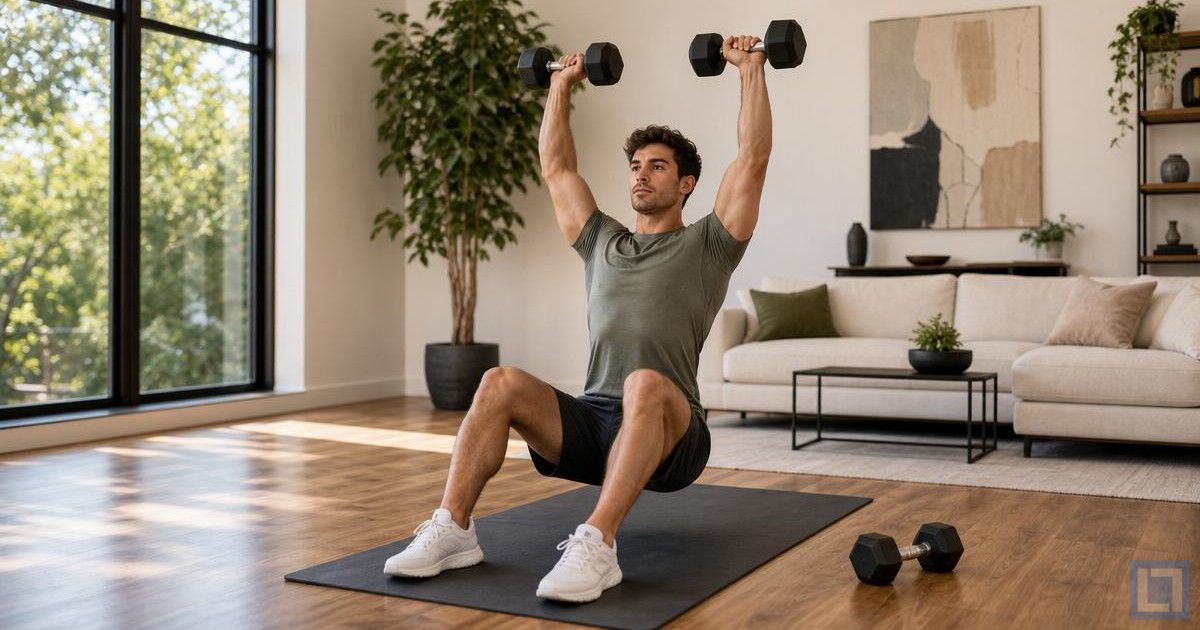
The Weighted Standing Shoulder Press stands tall with dumbbells at the shoulders and presses them overhead to lockout. The standing version requires significant core engagement on top of pure shoulder strength, which makes it more demanding than seated variations.
For at-home shoulder mass development, the standing dumbbell press is one of the most effective exercises that exists. The bilateral loading allows heavy total weight, the standing position adds core engagement, and the dumbbell shape allows each arm to move independently. Run it for 3 to 4 sets of 6 to 10 reps as the primary heavy shoulder lift.
Stand tall with dumbbells held at the shoulders, palms facing forward or slightly inward. Press both dumbbells overhead to lockout, ending with arms straight and dumbbells directly over the shoulders. Lower under control to the shoulders. Brace the core hard before each rep.
Dumbbell Incline Shoulders Press

The Dumbbell Incline Shoulders Press performs the shoulder press on an incline bench rather than upright. The slight incline (45 to 60 degrees) shifts emphasis between the front delts and the shoulders, producing a hybrid pressing pattern.
For variety in at-home shoulder pressing, the incline version produces different muscle recruitment than vertical pressing. The incline angle hits the upper chest and front delts simultaneously, which fills the gap between flat bench pressing and pure overhead pressing. Run it for 3 sets of 8 to 12 reps as accessory pressing work.
Set the bench to roughly 45 to 60 degrees. Sit with dumbbells held at the shoulders. Press both dumbbells up to lockout overhead, with the bar path tracking over the shoulder joint rather than the upper chest. Lower under control.
How To Program These Workouts
A productive at-home shoulder session pulls six to eight exercises from the list above. A balanced session starts with warm-up drills (shoulder circling, arm circles), follows with rotator cuff activation (band external/internal rotation), moves to primary pressing (band or dumbbell shoulder press), and finishes with accessory work (incline pressing, lying rotation). Run pressing for 3 to 4 sets of 8 to 12 reps; rotator cuff work for 3 sets of 12 to 15 reps; warm-up drills for 10 to 15 reps each.
Train shoulders one to two times per week. The shoulders recover within 48 to 72 hours of moderate training, but the high involvement in pressing exercises (chest day, tricep day) means shoulder work compounds with other upper-body training. Most lifters program at-home shoulder work once per week as a dedicated session or split it across two upper-body days.
For broader shoulder programming, see our best dumbbell shoulder workouts and best shoulder mobility exercises. For broader at-home programming, see our best upper body workouts at home.
Final Thoughts
The best at home shoulder workouts deliver complete shoulder development without requiring barbells, cable machines, or specialized gym equipment. The combination of dumbbell pressing, band variations, rotator cuff work, and mobility drills covers every major shoulder function in a way that fits any home setup. For home lifters and travelers, this format is one of the most effective shoulder training options available.
Pay attention to rotator cuff work. The most common at-home shoulder training mistake is skipping rotator cuff exercises in favor of more pressing volume. The fix: dedicate 5 to 10 minutes per session to rotator cuff and mobility work as warm-up. The 5 to 10-minute investment prevents the chronic shoulder issues that limit long-term training and produces stronger pressing performance through better shoulder integrity.
Frequently Asked Questions
What equipment do I need for at home shoulder workouts?
A pair of dumbbells (15 to 30 pounds for most beginners, 30 to 50 pounds for intermediates) and a resistance band cover everything in this list. The dumbbells handle pressing, the band handles rotator cuff and accommodating-resistance pressing variations. Optional additions: an adjustable bench (for incline pressing), but most exercises work without it.
How often should I train shoulders at home?
One to two times per week works for most lifters. The shoulders recover within 48 to 72 hours of moderate training. Most home lifters do well with one focused shoulder session per week as part of an upper-body day, or split shoulder work across two upper-body days for higher total volume.
Can I build big shoulders at home?
Yes for beginners and intermediates. Dumbbell and band-based shoulder training produces real shoulder growth for 12 to 24 months of consistent practice, and progressive variations extend that runway by another 12 to 24 months. Advanced lifters chasing maximum shoulder size eventually benefit from heavy barbell pressing, but consistent at-home shoulder training produces measurable development at every level.
Are bands as effective as dumbbells for shoulders?
Different equipment have different strengths. Dumbbells allow heavier loading at the bottom of pressing exercises, which produces stronger initial activation. Bands produce stronger loading at the lockout position, which is often the hardest part of overhead pressing. Most well-designed at-home programs use both: dumbbells for primary heavy work, bands for accessory work and rotator cuff training.
Why do my shoulders hurt during pressing?
The most common cause is weak rotator cuff muscles relative to the much stronger pressing muscles. The fix: include 5 to 10 minutes of rotator cuff work (band external/internal rotation, lying rotation) in every shoulder workout as warm-up. Most pressing-related shoulder pain resolves within 4 to 6 weeks of consistent rotator cuff training. Persistent pain warrants a visit to a sports medicine doctor.