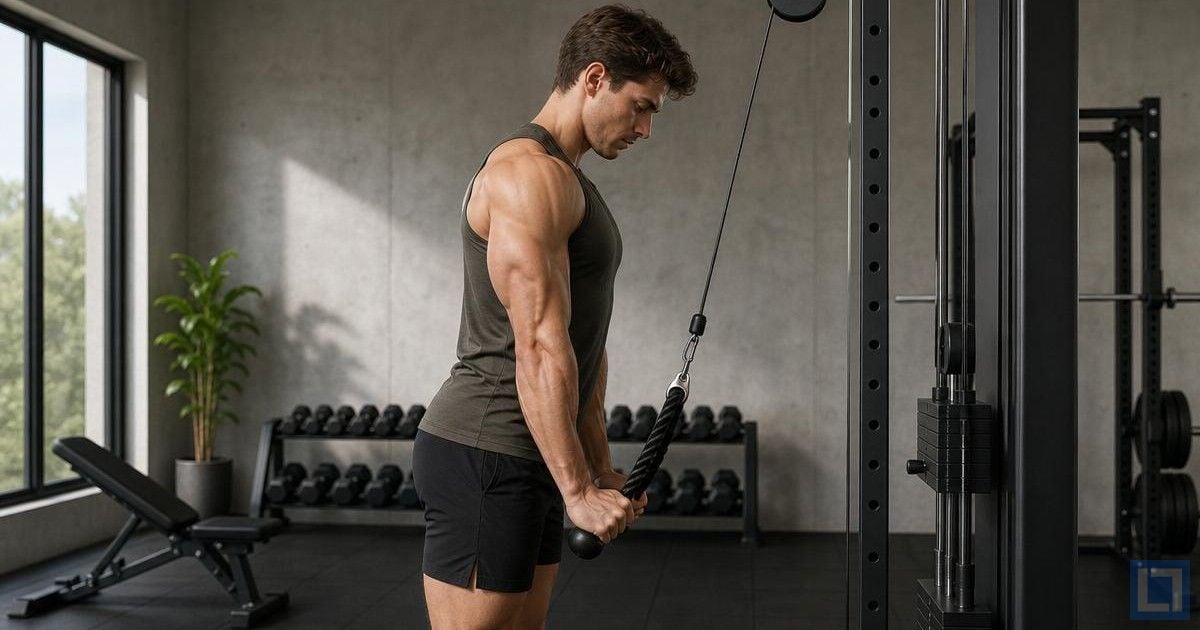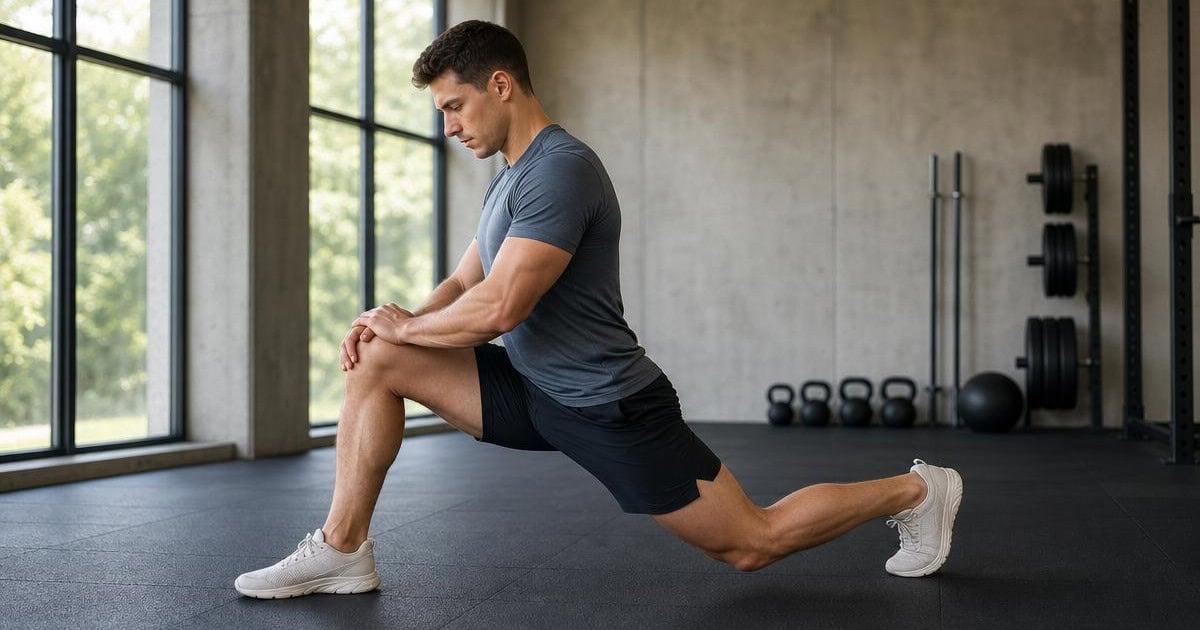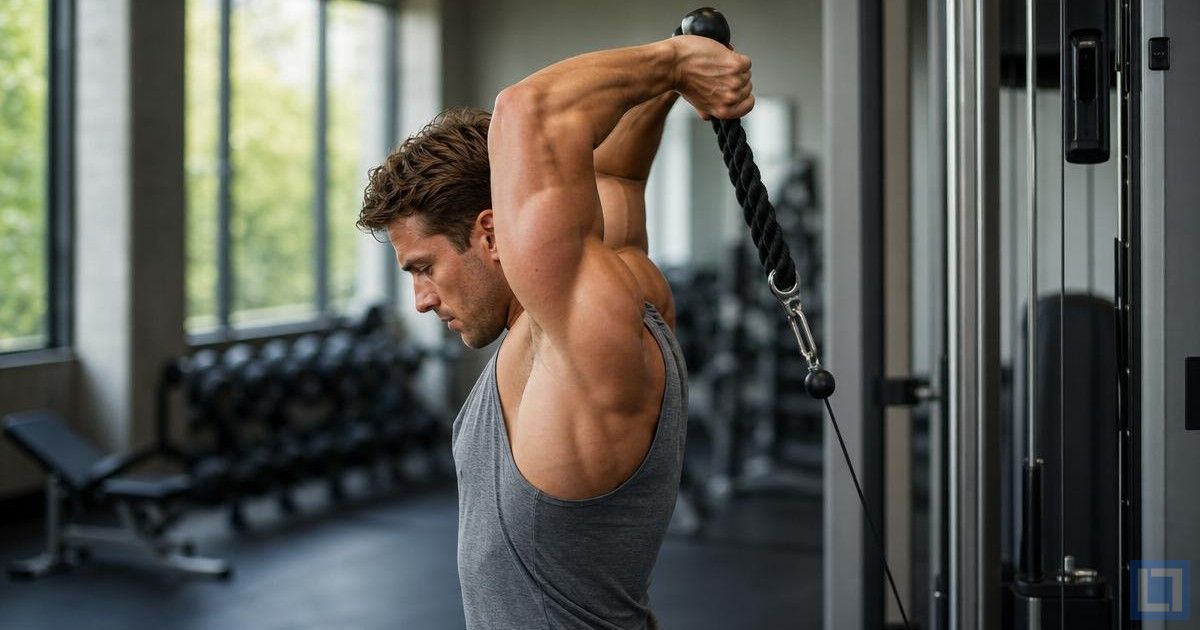
The long head is the largest of the three tricep heads and the muscle responsible for the visible mass at the back of the upper arm. Strong long head development produces the kind of arm thickness that fills out sleeves and changes the entire upper-body appearance from the back view. Despite this importance, the long head is one of the most underdeveloped tricep muscles because most pressing exercises (which provide the bulk of indirect tricep loading) emphasize the lateral and medial heads while leaving the long head relatively undertrained. The best long head tricep exercises emphasize overhead positions where the long head loads most heavily.
Below are ten effective long head tricep exercises that cover overhead extensions across multiple equipment types (barbell, cable, kettlebell, band, bed sheet), unilateral work, and complementary skull crusher variations that hit the long head as a secondary mover. Together they form a complete long head training program that produces visible upper-arm thickness over months of consistent practice. The exercises require equipment ranging from full commercial gym setups to minimal-equipment home situations.
Bar Band Overhead Triceps Extension

The Bar Band Overhead Triceps Extension uses a barbell with resistance bands attached for accommodating resistance, performing the overhead extension motion. The bands increase tension as the arms extend, which loads the long head heavily at the lockout position.
For combined free-weight and band loading, the bar-and-band overhead extension produces unique stimulus that pure barbell or pure band variations cannot match. The accommodating resistance trains the lockout (where the long head works hardest) more heavily than constant-load variations. Run it for 3 sets of 8 to 12 reps.
Set up a barbell with resistance bands anchored to a fixed point and looped around the bar ends. Stand or sit holding the bar overhead with both hands. Lower the bar behind the head by bending at the elbows, keeping the upper arms vertical. Extend back to lockout against the band tension.
Barbell Standing Overhead Triceps Extension

The Barbell Standing Overhead Triceps Extension stands tall holding a barbell overhead with both hands and lowers the bar behind the head by bending at the elbows. The standing position adds core engagement to the overhead extension motion.
For long head tricep development with heavy loading, the barbell standing overhead extension is one of the most effective exercises that exists. The bilateral barbell loading allows heavier total weight than dumbbell or kettlebell variations, which produces stronger long head growth per rep. Run it for 3 to 4 sets of 6 to 10 reps.
Stand tall with feet shoulder-width apart and a barbell held overhead with hands shoulder-width apart. Lower the bar behind the head by bending at the elbows, keeping the upper arms vertical. Extend back to lockout overhead. Brace the core throughout to prevent body sway.
Overhead Triceps Extension with Bed Sheet

The Overhead Triceps Extension with Bed Sheet uses a folded bed sheet anchored to a door and performs an overhead extension pattern with the sheet providing isometric resistance. The improvised setup produces strong tricep loading without any equipment beyond what most homes already have.
For travelers and lifters in extremely minimal-equipment situations, the bed sheet variation produces real overhead tricep loading without specialized gear. The tensile strength of folded fabric provides plenty of resistance for tricep work. Run it for 3 sets of 12 to 15 reps as accessory long head work.
Anchor a folded bed sheet by closing it in a sturdy door (with the door closed, the sheet should not slip out). Grip both sheet ends overhead. Lower the hands behind the head by bending at the elbows while pulling against the sheet tension. Press back to the start by extending the elbows.
Cable Overhead Tricep Extension Straight Bar

The Cable Overhead Tricep Extension Straight Bar attaches a straight bar to a low pulley on a cable station, faces away from the cable, and performs the overhead extension. The cable provides constant tension throughout the rep, which produces stronger long head loading than free-weight variations.
For lifters with cable access, the cable overhead extension is one of the most effective long head exercises that exists. The constant cable tension keeps the long head loaded throughout the entire rep, including the contracted position where free-weight variations lose tension. Run it for 3 to 4 sets of 10 to 12 reps.
Attach a straight bar to a low pulley. Stand facing away from the cable station with the bar held overhead with both hands. Lower the bar behind the head by bending at the elbows. Extend back to lockout overhead while squeezing the triceps hard. Lower under control.
Cable Standing Crossover Overhead Tricep Extension

The Cable Standing Crossover Overhead Tricep Extension uses two cable handles set at high pulleys, with the lifter standing in the middle and performing overhead extensions with both arms simultaneously. The crossover pattern produces unique loading on the long head from both sides.
For advanced long head training, the crossover overhead extension produces stronger bilateral loading than single-cable variations. The pattern fits best in fully-equipped commercial gyms with double cable stations. Run it for 3 sets of 10 to 12 reps as accessory work after primary overhead extension.
Set two cable handles to high pulleys on opposite sides of a cable station. Stand in the center facing away from one of the stations, with each hand gripping a handle. Lower both hands behind the head by bending at the elbows. Extend back to lockout. The arms work in unison; both extend together.
Cable One Arm High Pulley Overhead Tricep Extension

The Cable One Arm High Pulley Overhead Tricep Extension uses a single cable handle at a high pulley and performs the overhead extension with one arm at a time. The unilateral cable loading allows precise focus on each arm and catches strength imbalances.
For unilateral long head work, the single-arm cable overhead extension is one of the most effective exercises that exists. The unilateral loading catches the strength imbalances most lifters develop, and the cable provides constant tension that free-weight variations lose. Run it for 3 sets of 10 to 12 reps per arm.
Attach a single handle to a high pulley. Stand facing away from the cable with the handle held overhead in one hand, palm facing forward. Lower the hand behind the head by bending at the elbow. Extend back to lockout. Switch arms after each set.
Overhead Triceps Stretch

The Overhead Triceps Stretch reaches one arm overhead and bends at the elbow to bring the hand toward the back, then uses the opposite hand to gently pull the elbow further back. The stretch lengthens the long head through its overhead range.
For long head tricep recovery and ongoing flexibility, the overhead tricep stretch is essential. Heavy overhead extension training produces significant tightness in the long head, which can limit range of motion over time. Daily stretching for 30 to 60 seconds per side counteracts this directly. Run it as cool-down after pushing or arm sessions.
Stand or sit tall. Reach one arm straight overhead. Bend the elbow to bring the hand down behind the head. Use the opposite hand to gently pull the elbow further back, deepening the stretch through the back of the upper arm. Hold for 30 to 60 seconds. Switch sides.
Barbell Lying Triceps Extension Skull Crusher

The Barbell Lying Triceps Extension Skull Crusher lies flat on a bench with a barbell held above the chest, then lowers the bar toward the forehead by bending at the elbows. The exercise hits the long head through full elbow extension while loading the medial and lateral heads as primary movers.
While the skull crusher is more of a general tricep mass-builder than a pure long head exercise, the long head still works heavily through the full extension range. The exercise complements pure overhead extensions by adding heavy loading and the lying position eliminates body sway. Run it for 3 sets of 8 to 12 reps.
Lie flat on a bench. Hold a barbell or EZ curl bar with arms extended straight up above the chest. Lower the bar toward the forehead by bending at the elbows, keeping the upper arms vertical. Extend back to the start. Use moderate weight; this is a technique-focused movement.
Barbell Incline Triceps Extension Skull Crusher

The Barbell Incline Triceps Extension Skull Crusher performs the skull crusher on an incline bench rather than flat. The incline angle changes the loading on the long head compared to flat skull crushers, hitting the muscle from a slightly different position.
For variety in long head training, the incline skull crusher produces slightly different stimulus than flat variations. The incline angle shifts the loading and prevents the staleness that running only one variation produces over time. Run it for 3 sets of 8 to 12 reps as variation work in any well-rounded tricep program.
Set an incline bench to roughly 30 to 45 degrees. Lie back on the bench. Hold a barbell with arms extended straight up above the chest. Lower the bar toward the forehead by bending at the elbows, keeping the upper arms vertical. Extend back to the start.
Cable Lying Triceps Extension II

The Cable Lying Triceps Extension lies flat on a bench positioned in front of a cable station and uses the cable to perform the extension motion. The cable provides constant tension that free-weight skull crushers lose at the top.
For lifters with cable access who want stronger time under tension on the triceps, the cable lying extension produces stronger long head loading than barbell skull crushers because the cable maintains tension throughout the rep. Run it for 3 sets of 10 to 12 reps as accessory work after heavier free-weight extension.
Position a flat bench in front of a low cable pulley with a straight bar attachment. Lie on the bench with the head close to the cable. Grip the bar overhead with arms extended straight up. Lower the bar toward the forehead by bending at the elbows. Extend back to lockout. Lower under control.
How To Program These Workouts
A productive long head session pulls four to six exercises from the list above. A balanced session includes one heavy primary overhead extension (barbell standing or cable overhead extension), one unilateral exercise (cable one-arm overhead extension), one accessory variation (skull crusher or incline skull crusher), and one stretching component (overhead tricep stretch). Run primary work for 3 to 4 sets of 6 to 10 reps; accessory work for 3 sets of 10 to 12 reps; stretches for 30 to 60 seconds.
Train long head 1 to 2 times per week as part of broader tricep training. The long head recovers within 48 to 72 hours of moderate training. Most well-designed programs include dedicated long head work in nearly every tricep session, which means 1 to 2 sessions per week with 8 to 12 weekly sets of overhead extension work specifically.
For broader tricep programming, see our how to build bigger triceps and best dumbbell tricep workouts. For at-home tricep work, see our best at home tricep workouts.
Final Thoughts
The best long head tricep exercises produce visible upper-arm thickness through dedicated overhead extension work that pressing exercises alone cannot match. The combination of overhead loading across multiple equipment types, unilateral training, and complementary skull crusher work covers every major angle for long head development. For lifters who want fuller, thicker upper arms that look strong from every angle, dedicated long head training is one of the most effective options available.
Stay focused on full overhead range of motion. The most common long head training mistake is shortening the range of motion on overhead extensions to allow heavier weight, which kills the effective stimulus on the long head specifically. The fix: use weight light enough to perform the full overhead range with strict elbow position. The long head loads most heavily at the bottom of the overhead position; lifters who cut the range short never load the muscle through its full effective range.
Frequently Asked Questions
What’s the difference between long head and other tricep heads?
The long head crosses both the shoulder and elbow joints, which means it loads heavily during overhead movements where the arm is fully extended overhead. The lateral and medial heads only cross the elbow joint, so they load primarily during pressing movements and standard tricep extensions. Different exercises emphasize different heads: overhead extensions hit the long head heavily; close-grip pressing emphasizes the lateral and medial heads; pushdowns hit primarily the medial and lateral heads.
Why is the long head important for arm size?
The long head is the largest of the three tricep heads and produces the visible mass at the back of the upper arm. Underdeveloped long heads produce arms that look thin from the back view despite normal lateral and medial head development. Lifters with the biggest, fullest-looking arms typically have well-developed long heads that contribute most of the visible upper-arm thickness.
How often should I train long head?
1 to 2 times per week works for most lifters as part of broader tricep training. The long head recovers within 48 to 72 hours of moderate training. Most successful programs include 8 to 12 weekly sets of overhead extension work specifically, split across the tricep training sessions.
What’s the best long head exercise?
The barbell standing overhead extension is the most effective single long head exercise for most lifters. The combination of bilateral barbell loading and full overhead range of motion produces stronger long head growth per rep than most other exercises. Cable overhead extensions come second for the constant tension benefit. Most well-designed programs use both as primary long head exercises.
Why do my elbows hurt during overhead extensions?
The most common cause is using weight too heavy for current strength, which produces elbow flaring and excessive joint stress. The fix: use lighter weight that allows strict elbow position throughout the rep. Elbows should stay close to the head and pointed at the ceiling; if they flare out, the weight is too heavy. Persistent elbow pain even with appropriate weight warrants a visit to a sports medicine doctor.