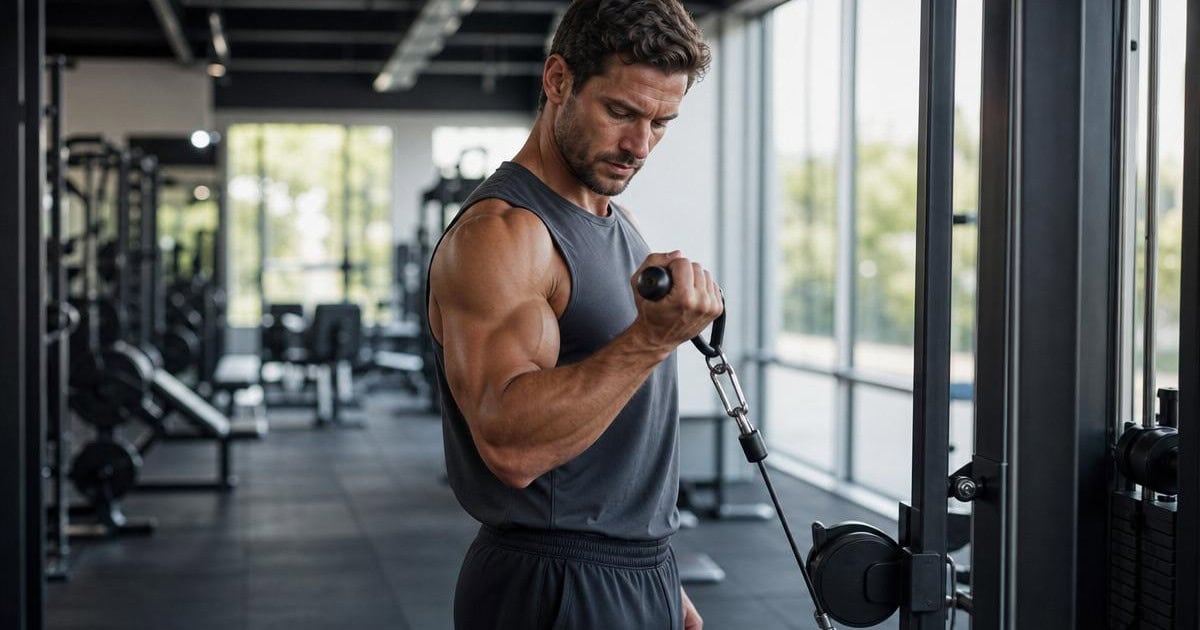
Cable bicep training produces real biceps growth through the unique mechanical advantage that cable resistance offers: constant tension throughout the entire range of motion, unlike free weights where tension drops at the top of every curl. The format works particularly well for biceps because the small muscle responds best to consistent tension and time under load rather than maximum weight, and cables deliver this perfectly through every degree of elbow flexion. Most lifters who consistently train cable bicep work 1 to 2 times per week alongside compound pulling movements see measurable arm growth, improved peak development, and better mind-muscle connection within 8 to 12 weeks. The combination of mass-building cable curls, brachialis-targeted hammer and reverse curls, isolation work like concentration and preacher curls, and stretched-position long-head emphasis work produces broader biceps development than any single training tool alone.
Below are ten effective cable bicep exercises that cover mass-building (cable curl, hammer curl), isolation (concentration curl, preacher curl), long-head emphasis (incline curl, lying curl), short-head emphasis (inner curl), brachialis development (reverse curl), peak contraction (overhead curl), and conditioning-bias variations (squatting curl). Together they form a complete cable bicep program that hits every angle and every head of the biceps without requiring multiple equipment changes. A 25 to 35-minute session pulled from this list, performed 1 to 2 times per week, produces strong biceps development that complements compound back work.
Cable Curl

The Cable Curl performs a standard biceps curl using a cable machine with a straight bar attachment. The cable maintains constant tension on the biceps throughout the entire range of motion, unlike free weights where tension drops at the top.
For cable bicep training, the cable curl is the foundational mass-building exercise. The pattern hits both bicep heads through full range of motion with constant tension that drives hypertrophy. Run it for 3 to 4 sets of 8 to 12 reps as the primary mass-builder in any cable bicep session.
Set the cable pulley to the lowest position and attach a straight bar. Stand facing the machine with feet shoulder-width and grip the bar with palms facing up. Keep elbows pinned to the sides. Curl the bar up toward the chest by flexing the biceps, squeeze hard at the top, then lower under control until arms are fully extended. Maintain elbow position throughout.
Cable Hammer Curl

The Cable Hammer Curl performs hammer curls with a rope attachment at the low pulley. The neutral grip emphasizes the brachialis and brachioradialis along with the biceps, building thickness across the entire upper arm.
For cable bicep training, the hammer curl variation hits the brachialis hard. The brachialis sits underneath the biceps and pushes them up, creating a more pronounced peak. Run it for 3 sets of 10 to 12 reps as primary brachialis and forearm work.
Attach a rope to the low pulley. Stand facing the cable with feet shoulder-width and grip the rope with palms facing each other (neutral grip). Keep elbows pinned to the sides. Curl the rope up toward the shoulders while maintaining the neutral grip. At the top, pull the rope ends apart slightly for peak contraction. Lower under control.
Cable Concentration Curl

The Cable Concentration Curl performs a one-arm seated curl with the elbow braced against the inner thigh, similar to the dumbbell concentration curl but with cable tension. The fixed elbow position maximizes biceps isolation.
For cable bicep training, the concentration curl produces near-peak biceps activation by removing momentum and isolating the muscle. The pattern hits the biceps with constant cable tension. Run it for 3 sets of 10 to 12 reps per arm as primary isolation work, typically toward the end of a bicep session.
Sit on a bench facing the cable machine with the pulley set low and a single handle attached. Grip the handle with one hand and brace that elbow against the inside of the same-side thigh. The non-working arm rests on the opposite leg for stability. Curl the handle up toward the shoulder by flexing the bicep. Lower under control. Switch arms between sets.
Cable Incline Biceps Curl

The Cable Incline Biceps Curl performs curls while lying back on an incline bench positioned in front of a cable column. The incline position stretches the long head of the biceps, increasing the loaded range and emphasizing the long head.
For cable bicep training, the incline cable curl produces strong long-head bicep loading through stretched-position emphasis. The long head contributes most to the bicep peak. Run it for 3 sets of 10 to 12 reps as long-head emphasis work.
Position an incline bench (set to about 45 to 60 degrees) about 3 feet in front of a low cable pulley. Lie back on the bench with palms facing up and grip a straight bar attachment with arms extended down toward the pulley. Curl the bar up toward the shoulders while keeping the elbows fixed in position. The stretched starting position hits the long head heavily. Lower under control.
Cable Kneeling Preacher Curl
The Cable Kneeling Preacher Curl performs preacher curls in a kneeling position using cable resistance. The fixed arm position eliminates body english and isolates the biceps at the bottom of the range.
For cable bicep training, the kneeling preacher curl produces strong biceps isolation at the stretched position. The pattern hits the lower portion of the biceps muscle that is most stretched. Run it for 3 sets of 10 to 12 reps as biceps isolation work.
Set up the cable pulley at the lowest position with a straight bar attachment. Kneel in front of an incline bench positioned to face the cable. Drape both arms over the angled pad of the bench with the back of the upper arms supported. Grip the bar with palms facing up. Curl the bar up by flexing the biceps. Lower until the arms are fully extended.
Cable Reverse Curl

The Cable Reverse Curl performs curls with an overhand (pronated) grip. The reverse grip emphasizes the brachialis and brachioradialis muscles much more than the biceps brachii, contributing to overall arm thickness.
For cable bicep training, the reverse curl is the most direct brachialis loading exercise. The pattern hits the often-neglected brachialis muscle that pushes the biceps up. Run it for 3 sets of 12 to 15 reps as primary brachialis work, typically at the end of a bicep session.
Attach a straight bar to the low cable pulley. Stand facing the cable and grip the bar with palms facing down (overhand grip), hands shoulder-width. Keep elbows at the sides. Curl the bar up toward the shoulders while maintaining the overhand grip. Lower under control. Use lighter weights than standard curls because the reverse grip is mechanically weaker.
Cable Seated Overhead Curl

The Cable Seated Overhead Curl performs curls with the cable handles set high and arms extended out to the sides. The pattern places the biceps in the fully shortened position with peak contraction at the top.
For cable bicep training, the overhead curl produces strong peak contraction loading. The pattern hits the biceps at the shortened end of the range that other curls can not reach. Run it for 3 sets of 10 to 15 reps as biceps peak contraction work.
Sit between two cable columns with handles set at the high pulley positions. Grip both handles with palms facing up and arms extended out to the sides at shoulder height. Curl both handles toward the head simultaneously by flexing the biceps. Squeeze hard at peak contraction with hands near the temples. Lower under control while maintaining elbow position.
Cable One Arm Inner Biceps Curl

The Cable One Arm Inner Biceps Curl performs single-arm curls with the cable pulled across the body to emphasize the inner (short) head of the biceps. The pattern hits the short head specifically.
For cable bicep training, the inner curl produces strong short-head biceps loading. The short head contributes to bicep width. Run it for 3 sets of 10 to 12 reps per arm as short-head emphasis work.
Set the cable pulley at the lowest position with a single handle. Stand sideways to the cable. Grip the handle with the hand farther from the cable column and pull the handle across the body to start. Curl the handle up and across the body toward the opposite shoulder while keeping the elbow pinned to the side. The cross-body angle hits the inner head specifically. Switch arms between sets.
Cable Lying Curl

The Cable Lying Curl performs curls while lying flat on a bench with cables overhead. The supine position eliminates lower back strain and forces strict biceps isolation.
For cable bicep training, the lying cable curl produces strong biceps isolation by removing all body english. The pattern is excellent for finishing sessions or when fatigue compromises standing form. Run it for 3 sets of 10 to 12 reps as biceps isolation work.
Set up the cable pulley at a high position with a straight bar attachment. Lie flat on a bench positioned with the head end facing the cable column. Reach overhead and grip the bar with palms facing up. Curl the bar down toward the forehead by flexing the biceps. The elbows stay fixed in space. Lower under control until the arms are fully extended overhead.
Cable Squatting Curl


The Cable Squatting Curl performs curls while in a deep squat hold position. The squatted stance places the biceps at a unique angle and increases time-under-tension challenge by adding lower-body isometric load.
For cable bicep training, the squatting curl produces unique loading that combines biceps work with lower-body endurance. The pattern hits the biceps while challenging total-body stability. Run it for 3 sets of 10 to 12 reps as combined biceps and conditioning work.
Set up the cable pulley at the lowest position with a straight bar attachment. Stand facing the cable and squat down into a deep squat hold (hips below knees) while gripping the bar. Maintain the squatted position throughout. Curl the bar up toward the chest while keeping the squat hold steady. Lower under control. Maintain squat depth throughout the set.
How To Program These Workouts
A productive cable bicep session pulls 4 to 6 exercises from the list above based on training goals and weekly volume. A common mass-building session: cable curl (mass), cable hammer curl (brachialis), cable incline curl (long head), cable concentration curl (isolation). A peak-development session: cable curl, cable seated overhead curl (peak contraction), cable kneeling preacher curl (stretched position), cable reverse curl (brachialis). Run mass-building work for 3 to 4 sets of 8 to 12 reps, isolation work for 3 sets of 10 to 12 reps per arm, and brachialis or peak-contraction work for 3 sets of 10 to 15 reps. Total session covers 14 to 18 working sets focused on biceps development.
Train cable bicep work 1 to 2 times per week as part of broader pulling-day or arm-day programming. The biceps are a small muscle group that recovers quickly but also accumulates fatigue from compound back work (rows, pull-ups, lat pulldowns) that already activates them substantially. Most successful programs schedule cable bicep work either: 1) at the end of a back day (after compound pulls), 2) on a dedicated arm day with triceps, or 3) twice per week with light volume on one day and heavier focused work on the other. Keep biceps training time under 30 to 35 minutes per session; longer sessions produce diminishing returns through accumulated fatigue.
For broader arm programming, see our best bicep workouts for men and best cable workouts for arms. For specific biceps work, see our how to build bigger biceps guide.
Final Thoughts
The best cable bicep workouts deliver real biceps growth through the unique advantage of constant tension that cables provide throughout the entire curl range. The combination of mass-building basics, brachialis development, long-head emphasis, peak contraction work, and isolation variations covers every angle of biceps development and produces broader arm growth than dumbbell or barbell curls alone. For lifters who want measurable biceps size and peak development improvements, want to break through plateaus in arm growth, or want to add variety to their bicep training, dedicated cable bicep work is one of the most effective options available.
Stay focused on form quality and constant tension. The most common cable bicep training mistakes include using too much weight (which forces body english and reduces biceps isolation) and rushing through reps (which eliminates the time-under-tension advantage cables provide). The fix: use weights light enough to maintain strict elbow position throughout each rep, control the eccentric (lowering) phase across 2 to 3 seconds, and squeeze hard at peak contraction on every rep. Quality reps with appropriate weights produce stronger biceps growth than ego-driven heavy weights with poor form.
Frequently Asked Questions
Are cable bicep curls better than dumbbell bicep curls?
They serve complementary roles. Cable curls produce constant tension throughout the entire range of motion, which dumbbells can not match (dumbbell tension drops at the top of every curl). Dumbbells produce more stabilizer recruitment and allow for more natural movement paths. Most successful biceps programs include both: dumbbells for foundational mass work and cables for constant-tension variation, peak contraction work, and isolation.
How often should I train biceps with cables?
One to two cable bicep sessions per week works for most lifters. The biceps are a small muscle that recovers quickly but accumulates fatigue from compound pulling work (rows, pull-ups). Most successful programs include cable bicep work either at the end of a back day, on a dedicated arm day, or twice per week with one heavier session and one lighter pump-focused session. Three or more dedicated bicep sessions per week typically produce diminishing returns.
What attachment is best for cable bicep curls?
Different attachments serve different purposes. The straight bar produces standard biceps loading and is best for primary mass work. The rope works best for hammer curls and brachialis emphasis. The EZ bar attachment is gentler on the wrists for some lifters. The single handle works for unilateral and concentration-style curls. Most successful programs include 2 to 3 different attachments across a session for variety in stimulus.
Should I do cable curls before or after compound exercises?
After compound back work in most cases. The biceps are heavily recruited during rows, pull-ups, and lat pulldowns, and pre-fatiguing them with cable curls compromises compound lifting performance. Most successful programs do compound back work first (rows, pulldowns), then move to direct biceps work including cable curls. The exception is dedicated arm days where biceps and triceps are the primary focus.
What rep range works best for cable bicep curls?
Eight to fifteen reps for most cable bicep work. Mass-building cable curls work best in the 8 to 12 rep range with moderate-heavy weight. Isolation work like concentration curls and preacher curls works best in the 10 to 12 rep range. Peak contraction and brachialis work like overhead curls and reverse curls works best in the 12 to 15 rep range with lighter weight. Most successful programs include a mix of rep ranges across exercises rather than the same range for all curls.