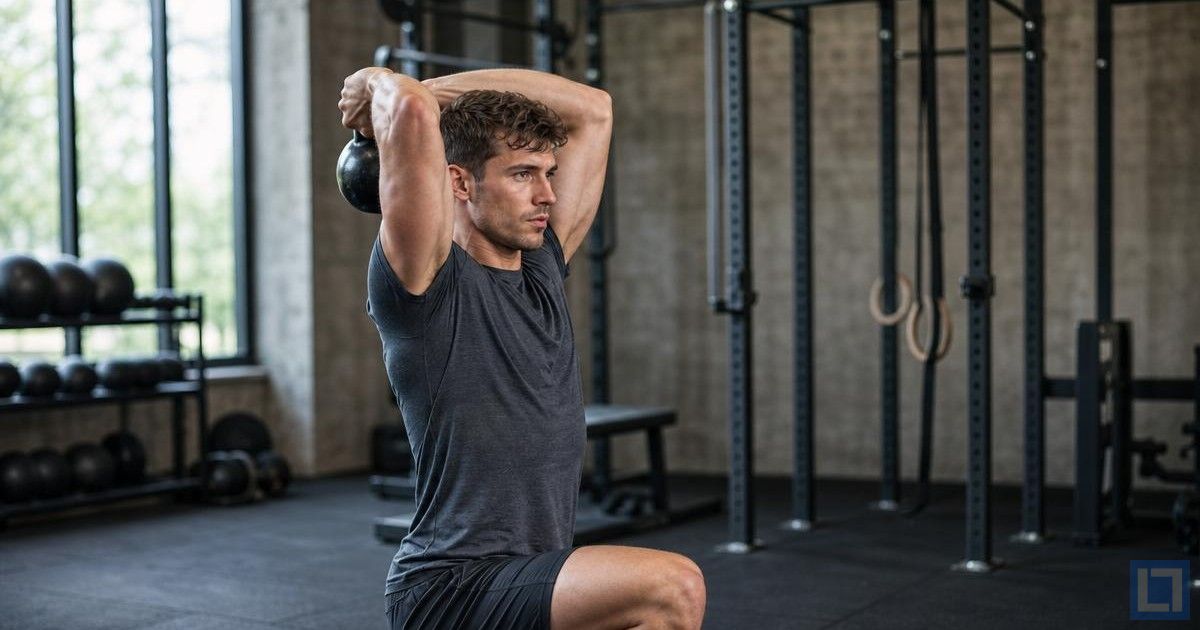
Kettlebells produce real tricep development across every major training pattern. The combination of overhead extensions (which target the long head heavily), pressing variations (which hit the lateral and medial heads as primary movers during the lockout), and explosive movements like jerks (which add power demand on top of pure strength) covers all three tricep heads in one piece of equipment. The unique handle position and offset center of gravity also produce stability demand that dumbbell training cannot fully replicate, which makes kettlebell tricep training particularly effective for building functional strength alongside size.
Below are ten effective kettlebell tricep exercises that cover overhead extension work, skull crusher variations, strict pressing, seated isolation pressing, and explosive jerk movements. Together they form a complete kettlebell tricep training program that fits in any home gym with one or two kettlebells. A 30 to 45-minute session pulled from this list produces strong tricep stimulus across every major head and movement pattern.
Kettlebell Overhead Triceps Extension

The Kettlebell Overhead Triceps Extension holds a kettlebell overhead with both hands and lowers it behind the head by bending at the elbows, then extends back to the start. The exercise targets the long head of the triceps directly through full overhead range of motion.
For kettlebell tricep mass development, the overhead extension is one of the most effective exercises that exists. The overhead position elongates the long head and produces stronger growth in the muscle that gives the upper arm its full appearance from the back. Run it for 3 to 4 sets of 10 to 12 reps as the primary tricep mass exercise.
Stand or kneel holding a single kettlebell overhead with both hands cupping the top of the bell. Lower the kettlebell behind the head by bending at the elbows, keeping the upper arms vertical. Extend back to the start by straightening the elbows. Use moderate weight; this is a technique-focused movement.
Kettlebell Lying Triceps Extension Skull Crusher

The Kettlebell Lying Triceps Extension Skull Crusher lies on a bench or floor with a kettlebell held above the chest with both hands and lowers it toward the forehead by bending at the elbows. The lying position eliminates body sway and produces strong tricep isolation.
For complete kettlebell tricep development, the skull crusher complements overhead extensions by hitting the triceps from a different angle. The combination covers all three tricep heads more thoroughly than either alone. Run it for 3 sets of 8 to 12 reps as accessory work after primary overhead extension.
Lie flat on a bench or the floor. Hold a kettlebell with both hands cupping the top end, arms extended straight up above the chest. Lower the kettlebell toward the forehead by bending at the elbows. Keep the upper arms still and pointed at the ceiling. Press back to the start.
Kettlebell Standing One Arm Extension

The Kettlebell Standing One Arm Extension holds a kettlebell overhead in one hand and lowers it behind the head by bending at the elbow, then extends back to lockout. The unilateral version catches strength imbalances and adds significant core demand.
Single-arm tricep work is one of the most underrated bodybuilding tools that exists. The unilateral loading catches the strength imbalances most lifters develop from years of bilateral training, and the asymmetric load demands core bracing that produces functional carryover beyond just arm size. Run it for 3 sets of 10 to 12 reps per arm.
Stand tall with a kettlebell held overhead in one hand. Lower the kettlebell behind the head by bending at the elbow, keeping the upper arm vertical. Extend back to lockout overhead by straightening the elbow. Switch arms after each set.
Kettlebell Seated Press

The Kettlebell Seated Press sits on a bench with back support and presses kettlebells overhead from the rack position. While primarily a shoulder exercise, the seated press hits the triceps heavily through the lockout portion.
For combined shoulder and tricep development, the seated kettlebell press is one of the most efficient exercises that exists. The compound loading produces stronger tricep development than isolation exercises alone, particularly for the lateral and medial heads. Run it for 3 to 4 sets of 6 to 10 reps as secondary tricep work.
Sit on a bench with back support set roughly upright. Hold kettlebells in the rack position at the shoulders. Press both kettlebells up to lockout overhead. Lower under control to the rack. Keep the back firmly against the support throughout. The triceps work hardest at the lockout.
Kettlebell Strict Press

The Kettlebell Strict Press holds a single kettlebell in the rack position at the shoulder and presses it overhead to lockout. While primarily a shoulder exercise, the strict press hits the triceps heavily through the lockout portion.
For combined unilateral shoulder and tricep development, the kettlebell strict press is one of the most efficient exercises in any kettlebell program. The compound loading produces stronger tricep development than isolation exercises alone for lifters who use full overhead range of motion. Run it for 3 to 4 sets of 6 to 10 reps per arm.
Hold a kettlebell in the rack position at the shoulder. Press the bell straight up to lockout overhead, keeping the body rigid throughout. Lower under control to the rack. The triceps work hardest at the lockout; emphasize the full extension at the top of every rep.
Kettlebell Seated One Arm Military Press

The Kettlebell Seated One Arm Military Press sits on a bench with back support and presses a single kettlebell from the rack position to overhead lockout. The seated position eliminates leg drive and forces the shoulders and triceps to do all the work.
For pure isolation of the shoulders and triceps, the seated one-arm military press eliminates the body momentum that standing variations allow. The strict isolation produces stronger development per rep, and the unilateral loading catches strength imbalances. Run it for 3 sets of 6 to 10 reps per arm.
Sit on a bench with back support upright. Hold a kettlebell in the rack position at one shoulder. Press the bell straight up to lockout overhead while keeping the back firmly against the support. Lower under control to the rack. Switch arms after each set.
Kettlebell One Arm Military Press to the Side

The Kettlebell One Arm Military Press to the Side performs the strict press while leaning slightly to one side, which changes the loading angle on the shoulders and triceps. The asymmetric stance also adds significant lateral core demand.
For variety in kettlebell tricep training, the angled military press produces unique loading that standard pressing variations cannot match. The slight lean shifts the shoulder and tricep loading and adds lateral core work. Run it for 3 sets of 6 to 10 reps per arm as accessory work.
Stand tall with a kettlebell in the rack position at one shoulder. As you press the bell overhead, lean slightly to the opposite side so the kettlebell tracks slightly diagonal. Press to full lockout. Lower under control while reversing the lean. The motion is slight; do not lean dramatically.
Kettlebell Extended Range One Arm Press on Floor

The Kettlebell Extended Range One Arm Press on Floor lies on the floor with one kettlebell held above the chest and presses it from chest level to lockout, with the floor stopping the elbow at a slightly different position than standard floor pressing. The exercise targets the triceps as the primary mover.
For combined chest and tricep work in kettlebell-only programs, the extended range floor press produces unique stimulus through the unilateral loading and the modified floor position. The exercise hits the triceps heavily because the floor stops the elbow short of full chest activation. Run it for 3 sets of 8 to 12 reps per arm.
Lie flat on the floor with one kettlebell held at chest level, palm facing forward. Press the kettlebell up to lockout above the chest. Lower under control until the elbow touches the floor. Press back to lockout. Maintain a tight body position throughout. Switch arms after each set.
Kettlebell Double Jerk

The Kettlebell Double Jerk lifts two kettlebells from the rack position to overhead using a powerful jerk motion driven by the legs and hips, with the triceps locking out the press. The explosive movement combines lower-body power with upper-body lockout strength.
For lifters who want to combine tricep training with full-body explosive power, the double jerk is one of the most demanding exercises that exists. The pattern requires solid kettlebell technique; build the basic strict press first before progressing to the jerk. Run it for 4 to 5 sets of 5 to 8 reps as power work, with full recovery between sets.
Hold two kettlebells in the rack position at the shoulders. Dip slightly by bending the knees, then drive explosively upward through the legs while pressing the kettlebells overhead. End with both kettlebells locked out overhead and the body upright. Lower under control to the rack. Maintain rigid body position at the lockout.
Kettlebell Angled Press
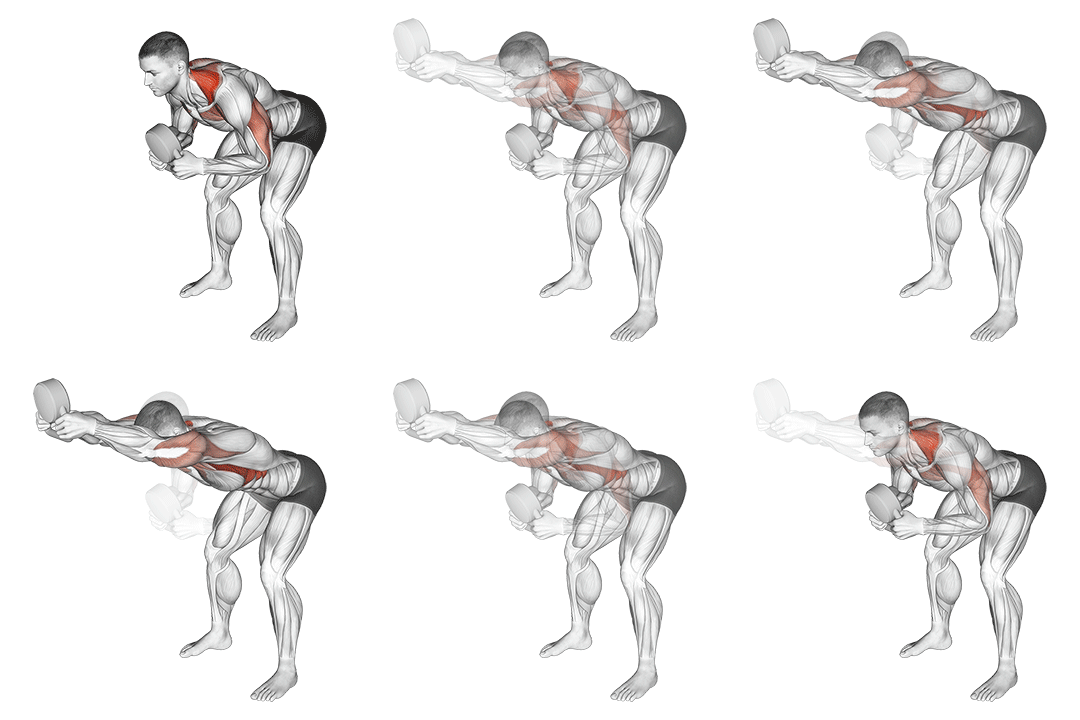
The Kettlebell Angled Press performs the press at an angle from one side, with the body leaning to one side as the press travels overhead. The angled motion produces unique loading on the shoulders and triceps from a non-vertical position.
For variety in kettlebell tricep training, the angled press hits the muscles from a different position than vertical pressing. The angled loading produces stronger functional carryover to athletic positions where the arms work at non-vertical angles. Run it for 3 sets of 6 to 10 reps per side.
Stand tall with a kettlebell in the rack position. Press the bell overhead while simultaneously bending laterally to one side, allowing the arm to track at an angle rather than straight up. Hold briefly at the locked-out angled position. Lower under control. Switch sides on the next set.
How To Program These Workouts
A productive kettlebell tricep session pulls five to seven exercises from the list above. A balanced session includes one overhead extension (long head primary), one skull crusher (medial/lateral head primary), one strict pressing exercise (compound tricep work), one unilateral exercise (catches imbalances), and one explosive movement (jerk for power). Run extensions and skull crushers for 3 sets of 8 to 12 reps; pressing for 3 to 4 sets of 6 to 10 reps; explosive work for 4 to 5 sets of 5 to 8 reps with full recovery.
Train kettlebell triceps 1 to 2 times per week. The triceps recover within 48 to 72 hours of moderate training, but they get significant indirect work from chest day and shoulder day, which means dedicated tricep work compounds quickly with other upper-body training. Most lifters program one focused kettlebell tricep session per week alongside the indirect tricep work from kettlebell pressing and pulling work.
For more kettlebell programming, see our best kettlebell arm workouts and best kettlebell shoulder workouts. For broader tricep training, see our how to build bigger triceps guide.
Final Thoughts
The best kettlebell tricep workouts deliver complete tricep development without requiring barbells, cable machines, or specialized arm-training equipment. The combination of overhead extensions, skull crushers, pressing variations, and explosive movements covers every major tricep training function in a way that fits any home or minimal-equipment setup. For home lifters and travelers, kettlebells are one of the most versatile tricep training tools available.
Pay attention to elbow position. The most common kettlebell tricep training mistake is letting the elbows drift forward during overhead extensions or out to the sides during skull crushers, which shifts loading away from the target muscle. The fix: keep the elbows pointing straight at the ceiling during overhead extensions and tracking close to the body during skull crushers. Strict elbow position produces stronger tricep development than heavier weight with sloppy form.
Frequently Asked Questions
What kettlebell weight should I use for tricep workouts?
Most intermediate lifters work with 12 to 24 kg kettlebells (26 to 53 pounds) for overhead extensions and skull crushers, and 16 to 32 kg (35 to 70 pounds) for pressing variations. The right weight is whatever allows clean reps in your target range. Heavier weight with poor form produces less benefit than moderate weight with strict technique.
Can kettlebells build big triceps?
Yes for beginners and intermediates. The combination of overhead extension work, skull crushers, and pressing variations produces real tricep development for years of progressive practice. The unilateral and explosive variations also produce strength benefits that barbell-only training rarely matches. Advanced lifters chasing maximum tricep size eventually benefit from heavy barbell pressing, but consistent kettlebell training produces measurable development at every level.
How often should I train triceps with kettlebells?
1 to 2 times per week works for most lifters. The triceps recover within 48 to 72 hours of moderate training. Most lifters do well with one focused kettlebell tricep session per week alongside the indirect tricep work from kettlebell pressing and pulling work. Spreading volume across two sessions produces faster growth than once-weekly high-volume sessions.
Do I need two kettlebells for tricep workouts?
Two is helpful but not required. Many tricep exercises (overhead extension, single-arm extension, strict press) work with a single kettlebell. A second matched kettlebell enables bilateral work (seated press, double jerks) that allows heavier total loading. A complete tricep setup typically uses two matching bells of 16 to 24 kg plus one lighter bell (8 to 12 kg) for isolation work.
Are kettlebells better than dumbbells for triceps?
Different equipment have different strengths. Dumbbells allow more precise weight selection for some isolation exercises. Kettlebells produce unique loading patterns due to the offset handle position and the bell shape, which adds stronger stability and grip demand during overhead movements. Most well-designed tricep programs use both: dumbbells for primary heavy work, kettlebells for variety, stability training, and explosive movements.