The triceps make up roughly two-thirds of the upper arm, but most lifters underdevelop them by relying entirely on pressing exercises. Direct tricep work targets the muscle through pure elbow extension, which produces stronger growth and stronger arms over months and years. The best dumbbell tricep workouts cover all three tricep heads (long head, lateral head, medial head) through the variety of angles and positions dumbbells make accessible.
Below are ten effective dumbbell tricep exercises that cover lying extensions, overhead variations, skullcrushers, kickbacks, and compound dips. Together they form a complete tricep training program that requires nothing more than a pair of dumbbells and a bench.
Dumbbell Lying Triceps Extension

The Dumbbell Lying Triceps Extension lies flat on a bench with two dumbbells held above the chest, then lowers them toward the forehead by bending at the elbows. The exercise isolates the triceps directly through their primary extension function.
The lying tricep extension is the most direct mass-builder for the triceps in any dumbbell program. The position eliminates body sway entirely and forces the triceps to do all the work, which produces stronger growth per rep than standing variations. Run it for 3 to 4 sets of 8 to 12 reps as the primary tricep exercise.
Lie on a bench with dumbbells held above the chest, palms facing each other. Bend at the elbows to lower the dumbbells toward the sides of the head, keeping the upper arms still and pointed at the ceiling. Press back to the start by extending the elbows. Use a moderate weight that allows clean reps.
Dumbbell Standing French Press

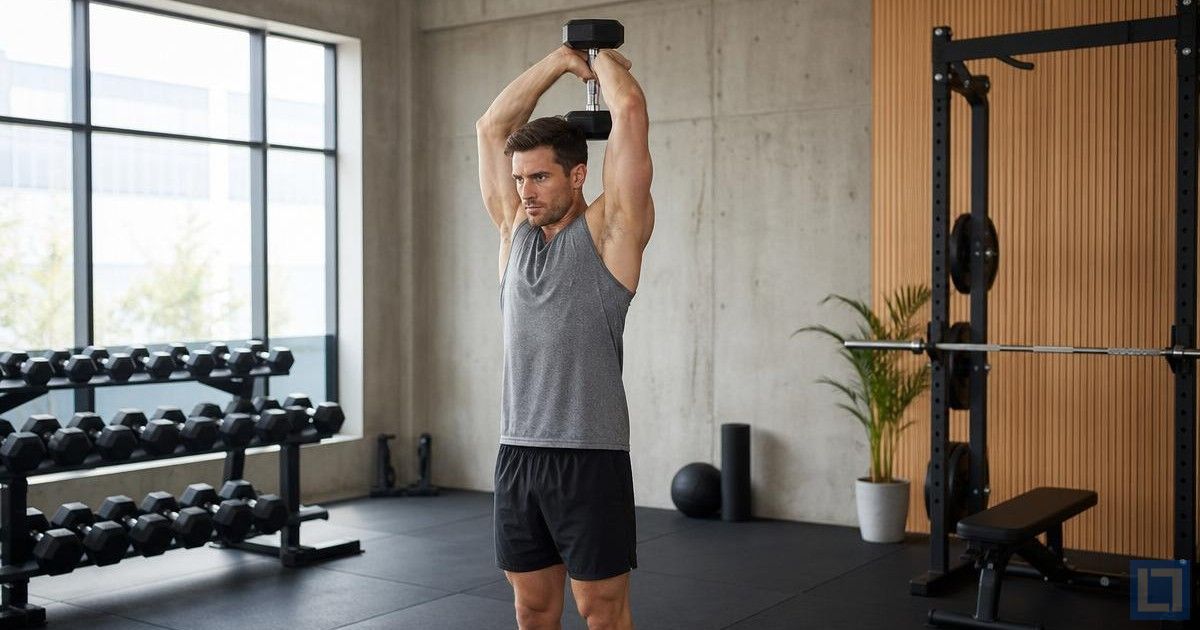
The Dumbbell Standing French Press holds a single dumbbell overhead with both hands and lowers it behind the head by bending the elbows. The standing overhead position emphasizes the long head of the triceps, which is the largest of the three tricep heads.
Direct overhead tricep work is one of the most under-programmed tricep exercises in any program. The long head responds best to overhead positions because of how the muscle attaches above the shoulder joint; standing French presses load this position more directly than lying or seated variations. Run it for 3 sets of 10 to 12 reps.
Stand tall with a single dumbbell held overhead with both hands cupping the top end. Lower the dumbbell behind the head by bending at the elbows, keeping the upper arms close to the head. Press back to lockout overhead by extending the elbows. Avoid arching the lower back to drive the dumbbell up.
Dumbbell Seated Single Arm Overhead Triceps Extension

The Dumbbell Seated Single Arm Overhead Triceps Extension sits on a bench and performs an overhead tricep extension with one arm at a time. The unilateral position allows focused attention on each side and catches strength imbalances bilateral overhead work hides.
Single-arm overhead tricep work is the most direct way to address tricep strength imbalances. Most lifters have one tricep noticeably stronger than the other due to handedness; unilateral training equalizes the development over months. Run it for 3 sets of 10 to 12 reps per side.
Sit on a bench with a single dumbbell held overhead with one arm. Lower the dumbbell behind the head by bending at the elbow, keeping the upper arm pointed at the ceiling. Press back to lockout. Switch sides on the next set or alternate as preferred.
Dumbbell Tate Press

The Dumbbell Tate Press lies flat on a bench and lowers the dumbbells to the chest with the elbows flared out, ending with the dumbbells touching the chest at the bottom. The flared-elbow position emphasizes the lateral head of the triceps differently than standard skull crushers.
For lifters who want tricep variety beyond standard extensions, the Tate press is a strong choice. The flared-elbow position produces different muscle recruitment than tucked-elbow extensions, which keeps the muscles fresh during long-term tricep training. Use it as a second tricep exercise after lying extensions.
Lie flat on a bench with dumbbells held above the chest, palms facing forward. Lower the dumbbells in an arc with the elbows flared out to the sides until the dumbbells touch the chest. Press back to lockout. Keep the wrists firm; the rep is about elbow extension, not chest pressing.
Dumbbell Kickback

The Dumbbell Kickback hinges over from a standing position with one knee on a bench and extends the dumbbell back behind the body, locking out the elbow. The exercise targets the long head of the triceps through pure extension at the back of the body.
Tricep kickbacks are sometimes dismissed as ineffective, but research shows they produce strong activation when performed strictly. The key is keeping the upper arm parallel to the floor throughout and not using body sway to swing the dumbbell. Run them for 3 sets of 10 to 12 reps per side as accessory work.
Hinge over with one knee on a bench and the same-side hand on the bench for support. Hold the dumbbell in the opposite hand with the upper arm parallel to the floor. Extend the elbow back until the arm is fully locked out. Squeeze the tricep at the top. Lower under control.
Dumbbell Lying Floor Skullcrusher

The Dumbbell Lying Floor Skullcrusher lies flat on the floor with dumbbells held above the chest and lowers them toward the floor by bending at the elbows. The floor variation limits the bottom range, which protects the elbows during heavier loading.
For lifters with elbow issues that limit standard skull crushers, the floor variation is the right call. The protected range at the bottom produces less stress on the elbow tendons while still loading the triceps with significant weight. It pairs well with bench-based extensions in a varied tricep program.
Lie flat on the floor with dumbbells held above the chest, palms facing each other. Bend at the elbows to lower the dumbbells toward the sides of the head until the elbows touch the floor. Press back to the start. Keep the upper arms still throughout.
Dumbbell Bench Dip

The Dumbbell Bench Dip places the hands on a bench behind the body and the feet on another bench in front, then dips the body down by bending the elbows. Adding a dumbbell on the lap loads the movement, building the triceps as a compound motion.
Bench dips are the most effective bodyweight tricep compound that exists. The hand position behind the body changes the angle of pull on the triceps, and adding load via a dumbbell keeps the movement progressing past pure bodyweight. Pair with isolation work for complete tricep development.
Hands grip the back bench with fingers forward. Lower the body until the elbows reach roughly 90 degrees, keeping the elbows tucked behind the body rather than flaring out. Press back to lockout. Add load by setting a dumbbell on the lap.
Dumbbell Decline Triceps Extension

The Dumbbell Decline Triceps Extension lies on a decline bench (head lower than feet) with dumbbells held above the chest, then performs a tricep extension. The decline angle changes the line of pull and emphasizes the long head of the triceps differently than flat extensions.
For lifters who already use flat extensions and want additional tricep variety, the decline version is a strong addition. The slightly different angle produces different muscle recruitment that keeps the muscles fresh during long-term training. Use it as a second tricep exercise on heavier programming days.
Lie on a decline bench with feet hooked at the top. Hold dumbbells above the chest with palms facing each other. Lower the dumbbells toward the sides of the head by bending at the elbows. Press back to the start. The decline angle adds slight intensity to the standard extension pattern.
Dumbbell Prone Triceps Kickback

The Dumbbell Prone Triceps Kickback lies face-down on an incline bench and performs the kickback motion with both arms simultaneously. The bench-supported position eliminates body sway entirely and forces the triceps to do all the work.
The prone variation is the cleanest version of the tricep kickback that exists. The chest-supported position removes the most common form mistake (body sway using momentum) and allows heavier weight than standing kickbacks while maintaining strict form. Run it for 3 sets of 10 to 12 reps.
Lie face-down on an incline bench with dumbbells hanging straight down. Bring the elbows up to the sides of the body. Extend both elbows back until the arms are fully locked out behind the body. Squeeze the triceps at the top. Lower under control.
Dumbbell Incline Two Arm Extension

The Dumbbell Incline Two Arm Extension sits on an incline bench and performs an overhead tricep extension with both arms simultaneously, holding a single dumbbell with both hands. The incline-bench seated position provides back support while emphasizing the long head of the triceps overhead.
For overhead tricep work with back support, the incline two-arm extension is a strong choice. The bench support eliminates lower-back stress that standing French presses sometimes create, while the bilateral grip allows heavier total loading than single-arm overhead variations. Run it for 3 sets of 10 to 12 reps.
Sit on an incline bench set to roughly 60 to 75 degrees. Hold a single heavy dumbbell with both hands cupping the top end above the head. Lower the dumbbell behind the head by bending at the elbows. Press back to lockout. Keep the upper arms close to the head throughout.
How To Program These Workouts
A productive dumbbell tricep session pulls four to six exercises from the list above. A balanced session includes one heavy lying extension (skullcrusher or lying triceps extension), one overhead variation (French press or seated overhead extension), one compound (bench dip), and one kickback variation. Run primary exercises for 3 to 4 sets of 8 to 12 reps; accessory work for 3 sets of 10 to 12 reps.
Train triceps once or twice per week. Triceps recover within 48 to 72 hours of moderate training, so they handle moderate frequency well. Most lifters program direct tricep work after pressing-heavy sessions when the muscles are already warm. Total weekly volume of 8 to 14 sets of direct tricep work produces strong growth for most lifters.
For more arm-focused programming, see our best dumbbell bicep workouts and how to build bigger biceps. To browse the muscle archive, explore our triceps exercise collection.
Final Thoughts
The best dumbbell tricep workouts deliver complete tricep development without requiring cable machines or barbells. The combination of lying extensions, overhead work, and compound movements covers every major tricep function and all three heads of the muscle. Dumbbells also allow joint-friendly loading patterns that protect the elbows during heavy training.
Pay attention to elbow position. The most common form mistake on tricep work is letting the elbows flare out or drift forward during the rep. Keeping the upper arms still and the elbows pointed straight up (or back, on kickbacks) is what isolates the triceps. Lifters who get the biggest triceps are the ones who use moderate weight with strict form rather than heavier weight with sloppy technique.
Frequently Asked Questions
How heavy should my dumbbells be for tricep workouts?
Most intermediate lifters work with 20 to 40 pounds for lying extensions and skullcrushers, 25 to 50 pounds for overhead French presses, and 15 to 30 pounds for kickbacks. Bench dips depend on bodyweight; loading with 25 to 60 pounds on the lap is typical for intermediate lifters. The right weight is whatever allows clean reps with one or two reps in reserve.
How often should I train triceps?
Once or twice per week is typical. Triceps recover within 48 to 72 hours of moderate training. Most lifters program direct tricep work on push days (after chest and shoulder pressing) or as a separate arm day combined with bicep training. Total weekly volume of 8 to 14 sets of direct tricep work produces strong growth.
Do I need to train all three tricep heads separately?
Most exercises hit all three heads to some degree, but emphasis varies. Overhead variations (French press, overhead extension) emphasize the long head. Lying extensions hit the long and lateral heads. Kickbacks favor the long head with the elbow extended behind the body. Including a mix of overhead and lying variations produces complete tricep development.
Can dumbbell tricep workouts replace cable work?
Yes for beginners and intermediates. Dumbbells produce real tricep growth for years before the load ceiling becomes meaningful. Cables provide constant tension that dumbbells cannot match at certain points in the rep, so advanced lifters often add cable work for variety, but consistent dumbbell tricep training produces strong development at every level.
Why don’t my triceps grow?
Three common reasons. First, insufficient volume: most lifters who fail to grow triceps do less than 8 weekly direct tricep sets. Second, poor form (elbows drifting, partial range of motion, momentum-based reps) reduces effective stimulus per rep. Third, weak mind-muscle connection: many lifters never feel their triceps work because the firing pattern stays dormant. Fix all three and growth resumes within a few weeks.