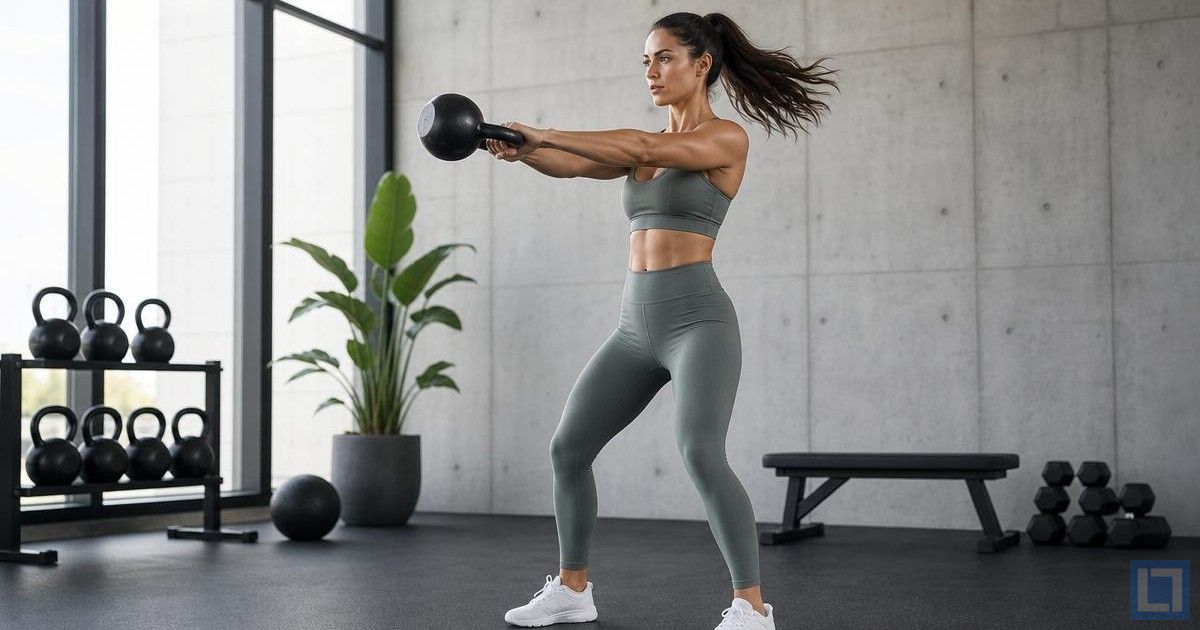
The kettlebell swing is one of the most efficient single exercises that has ever been invented. The combination of explosive hip drive, posterior chain loading, and cardiovascular response produces strength, power, and conditioning adaptations simultaneously in one continuous motion. The best kettlebell swing workouts build the foundational swing pattern, add variety through grip and stance variations, and include complementary exercises that support swing technique.
Below are ten effective swing variations and supporting exercises that cover bilateral and unilateral swings, banded variations, and the hinge-and-squat patterns that build the foundation for clean swing technique. Together they form a complete swing-focused training program that fits in any home gym.
Kettlebell Swing

The Kettlebell Swing is the foundational movement of the entire kettlebell training system. With a kettlebell held in both hands, you hinge at the hips and swing the bell back between the legs, then drive the hips forward explosively to swing the bell to chest height. It is one of the most efficient single exercises that exists for posterior chain power and conditioning.
The standard chest-height swing produces explosive hip drive without the technical demands of overhead variations. It serves as both a strength exercise (heavier weight for lower reps) and a conditioning exercise (lighter weight for high-rep timed sets). Run it for 5 sets of 15 to 25 reps as the centerpiece of any swing-focused workout.
Hinge at the hips and let the kettlebell swing back between the legs. Drive the hips forward explosively to launch the bell forward to chest height. The arms guide the bell but do not lift it; all the power comes from the hips. Reverse the swing back through the legs.
Kettlebell Full Swing

The Kettlebell Full Swing performs the swing motion all the way overhead rather than stopping at chest height. The kettlebell travels through a full range of motion from between the legs to fully overhead, which adds significant shoulder loading on top of the standard hip-hinge mechanics.
The full swing is the cornerstone of CrossFit-style kettlebell training. The combination of explosive hip drive and overhead loading hits the posterior chain, shoulders, and core simultaneously. It is more technical than the standard swing and requires solid shoulder mobility; build the standard swing first before progressing to the full version.
Hinge at the hips and swing the kettlebell back between the legs. Drive the hips forward explosively to swing the bell up and overhead, ending with arms locked over the head. Reverse the motion under control. Use moderate weight; the technical demand is the limiting factor.
Kettlebell Overhand Grip Swing

The Kettlebell Overhand Grip Swing performs the swing with both hands gripping the kettlebell from above (rather than the standard horn grip). The grip change shifts the loading slightly and adds different forearm and grip work to the swing pattern.
For lifters who want grip variety in their swing programming, the overhand grip variation is the most direct option. The grip difference produces slightly different muscle recruitment in the upper back and forearms while keeping the same hip-hinge mechanics that make swings effective. Use it as an occasional variation rather than as the primary swing pattern.
Grip the kettlebell with both hands from above (palms facing the body). Perform the standard swing pattern: hinge back, drive hips forward, swing bell to chest height. The grip difference will feel awkward initially; use lighter weight until the grip pattern is familiar.
Kettlebell Single Arm Swing

The Kettlebell Single Arm Swing performs the swing pattern with one hand instead of both. The unilateral grip catches strength imbalances and adds significant core demand because the body has to brace against the asymmetric load on every rep.
Single-arm swings are one of the most underrated kettlebell variations that exist. The unilateral loading forces the entire core to engage to prevent the body from twisting toward the loaded side, which produces stronger functional core work than bilateral swings. Alternate sides every 10 to 15 reps for balanced training.
Grip the kettlebell with one hand only. Perform the swing pattern: hinge back, drive hips forward, swing bell to chest height. Keep the body squared forward; the loaded side will want to rotate forward. Switch hands during the swing transition or alternate sets.
Kettlebell One Arm Swing
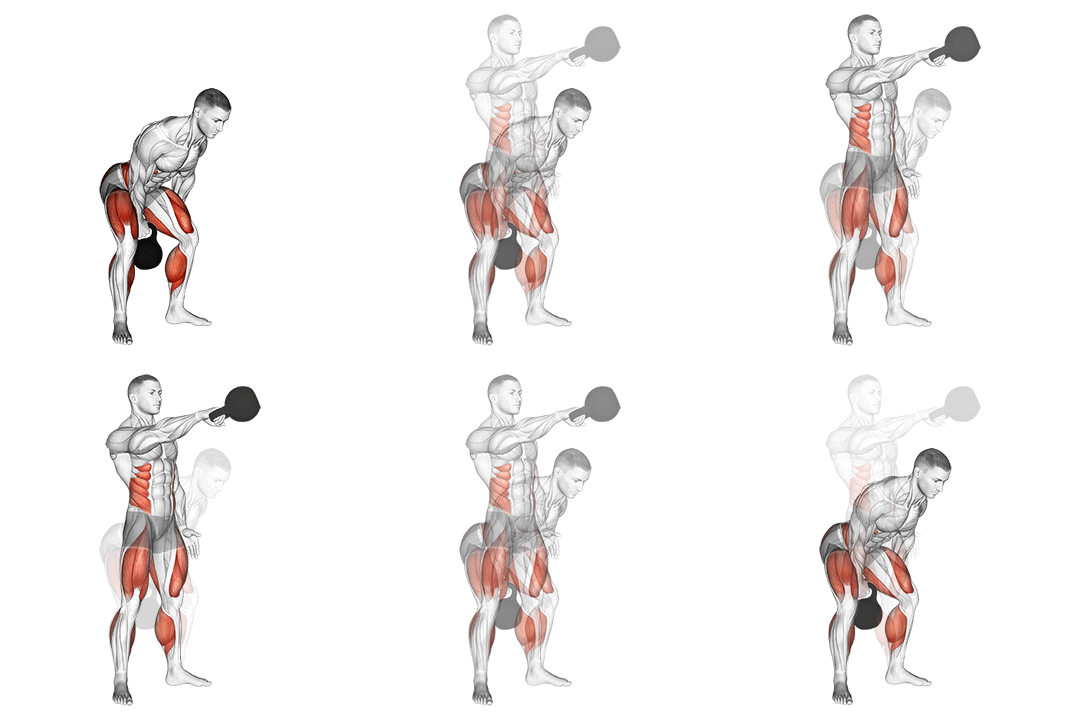
The Kettlebell One Arm Swing is functionally similar to the single-arm swing with subtle technique differences in grip position and arm path. The slightly different mechanics provide variety in single-arm swing programming and produce slightly different forearm and grip recruitment.
For experienced lifters who already include single-arm swings in their programming, the one-arm variation provides additional variety. The slightly different angle of pull keeps the muscles fresh during long-term training. Use it interchangeably with single-arm swings or alternate between the two on different days.
Grip the kettlebell with one hand. Perform the swing pattern with the kettlebell traveling slightly closer to the body line than a typical single-arm swing. Maintain a strong core to prevent rotation. Alternate sides between sets.
Kettlebell Banded Swing

The Kettlebell Banded Swing adds a resistance band attached to the kettlebell at one end and anchored to a fixed point at the other. The band tension increases as the kettlebell swings up, which adds significantly more loading at the top of the swing than a standard swing.
The accommodating resistance pattern (lighter at the bottom, heavier at the top) trains the lockout portion of the hip extension more effectively than constant-load variations. The band also speeds up the eccentric portion, which trains the body to absorb force quickly. Use it as a strength variation after standard swings are mastered.
Attach a resistance band to the kettlebell handle and to a heavy anchor point behind the lifter. Perform the standard swing pattern; the band adds tension at the top of the swing arc. Use lighter base weight than standard swings to account for the band tension.
Kettlebells Sumo Deadlift

The Kettlebells Sumo Deadlift uses a wide stance with two kettlebells held between the legs, then drives through the floor to stand. The wide stance reduces the range of motion compared to conventional deadlifts and shifts more emphasis to the glutes and adductors.
For swing-focused training, the sumo deadlift is one of the most valuable accessory exercises that exists. The hip-hinge mechanics carry over directly to swing technique, while the slower lift teaches the lockout pattern that swings require. Run it for 3 sets of 6 to 10 reps before swing-heavy sessions.
Set the feet wide with toes turned out roughly 30 to 45 degrees. Position the kettlebells between the legs. Hinge at the hips with a flat back, grip the bells, and drive through the floor to stand. Lock out by squeezing the glutes hard at the top.
Kettlebell Goblet Squat

The Kettlebell Goblet Squat holds a single kettlebell at the chest with both hands and squats to roughly parallel depth. The chest-loaded position keeps the torso upright through the squat, making it one of the most accessible squat variations that exists.
In a swing-focused program, the goblet squat provides the bilateral squat pattern that swings do not address. The combination of swings (hip hinge) and goblet squats (knee bend) covers both major lower-body movement patterns in two exercises. Run goblet squats for 3 sets of 8 to 12 reps.
Hold the kettlebell at the chest with both hands. Squat to parallel depth or below with feet shoulder-width and chest tall. Drive up through the whole foot. Keep the elbows tucked inside the knees at the bottom.
Kettlebell Romanian Deadlift

The Kettlebell Romanian Deadlift performs a Romanian deadlift with a kettlebell held in both hands. It targets the hamstrings, glutes, and lower back through the hinge pattern with a deeper stretch than the conventional deadlift allows.
The Romanian deadlift trains the same hip-hinge pattern that swings depend on, just at slower tempo with controlled load. Lifters who struggle with hip-hinge mechanics on swings often see immediate improvement from RDL practice. Use it as a technique drill before heavy swing sessions or as direct hamstring work in any program.
Hold the kettlebell with both hands at hip level. Hinge at the hips with a slight knee bend. Lower the bell in a path close to the legs until the hamstrings stretch. Drive the hips forward to stand back up. Keep the back flat throughout.
Kettlebell Step Up

The Kettlebell Step Up holds kettlebells at the sides and steps up onto a sturdy bench or box with one leg, driving the body up to standing on the platform. The unilateral pattern complements bilateral swing work with focused single-leg loading.
In swing-heavy programs, the step-up provides the unilateral leg work that bilateral swings do not address. The combination of swings (bilateral hip hinge) and step-ups (unilateral knee bend) produces balanced lower-body development across both major patterns. Run step-ups for 3 sets of 8 to 12 reps per side.
Step up onto a sturdy bench with one foot planted firmly. Drive through the front heel to bring the body to standing on the bench. Lower under control by stepping back down. Alternate legs on each rep.
How To Program These Workouts
A productive kettlebell swing session pulls four to six exercises from the list above. A typical structure starts with a swing-pattern warm-up (kettlebell RDL or sumo deadlift for 2 sets), runs the primary swing variation as the main work (5 sets of 15 to 25 reps), adds a complementary exercise (goblet squat or step-up), and finishes with a higher-volume conditioning swing block (10 rounds of 30 seconds work, 30 seconds rest).
Train swings two to four times per week. Swings recover quickly compared to heavier strength work because the loads are moderate; daily swing practice is feasible for advanced lifters as long as total volume stays moderate. Most lifters do well with three sessions per week (Monday/Wednesday/Friday) with rest days between.
For more kettlebell programming, see our best kettlebell workouts and best full body kettlebell workouts. To browse the equipment library, explore our kettlebell exercises collection.
Final Thoughts
The best kettlebell swing workouts produce strength, power, and conditioning simultaneously in a way few other exercises can match. The classic Russian-style chest-height swing remains one of the most effective single exercises in any program. Master the standard swing first, then add variety through unilateral and overhead variations once the bilateral pattern is solid.
Stay focused on hip drive. The most common technique mistake lifters make is using arm strength to lift the bell rather than letting the hip drive launch it. The arms should feel like ropes attaching the kettlebell to the body; all the power comes from the hips. Once the hip drive is dialed in, swings become both more effective and easier to perform at high volume.
Frequently Asked Questions
What kettlebell weight should I use for swings?
Most intermediate male lifters work with 20 to 32 kg (44 to 70 pounds) for standard swings. Female lifters typically use 12 to 20 kg (26 to 44 pounds). The right weight is whatever allows 15 to 25 explosive reps with clean technique. Heavier weight for fewer reps (5 to 10) builds more pure strength; lighter weight for higher reps (25 to 50) builds more conditioning.
How many swings should I do per workout?
Workouts vary widely. A simple structure runs 5 sets of 15 to 25 reps for 75 to 125 total swings. The classic Russian protocol does 10 sets of 10 reps with short rest periods. CrossFit-style workouts often do continuous swing sets for 30 seconds to 2 minutes. Total volume of 100 to 200 swings per workout is typical for general fitness; competitive kettlebell sport athletes go far higher.
Are swings safe for the lower back?
Yes, when performed with proper hip-hinge technique. The most common back-strain cause is using the lower back to lift the bell rather than driving through the hips. Lifters with existing lower-back issues should master the kettlebell RDL and sumo deadlift first to dial in the hinge pattern before progressing to full-speed swings.
What’s the difference between a Russian and American swing?
The Russian swing stops the bell at chest height with arms parallel to the floor; the American swing continues the bell all the way overhead. Russian swings produce more posterior chain loading per rep; American swings add overhead shoulder work. Most strength and conditioning programs use Russian swings as the standard; CrossFit programs typically use American swings.
How often should I do kettlebell swings?
Two to four times per week works for most lifters. Swings recover quickly because the loads are moderate. Daily swing practice is feasible for advanced lifters as long as total volume stays moderate (50 to 100 swings per session for daily training). Single high-volume sessions (200+ swings) need 48+ hours of recovery before the next swing session.