Few tools in strength training match the kettlebell for versatility. A single bell trains every major movement pattern: hinge, squat, press, pull, lunge, carry, and rotate. The best kettlebell workouts use that range of motion to build strength, power, and conditioning simultaneously, often within the same session and almost always with less time than equivalent barbell work.
Below are the ten foundational kettlebell exercises every lifter should know. Master these and you have a complete training system that fits in a corner of any room and travels with you anywhere.
Kettlebell Swing

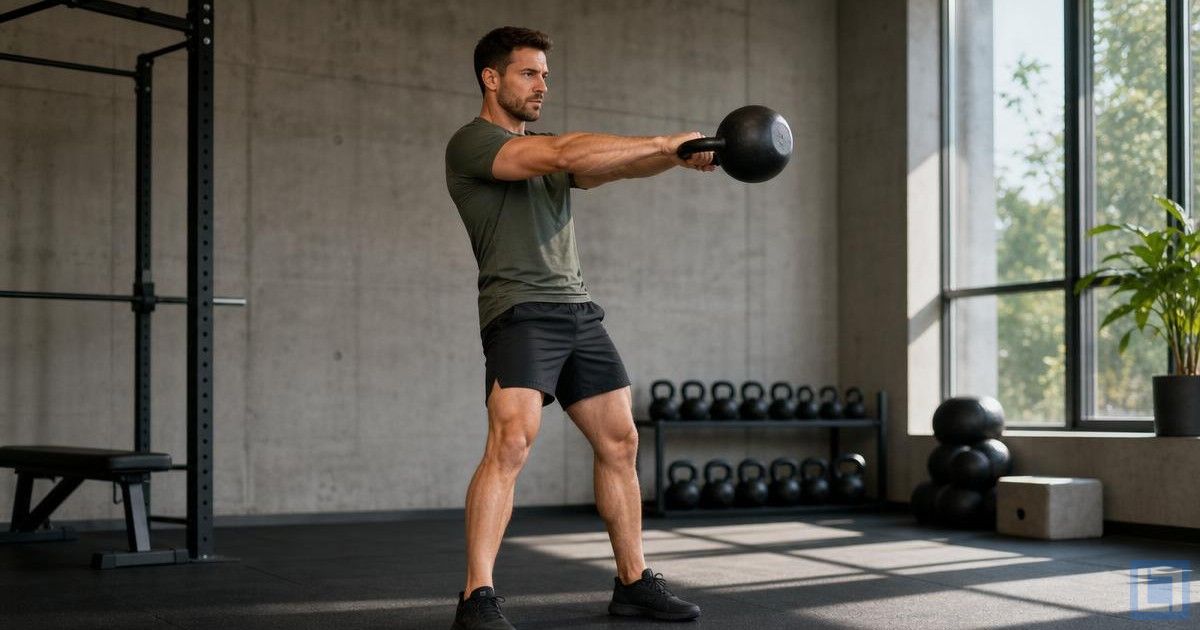
The Kettlebell Swing is the most iconic kettlebell exercise and the foundation of nearly every kettlebell program. Holding the kettlebell with both hands, you hinge at the hips and let the kettlebell swing between your legs, then drive your hips forward explosively to swing it to chest height. The hip drive is what powers the swing, not the arms.
No exercise teaches the hinge pattern better than the swing, and no kettlebell exercise builds the posterior chain (glutes, hamstrings, lower back) more efficiently. The continuous tempo also makes it one of the better cardio-strength hybrids in any training system.
The hinge has to come from the hips, not the lower back. Stand tall with the kettlebell forward at the top, snap the hips through, and let gravity pull the bell back down between the legs as you hinge again. Power generation should feel like a vertical jump executed through the hips.
Kettlebell Goblet Squat

The Kettlebell Goblet Squat holds a kettlebell at the chest in goblet position and squats deep. The front-loaded position naturally cues a vertical torso and clean depth, making it one of the easiest squat patterns to teach and one of the most reliable for legs and glutes.
Goblet squats work for absolute beginners learning to squat and for advanced lifters as a warm-up or accessory. The chest-loaded position also doubles as core training because the trunk has to brace against the front load to stay upright through the depth.
Hold the bell tight against the chest with elbows pointing down. Squat between the heels with knees tracking the toes. Drive up by pushing through the whole foot. The depth should be at least parallel; deeper if mobility allows.
Kettlebell Deadlift

The Kettlebell Deadlift is the ideal entry point to deadlifting. The kettlebell sits between the feet with a vertical pull path, the load is moderate enough to learn the hinge cleanly, and the handle position keeps the lifter from rounding forward as easily as a barbell deadlift can encourage.
For beginners, the kettlebell deadlift is the safest way to learn how to load the hinge pattern. For advanced lifters, it works as a warm-up before barbell deadlifting or as a high-rep posterior chain finisher with a single heavy bell.
Stand with feet shoulder-width and the bell between the feet. Hinge at the hips with a flat back and a slight knee bend. Grip the handle, brace the core, and stand up by driving the hips forward. The bell should travel in a vertical line, not arc forward.
Kettlebell Strict Press

The Kettlebell Strict Press cleans a kettlebell to the rack position at the shoulder, then presses it overhead without using leg drive. The strict press is a pure shoulder and tricep builder and one of the strongest tests of upper-body strength in kettlebell training.
Unlike a push press or jerk, which use the legs to help the bell overhead, the strict press isolates the shoulder. The kettlebell’s offset weight (mass behind the wrist) also forces stabilizers to work harder than a dumbbell press of equivalent load. The result is a more demanding pressing exercise than the bell weight suggests.
Press straight up with the elbow tracking forward through the rep. Lock out the elbow fully overhead with the bell stacked above the shoulder. Lower under control to the rack position before the next rep.
Kettlebell Two Arm Row

The Kettlebell Two Arm Row hinges over with one or two kettlebells in the hands and rows them to the lower chest. The position closely mirrors the barbell bent-over row, training the lats, mid-back, and biceps under significant load.
Most kettlebell programs are pressing-heavy and rowing-light, which produces shoulder imbalances over time. Adding rows to the program corrects that. The kettlebell row also lets each arm work independently if rowed one at a time, catching strength imbalances that bilateral barbell work hides.
Hinge at the hips with a flat back and a slight knee bend. Pull the kettlebells to the lower chest or upper abdomen, squeezing the shoulder blades together at the top. Lower under control. Avoid jerking the bells with the lower back.
Kettlebell Snatch

The Kettlebell Snatch is the most demanding kettlebell movement and the king of kettlebell sport. From a hinged position, you swing the bell up and lock it out overhead in one continuous motion, decelerating it at the top so the bell flips smoothly onto the back of the wrist.
The snatch is unmatched as a power and conditioning exercise. The hip drive of the swing combined with the overhead lockout produces a total-body output that few other movements can match. It is also the foundational test in kettlebell sport, where high-rep snatch sets define competitive levels.
This is an advanced movement. Master the swing first, then learn the high pull, then progress to the snatch. The bell should travel close to the body, not arc out in front. Lock out the arm fully overhead with the bicep next to the ear.
Kettlebell Two Arm Clean

The Kettlebell Two Arm Clean swings two kettlebells from the hinge position to the rack position at the shoulders. The clean is the entry point to pressing and jerking under load and serves as a strength-conditioning exercise on its own.
Cleans link the lower-body hinge with the upper-body rack position, training the body to transfer force through the trunk. They are also excellent conditioning when performed for high-rep sets, as the continuous swing-rack-lower cycle generates significant heart rate response.
Drive the hips through hard at the bottom of the swing. The kettlebells should travel close to the body and land softly in the rack position with elbows tucked and the bells resting in the front of the shoulders. Avoid catching the bells hard against the wrists.
Kettlebell Goblet Carry
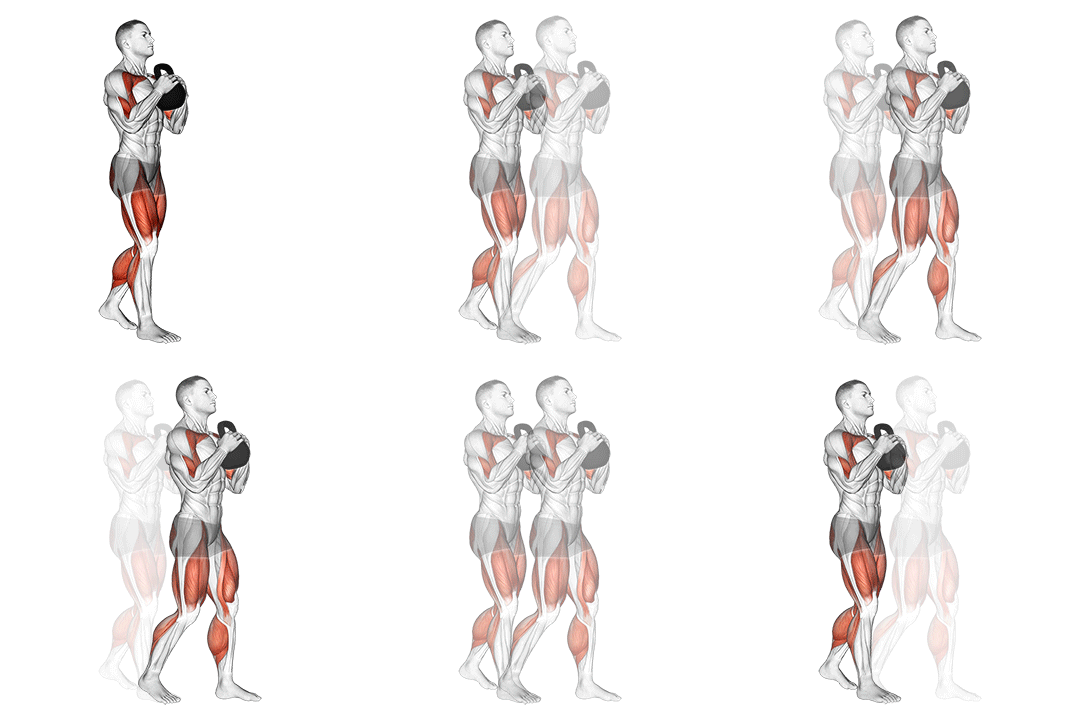
The Kettlebell Goblet Carry holds a kettlebell at chest height in goblet position and walks for distance or time. The chest-loaded carry trains anti-flexion core stability, upper back posture, and grip endurance simultaneously, all while the legs work continuously.
Loaded carries are massively underrated as full-body conditioning. The continuous walking time means the heart rate stays elevated, the load means the trunk has to brace through every step, and the chest position trains the upper back to fight the forward pull of the load. It is a complete exercise that takes only a kettlebell and some open floor.
Hold the bell tight against the chest with elbows tucked. Walk with normal posture: tall spine, ribs down, eyes forward. End the set when grip gives out or form breaks down. Both indicators are good signals to stop.
Kettlebell Forward Lunge

The Kettlebell Forward Lunge holds a kettlebell at the chest or in one hand and steps forward into a lunge. The unilateral leg work catches strength imbalances that bilateral squats cannot, and the front-loaded position adds core demand on top of the leg work.
Lunges are a critical complement to squats in any leg program. They train each side independently, expose any limitations the dominant side has been hiding, and load the legs in a different range and angle than squatting does. A complete leg routine includes both bilateral and unilateral work.
Step forward into a long lunge and drop straight down rather than forward. The front knee should track over the toes; the back knee hovers just above the floor. Drive through the front heel to stand, then alternate sides.
Kettlebell Half Turkish Get-Up

The Kettlebell Half Turkish Get-Up is the lower-half of the full Turkish get-up sequence. From a lying position with the kettlebell pressed overhead, you rise to a seated position and back down, all while keeping the kettlebell stable above the shoulder.
The half get-up is one of the best shoulder stability exercises in any training system. The overhead hold throughout a moving body position forces the shoulder, scapula, and core to work as one unit. It also doubles as a movement quality assessment because any weakness shows up immediately.
Press the bell up first and lock the arm out fully. Eyes track the bell throughout the movement. Move slowly and stop at any point where the shoulder loses position. The half get-up is the foundation; the full get-up adds standing back up after this position.
How To Program These Workouts
A standard kettlebell session pulls four to six exercises from the list above, organized by movement pattern: one hinge (swing or deadlift), one squat (goblet squat), one press (strict press or snatch), one pull (row), and one carry or get-up. That structure covers the full body in 30 to 45 minutes.
Two to four sessions per week works for most lifters. Single-bell training recovers fast for most people, but the swing and snatch are demanding enough that hitting them hard every day becomes counterproductive. Alternate heavier days with lighter technique-focused days.
For more cluster-specific kettlebell programming, see our best kettlebell core workouts and best kettlebell ab workouts. To browse the full equipment library, explore our kettlebell exercises collection.
Final Thoughts
The best kettlebell workouts deliver more than the simplicity of the equipment suggests. The combination of the swing, the squat, the press, the pull, and the carry covers virtually every demand the body has to meet, and a single 16 or 20 kilogram bell can keep most lifters challenged for years.
Start with the swing, the goblet squat, and the deadlift. Add the press and the row once those feel comfortable. Save the snatch, the clean, and the get-up for after several months of consistent practice. The progression is slow but the result is one of the most useful strength toolkits available.
Frequently Asked Questions
What weight kettlebell should I start with?
Most men do well starting with a 16 kilogram (35 pound) bell, while most women do well with an 8 to 12 kilogram (18 to 26 pound) bell. The bell should feel manageable for swings and rows but challenging for presses and snatches. Buying one bell at the right weight is better than buying two bells that are too light or too heavy.
How often can I train with kettlebells?
Three to five sessions per week works for most lifters. Kettlebell training tends to be slightly easier on the joints than heavy barbell work because the loads are smaller and the movement patterns are more dynamic. The swing and snatch still need recovery time, so spacing the heavier sessions with lighter days produces better long-term results.
Can kettlebells replace barbell training?
For beginners and intermediates, mostly yes. Kettlebells train every major movement pattern and load the body in ways most barbell work does not (offset load, dynamic swinging, asymmetric carries). Advanced lifters chasing maximum strength benefit from adding barbell work because the load potential is higher, but kettlebells remain useful even at advanced levels.
How long should a kettlebell workout last?
Twenty to forty-five minutes is the typical range. Kettlebell sessions tend to be shorter than barbell sessions because the continuous movement patterns generate significant cardio output alongside the strength work. Longer than 45 minutes usually means quality has dropped off.
Do I need one kettlebell or two?
One bell is enough to start. The full set of foundational movements (swing, goblet squat, deadlift, strict press, row, snatch, clean, carry, lunge, get-up) all work with a single bell. Adding a second bell unlocks two-arm pressing and two-arm snatch variations later, but no beginner needs two to start.