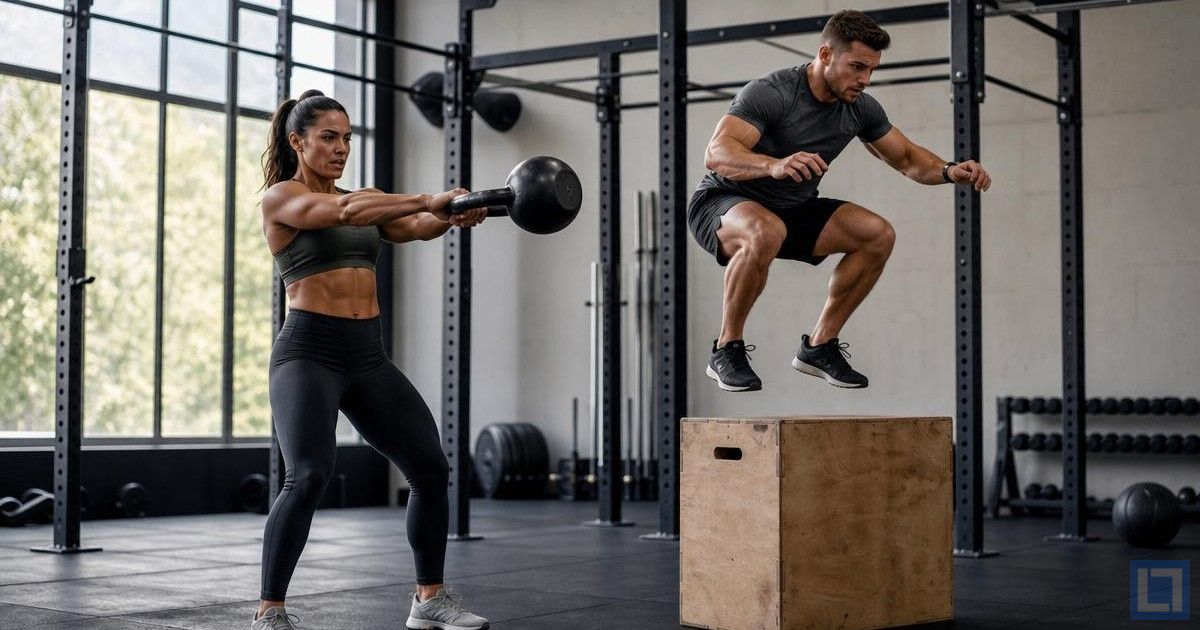
A strong core is the foundation under every movement you make, both in the gym and outside it. The best kettlebell core workouts deliver that strength better than most other tools because the kettlebell’s offset load forces your core to stabilize on every rep, even during exercises that look like they target other muscles.
Below are ten effective kettlebell core exercises ranging from rotational drills like the Russian twist to loaded carries that hit anti-flexion stability. If you are newer to kettlebell training, our beginner kettlebell workouts guide is a good starting point before tackling the advanced moves below. For a complete equipment library, browse our full kettlebell workouts collection.
Kettlebell Advanced Windmill

The Kettlebell Advanced Windmill is a progression of the standard windmill, often performed with a kettlebell balanced bottoms-up overhead, or with two kettlebells. The bottoms-up grip demands intense shoulder stability through the windmill movement, building elite-level core control alongside it.
Windmills are unique in that they hit the obliques, the hip mobility complex, and shoulder stability all in one drill. The advanced version turns the shoulder stability requirement up significantly, which carries over to overhead pressing, kettlebell sport, and any movement where the shoulder needs to lock in under load.
This is not a starter movement. Get comfortable with the regular windmill first. Move slow, keep the eyes on the bell, and end the set the moment your form starts breaking.
Kettlebell Overhead Carry

The Kettlebell Overhead Carry holds a kettlebell locked out overhead in one hand and walks for distance. It builds elite shoulder stability, anti-lateral-flexion core strength, and overhead endurance. Many coaches consider it one of the best single exercises for shoulder health.
The single-arm overhead position creates a constant rotational and lateral pull on the trunk. Your obliques and deep core have to fire continuously to keep you upright, which is exactly the kind of stability the spine actually needs in real life. There is no equivalent benefit from any seated or supine core exercise.
Walk for time or distance, switching arms when the working side fatigues. Keep the elbow locked out hard and the bicep close to the ear. If the shoulder starts wandering forward or backward, drop the bell and reset.
Kettlebell Russian Twist

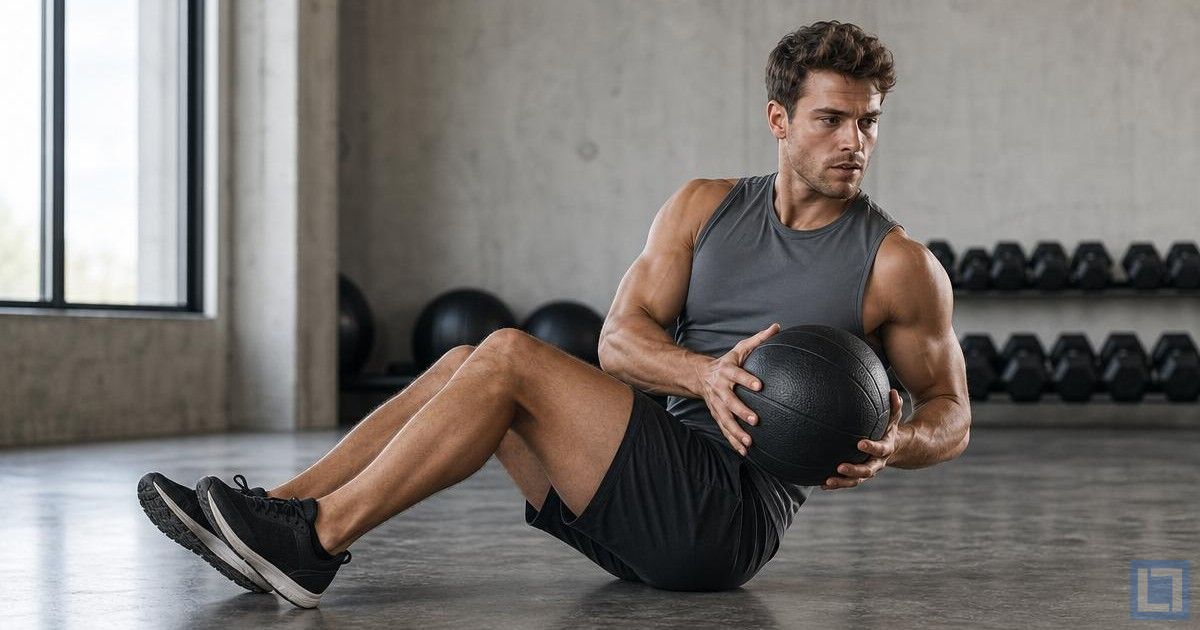
The Kettlebell Russian Twist sits balanced on the tailbone holding a kettlebell at the chest, then rotates the torso side to side, touching the kettlebell to the floor on each side. The added kettlebell load progresses the bodyweight version meaningfully and builds real oblique strength.
Bodyweight Russian twists become an endurance exercise within a few weeks of practice. Loading the rotation pulls the movement back into strength and hypertrophy territory, where actual oblique development happens.
Rotate from the trunk, not from the arms. Move under control rather than swinging the kettlebell across the body. Quality reps build the obliques much faster than speed.
Kettlebell Rotational Deadlift

The Kettlebell Rotational Deadlift combines a single-leg deadlift with a torso rotation. As you stand up from the deadlift, you rotate the kettlebell across your body, building hip drive that links directly into core rotation. It is a strong choice for athletes whose sport demands power transfer through the trunk.
Rotational power is hugely undertrained in most strength programs, and yet it is exactly what throwers, swingers, and combat athletes need. Linking the rotation to a hinge teaches the core to do something it actually has to do in real life: transfer force from the legs through a rotating torso into the upper body.
Start light. The rotation can pull you off balance fast if you bring too much weight too soon. Set up on one leg, hinge to the kettlebell, and rotate through as you stand. Eyes follow the bell across the body.
Kettlebell Angled Press
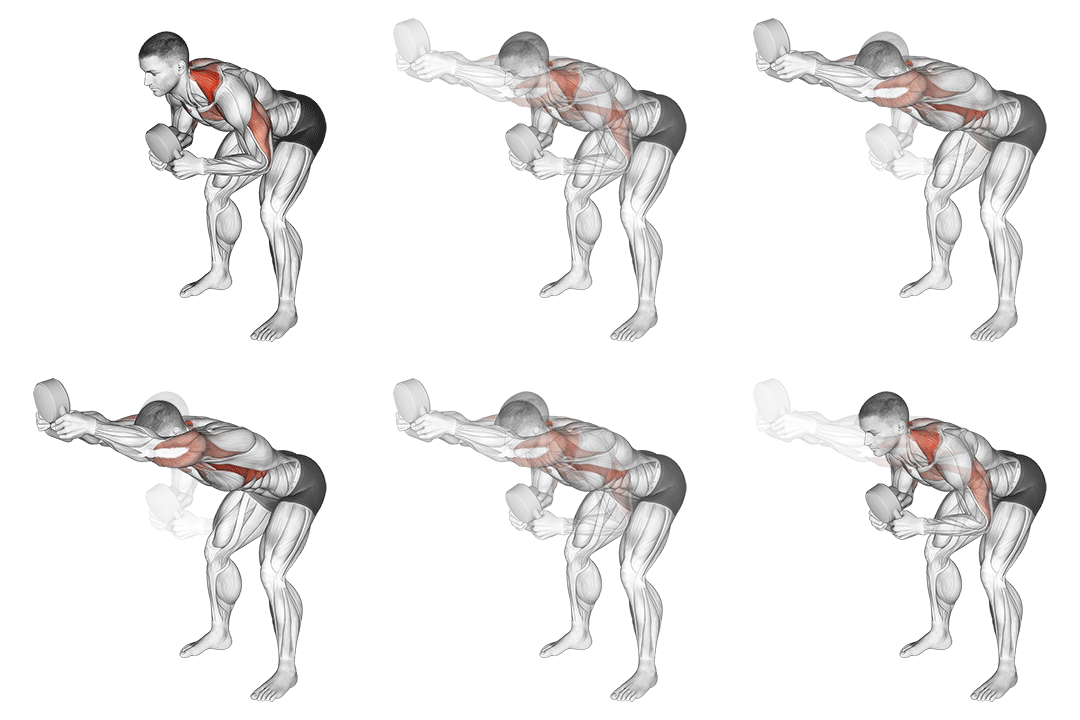
The Kettlebell Angled Press is an overhead variation where you press the bell at a diagonal angle, roughly 45 degrees between a lateral raise and a strict overhead press. The unique angle targets the shoulder differently than a vertical press while also forcing the core to stabilize against the off-axis load.
Standard overhead presses have the load travel in line with the shoulder joint. Angled presses introduce a sideways force the trunk has to resist. That extra demand makes the angled press a smart inclusion in any core-focused kettlebell workout.
Stand tall with the working-side hip braced. Press at a clean diagonal without letting the trunk lean to compensate. If your obliques have to bend to lock out, the load is too heavy.
Kettlebell Goblet Carry
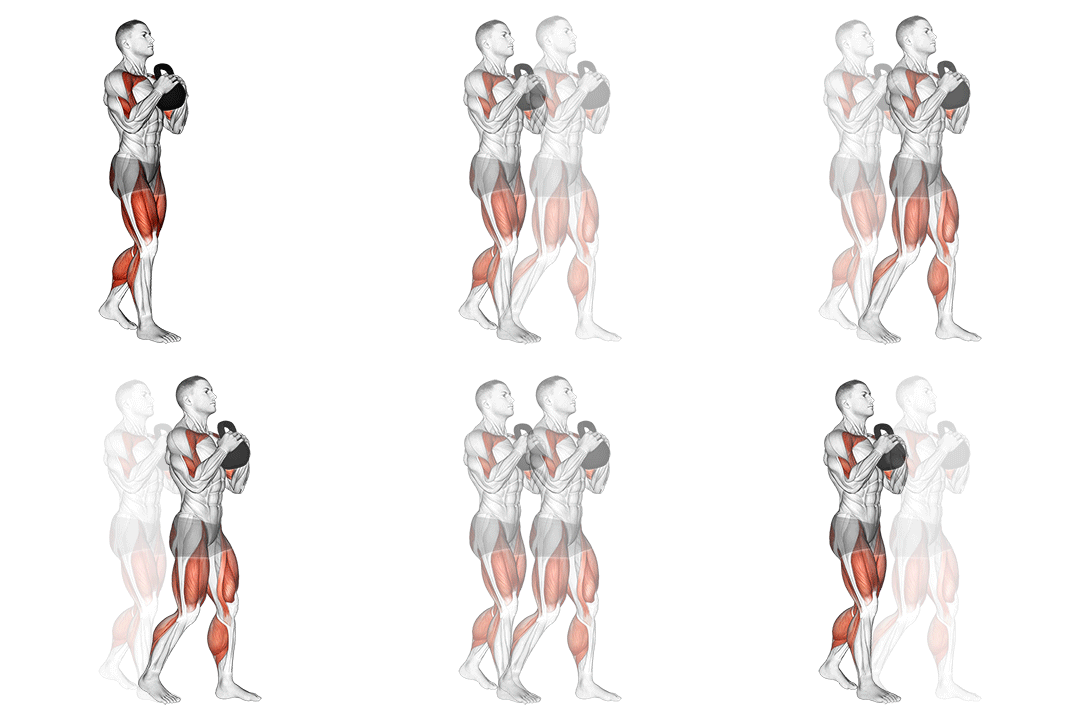
The Kettlebell Goblet Carry holds a kettlebell at chest height, goblet style, while walking for distance or time. The chest-loaded position challenges the upper back, anti-flexion core stability, and grip endurance simultaneously. It is one of the most underrated full-body conditioning exercises in the kettlebell library.
Goblet carries train the core to resist trunk flexion under load while you move. That is an extremely useful piece of core function that planks and crunches do not develop, because both of those are static. Real life and most sports involve carrying things while moving, and the goblet carry teaches exactly that.
Hold the bell tight against the chest with the elbows tucked. Walk with normal posture: tall spine, ribs down, eyes forward. End the set when your grip gives out or your form starts to drift.
Kettlebell Dead Bug

The Kettlebell Dead Bug adds external load to the standard dead bug by holding a kettlebell locked out overhead. The weight pulls the arms toward the floor, creating much greater anti-extension demand on the core throughout each rep.
Dead bugs are one of the smartest core exercises out there because they train the abs to do their actual job: prevent unwanted spinal extension. Adding a kettlebell forces the core to work harder to keep the lower back pressed flat against the floor as you alternate leg extensions.
Keep the kettlebell directly over the shoulders the entire time. If the lower back starts arching off the floor, lighten the load or shorten the leg extension until you can hold the position throughout the set.
Kettlebell Standing Slingshots

The Kettlebell Standing Slingshots, also called body passes or halos, pass a kettlebell around the body in a horizontal circle. Holding the kettlebell in front, you swing it around behind your back and return it to the front in a continuous circular motion.
The exercise trains shoulder mobility, core stability, and grip endurance at the same time. The core fires constantly to resist getting pulled in the direction of the moving load, which is a more realistic core demand than a static plank delivers.
Use slingshots as a warm-up, between heavier sets, or as a finisher. Pass the kettlebell smoothly without letting it dictate your stance. Hips and shoulders stay square through the entire circle.
Kettlebell Double Windmill

The Kettlebell Double Windmill holds one kettlebell locked out overhead and another in the free hand, then performs the windmill: hinging laterally and lowering the bottom kettlebell toward the floor. The added bottom kettlebell increases the total load and core demand significantly compared to the standard version.
The double windmill is one of the most demanding lateral-flexion-resisted core movements in any training system. The combination of the overhead lockout and the hinged lateral load creates a level of integrated core, hip, and shoulder demand that very few exercises match.
This is an advanced movement that should only be attempted after the standard windmill is comfortable with appropriate weight. Keep both arms in a vertical line through the trunk at every point in the rep.
Kettlebell Side Plank

The Kettlebell Side Plank holds a side plank position while pressing a kettlebell overhead with the top arm. The combination of the side-plank isometric and the loaded overhead hold builds elite-level core strength, shoulder stability, and total-body control in one position.
Standard side planks train anti-lateral-flexion isometrically. Adding a pressed kettlebell forces the obliques to brace harder while the shoulder stabilizes a load overhead. It is a strong drill for closing weak links between the core and the shoulder, which often show up in rotational sports and overhead athletics.
Build up to this gradually. Master the unloaded side plank for time first, then add a kettlebell at chest height before progressing to the overhead press. Hold for time, switch sides, and stop the set the moment the hip starts dropping.
How To Program These Workouts
You do not need all ten in a single session. Pick three to four exercises and rotate them at the end of your strength training, or run them as a standalone core circuit two or three times a week.
A useful split is one rotational/oblique drill (Russian twist, slingshots, or rotational deadlift), one anti-extension or anti-flexion movement (dead bug, goblet carry), and one stability piece (windmill, side plank, or overhead carry). That covers all three core functions in one short session.
If your goal is loaded ab work specifically rather than total core strength, our best kettlebell ab workouts guide has direct loaders like weighted sit-ups and lying leg raises.
Final Thoughts
The best kettlebell core workouts go far beyond crunches. The kettlebell’s offset load and the wide range of carries, windmills, and rotational drills it allows train the core through every function it actually has to perform: anti-extension, anti-flexion, anti-rotation, and rotational power.
Start with the simpler movements like dead bugs, Russian twists, and slingshots. Build up to the windmills, overhead carries, and side planks as your stability and shoulder control improve. Consistency over weeks and months delivers far more than any single workout.
Frequently Asked Questions
How heavy should my kettlebell be for core workouts?
It depends on the exercise. Direct ab loaders like Russian twists and dead bugs can use moderate weights, while windmills and overhead carries demand much lighter loads because shoulder stability becomes the limiter. Most lifters do well starting with 12 to 25 pounds for direct loaders and 8 to 16 pounds for overhead-loaded movements.
How often can I train my core with kettlebells?
Two to four sessions per week is a solid range. The core recovers relatively quickly compared to larger muscle groups, but heavy loaded core work still benefits from rest days. Spreading the load across the week rather than hammering it every day produces better long-term results.
Are kettlebell core exercises better than crunches?
For total core function, yes. Crunches train one movement (trunk flexion) and miss most of what the core actually does. Loaded kettlebell work covers anti-extension, anti-rotation, anti-lateral-flexion, and rotational power, which is the full job description for the muscles around your spine.
Can beginners do these exercises?
Some of them. The Russian twist, dead bug, slingshots, and goblet carry are beginner-friendly with light loads. Save the windmills, overhead carries, side planks, and rotational deadlifts until you have built a foundation of basic core strength and kettlebell handling first.
Will these exercises give me visible abs?
Loaded core work like the exercises above will absolutely thicken and strengthen the rectus abdominis and obliques, which makes them more visible at any body fat level. Whether they actually show through depends on your overall body composition, which is driven primarily by nutrition.