Five-minute ab workouts are one of the most underrated training tools that exist. Unlike longer ab routines that often turn into endurance grinds, the 5-minute format forces high intensity in every rep because the total work time is short. Done daily or near-daily, a focused 5-minute routine produces meaningful core strength and visible ab development in 8 to 12 weeks.
Below are ten effective bodyweight ab exercises that work especially well in fast, intense formats. Together they cover trunk flexion, rotation, lateral stability, and lower-ab work, which means a 5-minute circuit drawn from this list can hit the entire abdominal wall in a single short session.
Mountain Climber

The Mountain Climber starts in a push-up position and rapidly drives the knees toward the chest in alternating fashion. The continuous movement combines core engagement with cardiovascular demand, which makes it one of the most efficient ab exercises in any short-format workout.
For 5-minute workouts, mountain climbers earn their place by hitting the abs and elevating the heart rate simultaneously. Most other ab exercises only address one or the other; mountain climbers cover both, which makes them ideal as a fast workout finisher or as the high-intensity portion of a circuit.
Set up in a push-up position with arms straight and body in a straight line. Drive one knee toward the chest, then quickly switch and drive the other knee forward. Maintain a strong core position; do not let the hips pike up. Continue for 30 to 60 seconds at a fast tempo.
Bicycle Twisting Crunch

The Bicycle Twisting Crunch lies on the back and alternates bringing the opposite elbow toward the opposite knee in a bicycling motion. The combination of trunk flexion and rotation hits both the abs and the obliques in one movement.
For fast ab circuits, the bicycle twist is the most efficient single exercise that exists. It hits more ab muscle fibers per second than any other bodyweight ab exercise, which makes it a centerpiece of any 5-minute ab workout. Run it for 45 to 60 seconds at a controlled tempo.
Lie flat on the back with hands behind the head. Bring one knee toward the chest while rotating the trunk to bring the opposite elbow toward that knee. Switch sides in a continuous bicycling motion. Avoid pulling on the neck; the rotation comes from the trunk.
V-Up Double Crunch

The V-Up Double Crunch lies flat on the back and simultaneously lifts the legs and torso to meet in a V position over the midsection. The dual flexion (upper and lower abs working together) hits the entire abdominal wall in one movement.
V-ups are one of the most demanding bodyweight ab exercises that exists because they force both upper and lower abs to work simultaneously. For 5-minute workouts, even short sets of v-ups (20 to 30 seconds) produce strong fatigue. Pair them with easier exercises in alternation for a balanced fast workout.
Lie flat on the back with arms extended overhead. Simultaneously lift the legs and torso, reaching the hands toward the feet at the top of the rep. Lower under control to a fully extended position. Move smoothly; the difficulty is the simultaneous upper and lower flexion, not speed.
Ab Tuck

The Ab Tuck sits on the floor leaning back slightly with feet lifted, then alternates extending the legs straight out and tucking the knees back to the chest. The continuous tucking motion hits the lower abs and hip flexors directly.
Lower-ab work is often skipped in favor of crunches and planks, but the lower abs need direct training. The ab tuck is one of the most efficient lower-ab exercises for 5-minute workouts because it hits the muscles continuously rather than in isolated reps. Run it for 30 to 60 seconds.
Sit on the floor with hands behind for support and feet lifted off the ground. Lean back slightly to engage the abs. Extend both legs straight out, then tuck the knees back toward the chest. Continue alternating between extension and tuck without letting the feet touch the floor.
Bear Plank Kickback

The Bear Plank Kickback starts in a bear plank position (hands and knees with knees lifted slightly off the floor), then kicks one leg back and up while maintaining the plank. The combination hits the abs, glutes, and shoulders simultaneously.
Combination movements like the bear plank kickback earn a place in 5-minute workouts because they hit multiple muscle groups efficiently. The bear plank loads the abs and shoulders; the kickback adds glute work. The total effect produces more total-body fatigue per second than isolated ab exercises.
Set up in a bear plank with hands directly under shoulders, knees bent at 90 degrees and hovering just off the floor. Kick one leg straight back and up, squeezing the glute at the top. Return to the bear plank. Alternate sides on each rep.
Jack Split Crunches

The Jack Split Crunches lie on the back and perform a crunch while simultaneously splitting and closing the legs in a jumping-jack motion. The combined motion hits the abs through trunk flexion and adds inner thigh work through the leg movement.
For high-intensity ab work in short formats, jack split crunches deliver continuous demand because the legs and trunk both move on every rep. The dynamic motion drives heart rate up alongside the abdominal work, which fits the high-intensity goal of 5-minute formats.
Lie flat on the back with legs extended together and hands behind the head. Crunch up while simultaneously splitting the legs apart. Lower while bringing the legs back together. Continue for 30 to 45 seconds at a steady tempo.
Flutter Kicks

The Flutter Kicks lie on the back with legs extended and rapidly flutter the legs up and down in alternating fashion. The continuous lower-leg movement hits the lower abs and hip flexors continuously throughout the set.
Flutter kicks are one of the most underrated lower-ab exercises in any program. The continuous tension on the lower abs (no rest between reps) produces stronger growth in this often-neglected area than isolated leg raise variations. Run them for 30 to 60 seconds at a moderate pace.
Lie flat on the back with legs extended and hands at the sides or under the glutes for support. Lift the legs slightly off the floor and rapidly flutter them up and down in small alternating motions. Keep the lower back flat against the floor throughout.
Side Plank II
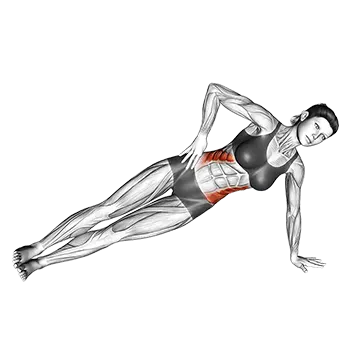
The Side Plank holds a side plank position on one forearm with the body in a straight line from head to feet. The lateral plank position loads the obliques and lateral core stabilizers isometrically.
For 5-minute workouts, side planks earn their place as the static finisher that locks in the rotational core work. Most ab exercises focus on flexion (crunches) or rotation (twists); side planks address the lateral plane that the other patterns miss. Hold for 20 to 30 seconds per side.
Set up on one forearm with the elbow directly under the shoulder. Stack the feet or drop the bottom knee for support. Hold the body in a straight line from head to feet. Hold for 20 to 30 seconds, then switch sides.
Russian Twist

The Russian Twist sits on the floor with knees bent and feet lifted, then twists side to side, touching the floor on each side. The rotational motion under bodyweight load hits the obliques and rotational core stabilizers.
Most ab work emphasizes trunk flexion and ignores rotation. The Russian twist fills that gap in 5-minute workouts with a fast, dynamic exercise that hits the obliques directly. The seated position with feet lifted increases the difficulty significantly compared to standing rotational variations.
Sit on the floor with knees bent and heels lifted slightly off the ground. Lean back to engage the abs. Touch the floor on alternating sides by rotating the trunk. Keep the feet stable; only the upper body rotates.
Reverse Crunch

The Reverse Crunch lies flat on the back and lifts the hips off the floor by drawing the knees up toward the chest. The motion hits the lower abs through hip flexion rather than the upper-ab dominant trunk flexion of standard crunches.
Direct lower-ab work is one of the most under-programmed elements in most ab routines. The reverse crunch addresses this directly with a clean hip-flexion pattern that targets the lower abs while leaving the upper abs relatively unloaded. Run it for 30 to 45 seconds as a finisher to balance upper-ab heavy workouts.
Lie flat on the back with hands at the sides for support. Bring the knees up to roughly 90 degrees. Lift the hips off the floor by drawing the knees toward the chest. Lower under control without letting the lower back arch.
How To Program These Workouts
A productive 5-minute ab session pulls four to six exercises from the list above and runs them as a circuit with minimal rest. A typical structure: 45 seconds of work, 15 seconds rest, repeat for 5 cycles. Choose one rotational exercise (Russian twist or bicycle crunch), one lower-ab exercise (ab tuck or reverse crunch), one full-body cardio piece (mountain climber or jack split crunch), and one isometric finisher (side plank).
Train abs daily or near-daily. Unlike larger muscle groups that need recovery between sessions, the abs respond well to high-frequency training because the loads are bodyweight-only and the volume per session stays moderate. The 5-minute format makes daily practice realistic; most lifters stick with daily 5-minute sessions where they would skip 30-minute ab routines.
For longer ab programming, see our best 10 minute ab workouts and best lower ab workouts. For broader core training, see our best standing ab workouts.
Final Thoughts
The best 5 minute ab workouts produce real core development through consistent daily practice. The short format makes the habit stick, the high intensity drives strong adaptations, and the variety of exercises covers every major ab function. For lifters who struggle to fit longer ab sessions into busy schedules, the 5-minute approach is the most realistic path to visible core development.
Stay consistent. Five minutes per day for 12 weeks produces stronger results than a one-hour ab session done occasionally. The body adapts to consistent stimulus over time; the lifters who get visible abs are the ones who treat daily ab training as a habit rather than as an occasional add-on. Pair the training with appropriate nutrition (visible abs require low body fat) and the results follow.
Frequently Asked Questions
Are 5 minute ab workouts effective?
Yes, when done with high intensity and consistent frequency. The short format actually drives stronger adaptations per minute than longer endurance-style ab work because the intensity stays high throughout. Daily 5-minute sessions produce more total weekly stimulus than once-per-week 30-minute ab sessions, which means faster development.
How often should I do 5 minute ab workouts?
Daily or near-daily works well for most lifters. The abs recover quickly because bodyweight loading is moderate. Five sessions per week (Monday through Friday with weekends off) is a typical sustainable pattern; daily training also works for advanced lifters who maintain consistent intensity.
Can I get visible abs from 5 minute workouts alone?
Visible abs require both ab development and low body fat. The ab workouts build the muscle; nutrition reveals it. Most lifters need to be at roughly 10 to 12 percent body fat (men) or 18 to 22 percent (women) for abs to show clearly. The 5-minute workouts handle the muscle-building side; diet handles the body fat side.
How long until I see results from 5 minute ab workouts?
Most lifters see noticeable strength improvements within 4 to 6 weeks of consistent daily practice. Visible muscle development takes 8 to 12 weeks for most beginners with appropriate nutrition. Major changes (highly defined abs) take 6 to 12 months of consistent training combined with sustained low body fat.
What’s the best 5 minute ab exercise?
The bicycle twisting crunch is the most efficient single ab exercise for short workouts. It hits the abs and obliques simultaneously through trunk flexion and rotation, which means more muscle fibers worked per rep than any other bodyweight ab exercise. If only one exercise had to fit into a daily 5-minute routine, this would be it.