Bodyweight ab training produces real core development through equipment-free exercises that hit every major core muscle and movement pattern. The format works particularly well for ab training because the rectus abdominis, obliques, and deep core stabilizers respond strongly to bodyweight loading combined with controlled tempo and progressive volume. Most bodyweight ab exercises are highly accessible (no equipment, low injury risk, scalable difficulty), which means lifters can train consistently across any setting from home to travel to outdoor practice. Most lifters who consistently train bodyweight abs 3 to 5 times per week see measurable core strength and visible ab development within 6 to 10 weeks combined with appropriate body fat management for visible abs.
Below are ten effective bodyweight ab exercises that cover oblique training (incline side plank, standing oblique twist, windmill), combined leg-and-oblique work (wood chop squat), sustained core (boat yoga pose), combined upper-and-lower ab loading (opposite crunch, ab tuck, seated alternate crunch), combined core and glute work (bear plank kickback), and cardio-combined ab work (jack split crunches). Together they form a complete bodyweight ab training program. A 15 to 25-minute session pulled from this list produces strong combined core development across every major ab function.
Bodyweight Incline Side Plank
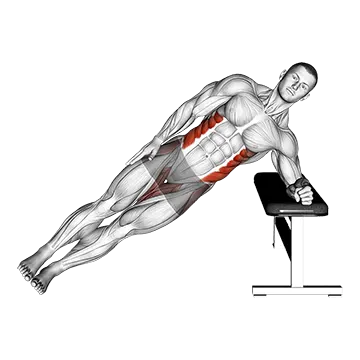
The Bodyweight Incline Side Plank performs a side plank with the upper body elevated on a bench or platform. The incline position reduces the difficulty compared to standard side planks while still producing strong oblique loading.
For bodyweight ab training, the incline side plank works as the foundational accessible oblique exercise. The pattern hits the obliques through isometric loading at adjustable difficulty. Run it for 3 sets of 30 to 60-second holds per side as introductory or accessible oblique work.
Place the forearm on an elevated surface (bench, box, or sturdy platform). Stack the feet on the floor with the body in a straight line from head to heels. Engage the obliques to maintain the position. Hold while breathing normally. Switch sides between sets.
Bodyweight Standing Oblique Twist

The Bodyweight Standing Oblique Twist stands with feet hip-width and rotates the trunk side-to-side while bringing the elbow toward the opposite knee. The pattern produces sustained oblique loading through dynamic rotation.
For bodyweight ab training, the standing oblique twist provides accessible oblique work that fits into any setting. The pattern hits the obliques through repetitive rotation. Run it for 3 sets of 16 to 24 total reps as oblique conditioning work.
Stand tall with feet hip-width and hands behind the head. Rotate the trunk to one side while bringing the elbow toward the opposite knee (lifting the knee up to meet the elbow). Reverse to the opposite side. Continue alternating in a steady tempo throughout the set.
Bodyweight Windmill

The Bodyweight Windmill stands with feet wide and reaches one hand toward the opposite foot while keeping the other arm extended overhead. The pattern produces strong oblique stretching combined with rotational loading.
For bodyweight ab training, the windmill produces combined oblique work and lateral mobility. The pattern hits the obliques while improving lateral hip flexibility. Run it for 3 sets of 8 to 10 reps per side as combined oblique and mobility work.
Stand with feet significantly wider than shoulder-width and toes pointed slightly out. Extend one arm straight up overhead. Hinge at the hip toward the opposite side, reaching the lower hand toward the same-side foot while keeping the eyes on the upper hand. Drive back to standing. Switch sides between sets.
Bodyweight Wood Chop Squat

The Bodyweight Wood Chop Squat combines a squat motion with a diagonal wood chop motion of the arms. The pattern produces combined leg and oblique loading per rep through the cross-body motion.
For bodyweight ab training, the wood chop squat is one of the most efficient combined exercises that exists. The pattern hits the obliques through rotation while the squat adds leg loading. Run it for 3 sets of 10 to 12 reps per side as combined leg and oblique work.
Stand with feet shoulder-width and hands clasped together at one shoulder. Squat down by sitting the hips back while simultaneously chopping the hands diagonally across the body to the opposite hip. Drive back to standing while reversing the chop back to the starting shoulder. Switch sides between sets.
Boat Yoga Pose
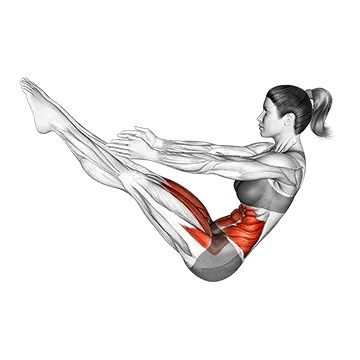
The Boat Yoga Pose sits on the floor and balances on the sit bones with the legs extended forward at a 45-degree angle and arms reaching forward parallel to the floor. The pattern produces strong sustained core demand through the balance position.
For bodyweight ab training, the boat pose is foundational sustained core work. The pattern hits the entire core through static loading that builds deep core strength. Run it for 3 sets of 30 to 60-second holds as foundational static core work.
Sit on the floor with knees bent and feet planted. Lean the upper body back slightly while lifting the legs to extend them forward at a 45-degree angle. Reach the arms forward parallel to the floor. The body forms a V shape balancing on the sit bones. Hold the position while breathing normally.
Opposite Crunch

The Opposite Crunch lies on the back and crunches up while reaching one hand toward the opposite knee, alternating sides on each rep. The contralateral motion hits both the upper abs and obliques.
For bodyweight ab training, the opposite crunch produces strong combined ab and oblique loading. The cross-body motion adds rotational demand that standard crunches lack. Run it for 3 sets of 12 to 15 reps per side as combined ab and oblique work.
Lie flat on the back with knees bent and feet planted. Hands placed behind the head. Crunch the trunk up while reaching one hand toward the opposite knee. Lower under control. Alternate sides on each rep, continuing in a smooth tempo throughout the set.
Ab Tuck

The Ab Tuck sits with the upper body leaned back and the legs extended forward, then tucks the knees toward the chest while pulling the upper body forward. The pattern produces strong combined upper and lower ab loading per rep.
For bodyweight ab training, the ab tuck is one of the most efficient combined ab exercises that exists. The simultaneous tuck-and-crunch motion hits the entire rectus abdominis. Run it for 3 sets of 10 to 15 reps as combined ab work.
Sit on the floor with legs extended and feet lifted slightly off the ground. Lean the upper body back to roughly 45 degrees. Pull the knees toward the chest while crunching the upper body forward. Reverse the motion to extend the legs back out. Continue in a controlled tempo throughout the set.
Bear Plank Kickback

The Bear Plank Kickback sets up in a bear plank position (hands and feet on the floor with knees hovering) and alternates kicking each leg back and up. The pattern combines plank stability with dynamic glute and lower-back loading.
For bodyweight ab training, the bear plank kickback combines core stability with posterior-chain loading. The pattern hits the abs through plank stability while the kickback adds glute activation. Run it for 3 sets of 8 to 12 reps per side as combined core and glute work.
Set up on hands and feet with knees bent and hovering 2 to 3 inches off the floor. Kick one leg straight back and up while maintaining the bear plank position with the other leg. Lower the leg under control. Switch sides on each rep.
Seated Alternate Crunch

The Seated Alternate Crunch sits with the upper body leaned back and alternates pulling each knee toward the chest while crunching the trunk forward. The pattern produces strong combined upper and lower ab loading.
For bodyweight ab training, the seated alternate crunch produces strong combined upper and lower ab loading through the alternating tuck motion. Run it for 3 sets of 10 to 15 reps per side as combined ab work.
Sit on the floor with legs extended and feet lifted slightly off the ground. Lean the upper body back to roughly 45 degrees with hands placed behind the head. Pull one knee toward the chest while crunching the upper body forward. Extend the leg back out. Switch sides on each rep in a controlled tempo.
Jack Split Crunches

The Jack Split Crunches lies on the back and performs crunch motion while jumping the legs apart and back together in a jumping jack pattern. The combined motion produces strong ab loading combined with cardiovascular demand.
For bodyweight ab training, the jack split crunches combine ab work with cardiovascular demand. The leg motion adds heart rate elevation while the crunch provides ab loading. Run it for 3 sets of 30 to 45-second intervals as combined ab and cardio work.
Lie flat on the back with legs extended and arms at the sides. Jump the legs apart while crunching the upper body up. Lower under control while jumping the legs back together. Continue alternating in a smooth tempo throughout the work interval.
How To Program These Workouts
A productive bodyweight ab session pulls 6 to 8 exercises from the list above. A balanced session includes one static core exercise (boat yoga pose), one combined upper-and-lower ab exercise (ab tuck or seated alternate crunch), one oblique exercise (incline side plank or standing oblique twist), one rotational exercise (windmill or wood chop squat), one cross-body crunch (opposite crunch), and one cardio-combined exercise (jack split crunches or bear plank kickback). Run isometric holds for 3 sets of 30 to 60 seconds; bodyweight reps for 3 sets of 10 to 15 reps; cardio-combined work for 3 sets of 30 to 45-second intervals. Total session covers 12 to 18 working sets.
Train bodyweight ab sessions 3 to 5 times per week with at least one rest day per week for full recovery. The format produces moderate core fatigue that recovers within 24 to 48 hours, which sustains higher training frequency than heavier weighted ab work. Most successful programs include 4 weekly bodyweight ab sessions of 15 to 25 minutes each. The format works particularly well as morning routines, post-workout finishers, or evening practice that builds the consistent training habit which drives long-term ab development.
For broader ab programming, see our best at home core workouts and best calisthenics ab workouts. For specific ab specializations, see our best lower ab workouts.
Final Thoughts
The best bodyweight ab workouts deliver real core development through equipment-free exercises that hit every major core muscle and movement pattern. The combination of static core work, combined ab loading, oblique training, rotational exercises, and cardio-combined ab work covers every major core function and produces broader development than single-modality ab training. For lifters who want effective core training without equipment, want sustainable ab practice that fits any setting, or prefer bodyweight training as a primary modality, dedicated bodyweight ab training is one of the most accessible and effective options available.
Stay focused on form quality over rep count. The most common bodyweight ab training mistake is rushing through reps to hit higher numbers, which compromises form and reduces the training stimulus that drives ab development. The fix: prioritize controlled tempo (2 to 3 seconds up, 2 to 3 seconds down) on every rep, with strict form throughout the working range. Quality reps with strict form produce stronger ab development than higher rep counts with rushed execution. The abs respond to time-under-tension as much as rep count, which makes tempo control critical for development.
Frequently Asked Questions
Can bodyweight workouts give me a six-pack?
Bodyweight ab training builds the muscle that gives the stomach its visible shape; reducing body fat through nutrition reveals that shape. Both are required for visible six-pack abs. Most lifters need to be at 12 to 18 percent body fat for abs to show clearly. Bodyweight ab training handles the muscle-building side; sustainable nutrition handles the body fat side. The combination produces visible six-pack results over 12 to 24 weeks for most lifters with appropriate caloric management.
How often should I train abs with bodyweight?
Three to five times per week works for most lifters. The format produces moderate core fatigue that recovers within 24 to 48 hours, which sustains higher training frequency than heavier weighted ab work. Most successful programs include 4 weekly bodyweight ab sessions of 15 to 25 minutes each. Pure daily training (7 sessions per week) typically benefits from at least one rest day for sustained long-term practice.
How long should bodyweight ab workouts be?
Fifteen to twenty-five minutes per session works for most lifters. The 20-minute format hits the sweet spot between meaningful training stimulus and sustainable recovery. Most successful programs include 4 weekly sessions of 15 to 20 minutes each. Shorter sessions (5 to 10 minutes) work well for daily practice; longer sessions (30+ minutes) typically produce accumulated fatigue without proportional benefit.
Are bodyweight or weighted abs better?
Different exercises serve different goals. Bodyweight ab training produces strong core endurance, deep stabilizer development, and accessible daily training. Weighted ab training produces stronger ab muscle thickness through progressive overload that bodyweight cannot match. Most successful programs include both: bodyweight ab work for higher-frequency core development and weighted ab work (1 to 2 sessions per week) for additional muscle thickness.
Do I need any equipment for bodyweight abs?
No, the format works entirely without equipment. All ten exercises in this list use only bodyweight loading. The format works in any setting (home, hotel room, park, beach) and requires only enough open floor space for a single person to move freely. Adding minimal equipment (a yoga mat for floor exercises) can improve comfort but isn’t required for effective practice.