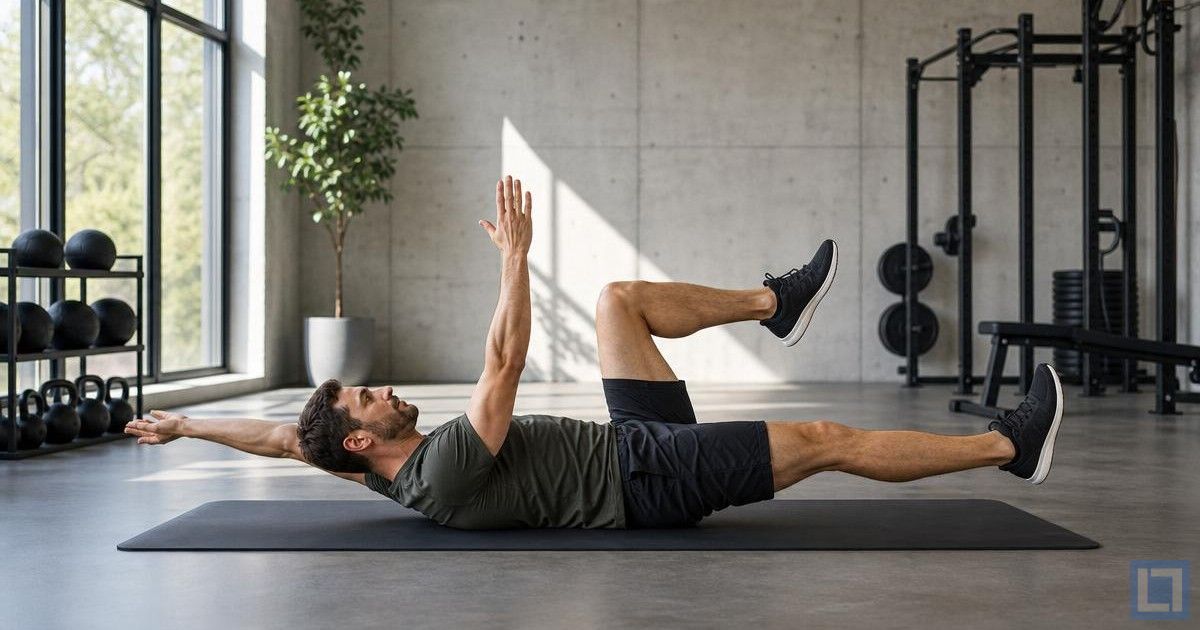
The dead bug is one of the most effective core exercises that exists for building anti-extension trunk stability. The supine position with extended limbs trains the abs to brace against opposing limb motion while keeping the lower back flat against the floor. This is the same trunk stability function that protects the spine during heavier lifts (squats, deadlifts, overhead presses), which makes dead bug training one of the most transferable core exercises for lifters who want to support heavier compound work.
Below are ten effective dead bug variations and the closely-related bird dog. Together they cover the foundational bodyweight dead bug, loaded variations with dumbbells, kettlebells, and medicine balls, advanced hanging and banded versions, and the supplemental bird dog pattern. A complete dead bug program produces strong functional core stability with progressive variations that scale across all training levels.
Dead Bug

The Dead Bug lies on the back with arms extended toward the ceiling and knees bent at 90 degrees, then lowers opposite arm and leg toward the floor while maintaining a flat lower back against the floor. The exercise builds anti-extension core stability through controlled movement.
The standard dead bug is the foundational version of the exercise. The position teaches the abs to brace against opposing limb motion while keeping the lower back flat against the floor, which is the essential trunk stability function that protects the spine during heavier lifts. Build to 3 sets of 10 to 12 reps per side with strict form before progressing to harder variations.
Lie flat on the back with arms extended toward the ceiling and knees bent at 90 degrees over the hips. Slowly lower the opposite arm and leg toward the floor (right arm and left leg, or vice versa) while keeping the lower back flat against the floor. Return to the starting position and switch sides.
Weighted Dead Bug

The Weighted Dead Bug performs the standard dead bug pattern while holding light dumbbells in the hands. The added load increases the demand on the abs throughout the movement and produces stronger anti-extension stimulus than bodyweight versions.
For lifters who have outgrown the bodyweight dead bug, the weighted version is the next major progression. Light dumbbells (5 to 10 pounds per hand) significantly increase the loading without compromising the movement quality. Run it for 3 sets of 8 to 10 reps per side with strict form.
Lie flat on the back with arms extended toward the ceiling holding light dumbbells, knees bent at 90 degrees over the hips. Slowly lower the opposite arm and leg toward the floor while keeping the lower back flat. Return to the starting position and switch sides.
Kettlebell Dead Bug

The Kettlebell Dead Bug holds a kettlebell with both hands at the chest while performing the dead bug pattern. The asymmetric weight position of the kettlebell creates additional core stability demand compared to dumbbells.
Kettlebell dead bugs add a unique stability challenge because the kettlebell handle position shifts the load away from the body axis. The increased instability forces stronger core engagement throughout the movement, which produces stronger results per rep than equivalent loaded dead bugs with symmetric weights. Run it for 3 sets of 8 to 10 reps per side.
Lie flat on the back with knees bent at 90 degrees over the hips. Hold a kettlebell with both hands at the chest level. Slowly lower one leg toward the floor while keeping the kettlebell stable and the lower back flat. Return to the starting position and switch legs.
Dead Bug With Stability Ball

The Dead Bug with Stability Ball holds a stability ball pinned between the hands and knees, then performs the dead bug pattern by extending one arm and the opposite leg while maintaining ball contact. The pressure required to keep the ball pinned produces continuous core engagement.
The stability ball version adds isometric core demand on top of the dynamic dead bug pattern. The ball must be pressed actively to maintain contact, which forces continuous abdominal contraction throughout the entire set. Run it for 3 sets of 8 to 10 reps per side.
Lie flat on the back with knees bent at 90 degrees over the hips. Hold a stability ball pinned between the hands and the knees, pressing actively to maintain contact. Extend one arm and the opposite leg straight out (using the diagonal pattern) while keeping the ball pinned with the other arm and knee. Return and switch sides.
Dead Bug With Medicine Ball

The Dead Bug with Medicine Ball holds a medicine ball at the chest with both hands and performs the dead bug pattern. The added weight intensifies the anti-extension demand on the abs throughout the movement.
Medicine ball dead bugs are similar to weighted dead bugs but with the load held centered at the chest rather than out at the arms. The center-of-mass loading produces slightly different muscle recruitment than weighted variations and is one of the most accessible loaded dead bug options. Run it for 3 sets of 8 to 10 reps per side.
Lie flat on the back with knees bent at 90 degrees over the hips. Hold a medicine ball at the chest with both hands. Slowly lower one leg toward the floor while keeping the medicine ball stable at the chest and the lower back flat. Return to the starting position and switch legs.
Hanging Deadbug

The Hanging Deadbug hangs from a pull-up bar and performs a dead bug-like leg motion while inverted. The hanging position adds significant grip and shoulder demand on top of the standard core work.
For advanced lifters who have mastered the floor-based dead bug variations, the hanging version is one of the most demanding core exercises that exists. The combination of hanging grip strength, shoulder stability, and core control produces total upper-body and core development that few other exercises match. Build to 3 sets of 8 to 10 reps after mastering bodyweight dead bugs.
Hang from a pull-up bar with arms straight. Engage the lats and core. Lift the legs to the dead bug starting position (hips and knees both bent at 90 degrees). Slowly extend one leg straight forward while keeping the other in the bent position. Return and switch legs while maintaining the hanging hold.
Resistance Band Anti Rotation Dead Bug

The Resistance Band Anti Rotation Dead Bug attaches a resistance band to a side anchor and performs the dead bug while resisting the rotational pull of the band. The added rotational force significantly increases the oblique and rotational core demand.
For complete core development, anti-rotation work complements the anti-extension work of standard dead bugs. The band attachment from the side forces the obliques and rotational core stabilizers to engage continuously throughout the dead bug pattern, which produces stronger total core development than unloaded variations.
Anchor a resistance band at hip height to one side of the body. Lie on the back perpendicular to the band, holding the band end in both hands with arms extended. Perform the dead bug pattern while resisting the rotational pull of the band. Switch sides on the next set.
Reverse Crunch to Dead Bug

The Reverse Crunch to Dead Bug combines a reverse crunch (lifting the hips off the floor) with a transition into the dead bug position. The combination hits both the lower abs (through the crunch) and trunk stability (through the dead bug).
Combination exercises like the reverse crunch to dead bug produce more total core stimulus per rep than either exercise alone. The flow between the two positions trains both dynamic core flexion and isometric core stability, which produces stronger functional results. Run it for 3 sets of 10 to 12 reps.
Lie flat on the back. Perform a reverse crunch by lifting the hips off the floor and bringing the knees toward the chest. Lower the hips back to the floor and immediately transition into the dead bug starting position (arms up, knees over hips). Perform one dead bug rep, then return for the next reverse crunch.
Banded Lower Body Dead Bug

The Banded Lower Body Dead Bug attaches a resistance band to the feet (or has the lifter hold the band ends with the band looped under the feet) and performs the dead bug pattern with band resistance on the legs. The added load on the legs intensifies the lower-ab demand significantly.
For lifters who want to overload the lower-body component of the dead bug specifically, the banded variation produces strong stimulus on the lower abs and hip flexors. The band resistance increases as the leg extends, which trains the strongest portion of the movement most heavily. Run it for 3 sets of 8 to 10 reps per side.
Lie flat on the back. Loop a resistance band around the feet with the ends held in the hands. Perform the dead bug pattern, extending one leg straight against the band resistance while keeping the other leg in the bent position. Return and switch legs.
Bird Dog
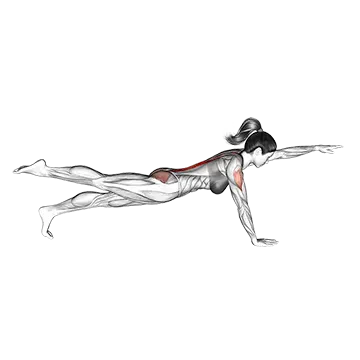
The Bird Dog starts on hands and knees and extends the opposite arm and leg simultaneously while maintaining a stable trunk. The cross-body extension trains anti-rotation core stability along with shoulder and hip control. It is closely related to the dead bug pattern in function.
In dead bug-focused programs, the bird dog complements the dead bug by training the same anti-rotation function from the prone position rather than supine. The two exercises together cover trunk stability across multiple positions, which produces stronger functional core development than either alone.
Start on hands and knees with hands directly under shoulders and knees under hips. Extend one arm forward while extending the opposite leg back, ending with both fully extended in a straight line with the trunk. Hold briefly. Return to the start and switch sides.
How To Program These Workouts
A productive dead bug session pulls four to six exercises from the list above. A balanced session includes the foundational dead bug as the primary exercise, one loaded variation (weighted, kettlebell, or medicine ball dead bug), one anti-rotation variation (band anti-rotation), and the bird dog as a supplemental exercise. Run sets of 8 to 12 reps per side with strict form; the slow controlled tempo is essential.
Train dead bugs three to four times per week. The light loading of most dead bug variations allows high-frequency training, and the trunk stability adaptations build faster with frequent practice than with once-weekly heavy sessions. Most lifters do well with brief 5 to 10-minute dead bug sessions tacked onto regular training days as a warm-up or activation drill.
For broader core programming, see our best standing ab workouts and 5 minute ab workouts. For ab roller and rollout work, see our best ab roller workouts.
Final Thoughts
The best dead bug ab workouts produce real anti-extension trunk stability that transfers directly to heavier compound lifts. The combination of foundational bodyweight work, loaded variations, anti-rotation challenges, and supplemental patterns covers every major function the trunk serves during athletic and lifting activities. For lifters who want stronger lifts and protected lower backs, dead bug training is one of the most useful core training options available.
Stay focused on the lower back position. The most common dead bug mistake is letting the lower back arch off the floor as the limbs lower toward the ground, which defeats the purpose of the exercise. The lower back should stay flat against the floor on every rep; if it cannot, reduce the range of motion until the bracing is solid. Quality dead bugs at limited range produce stronger results than full-range dead bugs with poor form.
Frequently Asked Questions
What does the dead bug exercise do?
Dead bugs train anti-extension trunk stability, which is the core function that prevents the lower back from arching during loaded movements. This is the same trunk stability function that protects the spine during squats, deadlifts, overhead presses, and most other heavy compound lifts. Stronger dead bug performance directly translates to safer, stronger lifts in nearly every other exercise.
How often should I do dead bug exercises?
Three to four times per week works for most lifters. The light loading of most dead bug variations allows high-frequency training, and the trunk stability adaptations build faster with frequent practice. Most lifters do well with brief 5 to 10-minute dead bug sessions tacked onto regular training days as a warm-up or activation drill.
Are dead bugs better than crunches?
Different exercises serve different functions. Crunches train trunk flexion (the rectus abdominis curling forward); dead bugs train anti-extension stability (the core bracing to prevent the back from arching). Both are valuable; complete core programs include both patterns. For lifters whose primary goal is stronger heavy compound lifts, dead bugs typically produce more transferable results than crunches.
Why is my lower back coming off the floor during dead bugs?
Either the abs are not strong enough yet to maintain the bracing position with the current range of motion, or the limbs are extending too far before the abs can resist. The fix is to reduce the range of motion until the lower back stays flat throughout. Build core strength gradually with limited-range reps before extending to full range. Most beginners need 4 to 8 weeks of consistent practice to maintain a flat back through full-range dead bugs.
How long until dead bugs improve my lifts?
Most lifters notice improved core bracing during heavy lifts within 4 to 6 weeks of consistent dead bug training. Visible strength improvements on heavy compound lifts (squat, deadlift, overhead press) typically appear within 8 to 12 weeks. The transfer is particularly strong for lifters who previously had weak core bracing during heavy lifts; lifters with already-strong cores see smaller improvements but still benefit from the additional stability work.