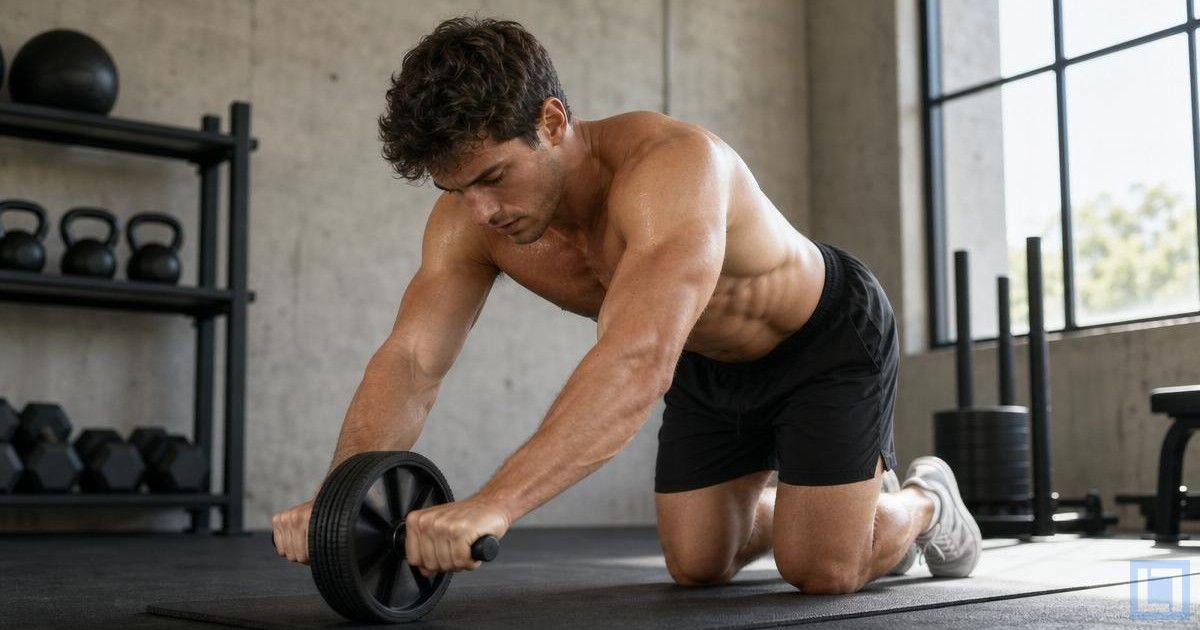
The ab roller (ab wheel) is one of the most efficient pieces of core training equipment that exists. The rollout pattern produces stronger ab loading than nearly any other bodyweight exercise because the muscles must contract maximally to prevent the body from collapsing into spinal extension. The best ab roller workouts use this loading effect to drive serious core development with minimal time investment.
Below are ten effective ab roller and rollout exercises that cover kneeling and standing variations, suspension trainer rollouts, ring rollouts, and supporting exercises that build the core strength to progress through the rollout progressions. Together they form a complete rollout-focused ab training program that fits in 15 to 25 minutes per session.
Ab Roller Crunch
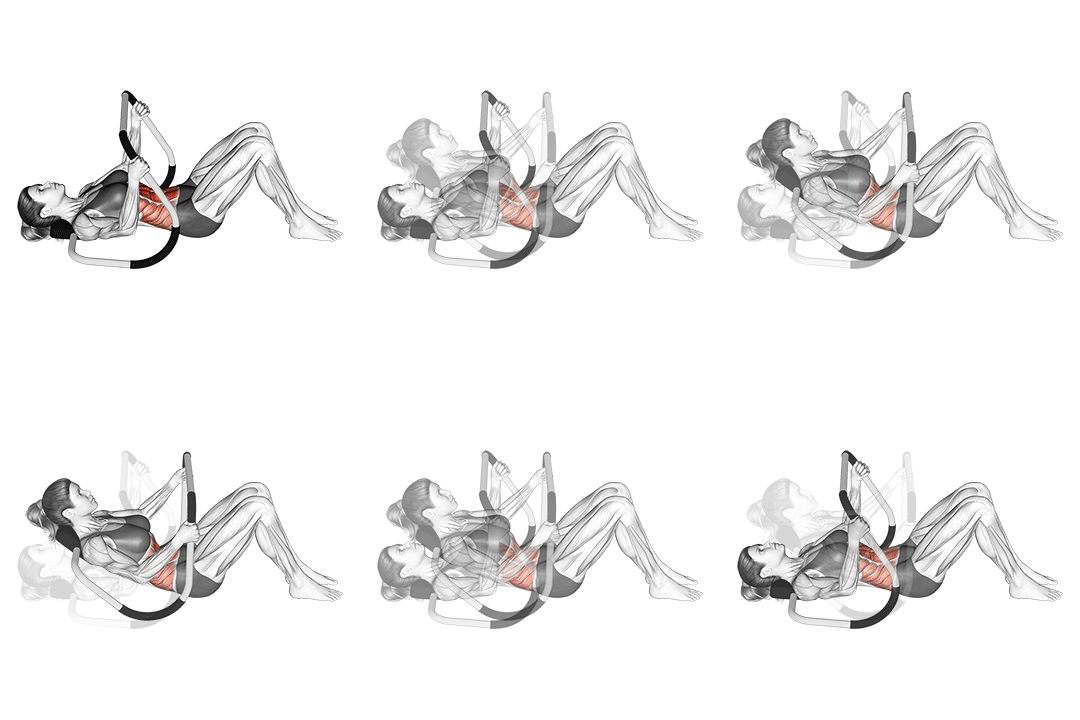
The Ab Roller Crunch grips the ab roller and rolls forward from a kneeling position, extending the body and then contracting the abs to roll back. The exercise is the foundational movement of all ab roller training and produces strong ab loading through the rollout pattern.
For abs roller training, the ab roller crunch is the primary exercise. The combination of full ab extension at the bottom of the rollout and strong contraction during the return phase produces stronger abdominal stimulus than crunches alone. Build to 3 to 4 sets of 8 to 12 reps as the foundation of any ab roller program.
Kneel on a soft surface with the ab roller in both hands, in front of the body. Roll the wheel forward by extending the body and reaching the arms forward. Stop at whatever depth allows clean form (no lower-back arching). Contract the abs to pull the body back to the kneeling position.
EZ Bar Kneeling Rollout

The EZ Bar Kneeling Rollout substitutes a loaded EZ curl bar with plates for an ab wheel, performing the same kneeling rollout pattern. The barbell variation is one of the most accessible ab roller substitutes because most gyms have EZ bars available even when a dedicated ab wheel is not.
For lifters without a dedicated ab roller, the EZ bar version produces nearly identical ab stimulus through the same rollout pattern. The bar with two plates provides the same rolling surface as a wheel, and the loaded plates can be increased gradually as strength improves. Pair it with the standard ab roller crunch for variety.
Kneel on a soft surface with an EZ curl bar loaded with plates on each end. Grip the bar near the center with both hands. Roll the bar forward by extending the body. Contract the abs to pull the bar back to the kneeling position. Use moderate weight; the rollout is technique-focused, not load-focused.
Suspender Rollout

The Suspender Rollout uses a suspension trainer (TRX or rings) anchored overhead and rolls forward from a kneeling position with hands gripping the handles. The suspension trainer adds unstable handles that demand stronger core stabilization than a fixed ab wheel.
For lifters with suspension trainer access, the suspender rollout is one of the most demanding ab exercises that exists. The unstable handle position forces the obliques and rotational stabilizers to work continuously alongside the standard ab loading. Progress to it once standard ab roller crunches feel manageable.
Set up a suspension trainer with handles roughly waist-height. Kneel facing away from the anchor, gripping the handles. Lean forward with arms extended. Roll the body forward and down by extending the arms further. Contract the abs to return to the kneeling position with arms forward.
Ring Kneeling Ab Rollout

The Ring Kneeling Ab Rollout uses gymnastics rings instead of an ab wheel for the rollout pattern. The rings rotate freely, which adds significant grip and shoulder demand on top of the ab work.
Ring-based ab work is one of the most demanding bodyweight ab options that exists. The rotating rings demand continuous grip and shoulder stability, and the bodyweight loading produces strong ab stimulus throughout the rollout pattern. Use it as a progression past standard ab roller work.
Set up rings hanging at roughly knee height. Kneel facing away from the rings, gripping the handles. Lean forward with arms extended. Roll the body forward by reaching the rings further away. Contract the abs to pull back to the kneeling position. The rings will rotate; control them firmly throughout.
Ring Reverse Ab Rollout

The Ring Reverse Ab Rollout reverses the direction of the standard ring rollout, with the lifter facing the rings instead of away. The reverse direction shifts emphasis slightly and produces different muscle recruitment patterns.
For variety in ring-based ab training, the reverse rollout adds a different angle that hits the abs from a unique direction. The change in body position produces stronger upper-ab loading than the standard rollout pattern. Use it as an occasional variation rather than as the primary exercise.
Set up rings hanging at roughly knee height. Kneel facing the rings, gripping the handles. Roll the rings backward over the head while extending the body forward. The motion is the opposite of the standard rollout. Contract the abs to return the rings to the front position.
Barbell Standing Ab Rollout

The Barbell Standing Ab Rollout performs the rollout pattern from a standing position rather than kneeling, using a loaded barbell as the rolling surface. The standing version is one of the most demanding ab exercises in any program because of the increased range of motion.
For advanced lifters who have outgrown the kneeling rollout, the standing version is the next major progression. The increased range of motion and harder mechanical disadvantage produce significantly more ab loading per rep. Most lifters need 6 to 12 months of consistent ab training before achieving a clean standing rollout.
Stand with a loaded barbell on the floor in front of the feet. Hinge forward at the hips and grip the bar with both hands. Roll the bar forward as far as possible while extending the body. Contract the abs to pull the bar back to the starting position. Use light to moderate weight initially.
Band Assisted Wheel Rollout

The Band Assisted Wheel Rollout attaches a resistance band to an overhead anchor and the lifter, providing assistance during the return phase of the rollout. The band assistance lets beginners progress to the rollout pattern before they have the core strength for unassisted reps.
For lifters who cannot yet perform a clean ab roller crunch, the band-assisted version is the right entry point. The band reduces the effective load during the return phase, which lets beginners build the strength to progress to unassisted rollouts within 4 to 8 weeks of consistent practice.
Anchor a resistance band overhead. Loop the band around the waist. Kneel with the ab roller in both hands. Roll forward, then use the band assistance to help pull the body back to the kneeling position. Reduce band tension over weeks as strength improves.
Suspender Standing Ab Rollout

The Suspender Standing Ab Rollout performs the rollout pattern from a standing position using a suspension trainer instead of an ab wheel. The combination of standing position and unstable handles makes this one of the most demanding ab exercises available.
For elite-level ab work, the suspender standing rollout combines the depth of the standing variation with the instability of the suspension trainer. The exercise produces strong ab loading along with significant shoulder and grip work. Most lifters need 12+ months of consistent ab training to perform this cleanly.
Set up a suspension trainer with handles at roughly waist height. Stand facing away from the anchor with arms extended forward gripping the handles. Roll the body forward by extending further. Contract the abs to pull back to the starting position. Use very strict form; failed reps in this position can strain the lower back.
Front Plank
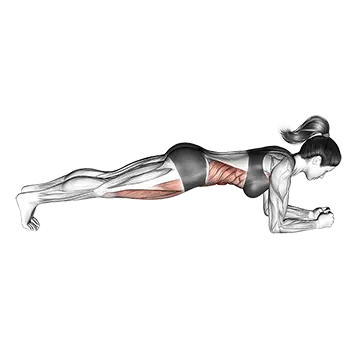
The Front Plank holds a forearm plank position with the body in a straight line from head to heels. The isometric hold builds the anti-extension core strength that supports rollout work.
For ab roller programming, the front plank serves as the foundational anti-extension exercise. The same core function (resisting spinal extension) is required during the bottom position of the rollout, so plank strength transfers directly to rollout performance. Build to 60-second clean holds before progressing to harder rollout variations.
Set up on the forearms with elbows directly under the shoulders. Body straight from head to heels, hips not sagging or piking up. Hold the position while breathing normally. End the set when form breaks down, not when an arbitrary clock runs out.
Ab Tuck

The Ab Tuck sits on the floor leaning back slightly with feet lifted, then alternates extending the legs straight out and tucking the knees back to the chest. The continuous tucking motion hits the lower abs and hip flexors directly.
In an ab roller program, the ab tuck adds direct lower-ab work that complements the rollout-pattern emphasis on upper abs and trunk stability. The combination produces more complete ab development than rollout work alone. Run it for 3 sets of 30 to 45 seconds as a finisher after rollout sets.
Sit on the floor with hands behind for support and feet lifted off the ground. Lean back slightly to engage the abs. Extend both legs straight out, then tuck the knees back toward the chest. Continue alternating between extension and tuck without letting the feet touch the floor.
How To Program These Workouts
A productive ab roller session pulls four to six exercises from the list above. A balanced session includes one primary rollout (ab roller crunch as the foundation), one variation (suspender or ring rollout), one supporting isometric (front plank), and one finisher (ab tuck or other dynamic ab work). Run primary rollouts for 3 to 4 sets of 6 to 12 reps; supporting work for 3 sets of 10 to 20 reps or 30 to 60-second isometric holds.
Train rollouts two to three times per week. The high core demand of rollout work needs more recovery than bodyweight ab exercises; daily rollout training often produces lower-back soreness within a few weeks. A Monday/Wednesday/Friday split or pairing rollout days with non-deadlift training days works well for most lifters.
For broader ab programming, see our best 10 minute ab workouts and 5 minute ab workouts. For standing core work, see our best standing ab workouts.
Final Thoughts
The best ab roller workouts deliver some of the strongest ab stimulus available from any single piece of equipment. The combination of full ab extension at the bottom and powerful contraction during the return produces stronger abdominal recruitment than crunches, planks, or sit-ups. For lifters who want serious core development without spending hours on ab work, the ab roller is one of the most efficient tools available.
Stay focused on technique. The most common ab roller mistake is rolling out too far before having the strength to control the bottom position, which arches the lower back and shifts loading off the abs. Build the core strength gradually: start with limited-range rollouts and progress to fuller depth over weeks of consistent practice. Lifters who get the most from rollout training are the ones who treat each rep as deliberate practice rather than chasing maximum range too soon.
Frequently Asked Questions
How heavy is an ab roller?
Standard ab rollers weigh 2 to 5 pounds and are essentially unloaded; the resistance comes entirely from bodyweight and the mechanical disadvantage of the rollout pattern. Some advanced ab rollers add resistance bands or weighted plates for additional loading, but most lifters never need more than the standard unloaded version because the bodyweight loading is plenty for years of progressive practice.
How often should I do ab roller workouts?
Two to three times per week works for most lifters. The high core demand of rollout work needs more recovery than easier bodyweight ab exercises; daily rollout training often produces lower-back soreness within a few weeks. Spacing rollout sessions every 48 to 72 hours allows full recovery while maintaining frequent training stimulus.
Are ab rollers good for beginners?
Yes, with appropriate progressions. Beginners should start with kneeling rollouts limited to a small range of motion (rolling out only 6 to 12 inches initially) and build gradually to fuller range over weeks. Alternatively, the band-assisted variation lets beginners progress to the full rollout pattern before they have the core strength for unassisted reps. Avoid jumping straight to standing rollouts; that progression typically takes 6 to 12 months of practice.
Do ab rollers actually work?
Yes, very effectively. Research shows that the rollout pattern produces some of the highest electromyographic (EMG) activation of the abdominal muscles of any common ab exercise, often outperforming crunches, planks, and sit-ups in muscle recruitment per rep. The combination of full ab extension and powerful contraction during the return phase loads the abs more thoroughly than nearly any other bodyweight exercise.
Can ab rollers cause back pain?
Only with poor technique. Lower back pain from rollout work typically comes from rolling out too far before the abs are strong enough to control the bottom position, which shifts loading from the abs to the lower-back extensors. The fix is simple: limit the rollout range to whatever depth allows the abs (not the lower back) to control the descent. Build range gradually as core strength improves.