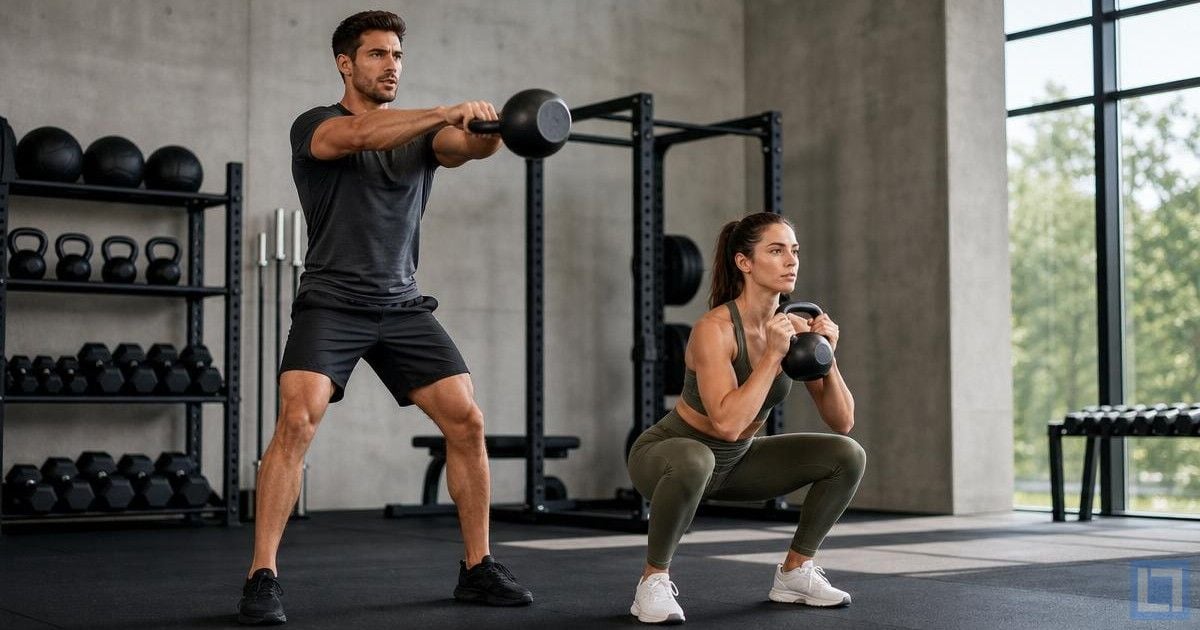
Kettlebells are the most efficient piece of equipment for full-body training that exists. A single kettlebell or a pair covers every major movement pattern (push, pull, squat, hinge, rotate, carry) and produces strength, power, and conditioning adaptations simultaneously. The best full body kettlebell workouts use this versatility to deliver complete training in 30 to 45 minutes.
Below are ten effective full-body kettlebell exercises that cover every major muscle group and movement pattern. Together they form a complete training session that fits in any home gym, garage, or hotel room with nothing more than one or two kettlebells.
Kettlebell Full Swing

The Kettlebell Full Swing performs an overhead kettlebell swing rather than the standard chest-height swing. The kettlebell travels through a full range of motion from between the legs all the way overhead, which adds significant shoulder loading on top of the standard hip-hinge mechanics.
The full swing is the cornerstone of CrossFit-style kettlebell training and a strong choice in any full-body program. The combination of explosive hip drive and overhead loading hits the posterior chain, shoulders, and core simultaneously, which fits the time-efficient goal of full-body sessions.
Hinge at the hips and swing the kettlebell back between the legs. Drive the hips forward explosively to swing the bell up and overhead, ending with arms locked over the head. Reverse the motion under control. Use a moderate weight; the full swing is technical, and form matters more than load.
Kettlebell Full Squat From Deficit

The Kettlebell Full Squat From Deficit holds a kettlebell goblet-style at the chest and squats from a slightly elevated platform, allowing deeper-than-standard squat depth. The deficit position adds range of motion to the squat pattern.
Deeper squat depth produces stronger leg development and better hip mobility over time. Most lifters squat above parallel out of habit; the deficit version forces depth by starting from an elevated platform. It is one of the most direct ways to retrain squat mechanics for full range of motion.
Stand on a low platform (one to three inches above the floor) with the kettlebell at the chest. Squat to whatever depth your mobility allows below parallel. Keep the chest tall and the core braced. Drive up through the whole foot. The deficit version requires significant ankle and hip mobility; build up gradually.
Kettlebell Floor Fly

The Kettlebell Floor Fly lies on the back with kettlebells in each hand and performs a fly motion (arms wide and back together). The floor limits the eccentric range of motion, which protects the shoulders while still loading the chest effectively.
For lifters without bench access, the floor fly is the most accessible chest fly variation that exists. The protected range of motion at the bottom (the kettlebells stop at the floor before overstretching) makes it appropriate even for lifters with shoulder issues that limit bench-based flies.
Lie flat with kettlebells held above the chest with palms facing each other. Lower the bells out to the sides in a wide arc until the upper arms touch the floor. Squeeze the chest to bring the bells back together. Move under control; flies are about chest stretch and contraction, not heavy weight.
Kettlebell Step Up

The Kettlebell Step Up holds kettlebells at the sides and steps up onto a sturdy bench or box with one leg, driving the body up and bringing the trailing leg up to a standing position on the platform. It is one of the most direct unilateral leg exercises that exists.
Step-ups train each leg independently, which catches strength imbalances and produces more balanced lower-body development than bilateral squatting alone. The kettlebell loading at the sides keeps the spine neutral, which makes the exercise more accessible for lifters with lower-back issues.
Step up onto a sturdy bench (knee-height or slightly higher) with one foot planted firmly. Drive through the front heel to bring the body to standing on the bench. Lower under control by stepping back down. Alternate legs on each rep.
Kettlebell Advanced Windmill

The Kettlebell Advanced Windmill holds a kettlebell overhead with one arm and bends sideways at the hip to lower the opposite hand toward the foot, with eyes following the kettlebell throughout. It builds hip mobility, core rotation, and overhead shoulder stability simultaneously.
The windmill is one of the most underrated full-body exercises in any program. The combination of hip mobility, oblique work, and overhead pressing stability produces a movement pattern that no other single exercise covers. It also serves as a strong injury-prevention tool for the shoulders and hips.
Hold the kettlebell overhead with arms locked out. Push the hips out toward the kettlebell side. Bend at the hips while keeping the eyes on the kettlebell. Lower the opposite hand toward the floor. Reverse the motion to stand. Use light weight to start; the technique requires significant practice.
Kettlebells Sumo Deadlift

The Kettlebells Sumo Deadlift uses a wide stance with two kettlebells held between the legs, then drives through the floor to stand. The wide stance reduces the range of motion compared to conventional deadlifts and shifts more emphasis to the glutes and adductors.
For lifters without barbell access, the kettlebell sumo deadlift is the most direct way to load the deadlift pattern with significant weight. The shorter range of motion compared to conventional deadlifts also makes it easier on the lower back at heavy loads.
Set the feet wide with toes turned out roughly 30 to 45 degrees. Position the kettlebells between the legs. Hinge at the hips with a flat back, grip the bells, and drive through the floor to stand. Lock out by squeezing the glutes hard at the top.
Kettlebell Overhead Carry

The Kettlebell Overhead Carry holds a kettlebell overhead with one arm locked out and walks for distance or time. The continuous walking under overhead load demands shoulder stability, core bracing, and total-body coordination.
Overhead carries are one of the most underrated shoulder-stability exercises that exists. The combination of static holding and walking forces the rotator cuff and scapular stabilizers to work continuously, which builds the kind of shoulder health that prevents injuries during heavier pressing work.
Press a kettlebell overhead with one arm locked out and the bicep close to the ear. Walk forward with normal posture, keeping the arm rigidly overhead the entire time. Switch arms after the first lap. Use moderate weight; the carry is about stability under load, not maximum strength.
Kettlebell Seated Press

The Kettlebell Seated Press sits on the floor with legs extended and presses two kettlebells overhead. The seated floor position eliminates leg drive entirely and forces the shoulders to do all the work, which produces stronger pure pressing strength than standing or bench-supported variations.
For shoulder development specifically, the seated press is one of the most direct exercises that exists. The floor-sitting position also requires significant core engagement to stabilize against the pressing load, which adds core work to the shoulder pressing pattern in one efficient movement.
Sit on the floor with legs extended. Press two kettlebells overhead from the shoulders, locking out the arms at the top. Lower under control. Keep the core braced and the spine tall throughout. Avoid leaning back to use leg drive; the seated position is supposed to remove that.
Kettlebell Double Jerk

The Kettlebell Double Jerk holds two kettlebells at the shoulders, dips slightly with the legs, then drives upward to drop the body under the kettlebells as the arms lock overhead. It is one of the most demanding kettlebell exercises that exists, training explosive power throughout the entire body.
The double jerk is the kettlebell equivalent of an Olympic lift. The technique demands time to learn, but once mastered the exercise produces total-body explosive power gains comparable to barbell Olympic lifting at a fraction of the equipment cost. It is a strong choice for advanced lifters who want power development.
Hold two kettlebells in the rack position at the shoulders. Dip the legs slightly while keeping the torso vertical. Drive the legs straight to push the kettlebells upward, then drop the body under the kettlebells as the arms lock out. Stand to complete the rep. Use moderate weight; the technique is the limiting factor.
Kettlebell Russian Twist

The Kettlebell Russian Twist sits on the floor with knees bent and feet lifted, then twists side to side with a kettlebell held in both hands. The rotation under load hits the obliques and rotational core stabilizers.
Most ab work emphasizes trunk flexion (crunches) and ignores rotation. The Russian twist fixes that gap. Loaded rotation is the function the obliques actually perform during athletic movement, and direct rotational training transfers better than crunch variations to athletic performance and back health.
Sit on the floor with knees bent and heels lifted off the ground. Hold the kettlebell in both hands at chest level. Rotate the trunk side to side, touching the kettlebell to the floor on each side. Move under control rather than chasing speed.
How To Program These Workouts
A productive full-body kettlebell session pulls six to eight exercises from the list above. A balanced session includes one explosive movement (full swing), one squat (full squat from deficit or step-up), one hinge (sumo deadlift), one push (seated press or double jerk), one pull (single-arm row, not listed but valuable), one core or rotation (Russian twist or windmill), and one finisher (overhead carry).
Train two to four times per week. Kettlebell training recovers fast for most lifters because the loads are moderate compared to barbell work, but the intensity is high. Three sessions per week (Monday/Wednesday/Friday) with rest days between produces strong results. Beginners should start at two sessions per week to allow more recovery while learning techniques.
For more kettlebell programming, see our best kettlebell workouts and best kettlebell core workouts. To browse the equipment library, explore our kettlebell exercises collection.
Final Thoughts
The best full body kettlebell workouts deliver complete training in minimal time and space. The combination of explosive ballistic work, strength compounds, and stability training produces broader athletic adaptations than dedicated barbell programs at a fraction of the equipment cost. For home lifters and travelers, kettlebells are the highest-leverage equipment investment available.
Stay focused on technique. Kettlebell exercises are more technical than barbell equivalents because the asymmetric load and ballistic patterns require precise body positioning. The lifters who get the most from kettlebell training are the ones who put the time into learning the foundational movements (swing, clean, press, snatch) rather than constantly chasing new variations.
Frequently Asked Questions
What kettlebell weight should I start with?
For most beginners, a single kettlebell in the 16 to 24 kg range (35 to 53 pounds) covers most needs. Smaller lifters often start with 12 kg; larger lifters often start with 20 kg as their primary bell. The most useful first purchase is a moderate-weight bell rather than a too-light or too-heavy starter; the right weight is heavy enough for swings to feel demanding but light enough for clean technique on presses.
How often should I do full body kettlebell workouts?
Two to four times per week works for most lifters. Beginners should start at two sessions per week to allow recovery while learning technique; intermediates and advanced lifters can typically handle three to four sessions. Daily kettlebell training is rarely productive because total recovery suffers and form quality drops over time.
Can kettlebells replace barbell training?
For most beginners, intermediates, and recreational lifters, yes. Kettlebells produce real strength and muscle gains for years before lifters bump up against the load ceiling barbells eventually surpass. Advanced lifters chasing maximum strength often add barbell work, but consistent kettlebell training remains useful at every level.
How long should a full body kettlebell workout be?
Thirty to forty-five minutes is the standard range. Kettlebell training is denser than barbell training (less rest between sets, more continuous movement), so total session length tends to be shorter for the same training stimulus. Twenty-minute focused sessions also work well for time-limited days; the format adapts to whatever schedule allows.
Do I need a pair of kettlebells or just one?
A single kettlebell covers most movements and is plenty for beginners. A pair adds bilateral pressing, double swings, and double jerks, which expand the program meaningfully. Most lifters do well with two bells of the same weight (or two pairs at different weights) once they progress past the beginner stage.