Resistance bands are the most portable strength training tool that exists. The best resistance band workouts use accommodating resistance to load every major movement pattern: pressing, pulling, squatting, hinging, and isolating. The setup fits in a backpack, sets up in seconds, and scales from beginner to advanced just by changing the band tension or stance width.
Below are ten foundational resistance band exercises that cover the full body. Together they form a complete training system that travels anywhere and produces real strength gains for beginners and intermediates without ever touching a barbell.
Band Bench Press

The Band Bench Press uses a resistance band looped around the back to perform a horizontal press. Lying flat or standing, you press the band forward until the arms lock out, then return under control. The band provides accommodating resistance, getting harder as the arms extend and the band stretches.
For lifters who want to train the bench press pattern at home, the band version is the cleanest alternative. The accommodating resistance hits the lockout portion harder than free weights do, which is exactly where most lifters are weakest. It also takes the spinal load out of the equation, making it shoulder-friendlier than barbell pressing.
Loop the band around the upper back and grip the ends near the chest. Press the bands forward to lockout, keeping the elbows at a moderate angle (not flared straight out). Return under control to chest level. Stand with feet staggered for balance.
Band Bent Over Row

The Band Bent Over Row hinges over with a resistance band anchored low or under the feet, then rows the handles to the lower chest. The band’s constant tension hits the lats, mid-back, and biceps through the full range of pulling motion.
Bands are excellent for rowing because the tension scales naturally with the angle of pull. As you draw the handles back, the band stretches and resistance increases, which produces the strongest contraction at the most contracted position. That mimics what cable rows feel like, with no machine required.
Hinge at the hips with a flat back and a slight knee bend. Pull the handles to the lower chest or upper abdomen, squeezing the shoulder blades together at the top. Lower under control. Avoid jerking the band with the lower back.
Resistance Band Squat

The Resistance Band Squat stands on the band and holds the ends at the shoulders. As you stand up, the band stretches and resistance increases, loading the top of the squat the heaviest. The accommodating resistance hits the glutes hard at lockout, where bodyweight squats give you the easiest portion of the rep.
Bands give you accommodating resistance, the opposite of how dumbbells and barbells work. That reverse loading pattern is excellent for glute development because it loads the lockout phase, which most lifters under-train. Combined with bodyweight or barbell squats, the band squat fills a gap in most leg programs.
Stand on the band with feet shoulder-width and the band fully under both feet. Hold the ends at the shoulders. Squat to whatever depth you can hit cleanly with a vertical torso, then drive up against the band. The band should be tight at lockout but slack at the bottom.
Resistance Band Overhead Shoulder Press

The Resistance Band Overhead Shoulder Press stands on the band and presses the handles overhead. The band loads the press accommodatingly, getting harder as the bands lengthen, which puts the heaviest loading at the lockout where most lifters need it.
For shoulder development at home, the band overhead press is one of the cleanest options. The accommodating resistance trains the lockout where dumbbell and barbell presses tend to lose tension. It also takes spinal compression off the equation, which makes it usable on heavier days when you do not want to load the spine further.
Stand on the band with feet shoulder-width. Press the handles overhead from shoulder level until the arms lock out. Lower under control. Keep the core braced and the rib cage stacked over the pelvis to prevent arching backward at lockout.
Band Standard Biceps Curl

The Band Standard Biceps Curl stands on the band and curls the handles up to the shoulders. The band’s tension increases through the rep, hitting the bicep contraction at the top harder than free weights do.
Most curl variations lose tension near the top of the rep because the elbow is past the point where gravity loads the biceps effectively. Bands fix that by adding tension exactly when the biceps are most contracted. The result is a curl variation that loads the peak contraction better than dumbbells or barbells alone can.
Stand on the band with feet shoulder-width. Hold the handles at the sides with palms forward. Curl up to the shoulders, squeezing hard at the top. Lower under control. Keep the elbows pinned to the sides through the rep; avoid swinging.
Resistance Band Triceps Pushdown

The Resistance Band Triceps Pushdown anchors a band high and pushes the handle or ends down to the thighs. It mimics the cable triceps pushdown using only a band and an anchor point, training the triceps through their primary function of elbow extension.
For triceps work without a cable machine, the band pushdown is hard to beat. The constant tension hits the triceps through the entire range of motion, and the accommodating resistance pattern loads the lockout the hardest. It is one of the best tricep isolation movements that requires no cable stack.
Anchor the band overhead. Stand under the anchor and grip the ends with elbows pinned to the sides. Push the band straight down to the thighs by extending only at the elbows. Slowly return to the start. The upper arms stay still throughout.
Resistance Band Glute Bridge
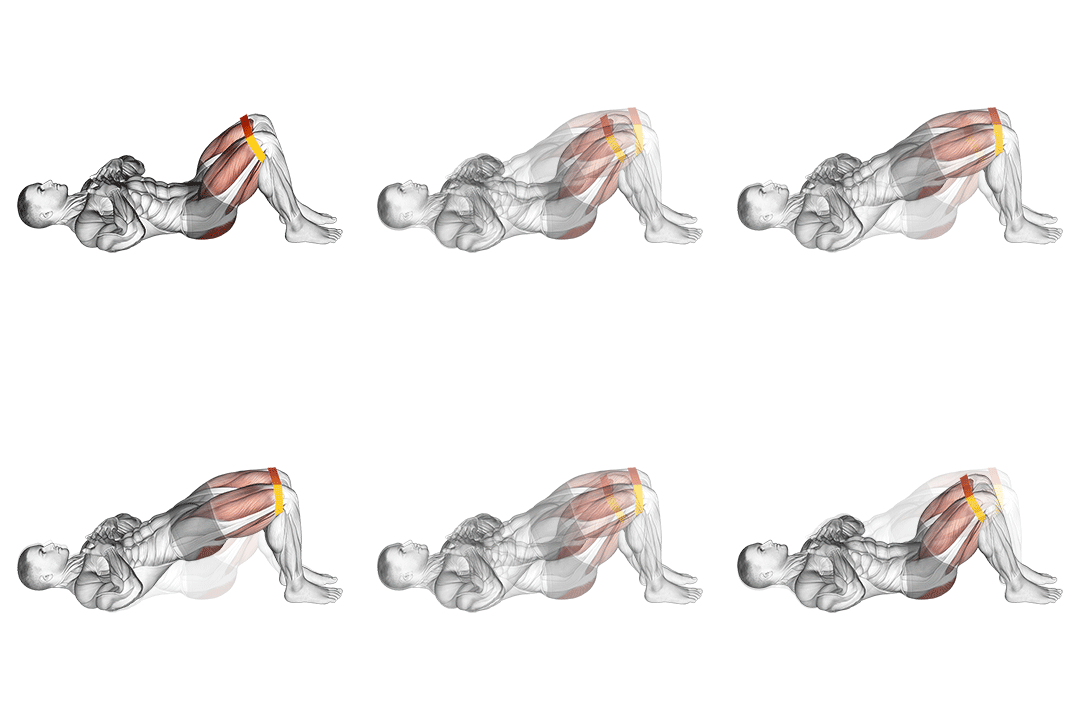
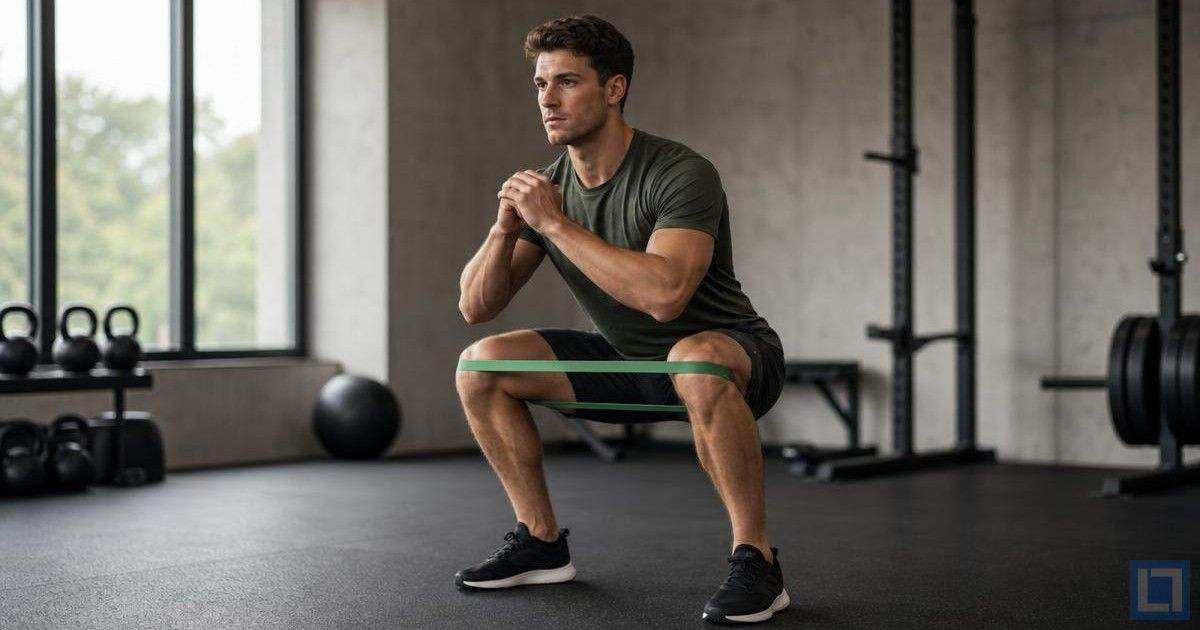
The Resistance Band Glute Bridge adds a mini band around the thighs above the knees to a standard glute bridge. The band provides constant outward tension that activates the gluteus medius alongside the gluteus maximus, making the bridge significantly more effective for total glute development.
Most lifters under-train the glute medius compared to the glute maximus. Adding a band recruits both heads of the glute simultaneously, which is exactly what you want for both strength balance and visible glute shape. It is one of the highest-value tweaks you can make to any glute exercise.
Press the knees outward against the band the entire time. Drive the hips up by squeezing the glutes hard at the top. The band’s job is to give you something to push against, so keep the tension live throughout the rep.
Band Lateral Raise

The Band Lateral Raise stands on the band and raises the handles out to the sides until the arms are parallel to the floor. The band provides constant tension throughout the lift, which loads the side delts harder than dumbbell lateral raises in the contracted position.
Lateral raises are the most effective side delt exercise, and the band version has a unique advantage: the resistance increases as the arms rise, which loads the contracted position (where the side delts are at their hardest-working angle). That produces a stronger stimulus than dumbbell laterals, where the load is heaviest at the bottom.
Stand on the band with one foot. Hold the handles at the sides with palms facing the body. Raise the arms out to the sides until parallel with the floor. Pause briefly at the top, then lower under control. Keep a slight bend in the elbows throughout.
Resistance Band Bent Over Row

The Resistance Band Bent Over Row positions a resistance band under the feet and rows the handles to the lower chest from a hinged-over position. It is a more refined version of the band row pattern, with the foot anchor providing a stable base for heavier rowing volume.
Where the standard band row uses the hands or a fixed anchor, the foot-anchored version more closely mirrors a barbell bent-over row pattern. The hinge position teaches good back posture under load, and the row trains the lats and mid-back through a full range of motion.
Stand on the band with feet shoulder-width. Hinge at the hips with a flat back. Pull the handles to the lower chest, squeezing the shoulder blades together at the top. Lower under control. Keep the back flat throughout; do not round under the load.
Resistance Band Reverse Crunch

The Resistance Band Reverse Crunch loops a band around the feet anchored low, then performs a reverse crunch. The band adds constant resistance throughout the rep, hitting the lower abs and hip flexors with significantly more load than the bodyweight version.
For training the lower abs at home with progressive load, the band reverse crunch is one of the cleanest options. The bodyweight version becomes endurance work fast, which is poor for muscle development. Adding band tension keeps the movement in strength and hypertrophy territory.
Anchor the band low and loop it around the feet or ankles. Lie on the back with hands at the sides for support. Pull the knees toward the chest while curling the hips off the floor. Lower under control rather than dropping back. The lower abs do the work, not the hip flexors.
How To Program These Workouts
A solid resistance band session pulls four to six exercises from the list above, organized by movement pattern: one push (band bench press or shoulder press), one pull (band row), one squat (band squat), one accessory (curl, lateral raise, or pushdown), and one core or glute piece. That structure covers the full body in 30 to 45 minutes.
Train two to four sessions per week. Bands recover faster than free weights for most lifters because the loads are smaller and the joint stress is lower. The downside is that progression eventually caps out at the strongest band you own, so heavier-leaning lifters often pair band work with occasional gym sessions for the maximum-strength lifts.
For cluster-specific resistance band programming, see our best resistance band glute workouts and best resistance band arm workouts. To browse the equipment library, explore our resistance band exercises collection.
Final Thoughts
The best resistance band workouts produce surprising results for how simple the equipment is. Properly loaded band exercises hit muscles in patterns that free weights cannot replicate, especially the accommodating resistance pattern that loads the lockout portion of every press, pull, and squat the hardest.
Start with the foundational compounds (bench press, row, squat, overhead press) and build up to higher-intensity isolation work as the bands start to feel manageable. A complete band program will keep most beginners and intermediates challenged for years, especially when paired with progressive band thickness over time.
Frequently Asked Questions
What strength of bands should I buy?
Most lifters start with a set of three to five bands ranging from light to heavy, plus a few mini-bands for activation work. Light bands work for high-rep accessory work and warm-ups; heavy bands cover compound movements like squats, presses, and rows. Tube bands with handles cover most pressing patterns; flat loop bands work better for hip and leg work.
Can resistance bands replace weights?
For beginners and intermediates, mostly yes. Bands train every major movement pattern with significant load. Advanced lifters chasing absolute maximum strength eventually benefit from barbell work because the load potential is higher, but bands remain useful even at advanced levels for accessory work, warm-ups, and travel training.
How often should I train with bands?
Three to five times per week works for most lifters. Band training tends to be slightly easier on the joints than heavy free weight work because the loads are smaller and the movement patterns are smoother. Heavy compound days (band bench, band squat) still need rest days to recover from.
Are bands enough for muscle growth?
Yes, when programmed with progressive overload, sufficient volume, and good nutrition. Muscle grows in response to mechanical tension and progressive overload, both of which bands deliver effectively. Expect visible changes within 8 to 12 weeks of consistent training combined with adequate calories and protein.
How long do resistance bands last?
Quality fabric or rubber bands last anywhere from 6 months to several years depending on use. Bands lose tension slowly over time and can develop wear at attachment points. Replace bands at the first sign of cracking or significant tension loss; old bands can snap unexpectedly under load.