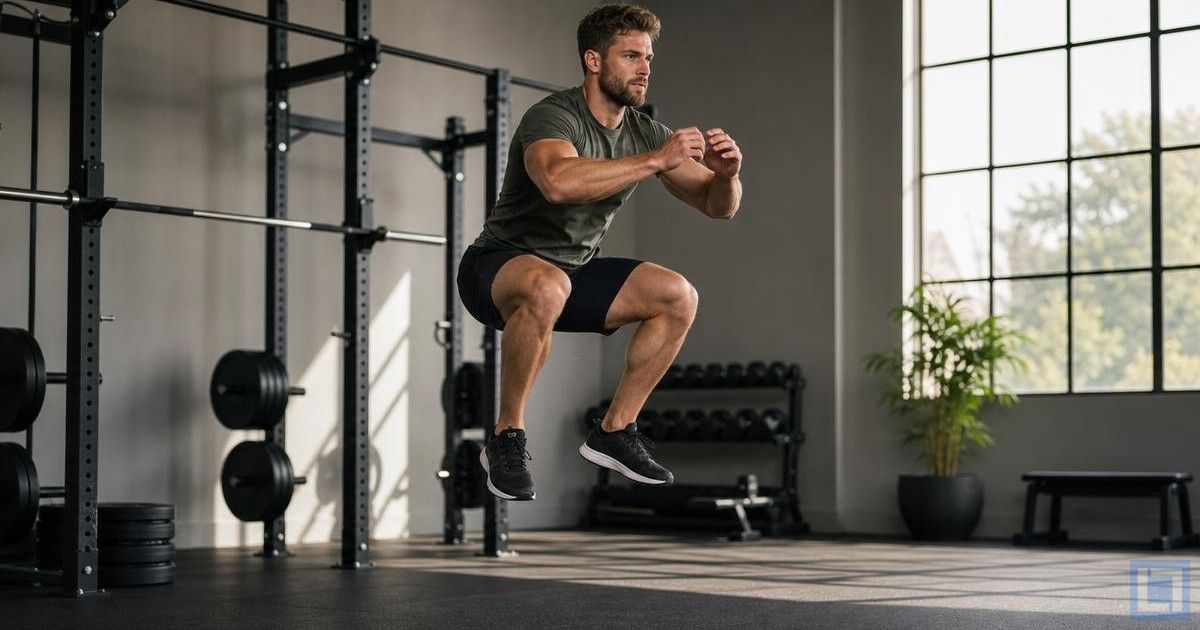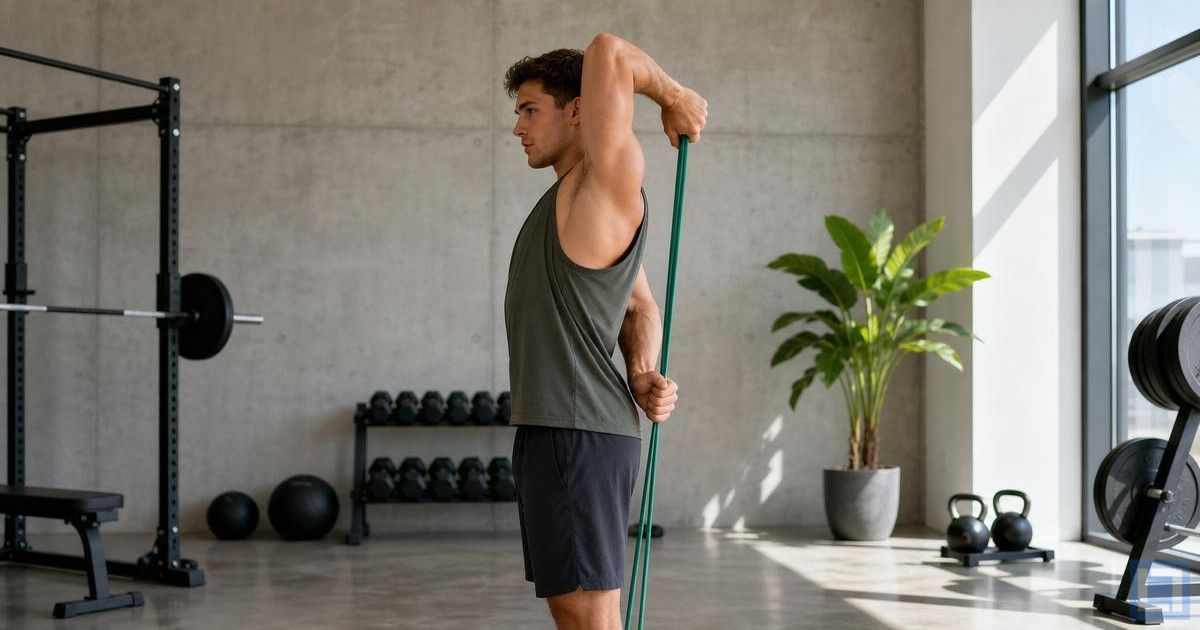
Resistance bands produce real arm development for lifters who do not have access to a full gym. The constant tension of band loading often produces stronger muscle contraction than free-weight exercises (which lose tension at certain points in the rep), and the variety of curl and tricep variations covers every part of the upper arm. The best resistance band arm workouts combine bicep variety with focused tricep isolation to deliver complete arm training in 30 to 45 minutes.
Below are ten effective resistance band arm exercises that cover six bicep variations, three tricep isolation movements, and one overhead extension. Together they form a complete arm training program that fits in any home gym, hotel room, or office with nothing more than a resistance band set and a sturdy anchor point.
Band Standard Biceps Curl

The Band Standard Biceps Curl stands on a resistance band with both feet and curls the band handles up to the shoulders. The constant tension produces a different bicep stimulus than free-weight curls, which lose tension at the top of the rep.
For at-home arm training, the standard band curl is the most direct foundational exercise that exists. The constant tension means the biceps work through the entire range of motion, which often produces stronger contraction at the top compared to dumbbell curls. Run it for 3 sets of 10 to 15 reps as the primary bicep exercise.
Stand on the resistance band with feet shoulder-width apart. Hold one handle in each hand at the sides, palms facing forward. Curl both handles up to the shoulders, keeping the elbows pinned to the sides. Lower under control to full extension. The tension increases through the rep as the band stretches.
Resistance Band Seated Biceps Curl

The Resistance Band Seated Biceps Curl sits on a chair with the band looped under the feet, then curls the handles up to the shoulders. The seated position eliminates body sway and isolates the biceps without lower-body involvement.
For the strictest possible bicep work, the seated band curl is the right call. The chair-supported position prevents the body sway that often creeps into standing curls, and the constant band tension produces strong contraction throughout the rep. Run it as a strict-form variation after standing curls.
Sit on a chair with the resistance band looped under both feet. Hold one handle in each hand at the sides, palms facing forward. Curl both handles up to the shoulders, keeping the elbows pinned to the sides and the back against the chair. Lower under control.
Resistance Band Hammer Curl

The Resistance Band Hammer Curl performs a curl with the palms facing each other (rather than facing up). The neutral grip emphasizes the brachialis muscle (which sits underneath the biceps) and the brachioradialis (forearm muscle) more than standard curls.
Hammer curls hit the brachialis directly, which is the muscle that pushes the biceps up to look bigger. For lifters chasing visible upper-arm thickness rather than just isolated bicep peak, the hammer curl is one of the most valuable exercises in any arm program. Run it for 3 sets of 10 to 12 reps as a second curl exercise.
Stand on the resistance band with feet shoulder-width apart. Hold the handles with palms facing each other (neutral grip). Curl both handles up toward the shoulders, keeping the elbows pinned to the sides. Lower under control.
Band Cross Chest Biceps Curl

The Band Cross Chest Biceps Curl curls the band handle across the body toward the opposite shoulder rather than straight up. The cross-body angle increases the stretch on the brachialis at the bottom and produces a stronger contraction at the top.
For lifters who already include standard curls and hammer curls, the cross-chest variation adds a slightly different angle that hits the bicep peak from a new direction. The cross-body motion also engages the brachialis intensely, which produces faster upper-arm thickness gains. Use it as an occasional variation rather than as the primary curl pattern.
Stand on the resistance band with one handle in each hand. Curl one handle across the body toward the opposite shoulder, keeping the elbow pinned to the side. Lower under control and switch sides on the next rep. The wrists stay neutral throughout.
Band Alternating Biceps Curl

The Band Alternating Biceps Curl curls one arm at a time in alternating fashion. While one arm curls up, the other extends back down. The alternating pattern produces continuous tension on the biceps because each arm is always under load.
Alternating curls double the time-under-tension per arm compared to bilateral curls because the working arm never gets a complete rest. The technique also catches strength imbalances that bilateral curls hide; lifters often discover one arm noticeably stronger than the other once alternating curls are programmed regularly. Run it for 3 sets of 10 to 12 reps per arm.
Stand on the resistance band with one handle in each hand. Curl one handle up to the shoulder while keeping the other arm extended at the side. Lower the curling arm and immediately curl the opposite arm up. Continue alternating throughout the set.
Band One Arm Overhead Biceps Curl

The Band One Arm Overhead Biceps Curl anchors the band overhead and curls one arm down toward the shoulder. The overhead anchor changes the line of pull and emphasizes the long head of the biceps from a different angle than vertical curls.
The overhead-anchor variation produces a slightly different bicep stimulus than standard curls because the arm direction changes. Use it as a secondary bicep exercise when the standard variations have plateaued; the angle change often resumes growth in lifters who have stagnated on standard curls.
Anchor the resistance band at chest height or slightly above. Stand facing away from the anchor. Reach one arm up and back to grip the handle with the arm extended overhead. Curl the handle down toward the shoulder by bending the elbow. Reverse under control.
Resistance Band Triceps Pushdown

The Resistance Band Triceps Pushdown anchors a resistance band overhead and presses the handles down toward the thighs by extending the elbows. It is the most accessible at-home version of the cable triceps pushdown that gym lifters use.
Pushdowns are one of the most direct tricep isolation exercises that exists. The combination of constant band tension and pure elbow extension produces strong tricep stimulus, particularly in the lateral and medial heads. Run it for 3 to 4 sets of 10 to 15 reps as the primary tricep exercise.
Anchor the resistance band overhead (door anchor or sturdy bar). Stand facing the anchor with the band handles in both hands. Keep the elbows tucked at the sides. Press the handles down toward the thighs by extending the elbows fully. Lower under control.
Band Triceps Kickback

The Band Triceps Kickback hinges over from a standing position with a band anchored low and extends the elbow back behind the body. The kickback motion targets the long head of the triceps through pure extension at the back of the body.
Band kickbacks are one of the most underrated tricep exercises in any home program. The constant band tension produces stronger contraction at the locked-out position than free-weight kickbacks (which lose tension as the dumbbell crosses vertical). Run it for 3 sets of 10 to 12 reps per side as a finisher after pushdowns.
Anchor the resistance band low (under a door or to a sturdy low point). Stand facing the anchor and hinge over with one arm bent at the elbow and the upper arm parallel to the floor. Extend the elbow back to lock out the arm. Squeeze the tricep at the top. Lower under control.
Band Overhead Single Arm Triceps Extension

The Band Overhead Single Arm Triceps Extension anchors the band low and extends the arm overhead by extending the elbow. The overhead position emphasizes the long head of the triceps, which responds best to overhead loading patterns.
Direct overhead tricep work is one of the most under-programmed tricep exercises in any home routine. The long head responds best to overhead positions because of how the muscle attaches above the shoulder joint; band overhead extensions load this position effectively without requiring gym equipment. Run it for 3 sets of 10 to 12 reps per side.
Anchor the resistance band low. Hold the handle with one hand, with the arm raised overhead and the elbow bent at 90 degrees pointing up. Extend the elbow to lock out the arm overhead. Lower under control. Switch sides on the next set.
Band 45 Degrees Biceps Curl

The Band 45 Degrees Biceps Curl anchors the band at floor level and curls the handles up at a 45-degree angle from the body. The angled line of pull produces different bicep recruitment than vertical curls and emphasizes the bicep peak from a unique angle.
For curl variety in a band-only program, the 45-degree variation provides a different angle that keeps the muscle fresh during long-term training. The combination of standard, hammer, cross-body, and 45-degree curls covers the biceps from multiple angles within a single workout. Run it for 3 sets of 10 to 12 reps as a third or fourth curl variation.
Anchor the resistance band at floor level. Stand back from the anchor with band handles in both hands. The bands should pull the arms forward at roughly 45 degrees from the body. Curl the handles up to the shoulders, maintaining the angle. Lower under control.
How To Program These Workouts
A productive band arm session pulls six to eight exercises from the list above. A balanced session includes two to three bicep variations (one standard curl, one hammer curl, one variation like cross-chest or alternating), one tricep pushdown, one tricep kickback, and one overhead extension. Run primary exercises for 3 to 4 sets of 10 to 15 reps; finishers for 2 to 3 sets to failure with shorter rest.
Train arms one to three times per week. Direct arm work recovers within 48 to 72 hours of moderate training. Most lifters program arm work after pressing or pulling sessions when the muscles are already warm, or as standalone arm days combined with shoulder work. Total weekly volume of 10 to 18 sets per muscle (biceps and triceps) produces strong growth.
For more arm-focused programming, see our best dumbbell bicep workouts and best dumbbell tricep workouts. For broader band programming, see our best resistance band workouts.
Final Thoughts
The best resistance band arm workouts deliver real bicep and tricep development without barbells, dumbbells, or specialized gym equipment. The constant tension of band loading produces stronger muscle stimulus throughout the full range of motion than free-weight exercises can match in some positions, and the variety of curl and tricep variations covers every part of the upper arm.
Pay attention to band tension and anchor points. The band needs to be appropriately resistant for clean reps in the target rep range; too light and the work is wasted, too heavy and form breaks down. Most lifters need a set with multiple resistance levels to cover all the exercises and rep ranges effectively. Sturdy door anchors are essential for the overhead and pushdown variations.
Frequently Asked Questions
Can resistance bands really build big arms?
Yes for beginners and intermediates. The constant tension and variety of band exercises produce real arm growth for years before lifters bump up against the load ceiling free weights eventually surpass. Advanced lifters chasing maximum arm size sometimes benefit from heavy barbell work, but consistent band arm training produces measurable development at every level.
How heavy should my resistance bands be?
Most lifters need a set with multiple resistance levels: light bands (5 to 15 pounds) for hammer curls, finishers, and rotator cuff work; medium bands (15 to 30 pounds) for primary bicep curls and tricep extensions; heavy bands (30+ pounds) for compound exercises and heavier curl variations. The right tension is whatever allows clean reps in your target range.
How often should I train arms with bands?
One to three times per week works for most lifters. Direct arm work recovers within 48 to 72 hours; spacing volume across multiple sessions can produce faster growth than once-weekly high-volume sessions. Most lifters do well with two arm sessions per week (one paired with chest, one paired with back) for a total weekly volume of 10 to 18 sets per muscle.
Do bands provide enough resistance for arm growth?
Yes for the rep ranges that build muscle. Most band sets reach 30 to 60 pounds of resistance at full stretch, which is plenty for 10 to 15-rep curl and tricep work. Advanced lifters who need 50+ pound curls eventually exceed band capacity, but most recreational lifters never reach that ceiling.
Can I build arms with only bodyweight, or do I need bands?
Bodyweight alone limits direct bicep training because the body has no natural way to load the curl pattern. Tricep work has bodyweight options (push-ups, dips, diamond push-ups), but biceps benefit significantly from added load. Resistance bands fill that gap with minimal equipment, which is why they remain one of the most useful pieces of home equipment for arm training.