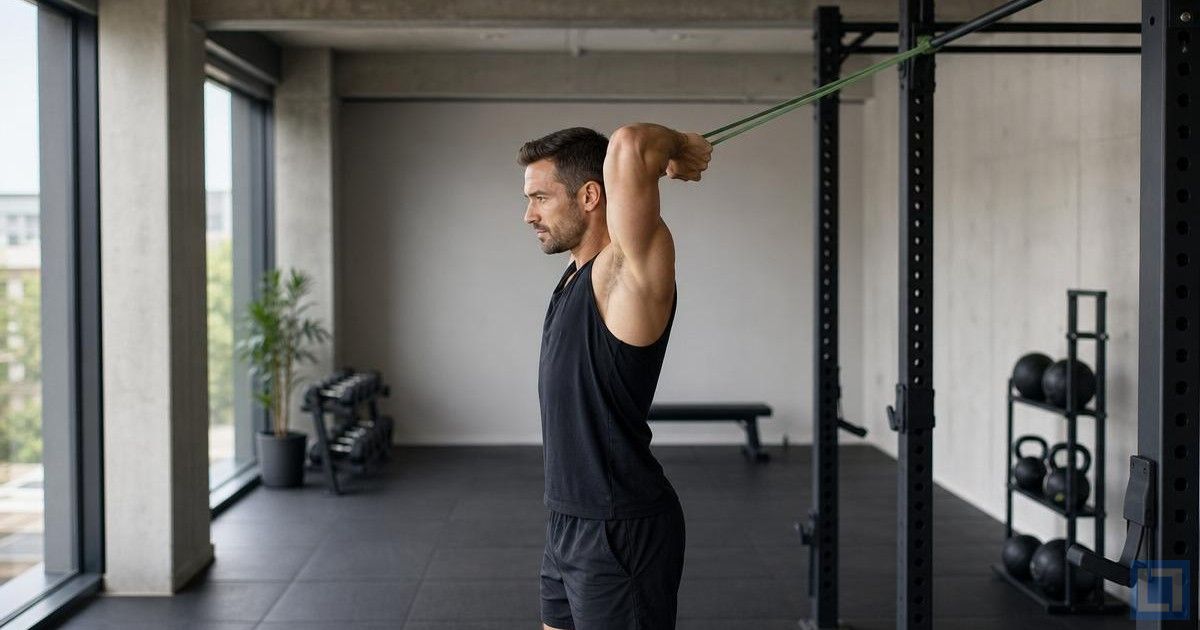
Resistance band tricep training produces real tricep development through accommodating resistance that loads the triceps most heavily at lockout where they generate the most force. The combination produces particularly strong tricep activation per rep because the band tension matches the natural strength curve of elbow extension. Bands also work well for tricep training because they fit easily in any setting (home, travel, outdoor), require minimal storage space, and provide multiple resistance levels through different band sizes. The format produces complete tricep development through pushdowns (lateral head focus), overhead extensions (long head focus), and kickbacks (peak contraction).
Below are ten effective resistance band tricep exercises that cover pushdowns (single-arm and bar-attached), kickbacks (unilateral isolation), overhead extensions (long head focus through stretch loading), side extensions (varied angle work), and complementary bodyweight tricep work (band push-up, close-grip push-up, diamond push-up). Together they form a complete band tricep training program that fits in any setting. A 30 to 40-minute session pulled from this list produces strong tricep stimulus across all three tricep heads.
Resistance Band Triceps Pushdown

The Resistance Band Triceps Pushdown anchors a band overhead and pushes the band down by extending at the elbows. The pattern isolates the triceps through pure elbow extension with continuous band tension throughout the rep.
For resistance band tricep training, the band pushdown is the foundational tricep isolation exercise. The fixed band path eliminates compensation patterns and produces strong direct tricep loading. Run it for 3 to 4 sets of 12 to 15 reps as primary tricep isolation work.
Anchor a resistance band overhead. Stand facing the anchor with the band gripped in both hands at chest level. Keep the elbows pinned at the sides. Push the band down by extending the elbows fully. Squeeze the triceps at the bottom. Return under control.
Band Triceps Kickback

The Band Triceps Kickback hinges over with a resistance band held in one hand and extends the arm back into a kickback motion. The pattern isolates the tricep through pure elbow extension, similar to a dumbbell kickback but with band tension.
For unilateral band tricep training, the band kickback produces strong tricep isolation through the standing or hinged position. The accommodating resistance is heaviest at the contracted position. Run it for 3 sets of 10 to 12 reps per side as accessory tricep work.
Anchor a resistance band at floor level. Stand or hinge over the band with one foot stepped forward. Hold the band end with one hand and brace the upper arm against the side of the body. Extend the band back by straightening the elbow. Squeeze the tricep at the top. Switch sides.
Bar Band Overhead Triceps Extension

The Bar Band Overhead Triceps Extension uses a bar attached to a resistance band held overhead and lowers the bar behind the head by bending at the elbows, then extends back to lockout. The overhead position emphasizes the long head of the triceps.
For long-head tricep development, the overhead band tricep extension is one of the most direct exercises that exists. The overhead position stretches the long head fully at the bottom of the rep. Run it for 3 sets of 10 to 12 reps as primary long-head tricep work.
Stand on a resistance band with both feet. Attach a bar to the band and hold it overhead with shoulder-width grip. Lower the bar behind the head by bending at the elbows while keeping the upper arms vertical. Extend back to lockout overhead. Maintain elbow position throughout.
Bar Band Standing Triceps Extension

The Bar Band Standing Triceps Extension uses a bar attached to a resistance band anchored overhead and pushes the bar down by extending at the elbows. The pattern is the heavier-loading variation of the standard band pushdown using a bar instead of a rope.
For heavier band tricep loading, the bar pushdown produces stronger bilateral tricep loading than rope variations. The fixed bar path also produces stricter tricep isolation. Run it for 3 sets of 10 to 12 reps as primary bilateral tricep work.
Anchor a resistance band overhead. Attach a bar to the band end. Stand facing the anchor with the bar gripped at chest level, hands shoulder-width. Keep the elbows pinned at the sides. Push the bar down by extending the elbows fully. Squeeze the triceps at the bottom.
Band Overhead Triceps Extension

The Band Overhead Triceps Extension stands on a band and holds it overhead, then lowers the band end behind the head by bending at the elbows, similar to a rope tricep extension. The overhead position stretches the long head of the triceps.
For long-head tricep development with single-handle equipment, the overhead band extension produces strong stretch loading at the bottom. Run it for 3 sets of 10 to 12 reps as accessory long-head tricep work.
Stand on a resistance band with both feet. Hold the band ends overhead with both hands together. Lower the band ends behind the head by bending at the elbows while keeping the upper arms vertical. Extend back to lockout overhead. Maintain elbow position throughout.
Band Overhead Single Arm Triceps Extension

The Band Overhead Single Arm Triceps Extension performs the overhead extension with one arm at a time. The unilateral pattern catches strength imbalances and allows greater range of motion than bilateral variations.
For unilateral long-head tricep training, the single-arm overhead extension produces strong unilateral loading with the band stretch pattern. Run it for 3 sets of 10 to 12 reps per side as unilateral tricep work.
Stand on a resistance band with one foot. Hold one band end overhead with the same-side hand. Lower the band behind the head by bending at the elbow while keeping the upper arm vertical. Extend back to lockout overhead. Switch sides between sets.
Band Side Triceps Extension

The Band Side Triceps Extension anchors a band at hip height to the side and performs a tricep extension across the body. The angled band path produces strong tricep loading from a different angle than vertical band exercises.
For tricep training that varies the loading angle, the side tricep extension produces unique tricep loading. The angled pattern complements vertical band work by hitting the triceps from a different direction. Run it for 3 sets of 10 to 12 reps per side.
Anchor a resistance band at hip height. Stand sideways to the anchor. Hold the band with the far-side hand and bring it to the same shoulder. Extend the arm across the body away from the anchor. Squeeze the tricep at the contracted position. Return under control. Switch sides.
Resistance Band Push-up

The Resistance Band Push-up performs a push-up while a resistance band is wrapped across the upper back and held under the hands. The band tension adds resistance to the pressing motion, increasing the loading on the triceps along with the chest.
For loaded push-up training in band tricep sessions, the band push-up adds real resistance to the standard push-up pattern. The accommodating resistance is heaviest at the lockout where the triceps contract hardest. Run it for 3 sets of 8 to 12 reps as combined chest-tricep work.
Wrap a resistance band across the upper back. Get into a push-up position with the band ends pinned under the hands. Lower the chest to within an inch of the floor by bending the elbows. Press back to lockout against the band tension. Maintain tight body position throughout.
Close Grip Push Up

The Close Grip Push Up performs push-ups with hands placed close together. The narrower grip biases loading toward the triceps more heavily than standard push-ups, making it the foundational bodyweight tricep exercise.
For tricep training that combines with band exercises, the close-grip push-up provides strong tricep loading without requiring band setup. The pattern hits the triceps with extreme intensity. Run it for 3 sets of 8 to 12 reps as bodyweight tricep work to complement band exercises.
Set up in a push-up position with hands placed close together (shoulder-width or narrower). Lower the chest to the floor by bending the elbows; keep the elbows tucked close to the body throughout. Press back to lockout, focusing on tricep extension. Keep the body straight.
Diamond Push Up

The Diamond Push Up performs push-ups with hands placed close together so the thumbs and index fingers form a diamond shape. The extreme close-grip position maximizes tricep loading.
For maximum bodyweight tricep loading, the diamond push-up is one of the most demanding bodyweight tricep exercises that exists. The pattern hits the triceps with extreme intensity. Run it for 3 sets of 8 to 12 reps as advanced bodyweight tricep work.
Set up in a push-up position with hands placed together so the thumbs and index fingers form a diamond shape directly under the chest. Lower the chest to the diamond by bending the elbows. Press back to lockout. The extreme close-grip position increases tricep loading significantly.
How To Program These Workouts
A productive band tricep session pulls six to eight exercises from the list above. A balanced session includes one pushdown variation (band pushdown or bar pushdown), one kickback (band tricep kickback), one overhead extension (bar overhead extension or single-arm overhead), one varied-angle exercise (side tricep extension), and 1 to 2 bodyweight complementary exercises (close-grip push-up, diamond push-up, band push-up). Run band exercises for 3 to 4 sets of 10 to 15 reps; bodyweight exercises for 3 sets of 8 to 12 reps. Total session covers 18 to 24 working sets.
Train band tricep sessions 1 to 2 times per week. The triceps recover within 48 to 72 hours of moderate training, but they get significant indirect work from any pressing exercise (bench press, overhead press, push-ups) which limits how much direct tricep work is needed. Most successful programs include 1 to 2 dedicated tricep sessions per week alongside chest pressing that produces secondary tricep loading.
For broader tricep programming, see our best dumbbell tricep workouts and best at home tricep workouts. For long-head specific work, see our best long head tricep exercises.
Final Thoughts
The best resistance band tricep workouts deliver real tricep development through accommodating resistance that loads the triceps most heavily where they generate the most force. The combination of pushdowns, kickbacks, overhead extensions, and complementary bodyweight work covers all three tricep heads (lateral, medial, long) and produces complete development from every angle. For lifters who want serious tricep training without weights, want to add band work to existing programs, or need effective tricep training in any setting, resistance band tricep training is one of the most versatile options available.
Stay focused on the contracted position of every rep. The most common band tricep training mistake is rushing through reps without squeezing the triceps hard at lockout, which reduces the effective stimulus. The fix: pause briefly at the contracted position of every rep and consciously squeeze the triceps. The accommodating resistance pattern is heaviest at lockout exactly where the contraction matters most; respecting that pattern through deliberate execution produces stronger results than mechanical rep counting.
Frequently Asked Questions
Are resistance bands good for triceps?
Yes, very effectively. The accommodating resistance pattern (heaviest at lockout) matches the natural strength curve of elbow extension, which produces strong tricep activation per rep. Bands also work well for varied-angle tricep training because they can be anchored at different heights and angles to load the triceps from multiple directions. Most lifters who consistently do band tricep work see measurable development within 8 to 12 weeks.
How heavy should bands be for tricep work?
Most beginners need a set ranging from light (10 to 20 pound resistance equivalent) to medium-heavy (30 to 50 pound resistance equivalent). Lighter bands work for isolation exercises (single-arm extensions, kickbacks); heavier bands work for compound exercises (push-ups, bar pushdowns). Most successful band tricep setups include 3 to 5 different resistance levels for progression and exercise variety.
How often should I do band tricep workouts?
One to two times per week works for most lifters. The triceps recover within 48 to 72 hours of moderate training, and they get significant indirect work from any pressing exercise. Most successful programs include 1 to 2 dedicated tricep sessions per week alongside chest pressing that produces secondary tricep loading. Daily tricep training typically produces accumulated fatigue without proportional growth benefit.
Bands or weights for tricep growth?
Both work; the choice depends on goals and equipment access. Bands produce strong tricep activation with accommodating resistance and work particularly well for varied-angle isolation. Heavy weights (cable pushdowns, skull crushers, weighted dips) allow heavier total loading and produce stronger overall mass development. Most successful tricep programs include both: weights for maximum loading, bands for varied-angle work and isolation.
What’s the best band tricep exercise?
The band pushdown is the foundational tricep exercise. The pattern isolates the triceps through pure elbow extension with continuous band tension, which produces strong direct tricep loading. Most successful band tricep programs include pushdowns as the cornerstone exercise alongside overhead extensions (for long head) and kickbacks (for peak contraction). The combination produces broader development than any single exercise alone.