Military calisthenics is one of the most battle-tested training systems in existence. Decades of refinement across every branch of service have narrowed the field to a small set of foundational movements that produce reliable strength, endurance, and conditioning with no equipment beyond a pull-up bar.
Below are the ten essential exercises that form the backbone of military physical training. Together they cover every major movement pattern (push, pull, squat, hinge, stabilize, jump) and produce the kind of broad-spectrum fitness that translates to nearly any physical task.
Push Ups

Push Ups are the foundation of military fitness. Every branch of service tests push-ups as a core fitness measure, and they form the backbone of every military calisthenics program. Hands set roughly shoulder-width apart, body in a straight line from head to heels, you lower the chest to nearly touch the floor and press back to lockout.
No military training program runs without push-ups, and for good reason. They train the chest, shoulders, triceps, and core simultaneously with no equipment, scale to any fitness level, and serve as both the daily workhorse and the standardized test of upper-body strength.
Body stays straight from head to heels through every rep. Lower until the chest is roughly an inch off the floor and press back without locking out hard. Keep elbows at roughly 45 degrees from the torso for shoulder health and the strongest pressing pattern.
Pull Up

The Pull Up is the standard test of upper-body pulling strength in military fitness. Hanging from a bar with an overhand grip, you pull the body up until the chin clears the bar, then lower under control. It builds the lats, biceps, mid-back, and core in a single brutal exercise.
Most lifters who can do 10+ clean pull-ups have built genuine pulling strength. The military pull-up standard tends to be strict: dead hang at the bottom, chin fully over the bar at the top, no kipping or swinging. That standard produces real strength rather than the loose form many gym lifters get away with.
Hang fully at the bottom with arms straight. Drive the elbows down and back to pull the chest toward the bar. Lower under control to a full hang and reset. No kipping, no body sway.
Squat

The Squat is the foundational lower-body movement in military training. Standing with feet shoulder-width, you squat to roughly parallel depth or below, then drive back to standing. Bodyweight squats run for high reps in nearly every military PT program, building leg endurance and basic strength.
Volume is what makes the bodyweight squat work in military settings. Sets of 50, 75, or 100 reps build the leg endurance that long ruck marches and field exercises demand. The pattern also serves as the foundation for jumping, sprinting, and every other lower-body skill the military requires.
Knees track over the toes and the chest stays tall. Squat to whatever depth your mobility allows cleanly. The heels stay planted; if they lift off the floor, mobility work needs to come first before adding load or volume.
Triceps Dip

The Triceps Dip is performed on parallel bars (or bench edges in field conditions) with the body upright, lowering until the upper arms are roughly parallel to the floor and pressing back to lockout. It is the most effective bodyweight tricep mass-builder in any military calisthenics rotation.
Dips complement push-ups by hitting the triceps from a different angle. Where push-ups load the chest primarily with triceps as a secondary mover, dips reverse that emphasis and load the triceps directly. Together they build complete pressing strength.
Stay relatively upright through the rep to keep the triceps as the prime mover. Lower until the upper arms reach parallel with the floor, then press back to full lockout. In field conditions, two sturdy benches or chairs work as well as parallel bars.
Sit-Up

The Sit-Up is the standard core test in military fitness. Lying flat with knees bent and feet planted, you raise the trunk to vertical and return to the floor. Military sit-ups are typically counted in two-minute timed sets, where speed and total rep count both matter.
For all the recent debate over whether sit-ups are the best core exercise, the military has kept them as a standard test for one practical reason: they accurately measure trunk strength endurance, which transfers to load-bearing tasks like carrying packs, climbing obstacles, and getting up from prone positions under load.
Lie flat with knees bent and feet planted. Cross arms over the chest or place hands behind the head. Raise the trunk until the elbows reach the knees, then lower with control. Move at a steady, sustainable tempo for high-rep timed sets.
Front Plank
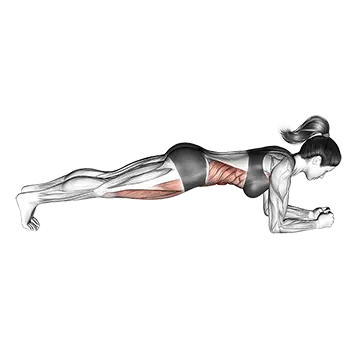
The Front Plank holds a forearm plank position with the body in a straight line from head to heels. It builds isometric core strength and teaches the trunk to brace under static load. Modern military fitness tests have begun replacing timed sit-ups with timed plank holds for exactly this reason.
Planks teach the core its primary function: bracing the trunk against unwanted movement. That skill carries directly to load-bearing tasks (rucking, carrying weight) and protects the lower back during the high-rep, high-volume work that military PT typically demands.
Set up on the forearms with elbows directly under the shoulders. Body straight from head to heels, hips not sagging or piking. Hold the position while breathing normally. End the set when form breaks down, not when a clock runs out.
Burpee

The Burpee combines a squat, a push-up, and a jump in one fluid sequence. From a standing position you drop to a plank, perform a push-up, jump the feet back to the squat, and explode upward into a jump. The combo trains every major movement pattern under cardiovascular load.
Few exercises produce as much fatigue per rep as the burpee. Military programs use them in punishment drills, conditioning circuits, and group cohesion exercises because they reliably break even fit recruits within a few minutes of continuous reps. The conditioning carryover to combat-relevant tasks is among the highest of any single movement.
Move continuously through all four phases (squat, plank, push-up, jump) without pausing. The push-up should be a real rep, not a chest dip. The jump should be a true vertical jump, not a half-hearted hop. Pace yourself; burpees burn out fast if you start too hot.
Mountain Climber

The Mountain Climber holds a high plank position and rapidly drives one knee forward to the chest, alternating sides. The continuous motion elevates the heart rate quickly while loading the core, hip flexors, and shoulders.
Mountain climbers fit any military PT session because they require zero equipment, almost zero space, and deliver serious cardio response within 30 to 60 seconds. They also train the core under dynamic load, which transfers better to athletic and combat-relevant movement than static plank holds alone.
Hold a strong plank position with hands directly under the shoulders. Drive each knee toward the chest in turn, keeping the hips level (not bouncing up and down). Move at whatever tempo you can hold without form breaking down.
Flutter Kicks

Flutter Kicks lie on the back with hands under the lower back for support, lift the legs slightly off the floor, and kick them up and down in a small alternating motion. The continuous low kicks load the lower abs and hip flexors with constant tension throughout the entire set.
Military PT favors flutter kicks for the same reason they favor sit-ups: they build sustainable core endurance under timed-set pressure. The continuous tension never lets the abs rest, which produces serious burn even at light load.
Lie flat with hands tucked under the lower back. Lift the legs slightly off the floor and start the alternating kick motion. Keep the lower back pressed firmly into the floor. The motion is small and continuous; do not let the legs drop or lift too high.
Jumping Jack

The Jumping Jack jumps the legs apart while raising the arms overhead, then jumps back to the start. It is the most basic conditioning exercise in any military PT program and the standard warm-up movement before more demanding work.
Jumping jacks earn their place because they warm up the entire body, elevate the heart rate quickly, and require no skill or technique to execute. Even fully exhausted recruits can keep moving on jumping jacks, which makes them the universal “active recovery” exercise during long PT sessions.
Move the arms and legs together rhythmically. The arms should reach fully overhead at the top; the legs should jump to roughly shoulder-width. Keep a steady tempo rather than rushing or slowing arbitrarily.
How To Program These Workouts
A standard military PT session pulls five to seven exercises from the list above and runs them as a timed circuit, often called a “Daily Dozen” or “PT 250” depending on the unit. A typical structure is two minutes of jumping jacks, two minutes of push-ups, two minutes of sit-ups, two minutes of squats, and two minutes of mountain climbers, repeated for two to four rounds.
Train four to six sessions per week. Military PT runs daily for a reason: bodyweight calisthenics recovers fast for most lifters, and the high frequency builds the kind of work capacity that becomes critical during sustained operations or training cycles. Alternate harder days (heavy push-up volume, weighted pack runs) with lighter days (mobility, light circuits) to manage cumulative fatigue.
For broader bodyweight programming, see our best calisthenics workout plan and best full body calisthenics workout. To browse the equipment-free library, explore our bodyweight exercises collection.
Final Thoughts
The best military calisthenics workout produces a kind of fitness that pure gym training rarely matches. The combination of strength, conditioning, and work capacity (the ability to keep performing under accumulated fatigue) is what makes military-style training valuable for civilians as well as service members. The exercises here form the foundation that every more advanced program builds on.
Stay consistent. Military PT works because it is done daily, not because the exercises are exotic. Push-ups, pull-ups, sit-ups, and squats look unimpressive on paper, but performed at high volume across years they produce a physical baseline most recreational lifters never reach.
Frequently Asked Questions
How often should I do military calisthenics?
Four to six sessions per week works for most committed lifters. Active service members typically do PT five days per week minimum. Beginners should start with three sessions per week and build up over four to six weeks before adding daily frequency.
What’s the standard military fitness test?
Each branch has its own version. The Army Combat Fitness Test (ACFT) includes deadlifts, sprint-drag-carry, hand-release push-ups, and a 2-mile run. The Navy PRT includes push-ups, sit-ups (or planks), and a run or swim. The Marine PFT includes pull-ups, crunches (or planks), and a run. Pull-ups, push-ups, and timed core movements show up on every test.
Can I build muscle with military calisthenics alone?
Yes for beginners and intermediates. The high-volume bodyweight work drives meaningful muscle growth in the chest, back, shoulders, and arms. Lower-body muscle development tends to be slower with bodyweight alone because the load capacity is lower, but adding weighted ruck marches or loaded carries closes that gap.
How long should a military calisthenics session last?
Thirty to sixty minutes is the standard range. Group PT sessions in active military units often run longer (60 to 90 minutes), but those include warm-ups, cooldowns, and structured recovery between hard intervals. Forty-five minutes of focused work is plenty for most civilian programs.
Do I need any equipment?
A pull-up bar is the only piece of equipment that meaningfully expands the program. Doorway bars are inexpensive and make pull-ups, hanging leg raises, and similar movements accessible at home. Without a bar, the inverted row is a workable substitute, though it does not develop the same vertical pulling strength.