Kettlebells produce real chest development for lifters who do not have access to a full bench-and-barbell setup. The combination of floor pressing, fly motions, push-up variations, and unilateral loading covers every major chest function the muscle uses. The best kettlebell chest workouts use this versatility to deliver complete chest training with one or two kettlebells and minimal floor space.
Below are ten effective kettlebell chest exercises that cover bilateral pressing, unilateral pressing, fly motions, and push-up progressions. Together they form a complete chest training program that fits in any home gym, garage, or hotel room with nothing more than one or two kettlebells.
Kettlebell Lying on Floor Single Arm Bottoms Up Chest Press

The Kettlebell Lying on Floor Single Arm Bottoms Up Chest Press lies on the floor and presses a kettlebell from a “bottoms up” position (with the bell facing the ceiling). The bottoms-up grip forces tight grip and shoulder stability, which intensifies the work on the rotator cuff and forearm.
The bottoms-up press is one of the most underrated kettlebell exercises that exists. The grip and stability demand produces shoulder health benefits that no other pressing variation matches, while the chest still gets significant loading. It pairs particularly well with heavier pressing variations as a finisher or warm-up.
Lie flat on the floor with one kettlebell held in the bottoms-up position (bell up). Press the kettlebell straight up with the working arm, keeping the wrist firm and the bell stable. Lower under control. Use lighter weight than standard pressing; the grip and stability are the limiting factors.
Kettlebell Lying on Floor Chest Press

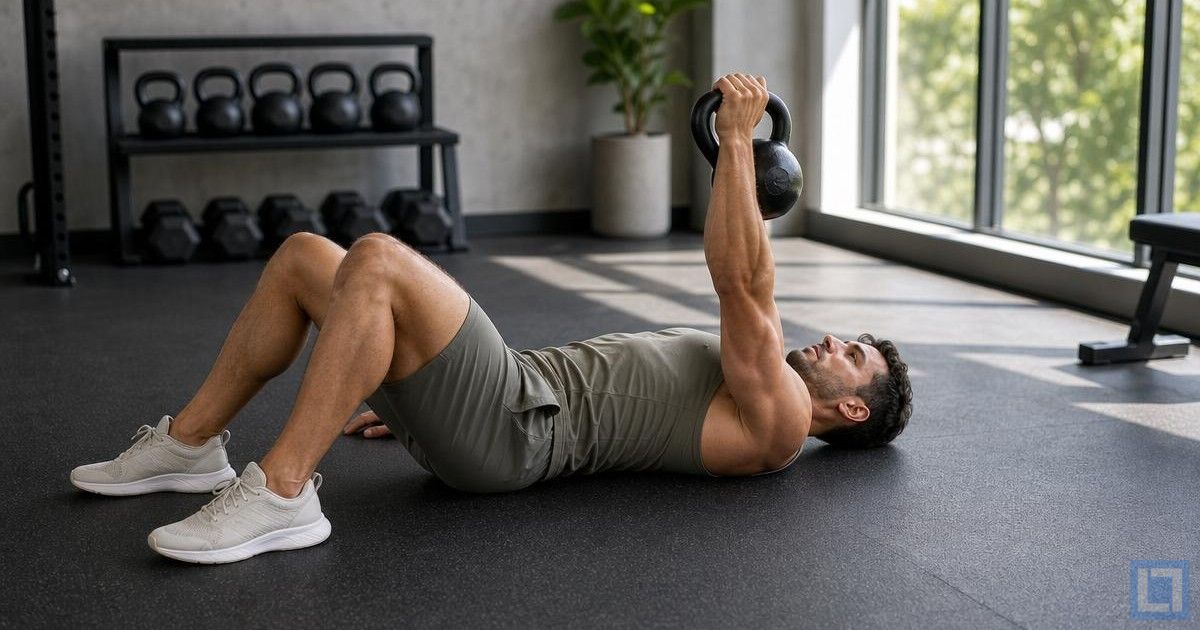
The Kettlebell Lying on Floor Chest Press lies on the floor with two kettlebells held above the chest and presses them up to lockout. The floor limits the eccentric range of motion, which protects the shoulders while still loading the chest effectively.
For lifters without bench access, the floor press is the most accessible kettlebell chest exercise that exists. The protected range at the bottom makes the lift appropriate even for lifters with shoulder issues that limit deeper pressing. It is the foundation of any kettlebell-only chest program.
Lie flat on the floor with kettlebells held above the chest in the rack position. Press both kettlebells straight up to lockout. Lower under control until the elbows touch the floor. The floor sets the bottom range; do not bounce off it. Use heavier weight here than on the bottoms-up variation.
Kettlebell Floor Fly

The Kettlebell Floor Fly lies on the back with kettlebells in each hand and performs a fly motion (arms wide and back together). The floor protects against overstretching while the bells loaded with proper chest fly mechanics produce significant chest stretch and contraction.
Flies complement pressing variations by hitting the chest through stretch and adduction rather than pressing alone. The floor fly is the kettlebell version of the dumbbell or cable fly, and it produces similar results with no bench required. It pairs well with the floor press in any kettlebell chest program.
Lie flat with kettlebells held above the chest with palms facing each other. Lower the bells out to the sides in a wide arc until the upper arms touch the floor. Squeeze the chest to bring the bells back together. Move under control; flies are about chest stretch and contraction, not heavy weight.
Kettlebell Press Up

The Kettlebell Press Up performs a push-up with one or both hands gripping a kettlebell handle on the floor. The kettlebell handle adds grip work on top of the standard push-up pattern and slightly elevates the hand position, which extends the range of motion at the bottom.
For advanced lifters who have outgrown standard push-ups, the kettlebell press up is a strong progression. The added grip demand and slightly extended range of motion produces stronger chest, tricep, and shoulder development than the standard push-up. It also serves as a useful coordination drill for kettlebell training in general.
Set kettlebells on the floor at the standard push-up hand position. Grip the handles and perform the push-up with hands on the bells. The slightly elevated hand position allows the chest to descend further than a standard push-up. Maintain a tight body line throughout.
Kettlebell Plyo Pushup

The Kettlebell Plyo Pushup performs an explosive push-up where the hands push off two kettlebells, briefly leaving the floor before landing back on the kettlebells. The plyometric demand develops explosive pressing power on top of the strength work.
For athletes and lifters chasing pressing power, kettlebell plyo pushups produce stronger chest power than standard push-ups can match. The combination of explosive concentric and absorbing eccentric phases trains the chest and triceps to produce force rapidly, which transfers to athletic performance.
Set up in push-up position with hands on kettlebells. Lower the chest to the bells, then explode upward off the bells, briefly leaving the floor. Land softly back on the kettlebells with bent elbows. Do not lock out hard on the catch. Use 3 to 5 explosive reps per set.
Kettlebell One Arm Floor Press

The Kettlebell One Arm Floor Press lies on the floor with one kettlebell held above the chest and presses it to lockout one arm at a time. The unilateral position catches strength imbalances and forces the core to brace against the asymmetric load.
Single-arm pressing variations earn a place in any complete chest program. The unilateral loading produces stronger imbalance-correction than bilateral pressing, and the core demand from bracing against the asymmetric load adds significant trunk training to the chest exercise. Run it for 3 sets of 8 to 12 reps per side.
Lie flat on the floor with one kettlebell held above the chest. Press the kettlebell straight up to lockout. Lower under control until the elbow touches the floor. Keep the body braced and avoid letting the trunk twist or roll during the rep.
Kettlebell Deep Push Up

The Kettlebell Deep Push Up sets two kettlebells on the floor at the push-up hand position and performs push-ups with the hands gripping the bells. The elevated hand position allows the chest to descend below the level of the kettlebells, producing significantly deeper range of motion than a standard push-up.
The deep push-up is one of the most effective bodyweight chest exercises that exists for advanced lifters. The increased range of motion produces stronger chest stretch and contraction patterns than standard push-ups, and the kettlebell-handle grip adds forearm work to the chest pattern. Pair with regular push-ups for variety.
Set kettlebells on the floor at standard push-up hand position. Grip the handles and lower the chest below the level of the kettlebell handles. The increased range produces deeper chest stretch. Press back to lockout. Maintain tight body position throughout.
Kettlebell Alternating Press On Floor

The Kettlebell Alternating Press On Floor lies on the floor with two kettlebells and presses them alternately rather than simultaneously. While one bell presses up, the other rests in the rack position. The alternating pattern adds significant core demand because each rep loads only one side at a time.
Alternating pressing is the kettlebell equivalent of dumbbell alternating press patterns, with the added grip demand of the kettlebell handle. The asymmetric loading throughout each set produces stronger core work than bilateral pressing while still hitting the chest with significant load. Run it for 3 sets of 12 to 16 alternating reps.
Lie flat with two kettlebells in the rack position above the shoulders. Press one kettlebell up while keeping the other in the rack. Lower the pressed kettlebell back to the rack as you press the other up. Continue alternating throughout the set.
Kettlebell One Arm Bench Press

The Kettlebell One Arm Bench Press lies on a bench with one kettlebell held above the chest and presses it to lockout. The unilateral bench press position allows deeper range of motion than the floor variation while maintaining the unilateral loading pattern.
For lifters with bench access, the one-arm bench press is the most direct unilateral chest exercise that exists. The combination of bench-allowed range, kettlebell grip demand, and unilateral loading produces results that bilateral barbell pressing cannot match. Run it for 3 to 4 sets of 6 to 10 reps per side.
Lie on a flat bench with one kettlebell held above the chest. Press the kettlebell straight up to lockout. Lower under control to the chest level. The bench allows deeper range than the floor variation; use this range fully. Keep the body braced; the asymmetric load wants to twist the torso.
Kettlebell Extended Range One Arm Press on Floor

The Kettlebell Extended Range One Arm Press on Floor places a low platform under the working shoulder during a one-arm floor press, which extends the bottom range past where the floor normally stops the rep. The added range produces significantly more chest stretch than the standard floor press.
For lifters who want bench-press-style range without bench access, the extended-range floor press is the closest substitute. A 2 to 3-inch riser under the shoulder is enough to clear the elbow and allow the kettlebell to descend past the chest level. Most lifters find this version particularly effective for chest stretching at the bottom of the rep.
Place a low riser under the working shoulder. Lie on the floor with one kettlebell held above the chest. Press the kettlebell straight up to lockout. Lower to the floor, allowing the elbow to descend below the riser line for extended stretch. The non-working arm rests on the floor.
How To Program These Workouts
A productive kettlebell chest session pulls five to seven exercises from the list above. A balanced session includes one heavy bilateral press (floor press), one fly motion (floor fly), one unilateral press (one-arm floor press or bench press), one push-up variation (deep push-up or plyo pushup), and a finisher (bottoms-up press for shoulder health).
Train chest two to three times per week. Kettlebell chest training recovers faster than barbell chest training because the loads are typically moderate compared to barbell pressing. Three sessions per week (Monday/Wednesday/Friday) works for most lifters; advanced lifters can sometimes handle four sessions if total volume per session stays moderate.
For more chest programming, see our best dumbbell chest workouts and best bodyweight chest workouts. To browse the equipment library, explore our kettlebell exercises collection.
Final Thoughts
The best kettlebell chest workouts deliver complete chest development without specialized gym equipment. The combination of pressing, flies, and push-up variations covers the full chest function in a way most barbell-only programs miss. For home lifters, kettlebells are the most versatile chest-training equipment available.
Pay attention to grip and stability on the bottoms-up and one-arm variations. The kettlebell handle demands tight grip throughout the rep, which produces forearm and shoulder stability gains that transfer to nearly every other lift in the program. Light weight done right on these exercises produces better long-term results than heavy weight done sloppy.
Frequently Asked Questions
What kettlebell weight should I use for chest workouts?
For most intermediate lifters, a pair of 16 to 24 kg kettlebells (35 to 53 pounds each) covers most chest exercises well. Floor press uses heavier weight; bottoms-up press and flies use lighter weight (8 to 16 kg). The right weight is whatever allows clean reps in your target range with one or two reps in reserve.
Can kettlebells build a big chest?
Yes, especially for beginners and intermediates. The floor press, deep push-up, and one-arm bench press all produce real chest growth when programmed with progressive overload. Advanced lifters chasing maximum chest size sometimes benefit from adding barbell bench pressing, but kettlebell chest training produces measurable development for years.
Are kettlebell chest exercises safer than barbell?
Generally yes, especially for the floor press variations. The protected range of motion at the bottom (the floor stops the rep before the shoulders overstretch) makes kettlebell pressing safer for lifters with shoulder issues that limit barbell bench pressing. The unilateral variations also catch strength imbalances bilateral barbell work hides.
How often should I train chest with kettlebells?
Two to three times per week works for most lifters. Kettlebell chest training recovers faster than barbell training; spacing volume across multiple sessions produces faster growth than once-weekly high-volume sessions. Pair kettlebell chest days with back or pull days for balanced upper-body programming.
Do I need a bench for kettlebell chest workouts?
No. Most exercises in this list work on the floor. A bench expands the options (one-arm bench press, fly with extended range), but the core chest-training pattern works fine with floor pressing only. For home lifters without a bench, kettlebell chest training is one of the most effective options available.