Kettlebells are uniquely well-suited for leg training. The chest-loaded goblet position, the unilateral hinge variations, and the explosive pressing patterns combine to cover every major leg function in one piece of equipment. The best kettlebell leg workouts use this versatility to build the quads, hamstrings, glutes, and calves with no rack or barbell required.
Below are ten effective kettlebell leg exercises that cover bilateral squatting, unilateral leg work, hip-hinging, and explosive power. Together they form a complete leg training program that fits into any home gym or garage with nothing more than one or two kettlebells.
Kettlebell Single Leg Step Up

The Kettlebell Single Leg Step Up holds a kettlebell at the chest or in one hand and steps up onto a sturdy bench with one leg, fully driving the body up before lowering under control. The unilateral pattern hits each leg independently with significant load.
Step-ups are one of the most efficient unilateral leg builders that exist. The bench-height range of motion produces deep hip flexion and full extension on each rep, which builds the glutes and quadriceps through their full functional range. The kettlebell loading keeps the exercise moving with progressive overload.
Step up onto a sturdy bench (knee-height or slightly higher) with one foot planted firmly. Drive through the front heel to bring the body to standing fully on the bench. Lower under control by stepping back down. Complete all reps on one leg before switching, or alternate as preferred.
Kettlebell Single Leg Deadlift

The Kettlebell Single Leg Deadlift holds a kettlebell in one hand and hinges forward on one leg while the opposite leg extends back as a counterweight. The unilateral hinge pattern builds hamstring strength and balance simultaneously.
Single-leg deadlifts catch hamstring strength imbalances that bilateral hinging hides and produce the kind of unilateral hip strength that transfers to running, jumping, and athletic movement. They also build the deep core stabilizers that maintain spinal position under asymmetric load.
Stand on one leg with a kettlebell in the opposite hand. Hinge forward at the hip while extending the back leg behind for counterbalance. Keep the back flat and the standing leg with a slight knee bend. Reverse to standing. Switch sides on the next set.
Kettlebell Kickstand One Leg Deadlift

The Kettlebell Kickstand One Leg Deadlift uses a modified single-leg position where the back foot rests lightly on the ground for balance, with most of the load on the front leg. The kickstand position retains most of the unilateral loading benefit while making balance easier than a pure single-leg deadlift.
For lifters who struggle with the balance demand of pure single-leg deadlifts, the kickstand variation is the right call. The simpler balance allows heavier loads, which produces stronger hamstring development without sacrificing the unilateral pattern. Most lifters can use 20 to 50 percent more weight on the kickstand version.
Set up with one foot planted firmly on the floor and the back foot resting lightly with toes touching the ground. Hinge forward at the hip with a kettlebell in the opposite hand. Keep most of the weight on the front leg. Reverse to standing.
Kettlebell Single Leg Glute Bridge Pullover

The Kettlebell Single Leg Glute Bridge Pullover combines two movements: a single-leg glute bridge with a pullover motion holding a kettlebell. Lying on the back with a kettlebell held in both hands, you simultaneously bridge the hips while pulling the kettlebell over the head and back.
Combined movements like this earn a place in time-efficient programs because they hit multiple muscle groups simultaneously. The single-leg glute bridge loads each glute individually, while the pullover motion adds lat and chest work. The result is a movement that hits the entire posterior chain plus upper-body pulling in one rep.
Lie on the back with one foot planted on the floor and the other extended out. Hold a kettlebell in both hands above the chest. Bridge the hips up while simultaneously lowering the kettlebell behind the head. Reverse the motion to return to start. Switch sides on the next set.
Kettlebell One Legged Deadlift
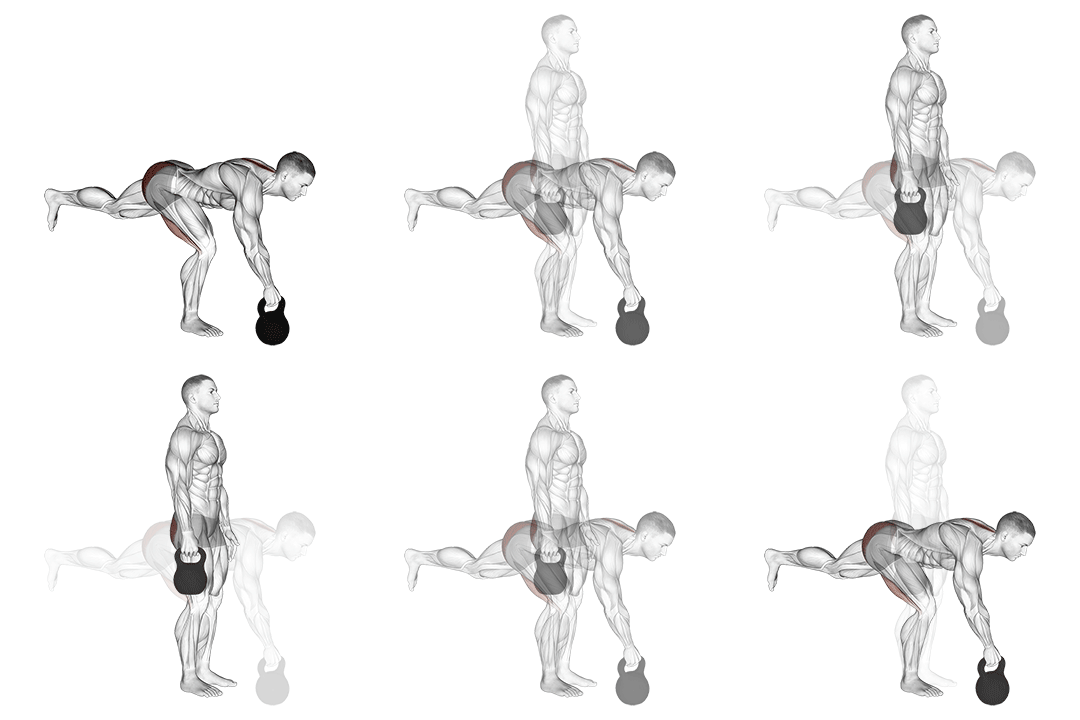
The Kettlebell One Legged Deadlift performs a deadlift while balancing entirely on one leg, with the kettlebell held in front of the body. The fully unilateral pattern produces the most direct strength loading on each leg with no counterweight assistance from the opposite limb.
For experienced lifters who have mastered the kickstand and standard single-leg variations, the one-legged deadlift is the most demanding hamstring exercise that exists. The pure unilateral loading builds the kind of leg strength that transfers directly to athletic performance and protects against the leg-length asymmetries that develop with bilateral training alone.
Stand on one leg with a kettlebell held in front of the body. Hinge forward at the hip while extending the back leg behind. Keep the back flat and the standing leg with a slight knee bend. Touch the kettlebell toward the floor at the bottom. Reverse to standing.
Kettlebell Step Up

The Kettlebell Step Up holds kettlebells at the sides and steps up onto a sturdy bench or box with one leg, driving the body up and bringing the trailing leg up to a standing position. Bilateral loading allows heavier weight than single-leg variations.
Step-ups train each leg independently while the bilateral loading allows heavier total weight. The combination produces strong leg strength gains that transfer to walking, running, and stair-climbing patterns. They also build glute strength better than most squat variations because the back leg is unloaded at the top.
Step up onto a sturdy bench with one foot planted firmly. Drive through the front heel to bring the body to standing on the bench. Lower under control. Alternate legs on each rep or complete all reps on one leg before switching.
Kettlebell Double Jerk

The Kettlebell Double Jerk holds two kettlebells at the shoulders and uses leg drive to push them overhead, then drops the body under the bells as the arms lock out. The exercise trains explosive lower-body power alongside overhead pressing, which makes it valuable in leg-focused sessions.
Most leg exercises train slow grinding strength. The double jerk adds explosive power, which is the function the legs perform during sprinting, jumping, and most athletic movements. Combining slower compound work (squats, lunges) with explosive power training (jerks) produces more complete leg development than either alone.
Hold two kettlebells in the rack position at the shoulders. Dip the legs slightly while keeping the torso vertical. Drive the legs straight to push the kettlebells upward, then drop the body under as the arms lock out. Stand to complete the rep. Use moderate weight; the technique is the limiting factor.
Kettlebell Goblet Squat

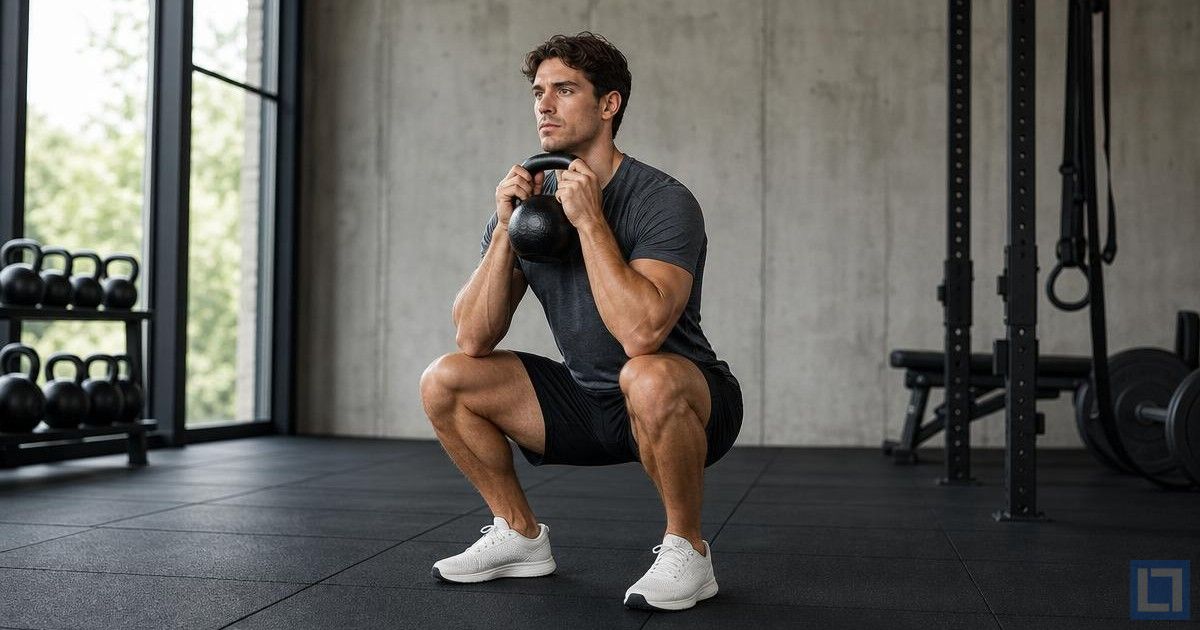
The Kettlebell Goblet Squat holds a single kettlebell at the chest with both hands and squats to roughly parallel depth. The chest-loaded position keeps the torso upright through the squat, which makes it one of the most accessible lower-body compound movements that exists.
For dedicated leg sessions without barbell access, the goblet squat is the foundation. The vertical loading produces full-range squat mechanics with appropriate weight for most lifters. Run it for 3 to 4 sets in the 8 to 12 rep range as the primary squat variation.
Hold the kettlebell at the chest with both hands. Squat to parallel depth or below with feet shoulder-width and chest tall. Drive up through the whole foot. Keep the elbows tucked inside the knees at the bottom.
Kettlebell Split Squat

The Kettlebell Split Squat takes a long stance with one foot forward and one back, then drops straight down by bending both knees. The split position creates significant unilateral loading on the front leg while the back leg provides only balance support.
Split squats are the foundation of unilateral leg training. They produce more direct loading on each leg than walking lunges (which split the load between balance and movement) and require less mobility than Bulgarian split squats (which elevate the back foot). They are the cleanest unilateral leg exercise for most lifters.
Take a long stance with one foot forward and one back, with feet roughly hip-width apart laterally. Drop straight down by bending both knees, lowering the back knee toward the floor. Drive through the front heel to stand. Complete all reps on one leg before switching.
Kettlebell Forward Lunge

The Kettlebell Forward Lunge holds kettlebells at the sides and steps forward into a long lunge, dropping the back knee toward the floor before pressing back to standing. The forward stepping pattern adds dynamic loading on top of the basic lunge mechanics.
Forward lunges complement static split squats by adding the dynamic stepping component. Each rep starts and ends in standing position, which trains the leg through both eccentric (controlled descent) and concentric (drive back) loading patterns. They produce slightly more functional strength than static variations.
Take a forward step into a long lunge. Drop straight down rather than forward, lowering the back knee toward the floor. Drive through the front heel to push back to standing. Alternate sides on each rep, or complete all reps on one leg before switching.
How To Program These Workouts
A productive kettlebell leg session pulls six to seven exercises from the list above. A balanced session includes one bilateral squat (goblet squat), one unilateral squat (split squat or forward lunge), one bilateral hinge (sumo deadlift, not in this list), one unilateral hinge (single-leg or kickstand deadlift), one explosive movement (double jerk or step-up), and finishers (loaded carries or higher-rep work).
Train legs two to three times per week. Heavy kettlebell leg work recovers within 48 to 72 hours for most lifters; the moderate weight relative to barbell training allows higher frequency than barbell-heavy programming. Pair with upper-body kettlebell sessions for a balanced full-body program.
For more leg programming, see our best dumbbell leg workouts and best kettlebell workouts. To browse the equipment library, explore our kettlebell exercises collection.
Final Thoughts
The best kettlebell leg workouts produce real lower-body development without requiring a rack, barbell, or specialized equipment. The combination of bilateral and unilateral patterns, slow strength work and explosive power, hits every leg function the body uses during athletic movement. For home lifters, kettlebells are the most efficient piece of leg-training equipment available.
Stay patient with technique. Kettlebell leg exercises (especially the unilateral variations and the explosive jerks) are more technical than barbell equivalents and take longer to master. The lifters who get the most from kettlebell leg training are the ones who put the practice into the foundational movements (goblet squat, single-leg deadlift, split squat) before progressing to advanced variations.
Frequently Asked Questions
What kettlebell weight should I use for leg workouts?
For most intermediate lifters, a 24 to 32 kg kettlebell (53 to 70 pounds) covers most leg exercises well. Goblet squats, lunges, and step-ups work well in that range. Single-leg deadlifts often require lighter weight (12 to 20 kg) due to the balance demand. Pick a weight that allows clean reps in your target range with a few reps in reserve.
Can kettlebells build big legs?
Yes, especially for beginners and intermediates. The goblet squat, single-leg deadlift, and split squat all produce real leg growth when programmed with progressive overload. Advanced lifters chasing maximum leg size sometimes benefit from adding barbell squatting and deadlifting for heavier loading, but kettlebell leg training produces measurable development for years.
How heavy can I go with kettlebells for legs?
Most lifters cap out at the 32 to 40 kg range for goblet squats simply because holding heavier weight at the chest becomes impractical. For step-ups and split squats with kettlebells at the sides, much heavier loads work; some lifters carry 70+ pounds per hand. The practical limits depend on grip strength and balance more than absolute leg strength.
How often should I train legs with kettlebells?
Two to three times per week works for most lifters. Heavy kettlebell leg work recovers within 48 to 72 hours; spacing volume across multiple sessions produces faster growth than once-weekly high-volume sessions. A Monday/Thursday or Tuesday/Friday split fits most schedules.
Do I need single-leg work if I do squats and lunges?
Yes, single-leg deadlifts add hip-hinge unilateral loading that lunges and squats do not provide. Lunges train the squat pattern unilaterally; single-leg deadlifts train the hinge pattern unilaterally. Both functions need direct work for complete leg development. Including at least one single-leg deadlift variation per leg session covers the gap.