Building bigger calves requires understanding the calf’s two-muscle anatomy (gastrocnemius – the visible upper calf muscle, soleus – the deeper muscle below the gastrocnemius) and applying training principles that develop both: standing calf raises with straight knees for the gastrocnemius (the muscle is most active when knees are straight), seated calf raises with bent knees for the soleus (the gastrocnemius deactivates with bent knees), heavy compound loading through machine variations, high-volume training (the calves are well-conditioned from daily walking and require substantial volume), high-frequency training (calves recover quickly), and full range of motion with deep stretch and full contraction. The calves are notoriously stubborn for many lifters – genetics play a substantial role, and calves develop slower than other muscle groups even with proper training. Most lifters who want bigger calves are making one or more of these mistakes: training only standing variations (missing soleus development), running insufficient volume (calves need more volume than other muscle groups), training calves too infrequently, using partial range of motion (limiting calf stretch), or treating calves as an afterthought. The fix involves: 1) standing variations for gastrocnemius (3 to 4 different variations), 2) seated variations for soleus (2 to 3 different variations), 3) heavy machine work for compound loading, 4) high frequency (3+ times per week), 5) high volume (16 to 24+ sets per week), and 6) full range of motion with deep stretch and full contraction.
Below are ten of the most effective exercises for building bigger calves, covering standing variations for gastrocnemius (standing calf raise, dumbbell standing calf raise, barbell standing calf raise, Smith standing leg calf raise, lever donkey calf raise), seated variations for soleus (Smith seated calf raise, dumbbell seated calf raise, lever seated one leg calf raise), heavy compound work (sled calf press on leg press), and dynamic high-volume work (jump rope). Together they form a complete calf-growth program. A 20 to 30-minute calf-focused session pulled from this list, performed 2 to 4 times per week, produces strong calf development for any lifter focused on building bigger calves.
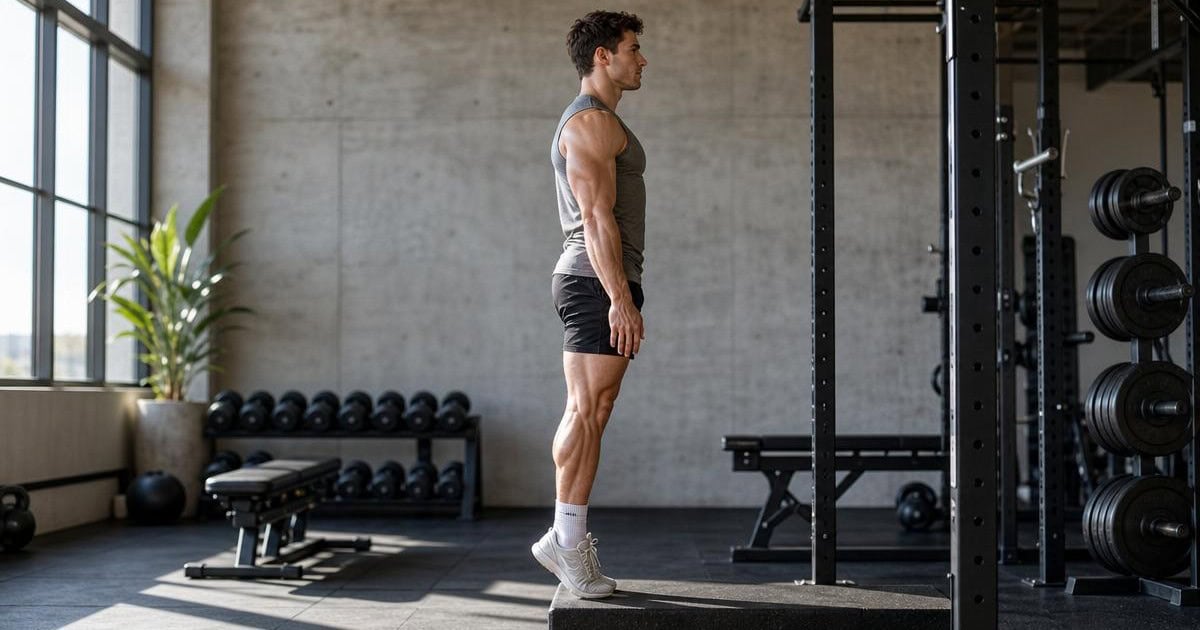
Standing Calf Raise

The Standing Calf Raise performs standing calf raises. The pattern is foundational direct calf isolation work.
For calf growth, the standing calf raise is foundational. The standing position emphasizes the gastrocnemius (the visible upper calf muscle). Run it for 4 sets of 12 to 20 reps as primary calf mass work.
Stand with feet hip-width on a flat surface (or with the balls of the feet on a slightly elevated surface like a step for added range of motion). Rise up onto the toes by extending the ankles. The calves work hard through plantar flexion – the gastrocnemius is the primary mover when knees are straight (standing position). Squeeze the calves hard at peak extension. Lower under control to a deep stretch at the bottom. The pattern is foundational for calf development – the standing position with straight knees emphasizes the gastrocnemius which creates the visible calf bulk.
Smith Seated Calf Raise

The Smith Seated Calf Raise performs seated calf raises on a Smith machine. The seated position emphasizes the soleus.
For calf growth, the seated calf raise emphasizes the soleus (the deeper calf muscle). The seated position with bent knees deactivates the gastrocnemius and isolates soleus. Run it for 3 to 4 sets of 12 to 15 reps as primary soleus work.
Sit on a bench under a Smith machine bar with the bar across the upper thighs (use a pad). Place the balls of the feet on a slightly elevated surface (small platform). Rise up onto the toes by extending the ankles. The soleus works hard through plantar flexion – the bent-knee position deactivates the gastrocnemius and isolates the soleus. Squeeze hard at peak. Lower under control to a deep stretch. The pattern is critical for complete calf development – many lifters undertrain the soleus, but it accounts for substantial calf size and is required for complete development.
Dumbbell Standing Calf Raise

The Dumbbell Standing Calf Raise performs standing calf raises with dumbbells. The pattern produces accessible calf work.
For calf growth, the dumbbell standing calf raise provides accessible calf isolation. Run it for 3 sets of 15 to 20 reps as accessible calf work.
Stand with feet hip-width holding dumbbells at the sides. Rise up onto the toes by extending the ankles. The calves work hard through plantar flexion. Squeeze hard at peak. Lower under control. The pattern provides accessible direct calf work and unilateral variations (one leg at a time with one dumbbell) address imbalances. The dumbbell loading is limited compared to barbell or machine versions, so use higher rep ranges for adequate stimulus.
Barbell Standing Calf Raise

The Barbell Standing Calf Raise performs standing calf raises with a barbell on the upper back. The pattern produces heavy bilateral calf loading.
For calf growth, the barbell standing calf raise allows heavy bilateral calf loading. Run it for 3 sets of 12 to 15 reps as heavy compound calf work.
Set up a barbell on the upper back as for a squat. Stand with feet hip-width with the balls of the feet on a small platform/plate. Rise up onto the toes by extending the ankles. The calves work hard through plantar flexion under heavy bilateral load. Squeeze hard at peak. Lower under control to a deep stretch. The pattern allows for heavier loading than dumbbell variations and provides bilateral balanced stimulus. Use moderate to heavy weights with strict form.
Sled Calf Press on Leg Press

The Sled Calf Press on Leg Press performs calf raises on a leg press machine. The pattern allows extreme heavy loading.
For calf growth, the sled calf press allows the heaviest possible calf loading – often heavier than any other variation. Run it for 3 to 4 sets of 12 to 15 reps as heavy compound calf work.
Set up on a leg press machine. Position the feet on the lower portion of the platform with only the balls of the feet on the platform. Press the platform up by extending the knees fully. From the locked-knee position, allow the heels to drop down (deep stretch) then press back up by extending the ankles. The calves work hard through plantar flexion under extreme bilateral load. Squeeze hard at peak. The pattern allows for the heaviest possible calf loading – often double or triple bodyweight – and is one of the most effective calf mass-builders.
Smith Standing Calf Raise

The Smith Standing Leg Calf Raise performs standing calf raises on a Smith machine. The pattern produces stable bilateral calf loading.
For calf growth, the Smith standing calf raise provides stable bilateral calf loading. Run it for 3 sets of 12 to 15 reps as stable bilateral calf work.
Set up a Smith machine bar at upper back height. Position the bar across the upper back. Stand with feet hip-width with the balls of the feet on a small platform/plate. Rise up onto the toes by extending the ankles. The calves work hard through plantar flexion. The Smith machine stability eliminates balance challenges and isolates the calf work. Squeeze hard at peak. Lower under control. The pattern provides controlled bilateral calf loading that complements free-weight calf variations.
Lever Donkey Calf Raise

The Lever Donkey Calf Raise performs donkey calf raises on a machine. The bent-over position emphasizes the gastrocnemius stretch.
For calf growth, the donkey calf raise emphasizes calf stretch through the bent-over position. Run it for 3 sets of 12 to 15 reps as stretch-emphasized calf work.
Set up on a lever donkey calf raise machine. Position the upper body in the bent-over position with the upper back against the pad. Place the balls of the feet on the platform. Rise up onto the toes by extending the ankles. The bent-over position emphasizes the calf stretch at the bottom of the motion. The gastrocnemius works hard. Squeeze hard at peak. Lower under control to deep stretch. The pattern produces unique calf loading through the stretch-emphasized bent-over position.
Dumbbell Seated Calf Raise

The Dumbbell Seated Calf Raise performs seated calf raises with dumbbells on the knees. The seated position emphasizes the soleus.
For calf growth, the dumbbell seated calf raise provides accessible soleus work. Run it for 3 sets of 15 to 20 reps as accessible soleus work.
Sit on a bench. Place the balls of the feet on a small platform with knees bent at 90 degrees. Hold dumbbells on the knees/upper thighs (use a pad). Rise up onto the toes by extending the ankles. The soleus works hard through plantar flexion – the bent-knee position deactivates the gastrocnemius and isolates the soleus. Squeeze hard at peak. Lower under control to deep stretch. The pattern provides accessible soleus work for those without access to a seated calf raise machine.
Jump Rope

The Jump Rope performs jump rope skipping. The pattern produces high-volume dynamic calf work.
For calf growth, jump rope provides high-volume dynamic calf work that complements heavy isolation. Run it for 3 to 5 rounds of 3 minutes as dynamic calf work.
Hold the jump rope handles in each hand with the rope behind. Swing the rope forward over the head and jump over it as it passes under the feet. Continue rhythmically. The calves work hard through repeated plantar flexion at high volume. The pattern provides high-volume dynamic calf work that complements heavy isolation training. Most calf-focused programs include jump rope as conditioning work that also produces calf loading. Build to longer rounds (3 to 5 minutes) for endurance plus calf work.
Lever Seated One Leg Calf Raise

The Lever Seated One Leg Calf Raise performs unilateral seated calf raises. The pattern produces unilateral soleus work.
For calf growth, the unilateral seated calf raise produces single-leg soleus work and addresses imbalances. Run it for 3 sets of 12 to 15 reps per leg as unilateral soleus work.
Sit on a seated calf raise machine with one foot on the platform and the pad over the knee. The other leg rests on the floor. Rise up onto the toes of the working leg by extending the ankle. The soleus of the working leg works hard. Squeeze hard at peak. Lower under control to deep stretch. Switch legs between sets. The pattern allows for unilateral focus on each leg individually and addresses left/right imbalances common in calf development.
How To Program These Workouts
A productive calf-growth session pulls 5 to 7 exercises from the list above. A common balanced session: standing calf raise (gastrocnemius), Smith seated calf raise (soleus), sled calf press on leg press (heavy compound), barbell standing calf raise (heavy bilateral), jump rope (dynamic). For mass focus: sled calf press, barbell standing calf raise, Smith seated calf raise, lever donkey calf raise. For complete development: include both standing and seated variations, heavy machine work, and high-volume work. Run heavy compound work for 3 to 4 sets of 8 to 15 reps, standing variations for 3 to 4 sets of 12 to 20 reps, seated variations for 3 to 4 sets of 12 to 20 reps, dynamic work for 3 to 5 rounds of 3 minutes. Total session covers 20 to 28 working sets focused on calf development.
Train calves 2 to 4 times per week for optimal growth. Calves recover quickly relative to other muscle groups and respond to higher frequency training than most muscles. Most successful calf-growth programs include 2 to 4 weekly calf sessions – typically distributed as: 1) one heavy day focused on compound machine work (sled, barbell), 2) one volume day focused on standing variations, 3) one volume day focused on seated/soleus work, 4) optional fourth day or daily light calf work. Total weekly volume should be 16 to 24+ working sets across both gastrocnemius and soleus. Calves can handle (and require) more volume than most other muscle groups for growth.
For broader programming, see our how to grow your calves and best calf workouts. For specific work, see our best soleus exercises.
Final Thoughts
Building bigger calves requires applying the right training principles consistently over time: standing variations for gastrocnemius (with straight knees), seated variations for soleus (with bent knees), heavy compound loading through machine work, high-volume training (more than other muscle groups), high frequency (calves recover quickly), and full range of motion with deep stretch and full contraction. The combination of standing calf raises (multiple variations), seated calf raises (multiple variations), sled calf press, donkey calf raise, and jump rope covers every functional pattern of the calves and produces broader development than any single exercise approach. Most lifters who consistently apply these principles see measurable calf growth within 16 to 20 weeks (calves are notoriously slower-growing than other muscle groups), often producing visible improvements in calf size and definition. For lifters who have struggled to grow their calves despite training, the combination of higher frequency (3+ times per week), increased volume (20+ sets per week), both standing AND seated variations, and full range of motion typically breaks through the plateau.
Stay focused on full range of motion and patience over time. The most common mistake lifters make in calf training is using partial range of motion (small bouncing reps with no deep stretch or full contraction). The fix: complete every calf rep with full deep stretch at the bottom (heel below the platform level) and full toe extension at the top (rising as high as possible on the toes). Use moderate weights with strict form rather than heavy weights with partial range. Combined with high frequency, high volume, and long-term patience (calves grow slower than other muscle groups), proper full-range work produces the calf development that ego-driven heavy partials never achieve.
Frequently Asked Questions
Why aren’t my calves growing?
Most lifters with stubborn calves make one or more of these mistakes: 1) training only standing variations and missing soleus work, 2) running insufficient volume (calves need more volume than other muscles), 3) training calves only once per week, 4) using partial range of motion (small bouncing reps without deep stretch), 5) treating calves as accessory work. The fix: include both standing AND seated variations, train calves 2 to 4 times per week, target 16 to 24+ weekly working sets, use full range of motion with deep stretch and full contraction. Note that genetics play a substantial role in calf development – some lifters will always struggle relative to others.
How often should I train calves?
2 to 4 times per week works for most lifters, with higher frequency producing better growth. Calves recover quickly relative to other muscles and respond to higher frequency training. Most successful calf programs include 2 to 4 weekly sessions distributed as: heavy day (machine compound), standing volume day, seated/soleus volume day, optional dynamic day. Total weekly volume should be 16 to 24+ sets across both gastrocnemius and soleus. The calves can handle (and require) more volume than most other muscles for growth.
What’s the best calf exercise?
Sled calf press on leg press allows the heaviest possible loading and is foundational for calf mass. Standing calf raises (with straight knees) emphasize the gastrocnemius (visible upper calf). Seated calf raises (with bent knees) isolate the soleus (deeper calf, accounts for substantial size). Combined with donkey calf raises and jump rope, these form the foundation of complete calf development. The fastest gains come from combining heavy compound work with high-volume isolation across both gastrocnemius and soleus.
Should I train calves with bent or straight knees?
Both – they target different muscles. Standing variations (straight knees) emphasize the gastrocnemius (the visible upper calf muscle that creates the obvious calf shape). Seated variations (bent knees) emphasize the soleus (the deeper calf muscle that accounts for substantial calf size). Most successful calf-growth programs include both variations regularly – typically allocating equal volume between standing and seated variations for complete calf development. Skipping either variation produces incomplete calf development.
How heavy should I lift for calves?
Mix of very heavy compound and moderate volume work. Sled calf press allows extreme heavy loading (often double bodyweight) for 8 to 15 reps. Standing calf raises use moderate to heavy weights for 12 to 20 reps. Seated calf raises use moderate weights for 12 to 20 reps. The goal is full range of motion with strict form rather than maximum weight – quality reps with full stretch and contraction beat ego-driven partial reps. Most successful programs progressively load all exercises while maintaining full range of motion.