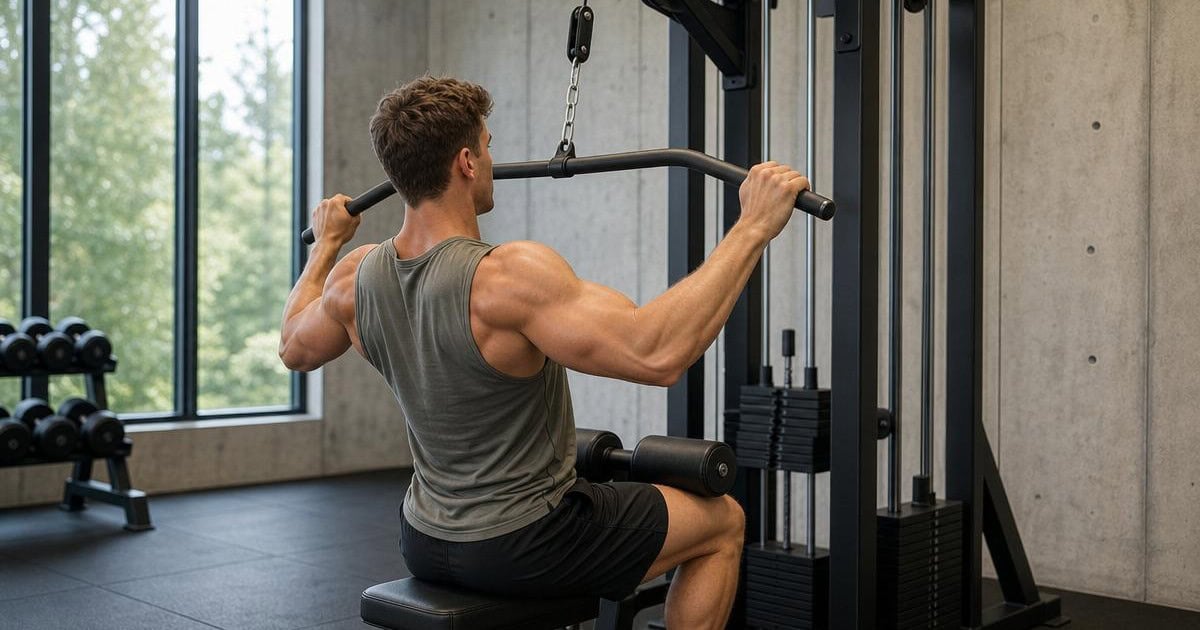
Machine lat training produces real lat development and V-taper width through patterns that load the lats with the unique advantages machines offer: chest-supported positions that eliminate lower-back fatigue, fixed bar paths on Smith machines for heavy compound rowing, dedicated lat pulldown machines for direct vertical pulling, T-bar row machines for compound thickness work, and assisted pull-up machines for scalable bodyweight progression. The format works particularly well for lats because the muscle responds to varied angle loading, and machines deliver dedicated loading patterns for each angle: pulldowns (vertical), rows (horizontal), unilateral variations (concentrated work), and pull-up progressions (compound mass). Most lifters who consistently train machine lat work 1 to 2 times per week alongside compound pulling movements see measurable lat development, improved V-taper width, better pulling performance, and stronger overall back development within 8 to 12 weeks. The combination of pulldowns, rows, T-bar variations, and assisted pull-ups produces broader lat development than free-weight-only programs for many lifters.
Below are ten effective machine lat exercises that cover lat pulldown variations (lever front pulldown, lever multi mode rope lat pulldown), seated row patterns (lever seated row, lever unilateral row), Smith machine row variations (Smith bent over row, Smith bent over narrow pronated grip row, Smith reverse grip bent over row), T-bar variations (lever T-bar reverse grip row), unilateral lateral pulling (lever one arm lateral high row), and assisted pull-up progressions (assisted parallel close grip pull up). Together they form a complete machine lat program that hits the lats through every available machine pattern. A 30 to 45-minute session pulled from this list, performed 1 to 2 times per week, produces strong lat development.
Lever Front Pulldown

The Lever Front Pulldown performs lat pulldowns on a plate-loaded machine. The pattern produces strong direct lat loading through vertical pulling motion.
For machine lat training, the front pulldown is the foundational lat width exercise. The pattern hits the lats through pulldown motion with quad-friendly setups. Run it for 4 sets of 8 to 12 reps as primary lat width work in any machine lat session.
Sit at a lat pulldown machine with the thighs secured under the pads and the feet planted. Grip the handles with both hands at slightly wider than shoulder-width with an overhand grip. Pull the handles down to the upper chest by retracting the shoulder blades and driving the elbows down toward the ribs. Squeeze the lats hard at the bottom. Return to extended position under control. The pattern produces strong lat width loading.
Lever Seated Row

The Lever Seated Row performs horizontal rows on a chest-supported plate-loaded machine. The pattern produces strong combined lat and upper back loading with chest support.
For machine lat training, the seated row is the foundational compound back exercise. The pattern hits the lats through horizontal pulling. Run it for 3 to 4 sets of 8 to 12 reps as primary compound back mass work.
Sit at a seated row machine with the chest pressed against the pad and the feet planted on the foot pads. Grip the handles with both hands. The arms start extended forward. Pull the handles back toward the lower chest by retracting the shoulder blades and bending the elbows back. Squeeze the upper back and lats hard at the top of the row. Lower under control. The chest support eliminates lower-back compensation.
Smith Bent Over Row
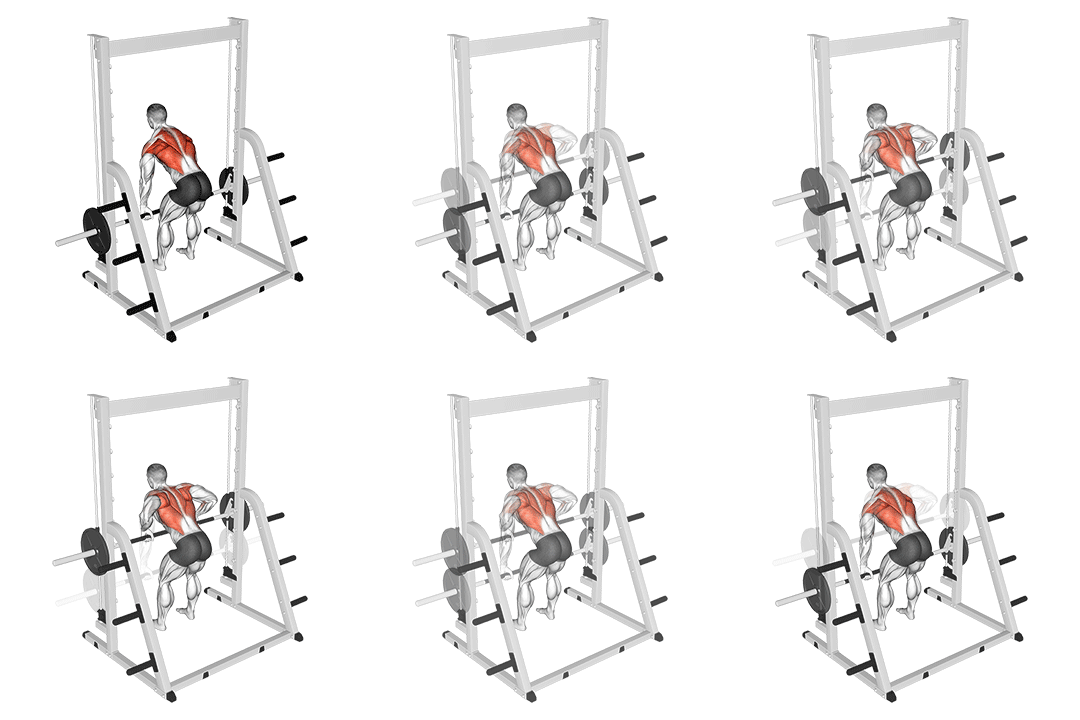
The Smith Bent Over Row performs bent-over rows on a Smith machine. The fixed bar path produces strong back loading with reduced stabilizer demands.
For machine lat training, the Smith bent over row produces strong compound back work with machine stability. The fixed bar path eliminates stabilizer demands. Run it for 3 sets of 8 to 12 reps as compound back work.
Position the bar at thigh level on a Smith machine. Stand with feet hip-width and grip the bar with both hands at shoulder-width using an overhand grip. Hinge forward at the hips with a flat back. Pull the bar up toward the lower chest by retracting the shoulder blades and bending the elbows back. The fixed bar path keeps the body stable. Lower under control. The pattern produces strong compound back work.
Lever Multi Mode Rope Lat Pulldown

The Lever Multi Mode Rope Lat Pulldown performs lat pulldowns with a rope attachment on a multi-mode lever machine. The rope attachment allows neutral grip and rope-pull-apart at the bottom.
For machine lat training, the multi-mode rope lat pulldown produces strong combined lat and rear delt work. The rope attachment allows pulling apart for peak contraction. Run it for 3 sets of 10 to 12 reps as combined back work.
Sit at a multi-mode lever lat pulldown with a rope attached. Grip the rope ends with both hands using a neutral grip (palms facing each other). Pull the rope down to the upper chest while pulling the rope ends apart at the end. The rope split produces strong rear delt and middle trap engagement at peak contraction along with lat loading. Squeeze the back hard at the bottom. Return under control.
Lever One Arm Lateral High Row

The Lever One Arm Lateral High Row performs unilateral high rows on a lever machine. The unilateral pattern allows greater concentration on each lat individually plus addresses imbalances.
For machine lat training, the one-arm lateral high row produces strong unilateral lat work. The pattern hits each lat individually. Run it for 3 sets of 8 to 12 reps per arm as unilateral lat work.
Set up at a lateral high row machine with one handle. Position one knee or chest against the pad for stability. Grip the handle with one hand. Pull the handle down and back by retracting the shoulder blade and bending the elbow back. The unilateral position allows concentrated work on each lat. Squeeze hard at peak retraction. Return under control. Switch sides between sets.
Smith Bent Over Narrow Pronated Grip Row

The Smith Bent Over Narrow Pronated Grip Row performs bent-over rows with a narrow overhand grip on a Smith machine. The narrow grip emphasizes the lower lats and inner back.
For machine lat training, the Smith narrow pronated row produces lower lat emphasis. The narrow grip recruits different lat fibers than wide-grip variants. Run it for 3 sets of 8 to 12 reps as lower lat emphasis work.
Position the bar at thigh level on a Smith machine. Stand with feet hip-width and grip the bar with both hands close together (within shoulder-width or narrower) using an overhand grip. Hinge forward at the hips with a flat back. Pull the bar up toward the lower abdomen by retracting the shoulder blades and bending the elbows back. The narrow grip produces stronger lower lat recruitment. Squeeze hard at the top. Lower under control.
Lever T-Bar Reverse Grip Row

The Lever T-Bar Reverse Grip Row performs T-bar rows with an underhand (palms-up) grip on a T-bar machine. The reverse grip emphasizes the lower lats and adds bicep involvement.
For machine lat training, the reverse grip T-bar row produces lower lat loading combined with bicep work. The reverse grip recruits different lat fibers. Run it for 3 sets of 8 to 12 reps as lower lat emphasis work.
Set up at a T-bar row machine. Grip the handles with both hands using a reverse (palms-up) grip. Hinge forward at the hips with a flat back. Pull the bar up toward the lower abdomen by retracting the shoulder blades and bending the elbows back. The reverse grip produces stronger lower lat recruitment. Squeeze hard at the top. Lower under control. The reverse grip produces stronger biceps involvement along with the back work.
Smith Reverse Grip Bent Over Row

The Smith Reverse Grip Bent Over Row performs bent-over rows with an underhand grip on a Smith machine. The reverse grip emphasizes the lower lats with stable bar path.
For machine lat training, the Smith reverse grip row produces strong lower lat emphasis. The reverse grip plus fixed bar path keeps strict form. Run it for 3 sets of 8 to 12 reps as lower lat focus work.
Position the bar at thigh level on a Smith machine. Stand with feet hip-width and grip the bar with both hands at shoulder-width using an underhand (palms-up) grip. Hinge forward at the hips with a flat back. Pull the bar up toward the lower abdomen by retracting the shoulder blades and bending the elbows back. The underhand grip plus fixed bar path produces strong lower lat work with bicep involvement. Lower under control.
Lever Unilateral Row

The Lever Unilateral Row performs unilateral rows on a plate-loaded machine with one arm at a time. The pattern produces strong unilateral back loading with machine stability.
For machine lat training, the unilateral row produces strong concentrated back work per side. The unilateral pattern allows greater concentration. Run it for 3 sets of 8 to 12 reps per arm as unilateral back mass work.
Set up at a unilateral row machine with the chest pressed against the pad. Grip one handle with one hand. The other hand can rest on a handle or the side of the machine. Pull the handle back by retracting the shoulder blade and bending the elbow back. Squeeze the back hard at the top of the row. Lower under control. Switch sides between sets. The unilateral pattern produces strong concentrated back work with the stability of machine path.
Assisted Parallel Close Grip Pull Up

The Assisted Parallel Close Grip Pull Up performs close-grip parallel-handle pull-ups on an assisted machine. The neutral parallel grip emphasizes the lower lats and adds bicep involvement.
For machine lat training, the assisted parallel close grip pull-up produces strong lower lat loading with bicep emphasis. The neutral grip is biomechanically efficient. Run it for 3 sets of 6 to 10 reps as compound lower lat work.
Set up at an assisted pull-up machine with parallel handle attachments. Adjust the assistance weight (more assistance = lighter relative load). Position on the assistance pad. Grip the handles with neutral parallel grip (palms facing each other) close together. Pull the body up by retracting the shoulder blades and bending the elbows. The close neutral grip produces strong lower lat and bicep involvement. Lower under control.
How To Program These Workouts
A productive machine lat session pulls 5 to 6 exercises from the list above based on training goals. A common balanced session: lever front pulldown (width), lever seated row (compound mass), lever T-bar reverse grip row (lower lats), lever unilateral row (unilateral), assisted parallel close grip pull up (compound vertical). For width focus: lever front pulldown, lever multi mode rope lat pulldown, lever one arm lateral high row. Run pulldown work for 3 to 4 sets of 8 to 12 reps, row work for 3 to 4 sets of 8 to 12 reps, unilateral work for 3 sets of 8 to 12 reps per arm, and pull-up progression work for 3 sets of 6 to 10 reps. Total session covers 14 to 20 working sets focused on lat development.
Train machine lat work 1 to 2 times per week as part of broader pulling-day programming. The lats recover reasonably quickly but accumulate fatigue from compound pulling work that activates them substantially. Most successful programs include machine lat work either: 1) on a dedicated pull day with machines as primary movements, 2) split across 2 pull days, or 3) at the end of a back day after compound free-weight pulls. Keep training time under 35 to 45 minutes per session. Machines allow productive higher rep ranges due to reduced stabilizer fatigue.
For broader lat programming, see our best lat workouts and how to grow your lats. For specific pull-up work, see our best pull up workouts.
Final Thoughts
The best machine lat workouts deliver real lat development and V-taper width through patterns that effectively load the lats with the unique advantages machines offer: chest-supported positions, fixed bar paths, dedicated machines, easy progressive overload, and unilateral options. The combination of pulldowns, rows, T-bar variations, and pull-up progressions covers every functional pattern of the lats and produces broader development than free-weight-only programs for many lifters. For lifters who want measurable lat size and V-taper improvements, want to add high-volume work without excessive lower-back fatigue, want to address muscle imbalances through unilateral machine work, or want to break through plateaus in lat development, dedicated machine lat work is one of the most effective options available.
Stay focused on shoulder blade retraction and full range of motion. The most common machine lat training mistakes include using arms instead of leading with the lats (which limits lat recruitment) and using partial range of motion (which limits lat loading and stretch). The fix: initiate every pulldown and row by retracting the shoulder blades first (think ‘pull with the lats, not the arms’), and complete every rep with full range from extended stretched position to fully contracted with hard back squeeze. Quality reps with proper lat engagement produce stronger lat development than ego-driven heavy weights with poor form.
Frequently Asked Questions
Are machines effective for lat development?
Yes very effectively. Machines produce real lat development through pulldown variations (direct lat loading), row patterns (compound back work), T-bar variations (lower lat emphasis), unilateral options (addressing imbalances), and assisted pull-up progressions. The chest-supported positions and fixed bar paths allow aggressive lat loading without lower-back fatigue. Most successful lat programs include machine work alongside pull-ups and barbell rows. Many lifters build excellent lats with machines as primary movements when free weights are limited.
Lever pulldown machine vs cable lat pulldown?
Both effective; choose based on availability. Lever (plate-loaded) pulldowns produce direct loading with simple plate progression. Cable lat pulldowns allow constant tension and pin-stack progression. Most successful lat programs include whichever is available with consistent progressive overload. Lifters with access to both can use cable pulldowns for variety and constant tension, and lever pulldowns for straightforward heavy loading. The combination produces broader development than either alone.
How heavy should machine lat work be?
Heavy for compound work, moderate for unilateral. Compound machine lat work like seated rows can use heavy weights (often 150 to 350+ pounds for advanced lifters). Lat pulldowns can use heavy weights (often 150 to 300+ pounds). T-bar rows use heavy weights (often 90 to 270+ pounds). Unilateral work uses moderate weights (50 to 150 pounds per arm). Most successful programs progressively load all exercises until 8 to 12 reps becomes challenging, then increase weight.
How often should I train lats with machines?
One to two machine lat sessions per week works for most lifters. The lats recover reasonably quickly but accumulate fatigue from compound pulling work that activates them substantially. Most successful programs include machine lat work either on a dedicated pull day, split across 2 pull days, or at the end of a back day after compound free-weight pulls. Three or more weekly heavy lat sessions typically produces overuse issues.
Are assisted pull-up machines effective for lats?
Yes effectively for lifters at appropriate strength levels. Assisted pull-up machines allow scalable bodyweight pull-up loading, which produces strong lat work through compound vertical pulling. The pattern is particularly valuable for lifters who can not yet do unassisted pull-ups, and even advanced lifters benefit from assisted high-volume work. Most successful programs include assisted pull-ups as primary compound work, building progressively from heavy assistance toward unassisted pull-ups over months of training.