Lower body resistance band training produces real lower body strength and stability development through the variable-tension equipment that combines progressive loading with strong stabilizer engagement throughout every rep. The format works particularly well for lower body training because resistance bands provide accommodating resistance (heaviest at peak contraction, lightest at the start), which produces strong contracted-position loading that fixed weights cannot match. Bands also enable specific lower-body training functions: glute medius isolation (clams), foot and ankle stability work (external rotation, inversion, plantar flexion), and explosive plyometric loading (long jump, jump squat) that adds resistance to athletic motions. Most lifters who consistently train lower body bands see measurable strength and stability improvements within 8 to 12 weeks of consistent training.
Below are ten effective lower body resistance band exercises that cover bilateral compounds (band squat), unilateral compounds (band lunge), glute work (clam, elevated glute bridge), explosive power (band jump squat, band long jump), posterior chain (45-degree hyperextension), and foot/ankle stability (external rotation, inversion, plantar flexion). Together they form a complete lower body band training program. A 35 to 45-minute session pulled from this list produces strong combined lower body strength, stability, and power stimulus across every major lower body function.
Resistance Band Lunge
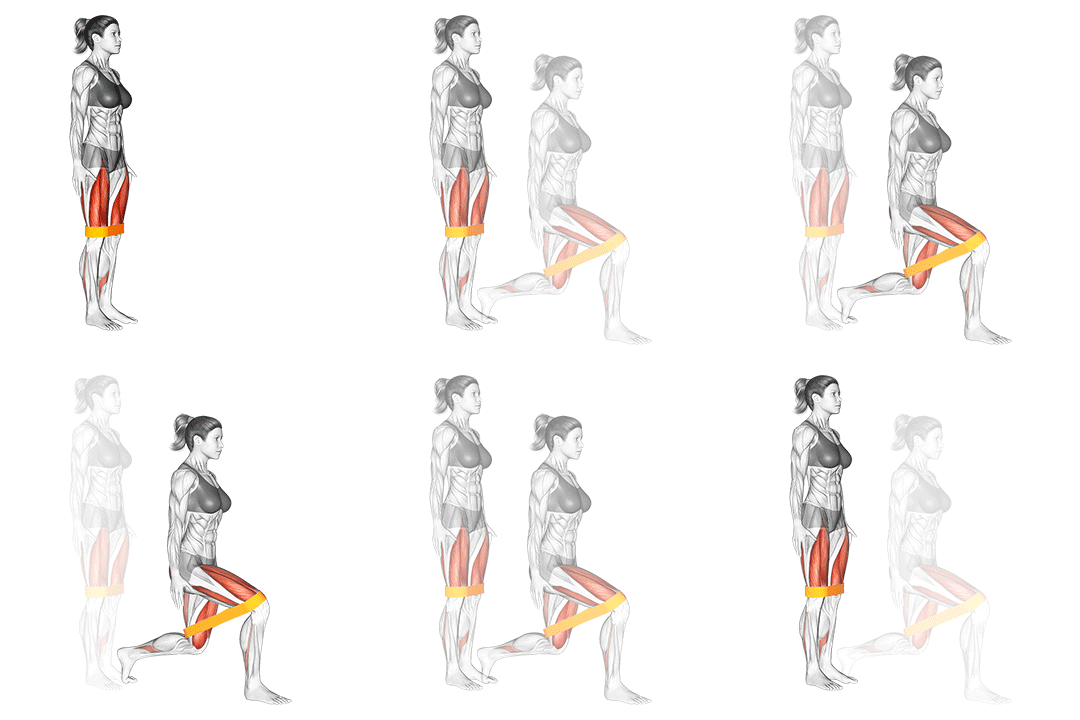
The Resistance Band Lunge performs forward lunges while a band provides resistance at the front foot. The added band tension increases the demand on the front-leg quadriceps, glutes, and hamstrings throughout the lunge motion.
For lower body band training, the band lunge is the foundational unilateral compound exercise. The pattern hits each leg independently with progressive resistance that builds strong leg strength. Run it for 3 sets of 8 to 10 reps per leg as primary unilateral leg work.
Anchor a resistance band at low position. Step into a lunge stance with one foot forward and the band attached around the front foot or ankle. Step forward into a lunge by lowering the back knee toward the floor. Drive through the front foot to step back to the start. Switch sides between sets.
Resistance Band Clam

The Resistance Band Clam loops a resistance band around the legs above the knees and lies on the side, then opens the top knee away from the bottom knee against the band resistance. The pattern produces direct glute medius loading.
For lower body band training, the band clam is the foundational glute medius isolation exercise. The pattern hits the side glutes through pure external rotation under band resistance. Run it for 3 sets of 10 to 15 reps per side as glute medius isolation work.
Loop a resistance band around the legs above the knees. Lie on one side with knees bent at roughly 90 degrees and feet stacked. Open the top knee away from the bottom knee by contracting the glute medius. Lower under control. Keep feet stacked throughout. Switch sides between sets.
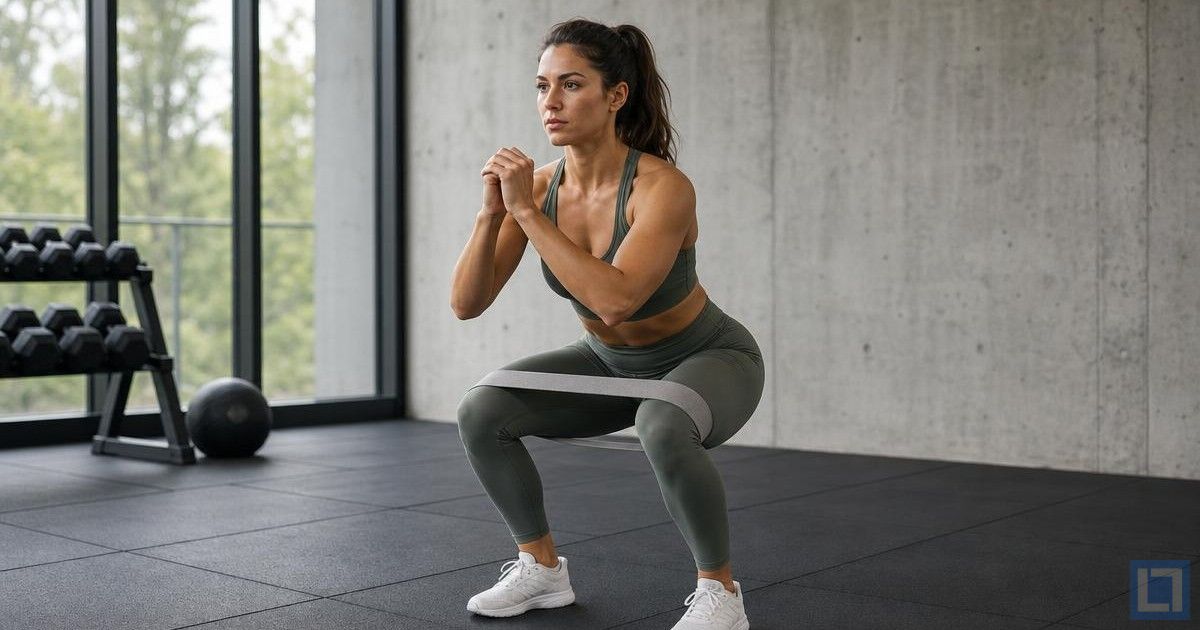
Resistance Band Squat

The Resistance Band Squat performs squats while standing on a resistance band with the band ends held at the shoulders. The added band tension increases the demand throughout the squat motion, especially at lockout.
For lower body band training, the band squat is the foundational bilateral compound. The accommodating resistance increases as the lifter stands up, which makes the lockout the hardest position. Run it for 3 sets of 8 to 12 reps as primary band leg work.
Stand on a resistance band with feet shoulder-width. Hold the band ends at the shoulders with elbows pointed forward. Squat down by sitting the hips back while bending the knees. Drive back to standing through the whole foot, fighting against the band tension at lockout.
Resistance Band Jump Squat

The Resistance Band Jump Squat performs explosive jump squats while standing on a resistance band with the band ends held at the shoulders. The added band tension increases the demand at lockout and produces strong loaded plyometric loading.
For lower body band training that includes explosive work, the band jump squat produces strong loaded plyometric loading that translates to athletic explosive power. Run it for 3 sets of 6 to 8 reps as explosive lower-body work with conservative band resistance.
Stand on a resistance band with feet shoulder-width and the band ends at the shoulders. Squat down by sitting the hips back. Drive up explosively, jumping straight up while the band fights the upward motion. Land softly with bent knees. Reset before each rep.
Resistance Band Foot External Rotation

The Resistance Band Foot External Rotation sits with a resistance band looped around the foot and anchored to the side, then rotates the foot outward against the band resistance. The pattern strengthens the lower-leg stabilizers.
For lower body band training that includes ankle stability, the foot external rotation produces direct lower-leg stabilizer loading. The pattern strengthens muscles that support ankle stability and complement traditional calf work. Run it for 3 sets of 12 to 15 reps per side as lower-leg stability work.
Sit on a bench or chair with a resistance band looped around the foot and anchored to one side. Rotate the foot outward (away from midline) against the band resistance by externally rotating the ankle. Return under control. Switch sides between sets.
Resistance Band Foot Inversion

The Resistance Band Foot Inversion sits with a resistance band looped around the foot and anchored to the outside, then rotates the foot inward (toward midline) against the band resistance. The pattern strengthens the inner ankle stabilizers.
For lower body band training that includes ankle stability, the foot inversion strengthens the inner ankle stabilizers that complement external rotation work. The combination produces complete ankle stability development. Run it for 3 sets of 12 to 15 reps per side as lower-leg stability work.
Sit on a bench or chair with a resistance band looped around the foot and anchored to the outside (away from midline). Rotate the foot inward (toward midline) against the band resistance by inverting the ankle. Return under control. Switch sides between sets.
Resistance Band Elevated Glute Bridge

The Resistance Band Elevated Glute Bridge places the feet on an elevated surface with a resistance band looped above the knees and performs glute bridges against both gravity and band resistance. The combination produces extreme glute loading.
For lower body band training, the elevated glute bridge with band is one of the most direct glute exercises that exists. The pattern hits the glutes through full hip extension under combined resistance. Run it for 3 sets of 10 to 15 reps as primary glute work.
Loop a resistance band around the legs above the knees. Lie on the back with feet on an elevated surface (bench or box) at knee height. Drive the hips up by contracting the glutes hard while pressing the knees outward against the band. Squeeze the glutes at the top. Lower under control.
Resistance Band 45 Degrees Hyperextension

The Resistance Band 45 Degrees Hyperextension performs hyperextension motion at a 45-degree angle while holding a resistance band that increases the resistance throughout the rep. The pattern hits the lower back, glutes, and hamstrings.
For lower body band training, the hyperextension with band produces strong combined posterior-chain loading. The pattern hits the lower back, glutes, and hamstrings through hip extension. Run it for 3 sets of 10 to 12 reps as posterior-chain work.
Set up at a 45-degree hyperextension bench with a resistance band held in front of the chest and anchored below. Hinge at the hips to lower the upper body until the abs are stretched fully. Drive back up to a fully extended position by contracting the glutes and lower back against the band resistance. Lower under control.
Resistance Band Long Jump

The Resistance Band Long Jump anchors a resistance band behind the body and performs explosive long jumps forward against the band resistance. The pattern produces extreme explosive lower-body power development.
For lower body band training that includes explosive power, the band long jump is one of the most demanding power exercises that exists. The accommodating resistance during the jump produces strong fast-twitch leg fiber recruitment. Run it for 3 sets of 4 to 6 reps as advanced explosive lower-body work.
Anchor a resistance band behind the body at hip height. Stand facing forward with the band attached around the waist. Squat down briefly to load the legs. Jump explosively forward and up against the band resistance, landing as far forward as possible. Reset before each rep.
Resistance Band Foot Plantar Flexion

The Resistance Band Foot Plantar Flexion sits with a resistance band looped around the foot and held with both hands, then plantar flexes the foot (points the toes) against the band resistance. The pattern strengthens the calves and front shin muscles.
For lower body band training that includes calf and shin work, the band plantar flexion produces direct calf and shin muscle loading. The pattern hits the muscles that traditional calf work often misses. Run it for 3 sets of 12 to 15 reps per side as foundational calf and shin work.
Sit on the floor with one leg extended and a resistance band looped around the foot. Hold the band ends with both hands at moderate tension. Plantar flex the foot (point the toes away from the body) against the band resistance. Return under control. Switch sides between sets.
How To Program These Workouts
A productive lower body resistance band session pulls 6 to 8 exercises from the list above. A balanced session includes one bilateral compound (band squat), one unilateral compound (band lunge), one glute exercise (clam or elevated glute bridge), one explosive exercise (jump squat or long jump), one posterior chain exercise (45-degree hyperextension), and one to two foot/ankle stability exercises (external rotation, inversion, plantar flexion). Run primary compounds for 3 to 4 sets of 8 to 12 reps; explosive work for 3 sets of 4 to 8 reps; isolation and stability work for 3 sets of 12 to 15 reps. Total session covers 17 to 22 working sets.
Train lower body resistance band sessions 1 to 2 times per week as part of broader leg or full-body programming. The legs recover within 48 to 72 hours of moderate training. Most successful programs include 1 to 2 weekly band leg sessions, which works well as either a complete leg program (for travelers, home gym setups) or as supplementary work alongside traditional gym training. The format is particularly effective for foot/ankle stability and glute medius work that traditional bilateral training often misses.
For broader band programming, see our best resistance band leg workouts and best full body resistance band workouts. For glute-specific band work, see our best resistance band glute workouts.
Final Thoughts
The best lower body resistance band workouts deliver real lower body strength and stability development through portable equipment that produces strong combined loading and stabilizer engagement. The combination of bilateral and unilateral compounds, glute work, explosive power exercises, posterior chain training, and foot/ankle stability work covers every major lower body function and produces broader development than single-modality training. For lifters who want effective lower body training without commercial gym access, want to add foot/ankle stability work that traditional training rarely includes, or are recovering from injuries that limit heavy loading, lower body resistance band training is one of the most accessible and complete options available.
Stay focused on band tension throughout every rep. The most common lower body resistance band training mistake is allowing the band to go slack during the exercise (which eliminates the loading) or using bands too easy to produce real training stimulus. The fix: choose band difficulty that produces challenging tension at the peak-contraction position while still allowing strict form throughout the full range. Quality reps with consistent band tension produce stronger lower body development than reps with band slack or excessive resistance that breaks form.
Frequently Asked Questions
Can resistance bands build leg muscle?
Yes for beginners through intermediate lifters. Resistance bands produce real leg muscle growth for the first 12 to 24 months of consistent training, especially when paired with progressive overload (using harder bands or higher reps over time). Most lifters can build the leg fitness level of someone who lifts weights 2 to 3 days per week using only bands. Advanced lifters chasing maximum leg strength typically benefit from adding free weights, but bands continue to provide useful supplementary stimulus.
How often should I train lower body with bands?
One to two times per week works for most lifters. The legs recover within 48 to 72 hours of moderate training. Most successful programs include 1 to 2 dedicated band leg sessions per week, which works well as either a complete leg program or supplementary work alongside traditional gym training. Daily band leg training typically produces accumulated fatigue without proportional gains.
Are bands good for glute training?
Yes, very effectively. Bands produce excellent glute activation through clams, glute bridges, hip abduction, and squat variations. The lateral resistance from looped bands (above the knees) produces strong glute medius engagement that traditional bilateral training often misses. Most successful glute programs include both band work (for medius and stability) and weighted work (for maximus mass-building).
Can I do leg day with only resistance bands?
Yes, the 10-exercise program above produces a complete leg session covering every major leg muscle and movement pattern. The combination of band squat, lunge, glute bridge, jump squat, hyperextension, and ankle stability work produces strong combined leg stimulus. Most successful band-only leg programs include 4 to 6 exercises per session focused on different leg functions, performed 1 to 2 times per week with progressive overload over time.
What size bands do I need for lower body?
Most lifters need a set of 4 to 5 looped resistance bands ranging from light (10 to 20 pounds equivalent) to very heavy (80 to 150 pounds equivalent) for lower body training. The legs can handle significantly heavier bands than the upper body. Long-loop bands (4 feet) work better for compound exercises (squat, lunge, jump squat); short-loop hip circle bands work better for glute and hip work (clam, bridge). The complete leg-focused band kit costs $30 to $80.