Kettlebell forearm training produces real grip strength and forearm development through the unique combination of carry exercises (which produce sustained grip demand under heavy load) and ballistic exercises (which produce dynamic grip work alongside full-body conditioning). The kettlebell’s offset center of mass (the bell hangs below the handle) produces grip demand that dumbbells and barbells cannot match because the kettlebell tries to rotate during carries and ballistic movements, forcing the forearm muscles to constantly stabilize the bell. The format produces complete forearm development through wrist flexion (wrist curl), sustained gripping (farmer’s carries), dynamic grip work (figure-8s, slingshots), and advanced grip stability (bottoms-up cleans).
Below are ten effective kettlebell forearm exercises that cover direct wrist work (kettlebell wrist curl), bilateral carries (farmer’s carry, farmer’s walk, goblet carry), unilateral carries (overhead carry, unilateral farmer’s walk, suitcase deadlift), dynamic grip exercises (figure-8, slingshot), and advanced grip stability (bottoms-up clean). Together they form a complete kettlebell forearm training program that fits in any setting. A 30 to 45-minute session pulled from this list produces strong grip stimulus combined with significant carryover to athletic and daily-life function.
Kettlebell Wrist Curl

The Kettlebell Wrist Curl sits with the forearm braced against the leg or bench and curls the wrist up by flexing at the wrist while holding a kettlebell. The pattern isolates the forearm flexors through pure wrist flexion.
For kettlebell forearm training, the wrist curl is the foundational direct forearm exercise. The pattern hits the forearm flexors specifically through wrist flexion. Run it for 3 to 4 sets of 12 to 15 reps as primary direct forearm work in any kettlebell forearm session.
Sit on a bench with the forearm braced against the leg or bench, palm facing up. Hold a kettlebell with the hand hanging off the edge. Curl the wrist up by flexing the fingers and wrist. Lower under control by extending the wrist fully. Switch sides between sets.
Kettlebell Overhead Carry

The Kettlebell Overhead Carry holds a kettlebell pressed overhead and walks for distance or time while maintaining the locked-out position. The exercise produces extreme grip demand alongside shoulder stability and core demand.
For kettlebell forearm training that includes carry work, the overhead carry produces strong grip strength development through extended carries with significant load. The pattern translates to athletic positions requiring sustained grip strength. Run it for 3 sets of 20 to 30-second carries per side.
Press a kettlebell overhead with one arm to full lockout. Maintain the locked-out position throughout. Walk forward at a steady pace while keeping the kettlebell directly overhead. Brace the core hard to prevent the kettlebell from drifting forward or back. Switch sides between sets.
Kettlebell Goblet Carry
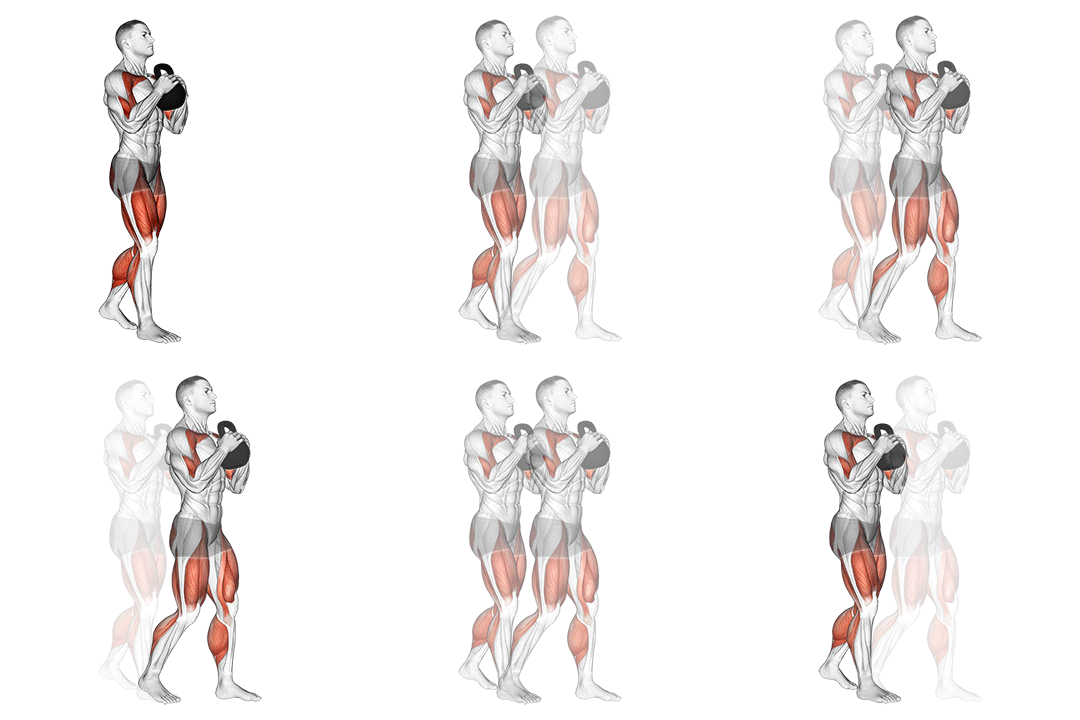
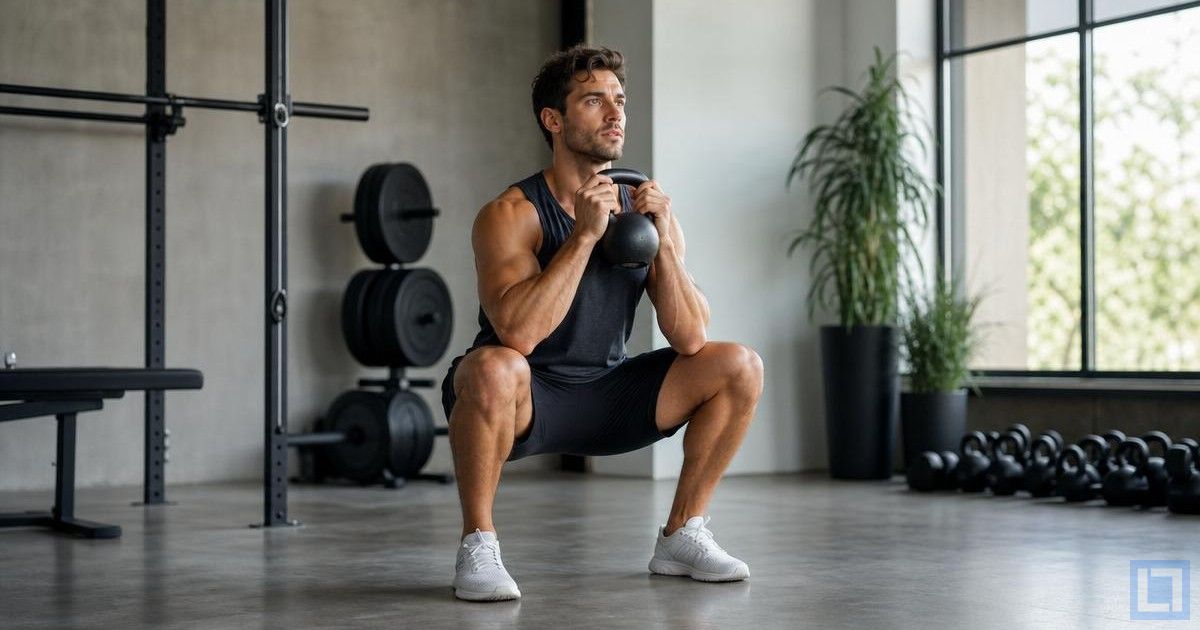
The Kettlebell Goblet Carry holds a kettlebell at chest level in goblet position (held by the horns with both hands at the chest) and walks for distance or time. The pattern produces strong upper-back, core, and grip demand.
For kettlebell forearm training with bilateral grip loading, the goblet carry produces strong combined grip and posture demand. The bilateral handle position trains both forearms simultaneously. Run it for 3 sets of 50 to 100-foot distances or 30 to 45-second carries.
Hold a kettlebell at chest level in goblet position (both hands gripping the horns of the kettlebell with elbows pointed down). Stand tall with shoulders back and chest out. Walk forward at a steady pace while maintaining upright posture. Continue for the prescribed distance or time.
Kettlebell Figure 8

The Kettlebell Figure 8 stands in a partial squat and passes a kettlebell between the legs in a figure-8 pattern, alternating which leg the kettlebell passes inside on each rep. The pattern produces strong grip endurance, rotational core demand, and full-body coordination.
For kettlebell forearm training that includes dynamic grip work, the figure-8 pattern develops grip endurance through continuous gripping under varying angles. The pattern also produces strong full-body coordination demand. Run it for 3 sets of 30 to 45-second intervals as dynamic grip and coordination work.
Stand with feet wider than shoulder-width and knees bent in a partial squat. Hold a kettlebell in one hand. Pass the kettlebell between the legs to the opposite hand, then around the outside of the leg, then back between the legs to the original hand. Continue the figure-8 pattern at a steady tempo.
Kettlebell Farmers Carry

The Kettlebell Farmers Carry holds two kettlebells at the sides and walks for distance or time while maintaining upright posture. The bilateral loading produces extreme grip strength along with trap, core, and full-body conditioning demand.
For kettlebell forearm training, the farmer’s carry is the foundational grip-building exercise. The pattern produces extreme grip strength development through extended carries with heavy bilateral loading. Run it for 3 to 4 sets of 50 to 100-foot distances or 30 to 60-second carries with heavy loading.
Hold heavy kettlebells at the sides with arms extended. Stand tall with shoulders back and chest out. Walk forward at a steady pace while maintaining upright posture and tight grip on the kettlebells. Continue for the prescribed distance or time. Set the kettlebells down with control.
Kettlebell Farmers Walk

The Kettlebell Farmers Walk performs the farmer’s carry pattern with kettlebells, similar to the farmer’s carry but with potentially different distance or pace targets. The pattern produces strong grip strength and full-body conditioning.
For kettlebell forearm training that varies the carry stimulus, the farmer’s walk allows different programming targets than the standard farmer’s carry (longer distances, faster pace, different rest periods). Run it for 3 sets of 100-foot distances or 60-second walks as endurance grip work.
Hold heavy kettlebells at the sides with arms extended. Stand tall with shoulders back. Walk forward at a steady pace while maintaining upright posture. Continue for the prescribed distance. Variations include longer distances, faster pace, or different rest intervals than standard farmer’s carries.
Kettlebell Slingshot

The Kettlebell Slingshot stands with a kettlebell held in front of the body and passes the kettlebell from one hand to the other behind the body in a circular motion. The pattern produces strong dynamic grip work and shoulder mobility.
For kettlebell forearm training that includes dynamic grip work, the slingshot pattern develops grip strength through continuous handoffs under load. The pattern also produces strong shoulder mobility work. Run it for 3 sets of 30 to 45-second intervals per direction.
Stand tall with feet shoulder-width and a kettlebell held in one hand. Pass the kettlebell behind the body to the opposite hand in a smooth circular motion. Continue passing the kettlebell from hand to hand around the body in a slingshot pattern. Switch directions between sets.
Kettlebell Unilateral Farmers Walk

The Kettlebell Unilateral Farmers Walk holds a single kettlebell at one side and walks for distance, similar to a suitcase carry. The unilateral loading produces extreme anti-lateral-flexion core demand alongside grip strength work.
For kettlebell forearm training that catches strength imbalances, the unilateral farmer’s walk produces strong unilateral grip and core loading. The pattern hits the lateral core stabilizers significantly along with the working forearm. Run it for 3 sets of 50-foot distances per side or 30-second carries per side.
Hold a single kettlebell at one side with arm extended. Stand tall with shoulders level (avoid leaning toward the loaded side). Walk forward at a steady pace while maintaining upright posture and level shoulders. Continue for the prescribed distance. Switch sides between sets.
Kettlebell Bottoms Up Clean From the Hang Position

The Kettlebell Bottoms Up Clean From the Hang Position cleans a kettlebell from the hang position to the rack with the kettlebell upside-down (bottoms up), which requires extreme grip strength and stability to control the kettlebell. The pattern produces extreme grip and coordination demand.
For advanced kettlebell forearm training, the bottoms-up clean is one of the most demanding grip exercises that exists. The inverted kettlebell position requires extreme forearm strength and grip stability to control. Run it for 3 sets of 5 to 8 reps per side as advanced grip work.
Stand with a kettlebell in one hand at hip level (hang position). Clean the kettlebell to the rack position by driving through the legs, but catch it with the bell pointing straight up (bottoms up) instead of resting on the forearm. Brace the hand and forearm hard to keep the kettlebell stable in the inverted position. Lower under control.
Kettlebell Suitcase Deadlift

The Kettlebell Suitcase Deadlift performs deadlifts with a kettlebell held at one side, similar to picking up a suitcase. The unilateral loading produces strong grip work alongside anti-lateral-flexion core demand.
For kettlebell forearm training that combines pulling strength and grip work, the suitcase deadlift is one of the most efficient exercises that exists. The pattern hits the entire posterior chain along with the working forearm. Run it for 3 sets of 6 to 8 reps per side as combined pulling and grip work.
Stand with a kettlebell beside one foot. Hinge at the hips and bend the knees to grip the kettlebell handle. Drive through the legs to lift the kettlebell to standing while maintaining level shoulders. Lower under control by hinging back at the hips. Switch sides between sets.
How To Program These Workouts
A productive kettlebell forearm session pulls six to eight exercises from the list above. A balanced session includes one direct forearm exercise (wrist curl), one bilateral carry (farmer’s carry), one overhead carry, one unilateral carry (suitcase deadlift or unilateral farmer’s walk), one dynamic grip exercise (figure-8 or slingshot), and one advanced grip exercise (bottoms-up clean). Run wrist curls for 3 sets of 12 to 15 reps; carries for 3 sets of 50 to 100-foot distances or 30 to 60-second intervals; dynamic exercises for 3 sets of 30 to 45-second intervals; bottoms-up cleans for 3 sets of 5 to 8 reps per side.
Train kettlebell forearm sessions 1 to 2 times per week as dedicated sessions or integrated into broader strength programming. The forearms recover within 24 to 48 hours of moderate training and get significant indirect work from any pulling or carrying exercise (deadlifts, rows, dumbbell carries). Most successful programs include 1 to 2 dedicated forearm sessions per week alongside broader strength training. The format works particularly well as morning routines or post-workout finishers because grip work doesn’t require the recovery time that compound lifts need.
For broader forearm programming, see our how to grow your forearms. For broader kettlebell training, see our best kettlebell workouts and best kettlebell arm workouts.
Final Thoughts
The best kettlebell forearm workouts deliver real grip strength and forearm development through the unique kettlebell loading that produces grip demand fixed equipment cannot match. The combination of direct wrist work, sustained carries, dynamic grip exercises, and advanced stability training covers every major forearm function and produces complete development. For lifters who want serious grip strength that translates to heavier deadlifts, stronger pulling, better carry capacity, and improved daily-life function, dedicated kettlebell forearm training is one of the most effective approaches available.
Stay focused on the offset loading that makes kettlebells unique. The most common kettlebell forearm training mistake is treating kettlebells like dumbbells and missing the unique grip demand that the offset center of mass produces. The fix: emphasize exercises that take advantage of the kettlebell’s rotation tendency (figure-8, slingshot, bottoms-up clean) rather than just substituting kettlebells into dumbbell exercises. The kettlebell produces stronger forearm development specifically because of the offset loading; respecting that pattern through exercise selection drives the unique forearm gains.
Frequently Asked Questions
Are kettlebells good for forearms?
Yes, very effectively. The kettlebell’s offset center of mass (the bell hangs below the handle) produces grip demand that dumbbells and barbells cannot match because the kettlebell tries to rotate during carries and ballistic movements. Most lifters who consistently do kettlebell forearm work see measurable grip strength and forearm development within 6 to 8 weeks. The combination of carries, dynamic exercises, and advanced grip work produces complete forearm development.
How heavy should kettlebells be for forearm work?
Most lifters need 16 to 24 kg (35 to 53 pounds) kettlebells for productive forearm training. Lighter kettlebells (8 to 12 kg) work for direct wrist exercises and dynamic grip work; heavier kettlebells work for carries and advanced grip exercises. Most successful kettlebell forearm setups include 2 to 3 different weights for varied training. The right weight is whatever produces challenging grip demand throughout the prescribed reps or duration.
How often should I train forearms with kettlebells?
One to two times per week works for most lifters. The forearms recover within 24 to 48 hours of moderate training and get significant indirect work from any pulling exercise. Most successful programs include 1 to 2 dedicated forearm sessions per week alongside broader strength training. Daily forearm training works for advanced practitioners but typically produces accumulated fatigue without proportional gains for most lifters.
Will kettlebell carries help my deadlift?
Yes, significantly. Grip strength is one of the most common limiting factors for deadlift progress, especially in higher rep ranges. Most lifters who add kettlebell carries to their training see measurable deadlift improvements within 4 to 6 weeks because the increased grip strength allows them to hold heavier weights longer. The combination of farmer’s carries (sustained grip) and bottoms-up cleans (grip stability) produces particularly strong deadlift carryover.
Bottoms-up clean or regular clean for forearms?
Both work; the bottoms-up clean produces stronger grip stability demand because the inverted kettlebell position requires extreme forearm control. Regular cleans produce stronger combined power and grip work. Most successful kettlebell forearm programs include both: regular cleans for foundational power and grip, bottoms-up cleans for advanced grip stability and forearm strength. Beginners should master regular cleans before attempting bottoms-up variations.