BOSU ball training produces real balance, stability, and strength development through the half-dome instability tool that combines the loading of bodyweight or weighted exercises with extreme stabilizer engagement. The format works because the unstable BOSU surface forces continuous adjustment from the deep stabilizer muscles (ankle, knee, hip, core) that traditional fixed-surface training rarely activates significantly. The BOSU also offers dual-side functionality: dome-side-up training emphasizes balance and proprioception (single-leg stands, squats, lunges), while flat-side-up training enables harder versions of pressing and squatting (push-ups gripping the edges, squats with the unstable round bottom). Most lifters who incorporate BOSU training see measurable balance and stability improvements within 4 to 6 weeks of consistent practice.
Below are six effective BOSU ball exercises that cover bilateral leg work (squat on BOSU), unilateral leg work (high-knee lunge, dumbbell split squat with BOSU), foundational balance training (single-leg stand), upper-body work (push-up), and ab work (myotatic crunch). Together they form a complete BOSU training program. The smaller exercise count compared to other workout articles reflects the BOSU’s primary role as a stability tool that complements traditional strength training rather than replaces it. Pull all 6 exercises across BOSU sessions or rotate based on training goals.
Myotatic Crunch on Bosu Ball

The Myotatic Crunch on Bosu Ball performs crunches lying back over the dome of a BOSU ball, which extends the range of motion well below floor level. The pre-stretch position produces stronger ab loading than standard floor crunches.
For BOSU ball training, the myotatic crunch is one of the most effective ab exercises that exists. The extended range of motion (well below the floor crunch start position) hits the abs through a deep stretched starting position. Run it for 3 sets of 10 to 15 reps as primary BOSU ab work.
Position the BOSU ball dome-side-up. Sit on the BOSU and roll back so the lower-back-and-glutes area rests on the dome with the head and shoulders hanging well below. Cross the arms over the chest. Crunch up by contracting the abs through the full range of motion. Lower under control to the deep stretch position.
High Knee Lunge on Bosu Ball

The High Knee Lunge on Bosu Ball performs alternating high-knee lunges with the front foot on the BOSU ball dome. The unstable surface forces strong ankle, knee, and hip stabilizer engagement.
For BOSU ball training, the high-knee lunge develops dynamic stability that translates to athletic single-leg movements. The unstable BOSU surface adds significant balance challenge to the standard lunge motion. Run it for 3 sets of 8 to 10 reps per leg as dynamic single-leg stability work.
Position the BOSU ball dome-side-up. Stand 2 to 3 feet behind the BOSU. Step the lead foot onto the BOSU dome and drop into a lunge position. Drive up through the BOSU while bringing the back knee up high to a standing high-knee position. Lower back into the lunge for the next rep. Switch legs between sets.
Single Leg Stand on Bosu Ball

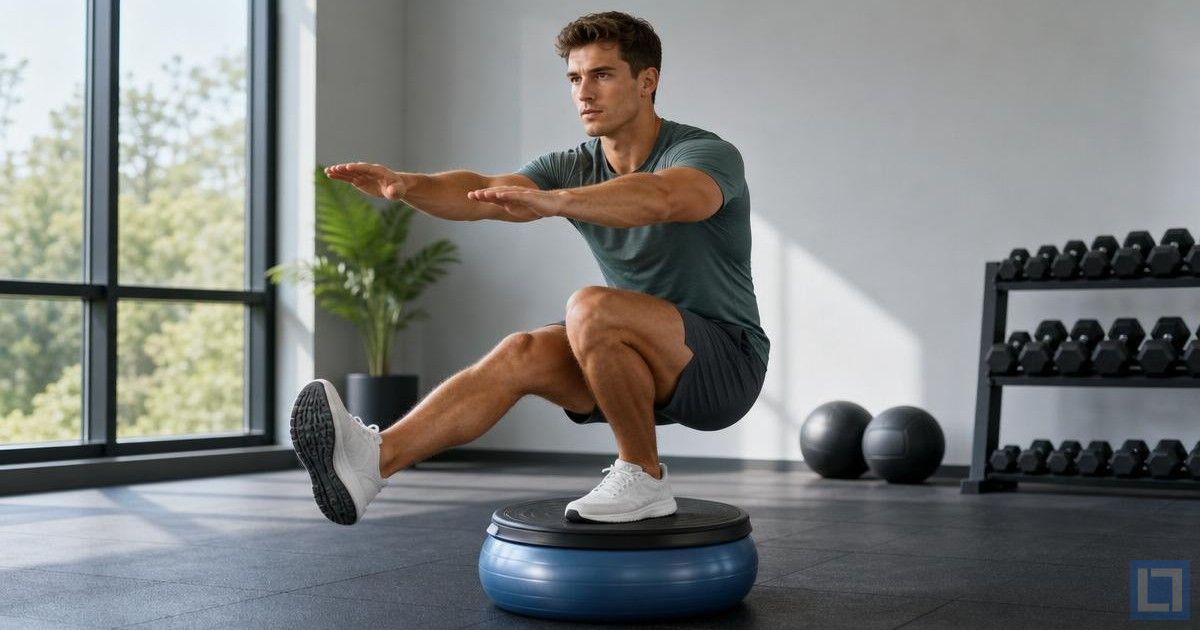
The Single Leg Stand on Bosu Ball balances on one foot on the BOSU ball dome (or flat side) while maintaining stability. The pattern produces extreme ankle, knee, and hip stabilizer demand.
For BOSU ball training, the single-leg stand is the foundational balance exercise. The pattern hits the deep stabilizers that traditional bilateral training cannot reach. Run it for 3 sets of 30 to 60-second holds per leg as foundational stability work.
Position the BOSU ball dome-side-up. Step onto the BOSU with one foot, finding a stable position on the dome. Lift the opposite foot off the floor and balance on the BOSU foot. Maintain the balance position by adjusting through the ankle, knee, and hip. Hold the balance for the prescribed time. Switch sides between sets.
Dumbbell Split Squat Front Foot Elevated with Bosu Ball

The Dumbbell Split Squat with BOSU Ball performs split squats holding dumbbells with the front foot on the BOSU dome. The unstable front foot adds significant balance demand to the loaded split squat.
For BOSU ball training that includes loaded leg work, the BOSU split squat produces strong unilateral leg loading combined with extreme stability demand. The pattern develops the leg strength and stability that translates to athletic single-leg movements. Run it for 3 sets of 8 to 10 reps per leg as primary BOSU leg work.
Position the BOSU ball dome-side-up. Stand with one foot on the BOSU dome and the other foot 2 to 3 feet behind. Hold dumbbells at the sides. Drop straight down by bending the front knee until the back knee approaches the floor. Drive through the front foot to push back to standing. Switch sides between sets.
Push Up on Bosu Ball

The Push Up on Bosu Ball performs push-ups with the hands on the BOSU ball (typically dome-down with hands gripping the flat side edges, or dome-up with hands on the dome). The unstable surface produces strong stabilizer engagement.
For BOSU ball training, the BOSU push-up develops upper-body pressing strength combined with extreme stability demand. The unstable surface hits the chest, shoulder, and core stabilizers that fixed-surface push-ups cannot reach. Run it for 3 sets of 8 to 12 reps as primary BOSU pressing work.
Position the BOSU ball dome-side-down (flat side up) with hands gripping the flat side edges. Set up in a high push-up position with feet on the floor. Lower the chest toward the BOSU by bending the elbows. Press back to lockout. Maintain tight body position throughout while adjusting for BOSU instability.
Squat on Bosu Ball
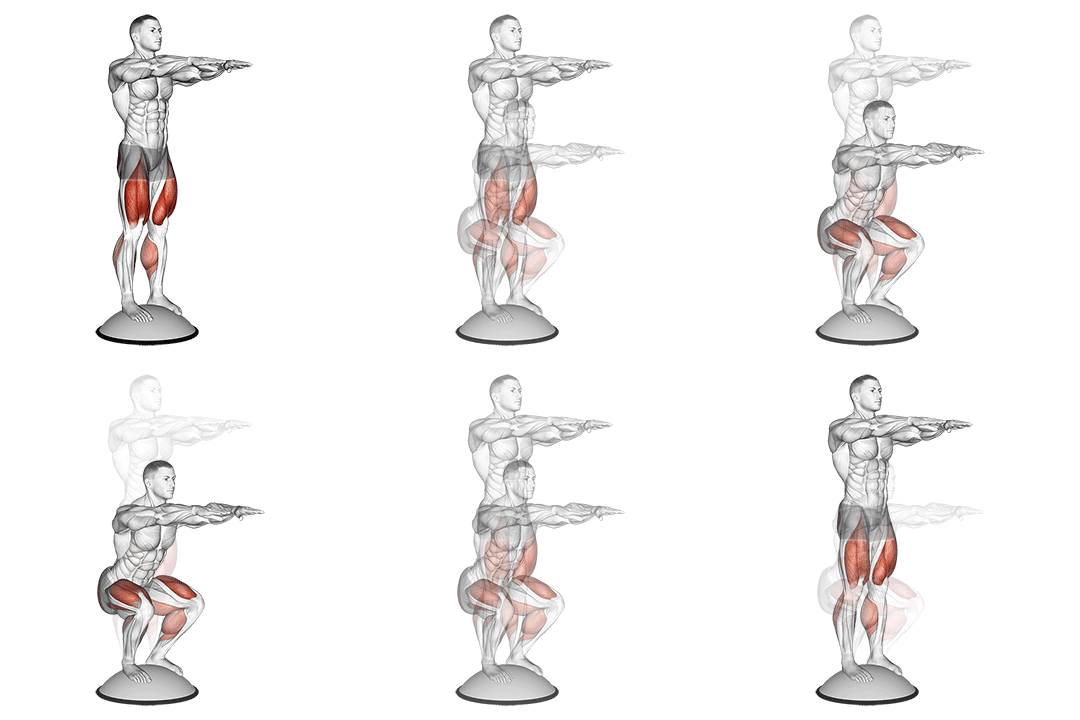
The Squat on Bosu Ball performs squats while standing on the BOSU ball (typically dome-side-up). The unstable surface produces extreme leg and core stabilizer demand alongside the standard squat motion.
For BOSU ball training, the BOSU squat develops bilateral leg strength combined with extreme stability demand. The pattern hits the deep stabilizers that traditional squat training cannot reach. Run it for 3 sets of 8 to 12 reps as primary BOSU bilateral leg work.
Position the BOSU ball dome-side-up. Step onto the BOSU with both feet, finding a stable position on the dome. Squat down by sitting the hips back while bending the knees, descending as deeply as stability allows. Drive back to standing through the whole foot. Maintain balance throughout the motion.
How To Program These Workouts
A productive BOSU ball session pulls all 6 exercises with appropriate volume. A standard BOSU session: BOSU squat 3×8 to 12, dumbbell split squat with BOSU 3×8 to 10 per leg, single-leg stand on BOSU 3×30 to 60 seconds per leg, BOSU push-up 3×8 to 12, high-knee lunge on BOSU 3×8 to 10 per leg, myotatic crunch on BOSU 3×10 to 15. The session covers 17 to 18 working sets across all major movement patterns with extreme stability emphasis throughout. Total session duration runs 35 to 45 minutes.
Train BOSU sessions 1 to 2 times per week as supplementary work alongside traditional strength training. The BOSU’s primary value is in developing balance and stability that complements (rather than replaces) the strength foundations built through traditional training. Most successful programs include 1 to 2 weekly BOSU sessions for athletes prioritizing stability development, or 1 weekly BOSU session for general fitness lifters wanting balance variety. The format also works well as a complete training program for stability-focused lifters or those recovering from lower-body injuries.
For broader stability programming, see our best stability ball workouts and best foam roller exercises. For balance-focused work, see our best yoga poses for beginners.
Final Thoughts
The best BOSU ball workouts deliver real balance, stability, and dynamic strength through the unique half-dome instability tool that combines loading with extreme stabilizer demand. The combination of bilateral and unilateral leg work, foundational balance training, upper-body pressing, and ab work covers the major movement patterns where instability adds the most training value. For lifters who want to develop dynamic stability that translates to athletic performance, athletes recovering from lower-body injuries, or general fitness lifters wanting balance variety, BOSU ball training is one of the most distinctive supplementary training tools available.
Stay focused on movement quality over load progression. The most common BOSU training mistake is using too much weight on BOSU exercises (which forces compensatory stabilization patterns) rather than mastering the movement quality with lighter loads first. The fix: start every BOSU exercise at bodyweight or very light loads and progress to moderate loads only after establishing strict form throughout the full range of motion. Quality reps on the unstable surface produce stronger stabilizer adaptations than heavier reps with shaky form.
Frequently Asked Questions
What is a BOSU ball used for?
BOSU balls develop balance, stability, and dynamic strength through the half-dome unstable surface that engages deep stabilizer muscles. The primary use cases include athletic stability training, balance rehabilitation after lower-body injuries, core stability work for general fitness, and varied training stimulus for lifters wanting equipment variety. The dual-sided design (dome-up or flat-up) enables varied training across balance work, lower-body work, and upper-body work.
Are BOSU balls effective for fitness?
Yes for specific training goals: balance, stability, and dynamic strength development. BOSU training is less effective than traditional strength training for raw strength gains because the unstable surface limits how much weight lifters can use safely. Most successful programs include BOSU as supplementary stability work alongside traditional strength training rather than as the primary training modality. The combination produces stronger overall athletic development than either modality alone.
How often should I use a BOSU ball?
One to two times per week works for most lifters. The format produces moderate stability fatigue that complements traditional strength training. Most successful programs include 1 to 2 weekly BOSU sessions for athletes prioritizing stability development. Daily BOSU training typically produces accumulated stabilizer fatigue without proportional benefit; spaced sessions sustain the format and produce stronger long-term adaptations.
Dome up or dome down for BOSU exercises?
Both have specific uses. Dome-up training emphasizes balance and proprioception (single-leg stands, squats, lunges) because the unstable dome forces constant adjustment. Dome-down (flat-side-up) training enables harder versions of pressing exercises because the round bottom creates instability while the flat top provides a stable hand surface. Most successful BOSU programs include both orientations across different exercises based on the training goal.
Can BOSU training replace regular strength training?
No for primary strength development. BOSU training’s unstable surface limits how much weight lifters can safely use, which means BOSU exercises produce less primary strength stimulus than traditional fixed-surface training. The format works best as supplementary stability training that complements (not replaces) traditional strength work. Most successful BOSU users include 1 to 2 weekly BOSU sessions alongside 2 to 4 traditional strength training sessions for complete development.