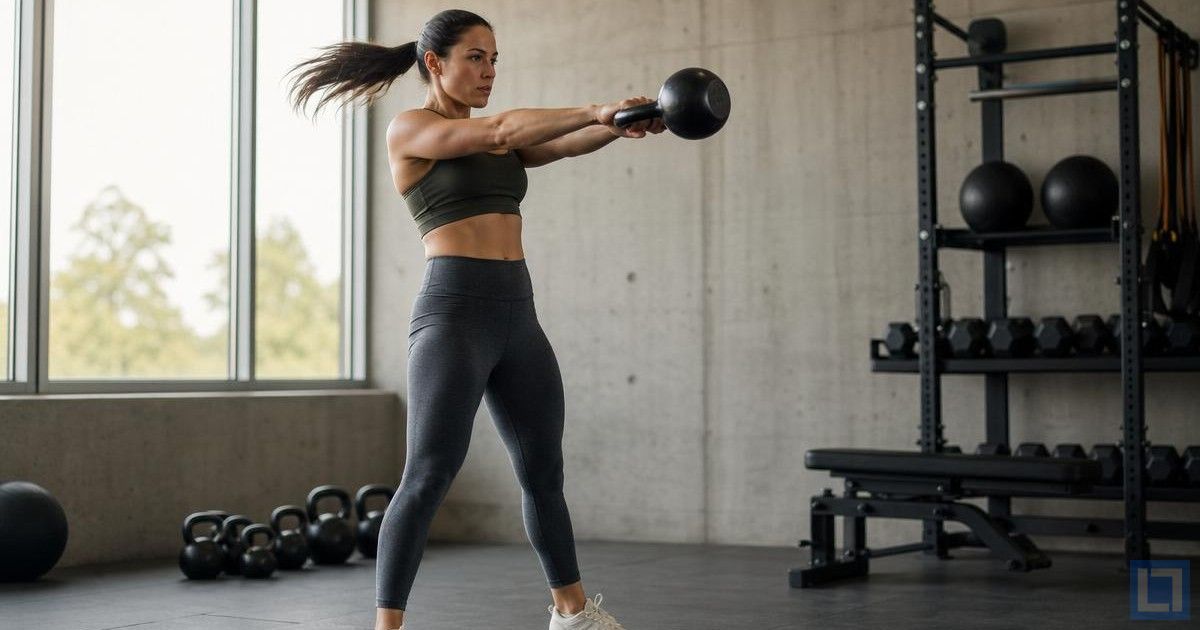
Twenty-minute kettlebell workouts produce real full-body fitness gains when programmed correctly. The compressed format requires high-density exercise selection (compound movements that hit multiple muscle groups per rep) and efficient transitions to maximize the training stimulus per minute. Done right, a focused 20-minute kettlebell session 4 to 5 times per week produces stronger results for most lifters than longer infrequent sessions, because the consistent frequency drives faster long-term progression than weekly marathon workouts.
Below are ten effective 20-minute kettlebell exercises that cover lower-body strength (sumo deadlift, step up), upper-body pressing (seated press, angled press, double jerk), core work (Russian twist, advanced windmill), full-body conditioning (rotational deadlift, overhead carry), and chest-focused training (floor fly). Together they form the foundation of any productive 20-minute kettlebell session. Pull 5 to 7 exercises per session and rotate the selection across sessions for complete training.
Kettlebell Floor Fly

The Kettlebell Floor Fly lies flat on the floor and lowers kettlebells out to the sides in a fly motion, then squeezes them back to the start position above the chest. The fly motion isolates the chest through pure horizontal adduction.
For 20-minute kettlebell sessions, the floor fly produces strong chest isolation in minimal time. The floor limits elbow drop, which reduces shoulder strain compared to bench-based flies. Run it for 3 sets of 10 to 12 reps as the chest-focused exercise in any 20-minute session.
Lie flat on the floor with kettlebells held above the chest, arms slightly bent. Lower the kettlebells out to the sides in a wide arc until the elbows touch the floor. Squeeze the chest to bring the kettlebells back to the start. Use lighter weight than for pressing.
Kettlebell Step Up

The Kettlebell Step Up holds kettlebells at the sides and steps up onto a sturdy box or bench, alternating legs. The exercise produces unilateral leg loading along with full-body conditioning that translates to athletic movement.
For 20-minute kettlebell sessions, the step up provides foundational unilateral leg loading. The pattern hits the glutes, quads, and calves directly while adding cardiovascular demand from the alternating step pattern. Run it for 3 sets of 10 to 12 reps per leg.
Hold kettlebells at the sides with arms extended. Stand in front of a sturdy box or bench. Step up onto the box with one foot, driving through the heel to bring the body fully upright. Step back down with the same foot. Alternate sides on each rep.
Kettlebell Advanced Windmill

The Kettlebell Advanced Windmill holds a kettlebell overhead and bends laterally to bring the opposite hand toward the floor while keeping the eyes on the kettlebell. The exercise produces strong oblique loading combined with shoulder stability demand.
For combined core and shoulder training in kettlebell programs, the windmill is one of the most efficient exercises that exists. The pattern hits the obliques, lateral core, and shoulder stabilizers simultaneously. Run it for 3 sets of 5 to 8 reps per side as core-focused work.
Hold a kettlebell overhead in one hand with the arm fully locked out. Take a wide stance with feet pointing slightly toward the kettlebell side. Bend laterally toward the opposite side, lowering the opposite hand toward the floor while keeping the eyes on the kettlebell. Return to standing. Switch sides on the next set.
Kettlebells Sumo Deadlift

The Kettlebells Sumo Deadlift takes a wide stance with kettlebells positioned between the legs and lifts them by extending through the hips and legs. The wide stance produces stronger inner thigh and adductor loading than conventional deadlifts.
For 20-minute kettlebell sessions, the sumo deadlift produces strong posterior chain loading with adductor emphasis that conventional deadlifts cannot match. The pattern fits naturally as the heavy pulling exercise. Run it for 3 to 4 sets of 6 to 10 reps as primary pull work.
Take a wide stance with toes pointed slightly outward. Place kettlebells between the legs. Hinge at the hips and bend the knees to grip the bells. Drive through the legs and hips to stand fully upright. Lower under control by hinging back at the hips.
Kettlebell Overhead Carry

The Kettlebell Overhead Carry holds a kettlebell pressed overhead and walks for distance or time while maintaining the overhead position. The exercise produces extreme shoulder stability demand along with core bracing throughout the carry.
For 20-minute kettlebell conditioning, the overhead carry produces unique stability demand that few other exercises match. The continuous overhead position teaches the shoulders, core, and back to brace under load during movement. Run it for 3 to 4 sets of 30 to 45 seconds or 30 to 50 steps per arm.
Press a kettlebell overhead to lockout with one arm. Walk forward at a steady pace while maintaining the overhead position with the arm fully locked out. Continue for the prescribed time or distance. Switch arms after each set.
Kettlebell Seated Press

The Kettlebell Seated Press sits on a bench with back support and presses kettlebells overhead from the rack position. The seated position eliminates leg drive and forces the shoulders to do all the work.
For 20-minute kettlebell sessions, the seated press is the most direct shoulder mass-builder available. The bench-supported position eliminates body sway and isolates the shoulders for pure pressing strength. Run it for 3 sets of 6 to 10 reps as the primary shoulder exercise.
Sit on a bench with back support set roughly upright. Hold kettlebells in the rack position at the shoulders. Press both kettlebells up to lockout overhead. Lower under control to the rack. Keep the back firmly against the support throughout.
Kettlebell Double Jerk

The Kettlebell Double Jerk lifts two kettlebells from the rack position to overhead using a powerful jerk motion driven by the legs and hips. The explosive movement combines lower-body power with upper-body lockout strength.
For 20-minute kettlebell sessions that include explosive work, the double jerk produces full-body power development in minimal time. The pattern requires solid kettlebell technique; build the basic strict press first before progressing to the jerk. Run it for 3 to 4 sets of 5 to 8 reps as power work.
Hold two kettlebells in the rack position at the shoulders. Dip slightly by bending the knees, then drive explosively upward through the legs while pressing the kettlebells overhead. End with both kettlebells locked out overhead and the body upright. Lower under control to the rack.
Kettlebell Russian Twist

The Kettlebell Russian Twist sits on the floor with a kettlebell held at the chest and twists the trunk side-to-side, optionally with the feet lifted off the floor for added difficulty. The continuous rotation hits the obliques throughout the entire set.
For 20-minute kettlebell sessions that need oblique work, the Russian twist produces strong rotational core loading in minimal time. The continuous tension fits the time-compressed format of 20-minute sessions. Run it for 3 sets of 16 to 20 total reps.
Sit on the floor with knees bent. Lean back slightly to engage the abs and lift the feet off the floor (optional, for added difficulty). Hold a kettlebell at the chest with both hands. Twist the trunk to bring the kettlebell to one side, then to the other side.
Kettlebell Rotational Deadlift

The Kettlebell Rotational Deadlift lifts a kettlebell from one side of the body and rotates the trunk during the lift to bring the kettlebell to the opposite shoulder area. The combined deadlift and rotation produces unique full-body loading.
For 20-minute kettlebell sessions, the rotational deadlift produces unique stimulus that few other exercises can match. The combination of hip-hinge motion and trunk rotation hits the posterior chain, obliques, and shoulders simultaneously. Run it for 3 sets of 8 to 10 reps per side.
Stand with feet shoulder-width and a kettlebell on the floor at one side. Hinge at the hips to grip the bell. Stand up while rotating the trunk to bring the bell to the opposite shoulder area. Lower under control by reversing the motion. Switch sides on the next set.
Kettlebell Angled Press
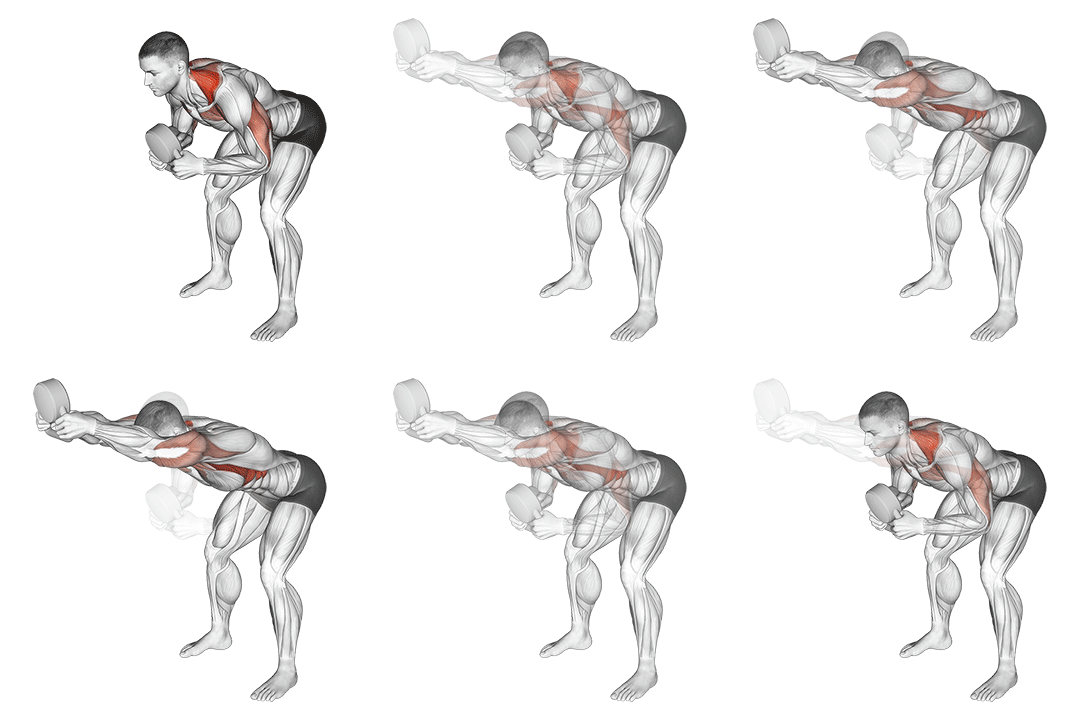
The Kettlebell Angled Press performs the press at an angle from one side, with the body leaning to one side as the press travels overhead. The angled motion produces unique loading on the shoulders and triceps from a non-vertical position.
For variety in 20-minute kettlebell sessions, the angled press hits the shoulders from a different position than vertical pressing. The angled loading produces stronger functional carryover to athletic positions where the arms work at non-vertical angles. Run it for 3 sets of 6 to 10 reps per side.
Stand tall with a kettlebell in the rack position. Press the bell overhead while simultaneously bending laterally to one side, allowing the arm to track at an angle rather than straight up. Hold briefly at the locked-out angled position. Lower under control. Switch sides on the next set.
How To Program These Workouts
A productive 20-minute kettlebell workout uses circuit-style organization to maximize density. A standard structure: 5 to 7 exercises performed back-to-back with minimal rest, repeated for 2 to 3 rounds, with the entire session including warm-up running 20 to 25 minutes. Run loaded movements for 30 to 45 seconds of work; rest 15 to 30 seconds between exercises within a circuit; rest 90 to 120 seconds between full circuit rounds. The compressed format produces strong total-body stimulus in minimal time.
Train 20-minute kettlebell sessions 4 to 5 times per week. The compact format produces moderate volume per session, which allows higher frequency than longer kettlebell programs. Most lifters do well with 4 to 5 sessions per week alongside 1 to 2 dedicated cardio or recovery days. The format also fits naturally as a quick training option on busy days when 60-minute sessions are not feasible.
For longer kettlebell programming, see our best kettlebell workouts and best full body kettlebell workouts. For specific kettlebell training, see our best kettlebell swing workouts.
Final Thoughts
The 20-minute kettlebell workout format delivers real full-body fitness through high-density training that fits in any schedule. The combination of compound lower-body work, pressing variations, core training, and conditioning movements covers every major fitness function in minimal time. For lifters who want consistent kettlebell training without the time commitment of longer sessions, this format is one of the most effective options available.
Stay focused on consistency and progressive loading. The most common 20-minute kettlebell training mistake is treating each session as a casual easy workout, which produces no progression over time. The fix: track the kettlebell weights used and aim to add weight, reps, or rounds every 2 to 4 weeks. Lifters who progress consistently across 6 to 12 months produce significantly stronger fitness gains than those who stay at the same loads indefinitely. The compressed format does not eliminate the need for progressive overload.
Frequently Asked Questions
Are 20 minute kettlebell workouts effective?
Yes, when programmed correctly and performed consistently. The compressed format produces strong full-body stimulus through high-density training, and the sustainable time commitment allows higher frequency than longer sessions. Most lifters see meaningful strength and conditioning improvements within 4 to 6 weeks of consistent 20-minute kettlebell training combined with appropriate progressive overload.
What kettlebell weight should I use for 20 minute workouts?
Most intermediate lifters work with 16 to 24 kg kettlebells (35 to 53 pounds) for compound movements (deadlifts, presses, jerks) and 8 to 16 kg (18 to 35 pounds) for isolation work (windmills, lateral raises). The right weight is whatever allows clean reps in your target range. Heavier weight with poor form produces less benefit than moderate weight with strict technique.
How often should I do 20 minute kettlebell workouts?
Four to five times per week works for most lifters. The compact format produces moderate volume per session, which allows higher frequency than longer kettlebell programs. Daily training is feasible with appropriate exercise rotation but typically requires careful programming to prevent burnout.
Do I need two kettlebells for 20 minute workouts?
Two is helpful but not strictly required. Many exercises (single-arm press, windmill, rotational deadlift, overhead carry) work with one kettlebell. A second matched kettlebell enables bilateral work (double jerk, double press, sumo deadlift with two bells) that allows heavier total loading. A complete kettlebell setup typically uses two matching bells plus one lighter bell for isolation work.
Can I build muscle with 20 minute kettlebell workouts?
Yes for beginners and intermediates. The combination of compound kettlebell movements and progressive loading produces real muscle development for years of consistent training. Advanced lifters chasing maximum mass eventually benefit from longer sessions and heavier barbell work, but consistent 20-minute kettlebell training produces measurable muscle development at every level when paired with appropriate nutrition.