The trap bar (also called hex bar) is one of the most versatile and joint-friendly pieces of strength equipment available. The hexagonal shape allows the lifter to stand inside the bar, which positions the load at the center of mass rather than in front of the body (as with conventional barbells). This centered loading produces strong full-body lifting with significantly reduced lower-back strain compared to conventional deadlifts, which makes the trap bar particularly valuable for lifters with lower-back sensitivity, beginners learning hip-hinge patterns, and athletes wanting to train explosive lifts safely. The neutral grip handles also reduce wrist and shoulder strain that conventional barbell grips can produce.
Below are nine effective trap bar exercises that cover heavy pulling (trap bar deadlift, deficit deadlift, banded deadlift), squat-pattern work (trap bar squat, jump squat), back work (bent-over row, standing shrug), unilateral work (split stance RDL), and full-body conditioning (farmer’s carry). Together they form a complete trap bar training program for lifters with trap bar access. The exercise count is nine rather than ten because the catalog includes a focused set of trap bar variations rather than dozens of similar movements.
Trap Bar Deadlift

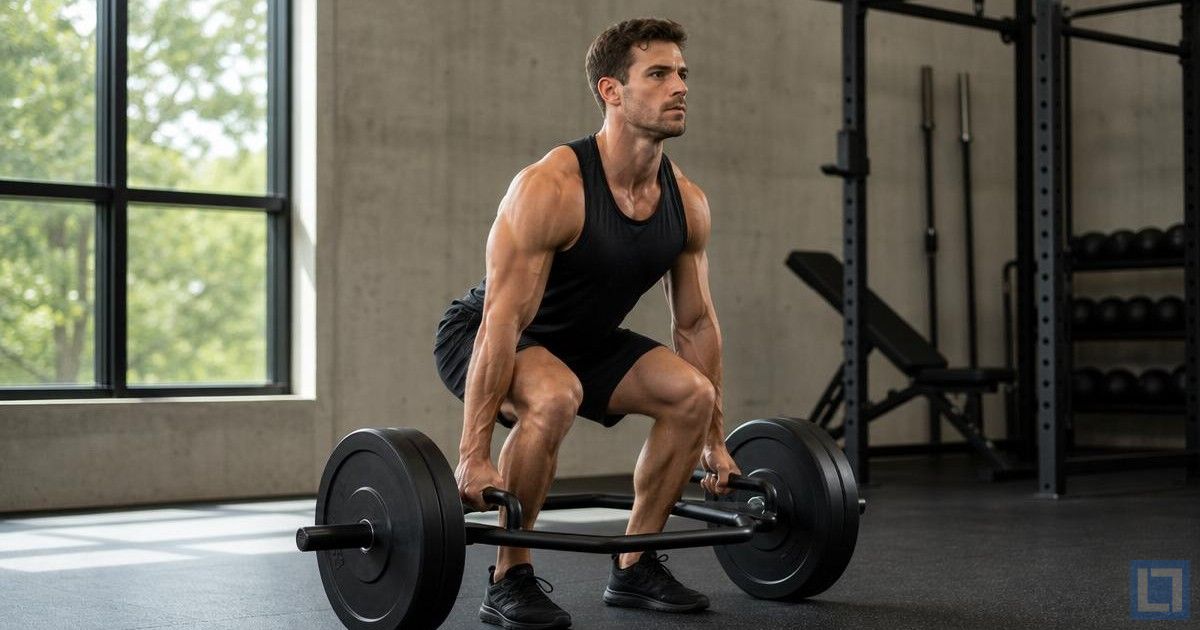
The Trap Bar Deadlift uses a hexagonal-shaped barbell (trap bar / hex bar) with handles inside the bar, allowing the lifter to stand inside the bar and lift with a more upright torso position than conventional deadlifts. The neutral grip and centered loading produce strong full-body lifting with reduced lower-back demand.
For trap bar training, the trap bar deadlift is non-negotiable. The pattern combines hip and knee extension with bilateral neutral-grip loading, which produces strong full-body development with less lower-back strain than conventional deadlifts. Many lifters can pull more weight on trap bar than conventional. Run it for 4 to 5 sets of 5 to 8 reps as primary heavy pulling work.
Stand inside a trap bar with feet hip-width. Hinge at the hips and bend the knees to grip the handles with arms straight. Drive through the legs and pull the bar up by extending the hips and knees together until standing fully upright. Reverse the motion under control. Reset before each rep.
Trap Bar Squat

The Trap Bar Squat performs a squat motion while holding a trap bar at the sides of the body with neutral grip. The bar position outside the body produces a hybrid squat-deadlift pattern that emphasizes the quads more than conventional trap bar deadlifts.
For trap bar training that emphasizes the quads, the trap bar squat shifts loading toward the legs more heavily than the standard trap bar deadlift. The pattern produces strong leg development with less back demand than back squats. Run it for 3 to 4 sets of 8 to 10 reps as accessory leg work.
Stand inside a trap bar with feet hip-width. Squat down by sitting the hips back while bending the knees to grip the handles. Drive through the legs while keeping the torso upright (more upright than standard trap bar deadlift). Stand up fully. Lower under control to the start.
Trap Bar Jump Squat

The Trap Bar Jump Squat performs an explosive jump while holding a trap bar with neutral grip, releasing the bar at the top of the jump. The pattern produces strong loaded explosive power development.
For trap bar training that includes power development, the jump squat is one of the most effective loaded plyometric exercises that exists. The pattern translates directly to athletic explosive power. Run it for 3 to 4 sets of 3 to 5 reps with appropriate loading as power-focused work.
Stand inside a trap bar with feet hip-width and grip the handles. Drop into a quarter-squat position. Drive up explosively, jumping straight up while keeping grip on the handles. Land softly with bent knees. Reset before each rep. Use moderate loads (40 to 60 percent of trap bar deadlift max) to allow explosive movement.
Trap Bar Deadlift from Deficit

The Trap Bar Deadlift from Deficit performs trap bar deadlifts while standing on an elevated platform (typically 2 to 4 inches), which increases the range of motion and stretches the hamstrings and glutes more deeply at the bottom.
For increased range-of-motion training, the deficit trap bar deadlift produces stronger stretch loading than standard trap bar deadlifts. The pattern hits the bottom-position weakness that limits many lifters. Run it for 3 sets of 5 to 8 reps with reduced loading as advanced posterior-chain work.
Stand on an elevated platform (2 to 4 inches tall) with feet hip-width inside a trap bar. Hinge at the hips and bend the knees to grip the handles. The increased range of motion produces a deeper start position. Drive through the legs to stand fully upright. Use lighter loads than standard trap bar deadlift due to the increased range of motion.
Trap Bar Bent Over Row

The Trap Bar Bent Over Row hinges over with a trap bar held at the sides and rows the bar up to the lower chest by pulling the elbows back. The neutral grip allows comfortable rowing with reduced wrist and shoulder strain.
For trap bar back training, the bent-over row produces strong horizontal pulling work with the comfortable neutral grip position. The pattern complements heavy trap bar pulling with direct back work. Run it for 3 sets of 8 to 10 reps as primary horizontal pull work in trap bar sessions.
Stand inside a trap bar with feet hip-width. Hinge at the hips with a slight knee bend, lowering the torso to roughly 45 degrees. Lift the bar slightly off the floor by gripping the handles. Row the bar up to the lower chest by pulling the elbows back. Lower under control. Keep the back flat throughout.
Trap Bar Standing Shrug

The Trap Bar Standing Shrug holds a trap bar at the sides with arms extended and shrugs the shoulders up toward the ears, contracting the upper traps. The neutral grip and centered loading produce strong trap loading with reduced wrist strain.
For trap bar training that includes upper-back work, the standing shrug isolates the upper traps with the comfortable trap bar handle position. The pattern allows heavier loading than dumbbell shrugs because the bar bears the weight rather than each hand independently. Run it for 3 to 4 sets of 10 to 15 reps as primary trap work.
Stand inside a trap bar with feet hip-width and grip the handles with arms extended. Shrug the shoulders up toward the ears as high as possible while keeping the arms straight. Squeeze the upper traps at the top. Lower under control to the start.
Trap Bar Farmers Carry
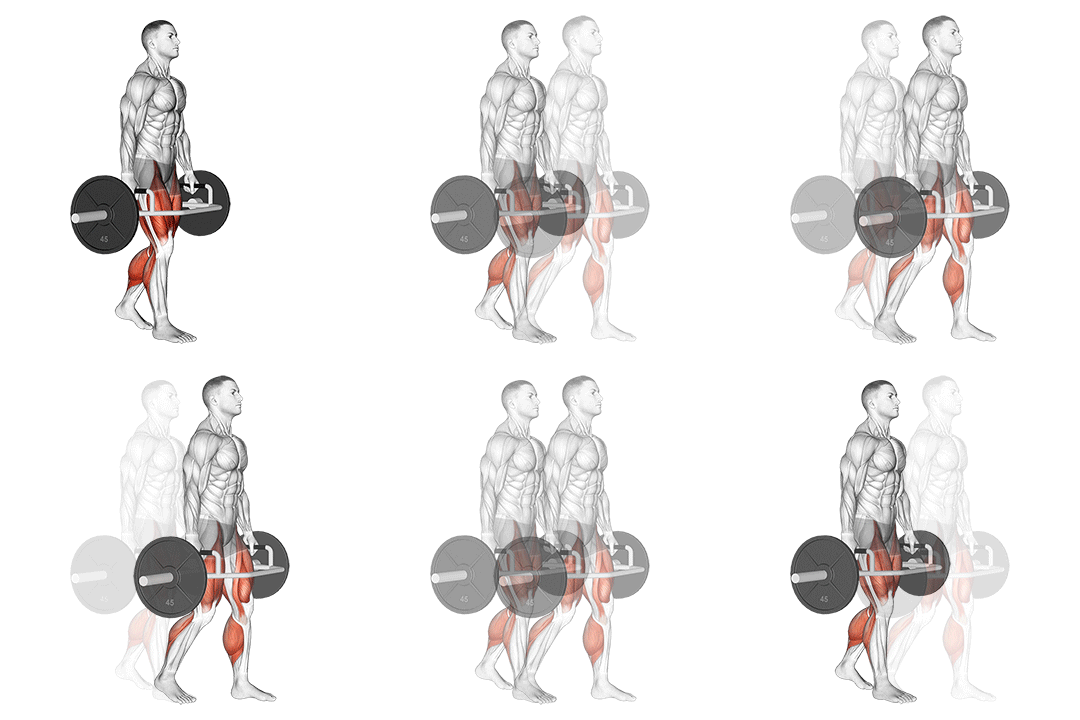

The Trap Bar Farmers Carry holds a trap bar at the sides with arms extended and walks for distance or time while maintaining upright posture. The pattern produces strong grip strength, trap loading, and core stability under load.
For trap bar training that includes carry work, the farmer’s carry produces strong full-body conditioning and grip development. The trap bar handle position is more comfortable than dumbbells for heavy carries. Run it for 3 sets of 50 to 100-foot distances or 30 to 60-second carries with heavy loading.
Stand inside a trap bar with feet hip-width. Lift the bar to standing by gripping the handles and extending through the legs. Walk forward at a steady pace while maintaining upright posture and tight grip on the handles. Continue for the prescribed distance or time. Set the bar down with control.
Trap Bar Split Stance Rdl

The Trap Bar Split Stance RDL performs a Romanian deadlift pattern with one foot forward and one foot back (split stance) while holding the trap bar. The unilateral-style loading produces strong unilateral hamstring and glute work.
For unilateral trap bar training, the split stance RDL catches strength imbalances that bilateral pulling can hide. The pattern hits the working leg’s hamstrings and glutes through unilateral hip-hinge motion. Run it for 3 sets of 8 to 10 reps per leg as unilateral posterior-chain work.
Stand inside a trap bar with one foot forward and one foot back in split stance. Most weight on the front leg. Grip the handles. Hinge at the hips with a slight bend in the front knee, lowering the bar in a path close to the front leg until the hamstring stretches. Drive the hips forward to stand back up. Switch sides between sets.
Trap Bar Banded Deadlift
The Trap Bar Banded Deadlift performs trap bar deadlifts with resistance bands attached to the bar, which adds accommodating resistance throughout the rep. The bands increase the loading at lockout where the lifter is mechanically strongest.
For trap bar training that includes accommodating resistance, the banded deadlift produces stronger loading at lockout where straight-bar loading produces minimal stress. The pattern develops the lockout strength that limits many lifters. Run it for 3 to 4 sets of 5 to 8 reps as advanced accommodating-resistance work.
Set up a trap bar with resistance bands anchored to the floor and looped around the bar handles or bar itself. Stand inside the trap bar. Grip the handles. Drive through the legs to lift the bar against the combined plate and band resistance. The bands add resistance as the bar rises. Lower under control.
How To Program These Workouts
A productive trap bar training session pulls five to seven exercises from the list above. A balanced session includes one heavy pull (trap bar deadlift), one squat-pattern exercise (trap bar squat or jump squat), one row variation (bent-over row), one isolation exercise (standing shrug), one unilateral exercise (split stance RDL), and one carry (farmer’s walk). Run heavy compound lifts for 4 to 5 sets of 5 to 8 reps; squat patterns for 3 to 4 sets of 8 to 10 reps; rows and shrugs for 3 to 4 sets of 8 to 12 reps; carries for 3 sets of 50 to 100 feet.
Train trap bar sessions 1 to 2 times per week as dedicated sessions or integrated into broader leg or full-body programming. The trap bar deadlift produces high systemic demand similar to conventional deadlifting, which limits how often it can be trained heavy. Most successful programs include 1 heavy trap bar session per week with optional moderate-intensity accessory work in a second weekly session. The format also works well as the primary pulling exercise in full-body programs.
For broader barbell programming, see our best barbell leg workouts and best compound exercises for strength. For specific deadlift variations, see our how to do a romanian deadlift.
Final Thoughts
The best trap bar workouts deliver real strength and muscle development through joint-friendly variations of foundational pulling and squatting movements. The combination of heavy pulling, squat patterns, back work, unilateral exercises, and carries covers every major movement function with reduced joint strain compared to conventional barbell training. For lifters with trap bar access who want hip-hinge training with less back demand, athletes training explosive lifts, or anyone preferring the comfortable neutral grip, the trap bar is one of the most effective alternatives to conventional barbells available.
Stay focused on the upright torso position. The most common trap bar deadlift mistake is allowing the torso to angle forward like a conventional deadlift, which loses the trap bar’s primary advantage (reduced lower-back strain through centered loading). The fix: keep the chest up and torso more vertical than conventional deadlift technique. The trap bar produces strong full-body loading specifically because of the upright position; respecting that pattern through proper technique drives both the strength gains and the joint-protective benefits.
Frequently Asked Questions
Is trap bar deadlift better than conventional deadlift?
Different exercises serve different goals. Trap bar deadlifts produce strong full-body strength with reduced lower-back strain through centered loading. Conventional deadlifts produce stronger posterior-chain development and translate better to powerlifting competition. Most successful programs include both: trap bar deadlifts for general strength and joint-friendly volume, conventional deadlifts for posterior-chain focus and competition prep. Beginners often do better starting with trap bar before progressing to conventional.
How heavy should I trap bar deadlift?
Most lifters can trap bar deadlift heavier than conventional deadlift due to the centered loading and reduced lower-back strain. A common ratio is 110 to 125 percent of conventional deadlift max for trap bar max. For training, work in the 5 to 8 rep range with 70 to 85 percent of trap bar deadlift max. Beginners should start with the empty bar (typically 45 to 60 pounds) and add weight gradually as form improves.
Trap bar squat or back squat?
Different exercises serve different goals. Trap bar squats produce strong leg development with reduced spinal loading (the bar bears the weight at the sides rather than across the upper back). Back squats produce stronger overall strength development and translate better to powerlifting competition. Most successful programs include back squats as the primary heavy compound and trap bar squats as accessory or alternative work for spinal-loading sensitivity.
Can beginners use a trap bar?
Yes, the trap bar is one of the best deadlift introductions for beginners. The centered loading, neutral grip, and more upright torso position make it easier to learn the hip-hinge pattern safely than conventional deadlifts. Most beginners can build to a moderately heavy trap bar deadlift (1 to 1.5x bodyweight) within 8 to 12 weeks of consistent practice. The trap bar pattern translates well to conventional deadlift technique once the fundamentals are established.
Do I need a trap bar to train trap bar exercises?
Yes, the unique hexagonal shape can’t be substituted with conventional barbells. Trap bars cost $150 to $400 for home gym setup or are typically available at most commercial gyms. Lifters without trap bar access can substitute many of the patterns: dumbbell deadlifts (instead of trap bar deadlift), dumbbell squats (instead of trap bar squat), dumbbell rows (instead of trap bar row), dumbbell shrugs (instead of trap bar shrug). The trap bar produces unique benefits but the patterns can be approximated with other equipment.