The Tabata protocol is one of the most efficient conditioning formats that exists. Eight rounds of 20 seconds of all-out work followed by 10 seconds of rest, totaling four minutes of training, produces cardiovascular adaptations that match or exceed much longer steady-state cardio sessions. The format demands maximum effort, and the best Tabata workouts choose exercises that maintain quality throughout the eight-round structure.
Below are ten effective bodyweight exercises that work especially well in Tabata format. Together they cover full-body explosive movement, lower-body loading, upper-body work, lateral motion, and isometric recovery, which means a four-minute Tabata block drawn from this list can produce a complete training stimulus in less time than most warm-ups.
Burpee

The Burpee combines a squat, push-up, and vertical jump in one continuous motion. Drop into a squat, kick the legs back into a plank, perform a push-up, jump the feet forward, and explode upward into a vertical jump. The combination drives heart rate up rapidly while hitting nearly every major muscle group.
For Tabata workouts, burpees are the most efficient single exercise that exists. The full-body recruitment and continuous motion produce the high heart rate and metabolic demand that make 20-second Tabata intervals genuinely brutal. They are the gold standard for any Tabata circuit.
Drop quickly into a squat with hands on the floor. Kick the legs back into a plank, perform one push-up, jump the feet forward to the squat position, then jump straight up with arms overhead. Land softly and immediately drop into the next rep. Aim for 8 to 12 reps per 20-second interval.
Squat

The Squat lowers the body by bending at the hips and knees, then drives back to standing. Bodyweight squats run for high-rep counts in nearly every Tabata workout because the pattern allows continuous motion and significant lower-body loading from bodyweight alone.
In Tabata workouts, the bodyweight squat fits because it allows fast, continuous motion without the technical demands of jumps or burpees. The leg loading combined with the speed produces strong cardiovascular response, which fits the high-intensity goal of 20-second intervals. Aim for 20 to 30 reps per 20-second interval.
Stand with feet shoulder-width apart. Squat down to roughly parallel depth or below by bending the hips and knees together. Drive back to standing through the whole foot. Maintain a fast tempo throughout the interval; quality of depth matters more than speed alone.
Push Ups

The Push Ups perform a push-up motion in standard plank position: lower the chest to the floor by bending the elbows, then press back to lockout. The exercise hits the chest, shoulders, and triceps as a coordinated unit.
In Tabata circuits, push-ups serve as the upper-body anchor. Most Tabata exercises emphasize lower-body and full-body movement; push-ups balance the work by adding focused upper-body loading. They also serve as a moderate-intensity exercise that recovers heart rate slightly during the 20-second interval, which lets the lifter maintain quality on harder exercises later in the workout.
Set up in plank position with hands directly under shoulders and body in a straight line. Lower the chest to within an inch of the floor by bending the elbows. Press back to lockout. Maintain tight body position throughout. Aim for 12 to 20 reps per 20-second interval.
Mountain Climber

The Mountain Climber starts in a push-up position and rapidly drives the knees toward the chest in alternating fashion. The continuous movement produces high cardiovascular demand alongside core engagement.
For Tabata workouts, mountain climbers earn their place because they drive heart rate up quickly and maintain it throughout the 20-second interval. The combination of upper-body bracing (plank position) and lower-body cardio (rapid leg drive) hits multiple training goals simultaneously, which fits the time-efficient nature of Tabata.
Set up in push-up position with arms straight and body in a line. Drive one knee toward the chest, then quickly switch and drive the other knee forward. Maintain the plank position throughout. Move at maximum sustainable speed for the 20-second interval.
Jumping Jack

The Jumping Jack jumps the feet apart while raising the arms overhead, then jumps back to standing position with arms at the sides. The full-body movement drives heart rate up while requiring no equipment or space beyond a few feet of clearance.
For Tabata circuits, jumping jacks serve as a moderate-intensity exercise that maintains cardiovascular load without the high impact of jumps or burpees. They work particularly well as the first exercise in a Tabata block (warm-up effect) or as a recovery exercise between harder movements.
Stand with feet together and arms at the sides. Jump and land with the feet shoulder-width apart while simultaneously raising the arms overhead. Reverse the motion immediately: jump back to feet-together while lowering the arms. Continue at maximum sustainable speed.
High Knees Butt Kicks

The High Knees Butt Kicks performs a rapid running-in-place pattern that alternates between high knees (driving the knees up to chest height) and butt kicks (kicking the heels back to the glutes). The combination hits the legs and core through dynamic motion.
In Tabata workouts, this combined dynamic movement produces strong cardiovascular response while requiring no skill or space. It also serves as a useful warm-up movement for the legs before more demanding exercises (jump squats, burpees) appear later in the workout.
Stand tall and run in place, alternating between high knees (knees driving up to chest height) and butt kicks (heels kicking back to the glutes). Maintain fast tempo throughout the interval. Use the arms for momentum and rhythm.
Jump Squat II

The Jump Squat squats down to a parallel position and explodes upward into a vertical jump, landing softly back into the squat position. The plyometric demand produces strong leg power development on top of cardiovascular response.
For Tabata workouts, jump squats earn their place as one of the most demanding exercises in any short-format circuit. The combination of explosive leg power and high heart rate response produces stronger fitness adaptations than steady-state cardio at a fraction of the time. Run them for 12 to 15 reps per 20-second interval.
Squat to roughly parallel depth with weight in the heels. Explode upward into a vertical jump, reaching the arms overhead. Land softly with bent knees and immediately drop into the next squat. Maintain quality through the set; if jump height drops significantly, the set is over.
Squat Thrust

The Squat Thrust drops into a squat with hands on the floor, kicks the legs back into a plank, then jumps the feet back to the squat position. The motion is functionally a burpee without the push-up and final jump, which produces moderate intensity and faster reps than full burpees.
For Tabata circuits where full burpees feel too demanding to maintain quality through 8 rounds, squat thrusts are the next-step substitute. They retain most of the cardiovascular and full-body demand of burpees while removing the push-up and vertical jump that often degrade as fatigue accumulates. Run them for 10 to 15 reps per 20-second interval.
Drop quickly into a squat with hands on the floor. Kick the legs back into a plank position, then immediately jump the feet forward to the squat position. Stand briefly, then drop into the next rep. Maintain fast tempo throughout the interval.
Skater

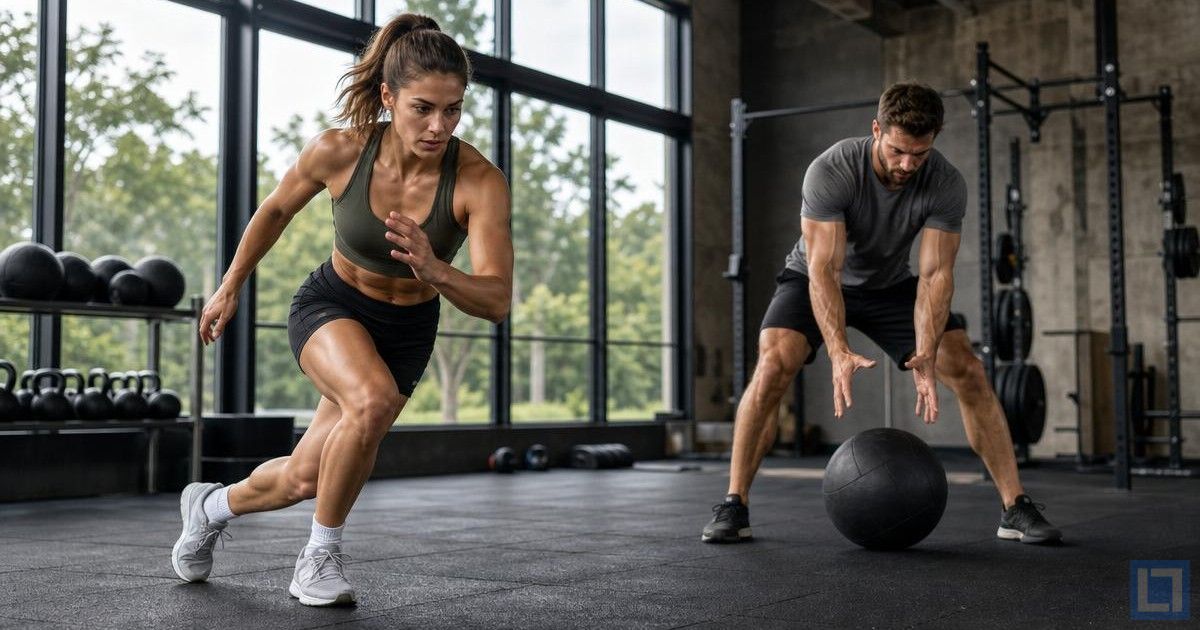
The Skater hops sideways from one leg to the other in a speed-skating motion, planting on the landing leg with the opposite leg crossed behind. The lateral motion combines cardiovascular demand with single-leg loading.
In Tabata workouts, skaters add lateral motion that the predominantly forward-and-back exercises miss. The unilateral loading also catches strength imbalances and produces stronger glute and hip stabilizer work than bilateral exercises. Run them for 14 to 20 reps per 20-second interval.
Stand on one leg with the other crossed behind. Hop laterally to the other side, planting on the opposite leg and crossing the first leg behind. Continue alternating sides in a smooth skating motion. Land softly on each side with bent knees.
Front Plank
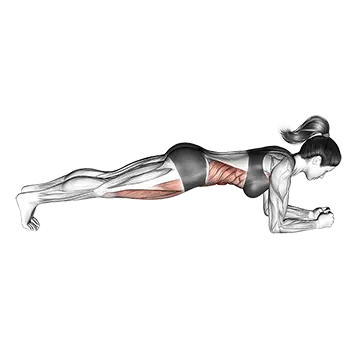
The Front Plank holds a forearm plank position with the body in a straight line from head to heels. The isometric hold produces continuous core engagement throughout the interval.
In Tabata workouts, the front plank serves as a recovery exercise that maintains training intensity (the abs work continuously) without the cardiovascular load of dynamic movements. It works well as a recovery exercise between harder Tabata blocks or as the final exercise of a complete workout.
Set up on the forearms with elbows directly under the shoulders. Hold the body in a straight line from head to heels, with the abs braced and glutes squeezed. Hold for the full 20-second interval. End the set when form breaks down.
How To Program These Workouts
A productive Tabata workout uses one to four 4-minute Tabata blocks, with 1 to 2 minutes of rest between blocks. A single-block workout uses one exercise for the full 8 rounds; multi-block workouts often use 2 to 4 different exercises. The classic protocol stays with one exercise per Tabata block, which produces the deepest cardiovascular adaptation; rotating exercises throughout makes the workout more engaging but slightly reduces the cumulative cardiovascular demand.
Train Tabata two to three times per week. The intensity is high enough that more frequent training burns most lifters out within a few weeks. Pair Tabata sessions with traditional strength training (Tabata is conditioning, not strength) and rest days for full recovery. Most lifters see strong fitness adaptations within 6 to 8 weeks of consistent Tabata practice.
For more high-intensity programming, see our best HIIT workouts at home and best 10 minute ab workouts. For broader bodyweight conditioning, see our best full body calisthenics workout.
Final Thoughts
The best Tabata workouts deliver maximum conditioning adaptation in minimum time. The 4-minute structure makes daily training realistic, the high intensity drives strong fitness gains, and the bodyweight format works anywhere from a hotel room to a backyard. For lifters chasing time-efficient cardiovascular fitness alongside strength training, Tabata remains one of the most effective tools available.
Stay focused on intensity. The Tabata protocol only works when each 20-second interval is performed at genuinely maximum effort. Pacing through the rounds at 70 to 80 percent effort produces ordinary cardio results; pushing each interval to all-out maximum produces the elite cardiovascular adaptations that made the protocol famous. Quality matters more than completion.
Frequently Asked Questions
What is the original Tabata protocol?
The original Tabata protocol was developed by Dr. Izumi Tabata in 1996 using stationary bicycles at 170 percent of VO2 max. The structure: 20 seconds of all-out effort, 10 seconds of complete rest, repeated for 8 rounds (4 minutes total). Modern Tabata workouts apply the same timing structure to bodyweight exercises, kettlebells, and other equipment. The intensity requirement is the same: each 20-second interval must be at maximum sustainable effort.
How often should I do Tabata workouts?
Two to three times per week works for most lifters. The intensity is high enough that more frequent training produces fatigue and reduced quality within a few weeks. Pair Tabata sessions with traditional strength training (Monday/Wednesday/Friday strength + Tuesday/Thursday Tabata is a typical structure) and ensure adequate recovery between high-intensity sessions.
Are Tabata workouts good for fat loss?
Yes, when combined with appropriate nutrition. Tabata produces strong post-exercise calorie burn through what is called EPOC (excess post-exercise oxygen consumption), and the high intensity drives strong cardiovascular adaptations that improve fat-burning capacity over time. However, Tabata alone cannot create the calorie deficit required for fat loss; nutrition handles that side.
What’s the best Tabata exercise?
Burpees are the gold standard for Tabata workouts. The full-body recruitment and continuous motion produce the highest heart rate response and metabolic demand of any single bodyweight exercise that fits the format. If only one exercise had to be chosen for a Tabata workout, burpees would be it. Most other exercises work, but burpees produce the deepest training stimulus per minute.
Can beginners do Tabata workouts?
Yes, with appropriate exercise choice. Beginners should start with lower-intensity exercises (jumping jacks, mountain climbers, squats) before progressing to harder movements (burpees, jump squats). Two to three Tabata sessions per week with manageable exercises produces fast fitness gains for beginners. The exercise selection matters more than the protocol; even Tabata-formatted easy exercises produce strong adaptations for less-fit individuals.