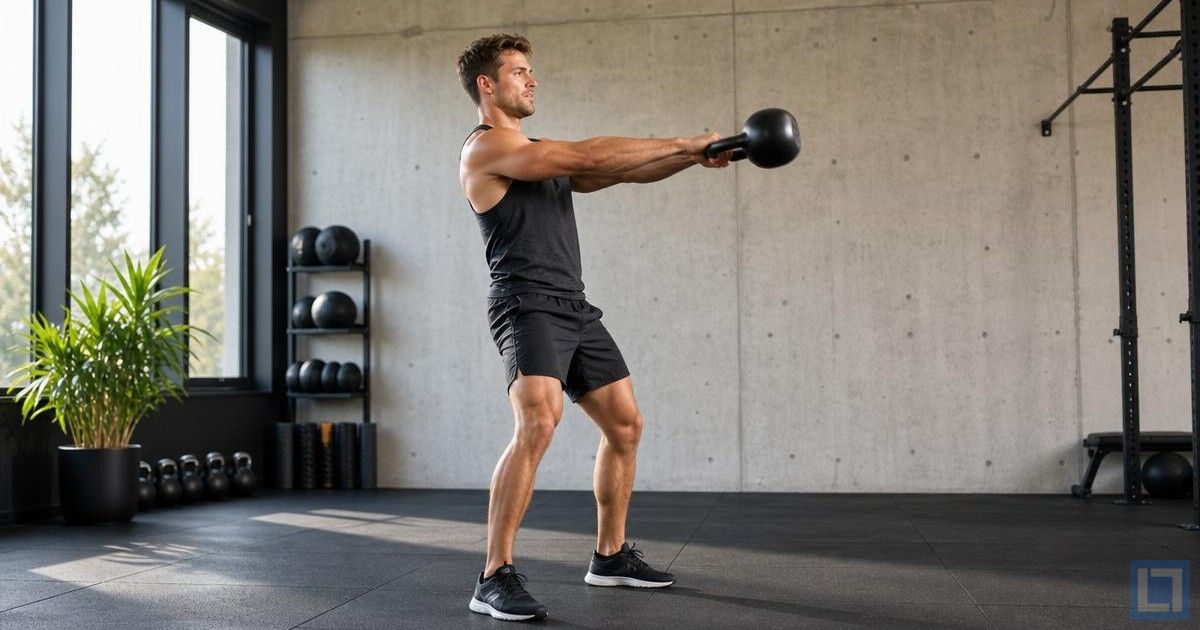
Kettlebells produce real back development across every major function the back muscles serve. The combination of explosive swings, ballistic snatches, controlled rows, and hinge-based deadlifts covers the upper back, lower back, lats, traps, and rear delts in one piece of equipment. The best kettlebell back workouts use this versatility to deliver complete back training in 30 to 45 minutes with one or two kettlebells.
Below are ten effective kettlebell back exercises that cover hip-hinge patterns, rowing, ballistic explosive work, and unilateral variations. Together they form a complete back training program that fits in any home gym, garage, or hotel room with nothing more than one or two kettlebells.
Kettlebell Romanian Deadlift

The Kettlebell Romanian Deadlift performs a Romanian deadlift pattern with a kettlebell held in both hands. The hinge motion targets the lower back, glutes, and hamstrings through controlled lowering rather than ground-based pulling.
For back-focused kettlebell training, the RDL builds the lower back endurance and erector strength that supports every other back exercise. A strong lower back stabilizes heavier rowing, swinging, and deadlifting patterns. Run it for 3 to 4 sets of 8 to 12 reps as the primary lower-back-and-hamstring exercise.
Hold the kettlebell with both hands at hip level. Hinge at the hips with a slight knee bend. Lower the bell in a path close to the legs until the hamstrings stretch. Drive the hips forward to stand back up. Keep the back flat throughout.
Kettlebell Full Swing

The Kettlebell Full Swing performs the swing motion all the way overhead rather than stopping at chest height. The kettlebell travels through a full range of motion from between the legs to fully overhead, hitting the back, glutes, and shoulders simultaneously.
Full swings produce stronger upper back loading than chest-height swings because the bell continues past the shoulders to the overhead position, which engages the lats and traps significantly more. The combination of hip drive and overhead pulling produces unique back development that few other exercises match.
Hinge at the hips and swing the kettlebell back between the legs. Drive the hips forward explosively to swing the bell up and overhead, ending with arms locked over the head. Reverse the motion under control. Use moderate weight; the technical demand is the limiting factor.
Kettlebell Snatch

The Kettlebell Snatch swings a single kettlebell from between the legs to the overhead lockout in one explosive motion. The unilateral pattern builds the entire posterior chain (back, glutes, hamstrings) along with significant shoulder and core demand.
The snatch is one of the most demanding kettlebell exercises that exists. The combination of explosive hip drive, unilateral loading, and overhead pressing produces unique back development that builds both strength and conditioning simultaneously. Use it as a primary explosive exercise after the swing pattern is mastered.
Hold the kettlebell between the legs with one hand. Hinge at the hips, then drive the hips forward explosively. As the bell rises, pull it close to the body and rotate the wrist so the bell lands in the overhead position with the arm locked out. Lower under control through the rack to the start.
Kettlebell Alternating Row

The Kettlebell Alternating Row hinges at the hips with two kettlebells and rows them alternately rather than simultaneously. While one bell rows up, the other extends back down. The alternating pattern produces continuous tension on the back muscles.
Alternating rows double the time-under-tension per side compared to bilateral rows because the working side never gets a complete rest. The technique also catches strength imbalances that bilateral rowing hides. Run it for 3 sets of 10 to 12 alternating reps per side.
Hinge at the hips with a flat back, kettlebells hanging straight down. Pull one bell to the lower chest by squeezing the shoulder blade back. Lower the bell while pulling the other up. Continue alternating throughout the set. Keep the hips and back stable; only the arms move.
Kettlebell Deadlift

The Kettlebell Deadlift positions a kettlebell between the feet and lifts it to standing position with a hip-hinge motion. The exercise teaches the deadlift pattern at moderate loads with a more accessible setup than barbell deadlifting.
For back-focused training, the kettlebell deadlift builds the same posterior chain strength as barbell deadlifts at lighter loads that allow higher rep counts. The compact bell shape and centered loading make the exercise easier to perform with clean form than barbell variations. Run it for 3 to 4 sets of 8 to 10 reps.
Stand with a kettlebell between the feet, slightly forward of center. Hinge at the hips with a flat back, grip the bell, and drive through the floor to stand. Lock out by squeezing the glutes at the top. Lower under control by hinging back at the hips.
Kettlebell Good Morning

The Kettlebell Good Morning holds a kettlebell at the chest with both hands and hinges forward at the hips with a flat back, then returns to standing. The exercise targets the lower back and hamstrings through a hinge pattern with chest-loaded weight.
The good morning is one of the most direct lower-back strengtheners that exists. The chest-loaded position stresses the entire posterior chain (lower back, glutes, hamstrings) and produces strong erector strength that protects against injury during heavier lifts. Use moderate weight and perfect form.
Stand tall holding a kettlebell at the chest with both hands. Hinge at the hips with a slight knee bend, lowering the chest forward until the hamstrings stretch. Keep the back flat throughout. Reverse the motion to stand. Use light to moderate weight; this is form-focused work.
Kettlebell Suitcase Deadlift

The Kettlebell Suitcase Deadlift holds a single kettlebell to one side at the hip and performs a deadlift motion with the asymmetric load. The unilateral loading forces the core and back to brace against rotation, which produces stronger lateral core work than bilateral deadlifts.
For back development with significant core demand, the suitcase deadlift is one of the most efficient exercises that exists. The asymmetric load demands continuous bracing through the entire lift, which builds the kind of trunk stability that protects the spine during heavier bilateral lifts. Run it for 3 sets of 8 to 10 reps per side.
Stand with a kettlebell on one side. Hinge at the hips with a flat back, grip the bell with the same-side hand. Drive through the floor to stand, keeping the body squared forward. The non-loaded side will want to twist toward the bell; resist that rotation. Lower under control.
Kettlebell Kickstand One Leg Deadlift

The Kettlebell Kickstand One Leg Deadlift uses a modified single-leg position where the back foot rests lightly on the ground for balance, with most of the load on the front leg. The kickstand position retains most of the unilateral loading benefit while making balance easier.
For back work with unilateral loading, the kickstand variation is one of the most accessible options that exists. The simpler balance allows heavier loads, which produces stronger lower back and glute development without sacrificing the unilateral pattern. Use it as accessory work after primary bilateral exercises.
Set up with one foot planted firmly on the floor and the back foot resting lightly with toes touching the ground. Hinge forward at the hip with a kettlebell in the opposite hand. Keep most of the weight on the front leg. Reverse to standing.
Kettlebell Rear Delt Row

The Kettlebell Rear Delt Row hinges at the hips with kettlebells and rows them with elbows flared wide, emphasizing the rear delts and upper back rather than the lats. The flared-elbow position changes the muscle recruitment significantly compared to standard rows.
The rear delts and upper back are the most under-trained back areas in most programs. The kettlebell rear delt row addresses this directly with a movement pattern that hits the muscles other rowing exercises miss. Run it for 3 sets of 10 to 12 reps with moderate weight.
Hinge at the hips with a flat back, kettlebells hanging straight down. Pull the bells out to the sides with elbows flared wide, squeezing the rear delts and upper back at the top. Lower under control. Keep the elbows higher than the wrists throughout.
Kettlebell One Legged Deadlift
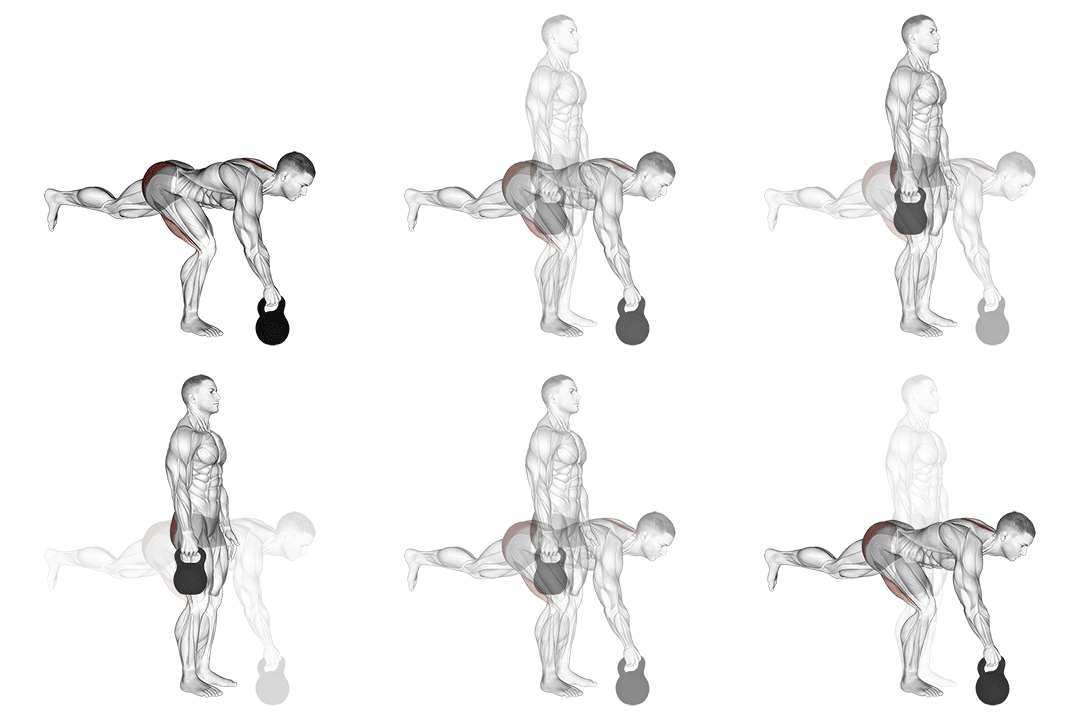
The Kettlebell One Legged Deadlift performs a deadlift while balancing entirely on one leg, with the kettlebell held in front of the body. The fully unilateral pattern produces the most direct strength loading on each leg with significant core demand.
For experienced lifters who want maximum unilateral loading, the one-legged deadlift is the most demanding back-and-leg exercise that exists. The pure unilateral loading builds the kind of leg and back strength that transfers directly to athletic performance and protects against the asymmetries that develop with bilateral training alone.
Stand on one leg with a kettlebell held in front of the body. Hinge forward at the hip while extending the back leg behind. Keep the back flat and the standing leg with a slight knee bend. Touch the kettlebell toward the floor at the bottom. Reverse to standing.
How To Program These Workouts
A productive kettlebell back session pulls six to eight exercises from the list above. A balanced session includes one explosive movement (swing or snatch), one bilateral hinge (kettlebell deadlift or RDL), one rowing variation (alternating row or rear delt row), one unilateral hinge (suitcase deadlift or one-legged deadlift), and one good morning. Run primary exercises for 3 to 4 sets of 6 to 12 reps; finishers for higher rep counts.
Train back two to three times per week. Heavy hinge work recovers within 48 to 72 hours; spacing volume across multiple sessions produces faster growth than once-weekly high-volume sessions. A Monday/Thursday or Tuesday/Friday split fits most schedules; advanced lifters can sometimes handle three sessions per week.
For more kettlebell programming, see our best kettlebell workouts and best full body kettlebell workouts. To browse the equipment library, explore our kettlebell exercises collection.
Final Thoughts
The best kettlebell back workouts deliver complete back development without barbells, racks, or specialized gym equipment. The combination of swings, rows, deadlifts, and unilateral variations covers every major back function in a way most barbell-only programs cannot match. For home lifters, kettlebells are the most versatile back-training equipment available.
Pay attention to hinge mechanics. Every kettlebell back exercise depends on solid hip-hinge technique: the swing, snatch, deadlift, RDL, and good morning all share the same fundamental pattern. The lifters who get the most from kettlebell back training are the ones who master the hinge first with controlled deadlifts and RDLs before progressing to ballistic patterns. Master the basics; everything else follows.
Frequently Asked Questions
What kettlebell weight should I use for back workouts?
Most intermediate lifters work with 24 to 32 kg kettlebells (53 to 70 pounds) for swings and deadlifts. Rowing variations typically use lighter bells (16 to 24 kg). Single-arm work runs lighter still. The right weight is whatever allows clean reps in your target range with one or two reps in reserve. Heavy weight with poor form produces less benefit than moderate weight with strict technique.
Can kettlebells build a thick back?
Yes, especially for beginners and intermediates. The combination of swings, rows, snatches, and deadlifts produces real back development for years before lifters bump up against the load ceiling barbells eventually surpass. Advanced lifters chasing maximum back size sometimes benefit from adding heavy barbell deadlifts and rows, but consistent kettlebell back training produces strong development at every level.
How often should I train back with kettlebells?
Two to three times per week works for most lifters. The back recovers within 48 to 72 hours of moderate kettlebell training because the loads are typically lighter than barbell work. Spacing volume across multiple sessions produces faster growth than once-weekly high-volume sessions. Pair kettlebell back days with chest or push days for balanced upper-body programming.
Are kettlebell back exercises safe for the lower back?
Yes, when performed with proper hip-hinge technique. The most common back-strain cause is using the lower back to lift the bell rather than driving through the hips. Lifters with existing lower-back issues should master the kettlebell RDL and deadlift first to dial in the hinge pattern before progressing to ballistic patterns like swings and snatches.
Do I need both bilateral and unilateral kettlebell back work?
Yes for complete development. Bilateral exercises (kettlebell deadlift, two-arm row) allow heavier total loading that builds maximum strength. Unilateral exercises (suitcase deadlift, one-legged deadlift) catch strength imbalances and produce stronger core engagement. Including both in the program produces more balanced back development than either alone.