Fixing achilles tendonitis (the painful inflammation of the achilles tendon – the large tendon connecting the calf muscles to the heel bone, typically caused by overuse) requires understanding both the contributing factors (achilles tendonitis typically develops from a combination of: 1) sudden increases in running volume or intensity, 2) tight calves that limit ankle dorsiflexion and produce excessive tendon loading, 3) weak calves that allow tendon overload during activity, 4) abnormal foot mechanics or overpronation, 5) hard running surfaces, 6) inadequate footwear or worn shoes, 7) hill running or excessive uphill work, 8) weak glutes producing compensation patterns, or 9) the cumulative effect of multiple factors) and the training principles that resolve it: slow eccentric calf raises as the primary intervention (the most well-researched and effective treatment for achilles tendinopathy – the slow eccentric loading supports tendon healing), calf stretching for mobility and reduced tendon strain, ankle mobility work for proper mechanics, progressive calf strengthening for muscular support, glute strengthening for hip stability, foot mobility for proper function, and adequate recovery time. Most cases improve within 8 to 16 weeks with consistent eccentric loading plus appropriate activity modification. Severe or persistent cases (especially with significant tendon thickening or partial tearing) warrant medical evaluation – this article addresses general exercise approaches for typical cases.
Below are ten of the most effective exercises for fixing achilles tendonitis, covering primary calf flexibility (standing gastrocnemius calf stretch), ankle mobility (rocking ankle stretch), eccentric calf strengthening (bodyweight standing calf raise, dumbbell standing calf raise – with emphasis on slow eccentric), tibialis strengthening (seated tibialis anterior press), foot mobility (feet and ankles stretch), hip support (barbell glute bridge), core stability (front plank), calf endurance (toe walk), and gait pattern (heel-to-toe walk). Together they form a complete achilles tendonitis correction program. A 15 to 25-minute session pulled from this list, performed 1 to 2 times per day initially (high frequency for accelerated correction), produces measurable achilles tendonitis improvement within 8 to 16 weeks of consistent practice for most cases. Note: combine exercise correction with appropriate activity modification (reducing aggravating activities until symptoms subside).
Standing Gastrocnemius Calf Stretch

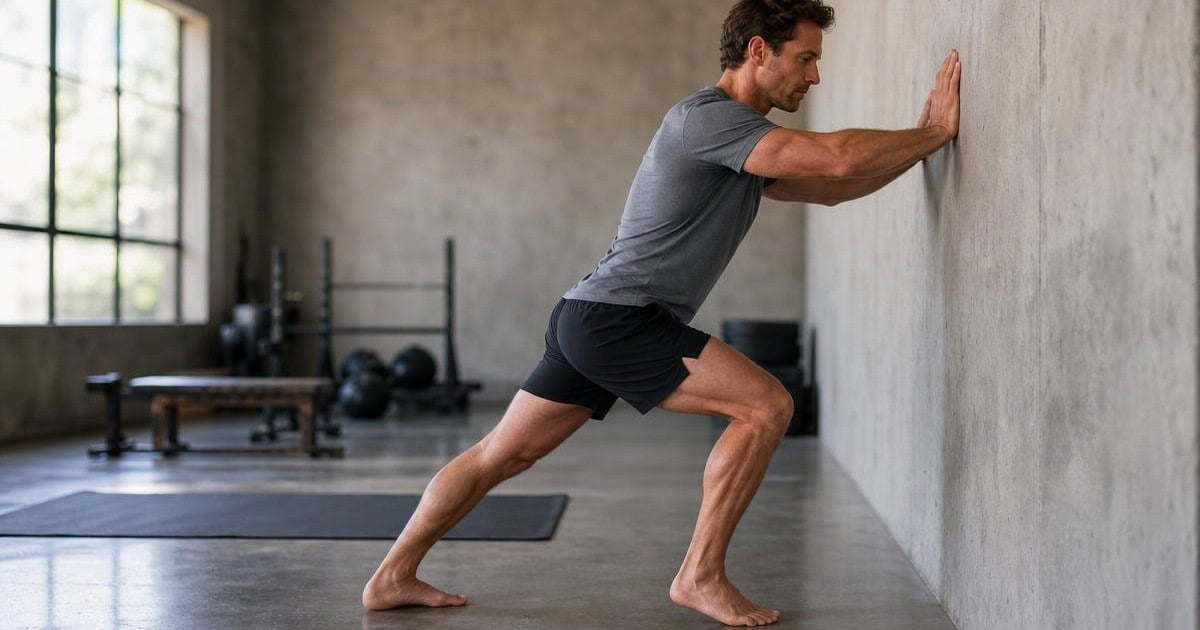
The Standing Gastrocnemius Calf Stretch performs the wall calf stretch. The pattern is foundational for achilles tendonitis correction.
For achilles tendonitis correction, the calf stretch is foundational. Run it for 3 sets of 30 to 60-second holds per side, multiple times daily.
Stand facing a wall about 2 feet away. Place hands on the wall at shoulder height. Step one leg back with the heel down and knee straight. Lean forward into the wall to feel deep stretch through the calf. Hold for 30 to 60 seconds. Switch sides. The pattern is foundational for achilles tendonitis correction – tight calves are one of the primary contributors to achilles tendonitis because they limit ankle dorsiflexion and produce abnormal tendon loading. Daily calf stretching addresses this primary contributing factor and supports tendon healing through reduced strain.
Rocking Ankle Stretch
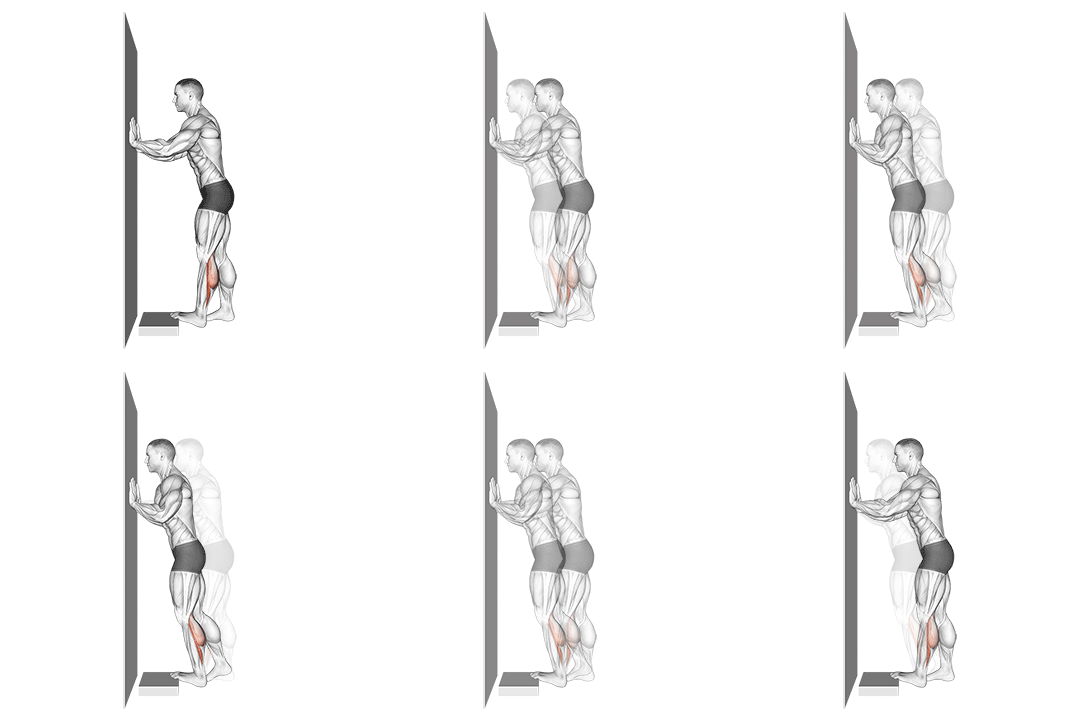
The Rocking Ankle Stretch performs rocking ankle mobility. The pattern produces ankle mobility for achilles tendonitis correction.
For achilles tendonitis correction, the rocking ankle stretch produces dynamic ankle mobility. Run it for 3 sets of 10 to 15 reps per side as ankle mobility work, daily.
Stand or kneel in a half-kneeling position. Rock the ankle forward (dorsiflexion) and back (plantar flexion) through full range of motion. The ankle joint mobilizes through the full range. Continue for the working interval. Switch sides. The pattern produces dynamic ankle mobility – critical for achilles tendonitis correction because limited ankle mobility contributes to abnormal tendon loading. Daily ankle mobility work addresses this contributing factor and supports proper foot and ankle mechanics.
Bodyweight Standing Calf Raise

The Bodyweight Standing Calf Raise performs bodyweight calf raises. The pattern produces calf and tendon strengthening.
For achilles tendonitis correction, bodyweight calf raises produce eccentric loading critical for tendon healing. Run it for 3 sets of 15 to 25 reps as calf strengthening work, daily, with emphasis on slow eccentric (3 to 5 second lowering).
Stand on a flat floor with feet hip-width. Lift the heels up to rise onto the balls of the feet by extending at the ankles. Hold briefly at peak. Lower under control with eccentric loading (slow 3 to 5 second lowering). The pattern produces tendon-friendly eccentric loading – critical for achilles tendonitis correction because slow eccentric calf raises (the most well-researched intervention for achilles tendinopathy) provide the controlled loading that supports tendon healing. Most successful achilles tendonitis correction programs feature daily slow eccentric calf raises.
Dumbbell Standing Calf Raise

The Dumbbell Standing Calf Raise performs weighted calf raises. The pattern produces progressive calf and tendon strengthening.
For achilles tendonitis correction, the dumbbell calf raise produces progressive eccentric loading. Run it for 3 sets of 12 to 15 reps with slow eccentric, 3 to 4 times per week as progressive loading.
Stand holding dumbbells in each hand at the sides. Position the balls of the feet on a slightly elevated surface (or stand flat). Lift the heels up to rise onto the balls of the feet by extending at the ankles. Lower under slow eccentric control (3 to 5 seconds) to deep stretch position. The pattern produces progressive calf and tendon loading – the addition of dumbbells provides progressive overload that builds calf strength and tendon capacity. Critical for advanced achilles tendonitis correction because robust calf strength prevents recurrence.
Seated Tibialis Anterior Press

The Seated Tibialis Anterior Press performs tibialis raises. The pattern produces direct tibialis anterior strengthening.
For achilles tendonitis correction, the seated tibialis anterior press produces tibialis strengthening for ankle balance. Run it for 3 sets of 12 to 15 reps as tibialis strengthening, daily.
Sit on a chair or bench with feet flat on the floor. Lift the toes up by dorsiflexing the ankles while keeping the heels on the floor. The tibialis anterior muscle (front of shin) works hard. Lower under control. The pattern produces direct tibialis anterior strengthening – while the achilles is at the back of the lower leg, balanced lower-leg strength (both tibialis and calves) supports ankle health and proper mechanics that prevent achilles overload. Combined with calf work, tibialis training produces complete lower-leg balance.
Feet and Ankles Stretch

The Feet And Ankles Stretch performs combined foot/ankle stretching. The pattern produces complete lower-extremity mobility.
For achilles tendonitis correction, the feet and ankles stretch produces complete foot/ankle mobility. Run it for 2 to 3 sets of 30 to 60-second holds, daily.
Sit or stand with feet flat. Slowly stretch through different foot positions – point and flex the toes, rotate ankles, stretch the bottom of the foot, and stretch the top of the foot. Cover all directions of foot motion. Hold each position for the working interval. The pattern produces integrated foot and ankle mobility – critical for achilles tendonitis correction because foot dysfunction contributes to abnormal lower-leg loading. Daily foot mobility supports proper foot mechanics and prevents the foot issues that aggravate achilles tendonitis.
Barbell Glute Bridge
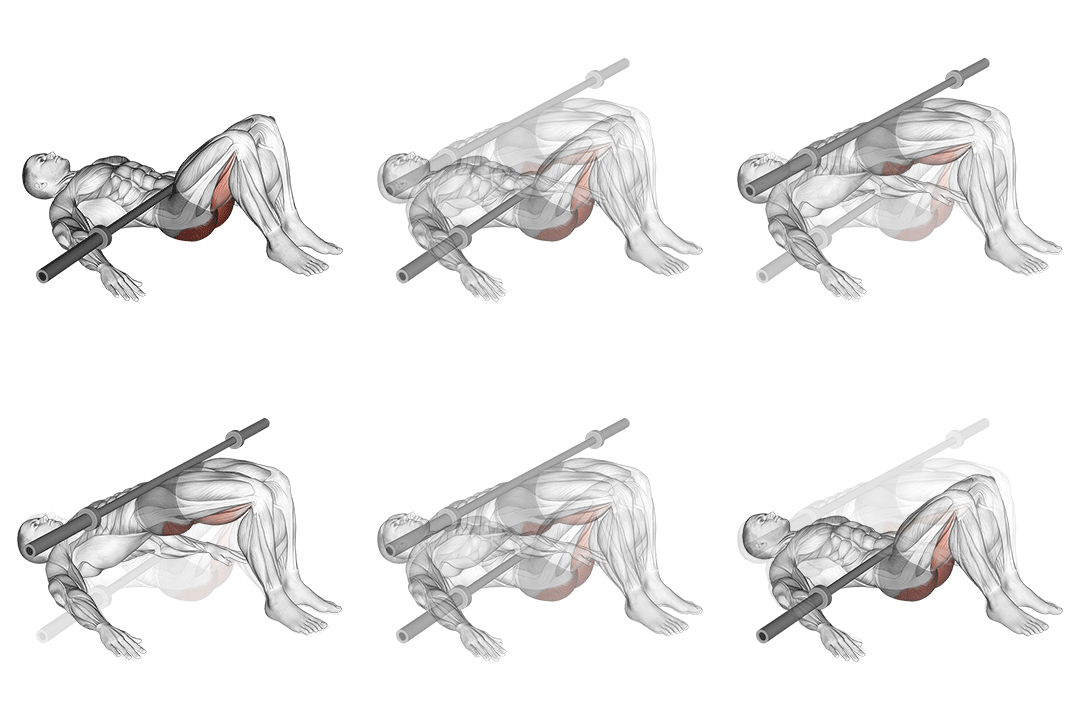
The Barbell Glute Bridge performs glute bridges. The pattern produces glute strengthening for achilles tendonitis correction.
For achilles tendonitis correction, the glute bridge produces glute strengthening that addresses contributing weakness. Run it for 3 sets of 10 to 15 reps as glute strengthening, 3 times per week.
Lie on the floor with knees bent and feet planted. Position a barbell across the hips (or use bodyweight). Drive through the heels to lift the hips up by extending the hips. The body forms a straight line from shoulders to knees at the top. The glutes work hard. Squeeze at peak hip extension. Lower under control. The pattern produces glute strengthening – critical for achilles tendonitis correction because weak glutes contribute to abnormal lower-leg loading patterns. Strong glutes support proper hip mechanics and reduce the lower-leg compensation patterns that produce achilles overload.
Front Plank
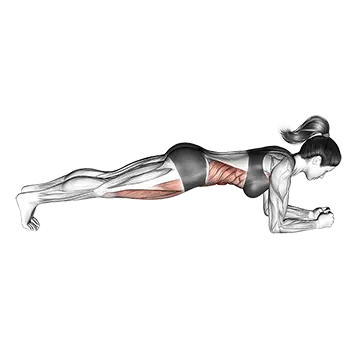
The Front Plank performs forearm plank holds. The pattern produces foundational core for proper running mechanics.
For achilles tendonitis correction, the plank produces foundational core stability supporting proper mechanics. Run it for 3 sets of 30 to 60-second holds, 3 times per week.
Lie face-down on the floor. Prop up on the forearms with elbows under the shoulders. Lift the hips so the body forms a straight line from shoulders to ankles. The core works hard isometrically. Hold for the working interval. The pattern builds isometric core strength supporting proper running and walking mechanics – strong core supports proper posture during gait which prevents the compensation patterns that contribute to achilles overload. Combined with hip and lower-leg work, core strengthening completes the integrated approach.
Toe Walk

The Toe Walk performs walking on toes. The pattern produces calf strengthening and tendon work.
For achilles tendonitis correction, toe walking produces calf endurance work supporting tendon health. Run it for 3 sets of 30-second walks as calf endurance work.
Stand on the balls of the feet with heels lifted. Walk forward maintaining the toe position with heels off the ground. Continue for the working interval. The calves work hard isometrically and through repeated calf raises. The pattern produces calf endurance plus dynamic loading – addresses calf weakness that contributes to achilles tendonitis. Note: progress carefully and stop if symptoms aggravate. Excellent functional exercise once initial inflammation has subsided.
Heel to Toe Walk

The Heel To Toe Walk performs gait pattern walking. The pattern produces dynamic ankle mobility.
For achilles tendonitis correction, heel-to-toe walking produces gentle dynamic ankle work. Run it for 3 sets of 30-second walks as gait support work.
Walk forward placing each foot heel-first, then rolling through the foot to push off with the toes. Emphasize the deliberate heel-strike and toe-off pattern. Continue for the working interval. The ankle and lower-leg work through the full gait pattern. The pattern produces dynamic ankle motion through proper gait mechanics – excellent supporting work for achilles tendonitis correction because it reinforces proper foot strike and reduces the abnormal loading patterns that contribute to achilles issues.
How To Program These Workouts
A productive achilles tendonitis session emphasizes slow eccentric calf raises. A common balanced session: bodyweight standing calf raises (slow eccentric primary – 3 sets of 15 reps with 3 to 5 second eccentric), dumbbell standing calf raises (progressive loading – 3 sets of 12 reps with slow eccentric), standing gastrocnemius calf stretch (mobility), rocking ankle stretch (mobility), seated tibialis anterior press (balance), feet and ankles stretch (foot mobility), barbell glute bridge (hip support). For acute pain phase: emphasize gentle stretching and very gentle isometric calf work, avoiding aggressive loading. For correction phase: include progressive eccentric calf raises (the foundational intervention) plus continued mobility. Run eccentric calf raises for 3 sets of 12 to 15 reps with slow 3 to 5 second eccentric, stretching for 3 sets of 30 to 60-second holds, supporting work for 3 sets of 10 to 15 reps.
Train achilles tendonitis correction with daily eccentric loading and progressive intensity. The condition responds best to consistent eccentric loading plus activity modification. Most successful achilles tendonitis programs include: 1) daily slow eccentric calf raises (the primary intervention – bodyweight initially, progressing to dumbbells over weeks), 2) daily calf stretching, 3) daily ankle mobility, 4) glute strengthening 3 times per week, 5) reducing aggravating activities (running, hill work, high-impact) until symptoms subside, 6) gradual return to full activity. Most cases improve within 8 to 16 weeks of consistent practice plus activity modification. Critical: progress eccentric loading gradually – aggressive loading aggravates the condition. The eccentric loading research is well-established for achilles tendinopathy.
For broader programming, see our how to improve ankle mobility and how to fix shin splints. For specific work, see our best workouts for runners.
Final Thoughts
Fixing achilles tendonitis requires applying the right intervention principles consistently over time: slow eccentric calf raises as the primary intervention (the most well-researched treatment), calf stretching for mobility and reduced tendon strain, ankle mobility work for proper mechanics, progressive calf strengthening for muscular support, glute strengthening for hip stability, foot mobility for proper function, core stability for proper mechanics, and adequate recovery with activity modification. The combination of eccentric calf raises, calf stretches, ankle mobility, tibialis raises, foot mobility, glute bridges, planks, toe walks, and heel-to-toe walks covers every functional pattern needed for achilles tendonitis correction and produces broader lower-leg, hip, and core function improvement than rest-only approaches. Most individuals who consistently apply these principles see measurable achilles tendonitis improvement within 8 to 16 weeks – including reduced tendon pain, ability to return to running, better lower-leg mechanics, and the integrated lower-extremity health that prevents recurrence. For most achilles tendonitis cases, dedicated exercise-based correction (especially eccentric loading) plus activity modification is the most effective conservative intervention available.
Stay focused on slow eccentric calf raises as the priority intervention for achilles tendonitis. The most common mistake people make in achilles tendonitis correction is focusing only on rest without addressing the underlying tendon dysfunction (which only worsens with rest alone). The fix: 1) prioritize daily slow eccentric calf raises (3 to 5 second eccentric) as the foundational intervention – the most well-researched treatment for achilles tendinopathy, 2) progress weight gradually over weeks (bodyweight, then add dumbbells), 3) include calf stretching multiple times daily, 4) modify aggravating activities until symptoms subside, 5) gradually return to running with proper progression. Combined with patience and consistent gradual progression, slow eccentric loading produces the achilles tendonitis correction that rest or aggressive loading alone never achieves. The eccentric loading research is well-established.
Frequently Asked Questions
How do I fix achilles tendonitis fast?
Daily slow eccentric calf raises plus calf stretching plus activity modification. Slow eccentric calf raises (3 to 5 second eccentric, 3 sets of 15 reps daily) provide the foundational tendon loading that supports healing – the most well-researched intervention for achilles tendinopathy. Daily calf stretching addresses tight calves. Reducing aggravating activities (running, hill work, high-impact) allows tendon healing. Combined with ankle mobility, foot mobility, glute strengthening, and core work, this comprehensive approach produces accelerated correction within 8 to 16 weeks.
What causes achilles tendonitis?
Multiple contributing factors. Achilles tendonitis typically develops from: 1) sudden increases in running volume/intensity, 2) tight calves limiting ankle dorsiflexion, 3) weak calves allowing tendon overload, 4) abnormal foot mechanics or overpronation, 5) hard running surfaces, 6) inadequate footwear, 7) hill running, 8) weak glutes producing compensation, 9) cumulative effect of multiple factors. Most cases involve multiple factors. The fix combines eccentric tendon loading (the primary intervention), calf flexibility, ankle mobility, glute strengthening, and addressing aggravating factors.
How long does achilles tendonitis take to heal?
8 to 16 weeks for measurable improvement, longer for severe cases. Most people who consistently apply daily slow eccentric calf raises plus stretching plus activity modification see measurable improvement within 8 to 16 weeks. Beginners often see initial gains within 4 to 8 weeks. Severe cases may take 16 to 24+ weeks. Persistent cases (those not improving with conservative treatment after 12 to 16 weeks) warrant medical evaluation – persistent achilles pain may indicate partial tearing or significant tendon thickening. Achilles tendonitis is highly treatable through consistent eccentric loading.
Should I run with achilles tendonitis?
Reduce or eliminate running until symptoms subside. Continuing to run with achilles tendonitis typically aggravates the condition and delays healing. The fix: 1) reduce running volume substantially or eliminate temporarily, 2) substitute low-impact cardio (cycling, swimming, elliptical) during recovery, 3) continue daily eccentric loading and stretching, 4) gradually return to running once symptoms subside, 5) progress running volume slowly (10 to 15% increase per week maximum). Active rehabilitation (eccentric loading) produces faster correction than continued running.
What’s the best exercise for achilles tendonitis?
Slow eccentric calf raises – the most well-researched intervention. Daily slow eccentric calf raises (3 to 5 second eccentric lowering) produce the controlled tendon loading that supports healing – the most well-researched and effective treatment for achilles tendinopathy. Combined with calf stretches (mobility), ankle mobility (rocking ankle stretch), tibialis strengthening (balance), foot mobility, glute strengthening (hip support), planks (core), toe walks (calf endurance), and heel-to-toe walks (gait), eccentric calf raises form the foundation of achilles tendonitis correction. The eccentric protocol is well-established research.