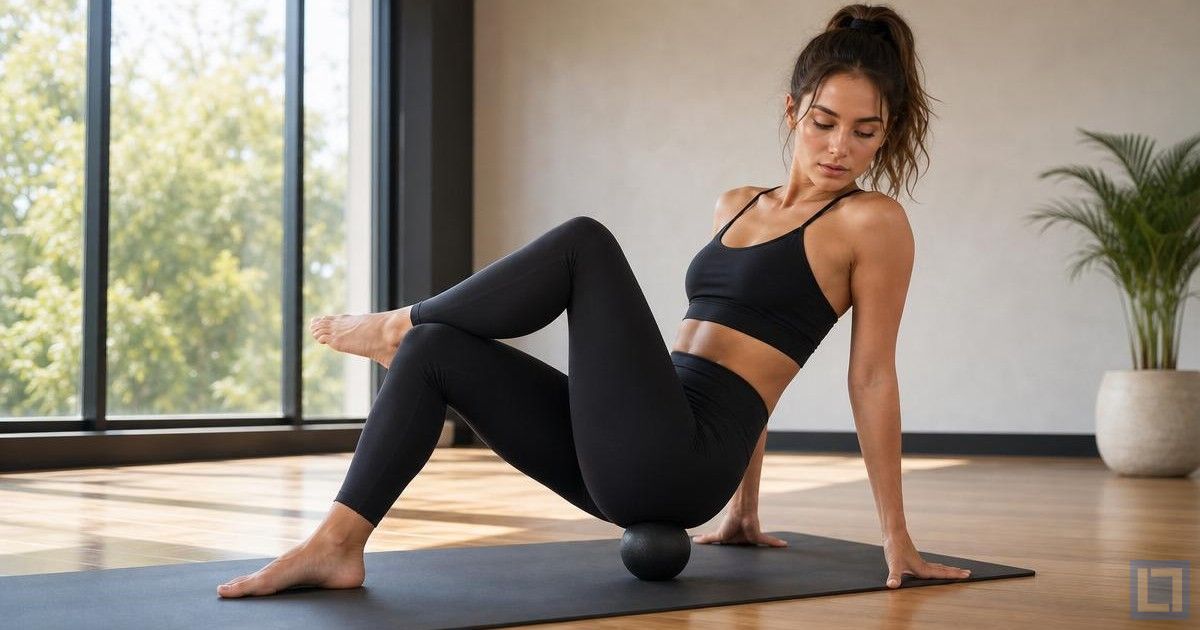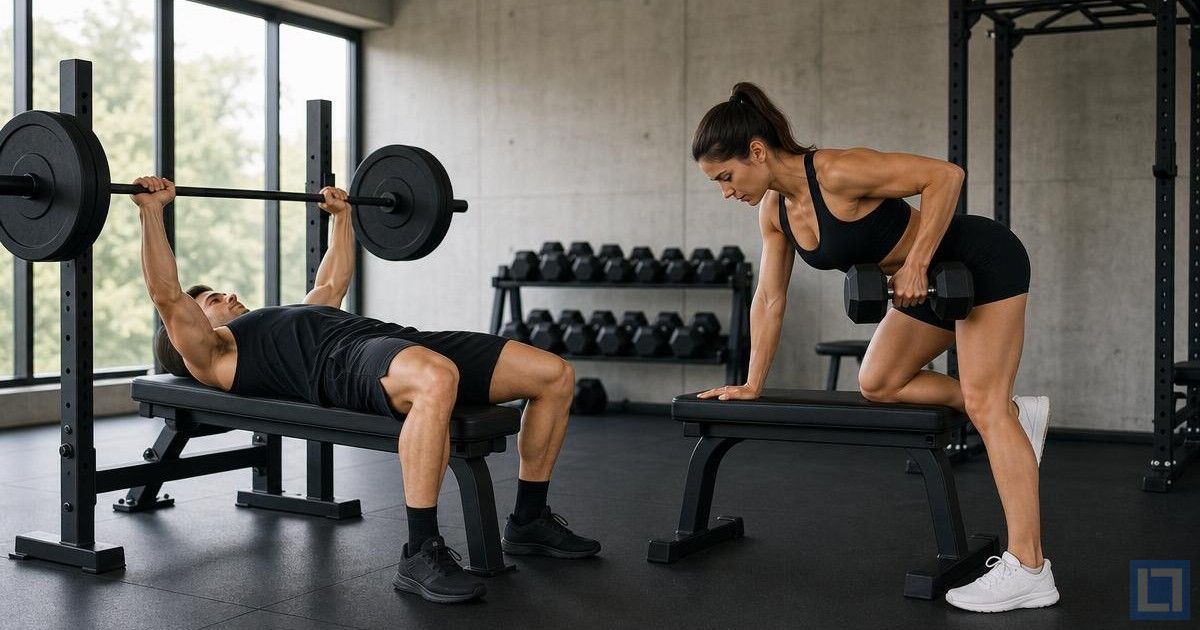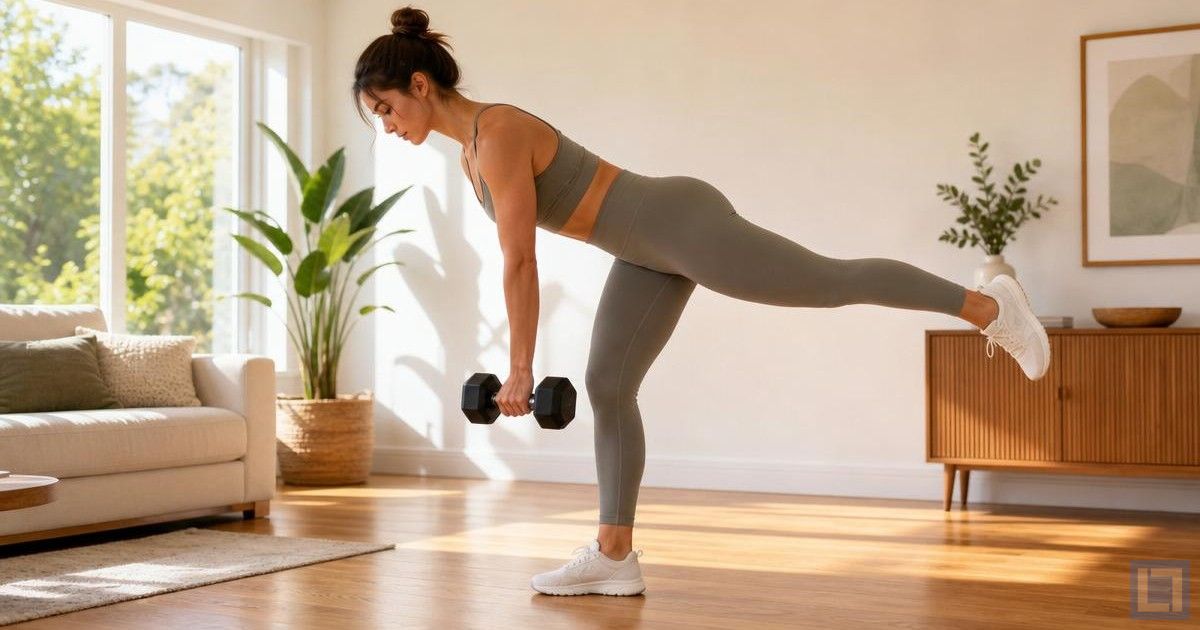
At-home hamstring training requires a slightly different approach than gym-based programming because most home setups lack the leg curl machines that produce direct knee-flexion isolation. The best at home hamstring workouts work around this by combining hip-hinge variations (RDLs, deadlifts, good mornings) with bodyweight and band-based knee-flexion exercises (stability ball curls, Nordic curls, band leg curls). Together these patterns cover both major hamstring functions and produce real hamstring development without machine access.
Below are ten effective at-home hamstring exercises that cover the major hip-hinge variations, glute-bridge work, knee-flexion isolation, advanced Nordic-style training, and recovery stretching. Together they form a complete hamstring training program that fits in any home gym with a pair of dumbbells, a resistance band, and a stability ball (the last is optional). A 30 to 45-minute session pulled from this list produces strong hamstring stimulus.
Dumbbell Romanian Deadlift
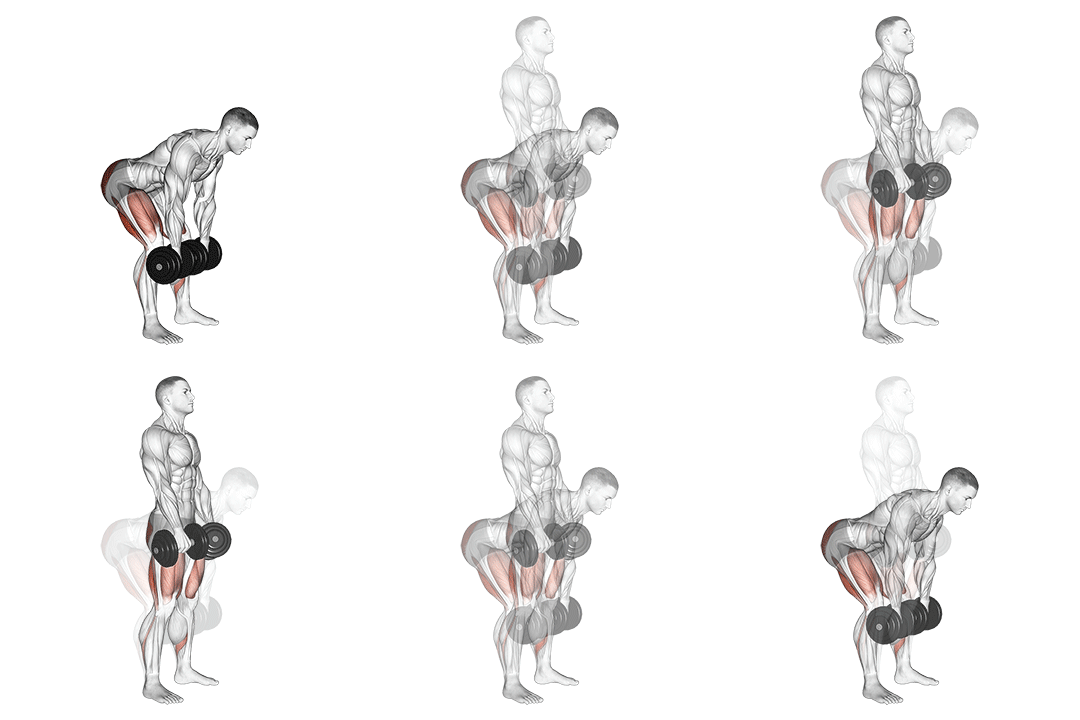
The Dumbbell Romanian Deadlift performs the Romanian deadlift pattern with dumbbells held at the sides. The hinge motion targets the hamstrings and glutes through controlled lowering rather than ground-based pulling.
For at-home hamstring development, the Romanian deadlift is the foundational exercise. The hinge pattern produces direct hamstring loading through the eccentric (lowering) phase, which drives stronger growth than concentric-emphasized exercises. Run it for 3 to 4 sets of 8 to 12 reps as the primary heavy hamstring lift.
Hold dumbbells at the sides with arms extended. Hinge at the hips with a slight knee bend, lowering the dumbbells in a path close to the legs until the hamstrings stretch (typically mid-shin level). Drive the hips forward to stand back up. Keep the back flat throughout.
Dumbbell Deadlift

The Dumbbell Deadlift positions dumbbells at the sides and lifts them with a hip-hinge motion, ending in a standing position with the dumbbells at the hips. The compound exercise hits the entire posterior chain (hamstrings, glutes, lower back) through a full range of motion.
For complete posterior chain training at home, the deadlift complements the RDL by adding the lift-from-the-floor pattern. Where RDLs emphasize the eccentric loading on the hamstrings, deadlifts add concentric loading from the floor. Both patterns are foundational; well-designed hamstring programs include both. Run it for 3 to 4 sets of 6 to 10 reps.
Stand with dumbbells at the sides, arms extended. Hinge at the hips with a flat back, sliding the dumbbells down the legs as the body bends forward. Drive through the floor to stand back up. Lock out by squeezing the glutes at the top. Lower under control.
Glute Bridge March

The Glute Bridge March lies on the back in a glute bridge position and alternates lifting one knee toward the chest while maintaining the bridge. The combined hip extension and unilateral leg lift produces strong hamstring and glute demand.
For at-home hamstring work without weights, the glute bridge march produces real loading through bodyweight alone. The marching motion adds unilateral stress to the hamstring on the planted leg, which produces stronger hamstring development per rep than standard glute bridges. Run it for 3 sets of 10 to 12 reps per leg.
Lie flat on the back with knees bent and feet planted shoulder-width apart. Lift the hips up into a glute bridge. Maintaining the bridge, lift one knee toward the chest, then lower back to the start. Lift the opposite knee. Continue alternating without dropping the hips.
Dumbbells Glute Bridge

The Dumbbells Glute Bridge lies on the back with knees bent and dumbbells across the hips, then drives the hips up by squeezing the glutes hard. The added external load increases the strength stimulus on both the glutes and hamstrings significantly compared to bodyweight bridges.
For at-home programs that emphasize glute and hamstring development together, the loaded glute bridge is one of the most direct exercises that exists. The hip-thrust mechanics target both muscles simultaneously, which fits the often-paired nature of glute and hamstring training. Run it for 3 to 4 sets of 12 to 15 reps with hard glute squeezes at the top.
Lie flat with knees bent and feet planted shoulder-width apart. Place a heavy dumbbell across the hips. Drive the hips up by squeezing the glutes and hamstrings hard at the top. Lower under control. Hold the top position briefly on each rep to maximize the contraction.
Exercise Ball Leg Curl

The Exercise Ball Leg Curl lies on the back with the heels resting on a stability ball, lifts the hips up, then curls the ball toward the body by bending at the knees. The pattern hits the hamstrings through their primary knee-flexion function.
For at-home hamstring training, the stability ball leg curl is one of the most effective exercises that targets hamstring knee-flexion specifically. The hip-bridged position also engages the glutes and core, which produces broader posterior chain training. Run it for 3 sets of 10 to 12 reps as accessory work.
Lie flat on the back with the heels resting on top of a stability ball. Lift the hips off the floor into a bridge position. Curl the ball toward the body by bending at the knees and pulling the heels in. Extend back to the start. Keep the hips elevated throughout the entire set.
Resistance Band Assisted Nordic Hamstring Curl

The Resistance Band Assisted Nordic Hamstring Curl kneels with the ankles secured (under a couch, by a partner, or under a heavy object) and lowers the body forward toward the floor under control while a resistance band anchored overhead provides assistance. The exercise loads the hamstrings eccentrically with maximal demand.
Nordic hamstring curls are among the most effective hamstring exercises that exist for both strength and injury prevention. Research shows they reduce hamstring injury rates by up to 50 percent in athletes. The band-assisted version makes the exercise accessible to lifters who cannot yet perform unassisted Nordics (most beginners need 4 to 8 weeks of band assistance before progressing).
Kneel with the ankles secured (use a sturdy couch base, ask a partner to hold your ankles, or place a heavy object on your calves). Anchor a resistance band overhead in front of the body and hold the band end at the chest. Slowly lower the body forward toward the floor under control, using the band tension to assist. Push back to the kneeling position by engaging the hamstrings.
Band Lying Leg Curl

The Band Lying Leg Curl lies face-down with a resistance band looped around the ankles and a fixed anchor, then curls the legs up toward the glutes against the band tension. The exercise mimics the machine leg curl pattern using only band equipment.
For at-home hamstring isolation, the band lying leg curl is the most direct alternative to gym-based machine leg curls. The band tension produces continuous loading throughout the rep, and the lying position eliminates body sway. Run it for 3 sets of 12 to 15 reps as accessory hamstring work.
Anchor a resistance band at floor level (loop it around a sturdy object). Lie face-down with the band looped around the ankles. Curl both legs up toward the glutes by bending at the knees against the band tension. Squeeze the hamstrings at the top. Lower under control.
Bodyweight B Stance Good Morning

The Bodyweight B Stance Good Morning takes a B-stance position (one foot slightly behind the other, kickstand-style) and performs a hip-hinge good morning motion. The B-stance shifts the loading toward the front leg, producing unilateral hamstring work without losing balance demands.
B-stance variations are one of the most underrated training tools that exist for unilateral lower-body work. The kickstand position allows higher loading on the front leg than pure single-leg variations while still catching the strength imbalances that bilateral exercises hide. Run it for 3 sets of 10 to 12 reps per leg.
Set up in a B-stance: one foot fully planted, the other foot positioned slightly behind with only the toes lightly touching the floor for balance. Place hands on the head or extended forward. Hinge at the hips with a flat back, lowering the trunk forward. Drive the hips forward to stand back up. Switch the lead leg on the next set.
Reverse Plank With Leg Lift

The Reverse Plank With Leg Lift sits on the floor with hands behind the body, lifts the hips up to form a reverse plank position, then lifts one leg up while maintaining the plank. The combined position hits the hamstrings, glutes, and core simultaneously.
For at-home hamstring training that adds core demand, the reverse plank with leg lift produces strong posterior chain work alongside isometric core engagement. The reverse plank position itself loads the hamstrings continuously, and the leg lift adds dynamic loading that intensifies the work. Run it for 3 sets of 8 to 10 reps per leg.
Sit on the floor with hands placed flat behind the body, fingers pointing toward the feet. Lift the hips up by engaging the glutes and hamstrings into a reverse plank position. While maintaining the plank, lift one leg up toward the ceiling. Lower the leg under control without dropping the hips. Switch legs.
Standing Hamstring Stretch

The Standing Hamstring Stretch places one foot forward with the leg straight and hinges at the hips to feel a stretch in the hamstring. The static stretch produces direct hamstring lengthening and serves as a recovery tool after hamstring training.
For post-workout hamstring recovery and ongoing flexibility work, the standing hamstring stretch is one of the most accessible exercises that exists. Run it for 30 to 60 seconds per leg as cool-down after hamstring training, or daily as a maintenance flexibility habit. Most lifters benefit from including hamstring stretching as a recovery tool.
Stand tall and place one foot a step forward, with that leg straight and the heel on the floor. Hinge at the hips with a flat back, leaning the trunk forward over the front leg until the hamstring stretches. Hold the position for 30 to 60 seconds. Switch legs.
How To Program These Workouts
A productive at-home hamstring session pulls six to eight exercises from the list above. A balanced session includes one heavy hip-hinge (Romanian deadlift or deadlift), one glute-bridge variation (loaded glute bridge), one knee-flexion exercise (stability ball curl or band lying curl), one advanced eccentric exercise (Nordic curl with band assistance), and one unilateral exercise (B-stance good morning). Run primary lifts for 3 to 4 sets of 6 to 12 reps; isolation work for 3 sets of 10 to 15 reps.
Train hamstrings two times per week. Heavier hip-hinge work (RDLs, deadlifts) once per week. Lighter knee-flexion isolation and Nordic work once or twice per week. Spread the volume across two sessions to drive faster growth than once-weekly high-volume sessions. Most lifters do well with one heavier session (Monday) and one lighter session (Thursday or Friday).
For more lower-body programming, see our best dumbbell leg workouts and best at home glute workouts. For recovery work, see our best hamstring stretches.
Final Thoughts
The best at home hamstring workouts deliver complete hamstring development without requiring leg curl machines or specialized gym equipment. The combination of hip-hinge variations, knee-flexion exercises, and advanced eccentric work covers both major hamstring functions in a way that produces real strength and visible muscle development. For home lifters and travelers, this format is one of the most effective hamstring training options available.
Pay attention to both hip-hinge and knee-flexion work. The most common at-home hamstring training mistake is doing only RDLs and deadlifts (which hit the hamstrings primarily through hip extension) and skipping knee-flexion exercises (which hit the hamstrings through their other primary function). The fix: include both patterns in every hamstring workout. Stability ball curls, band leg curls, and Nordic curls fill the knee-flexion gap that hip-hinge work alone cannot address.
Frequently Asked Questions
Can I build big hamstrings at home?
Yes for beginners and intermediates. Dumbbell-based hip-hinge work, band and bodyweight knee-flexion exercises, and Nordic curl progressions produce real hamstring development for years before lifters bump up against the load ceiling barbells eventually surpass. The unilateral and Nordic variations actually produce stronger hamstring development per rep than many machine-based options.
What equipment do I need for at home hamstring workouts?
A pair of dumbbells (30 to 60 pounds for most intermediate lifters) and a resistance band cover most of the exercises. Optional additions: a stability ball (for ball leg curls) and a sturdy anchor for Nordic curls (a couch base, a sturdy table, or a partner to hold ankles). Most home lifters can do effective hamstring training with just dumbbells and a band.
How often should I train hamstrings at home?
Two times per week works for most lifters. The hamstrings recover within 48 to 72 hours of moderate training, but they get significant indirect work from squat day and deadlift day. Most productive home programs run one heavier hamstring session per week alongside one lighter session focused on knee-flexion and Nordic curl work.
Are Nordic curls dangerous?
Not when performed with appropriate progression. Nordic curls produce strong hamstring loading and have been shown to reduce hamstring injury rates by up to 50 percent in athletes. The progression matters: most beginners cannot perform unassisted Nordics, so band-assisted variations build the strength gradually over 4 to 8 weeks. Lifters who jump straight into unassisted Nordics often experience extreme soreness or strain; the band-assisted progression eliminates this risk.
Why do my hamstrings feel weak compared to my quads?
Most lifters develop a strength imbalance between quads and hamstrings because squat-heavy training emphasizes quad development while neglecting hamstring work. The fix: program hamstring training with at least equal volume to quad-focused exercises (10 to 15 weekly hamstring sets), and prioritize Nordic curl progressions for the eccentric strength that prevents hamstring strains. Most lifters need 12 to 16 weeks of dedicated hamstring training to catch up the hamstrings to match quad development.