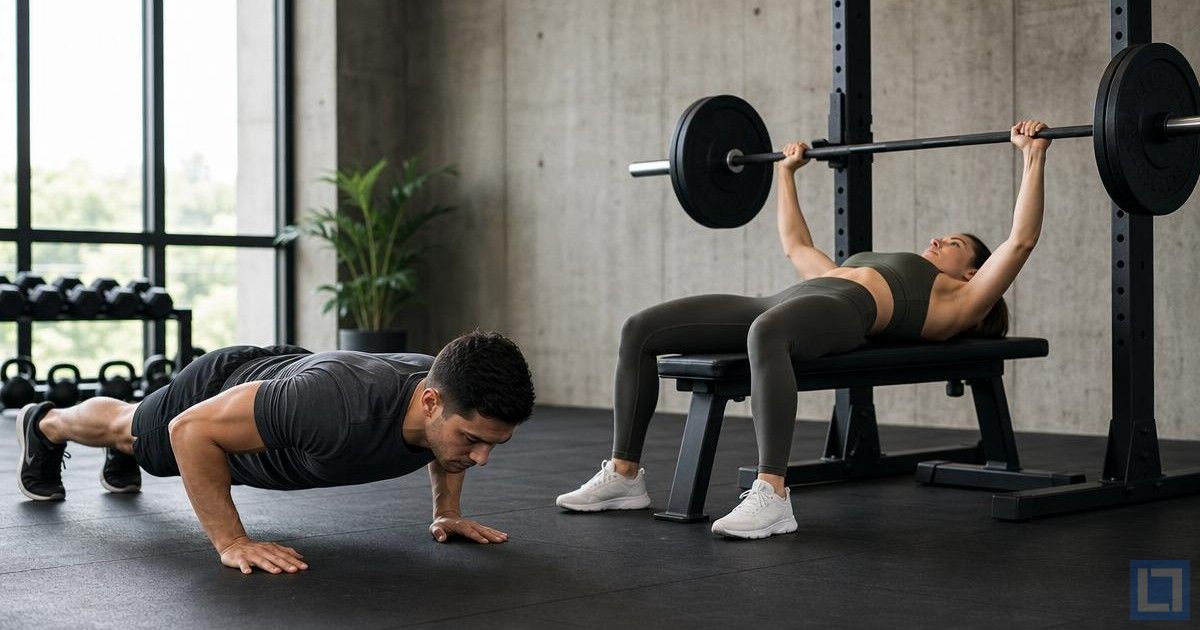
Push-ups and bench press are both fundamental pressing exercises that train the chest, shoulders, and triceps, but they differ significantly in loading mechanics, equipment requirements, training application, and outcomes. The key differences: bench press allows progressive heavy loading (up to 1 to 2x bodyweight or more for trained lifters) through bilateral barbell loading, while push-ups produce moderate loading (typically 60 to 70 percent of bodyweight on the hands) but can be performed anywhere without equipment. Bench press emphasizes maximum strength development through heavy loading; push-ups emphasize muscular endurance through bodyweight high-rep training. Both exercises hit the same primary muscles (pectoralis major, anterior deltoids, triceps brachii) but with different stimulus, training adaptations, and practical applications.
Below are ten exercises that represent both ends of the pressing spectrum and the variations between: heavy barbell bench press (flat, incline, decline) for maximum strength development, dumbbell bench press variations for combined heavy loading and range of motion, and push-up variations (standard, incline, close-grip, diamond, plyo) that scale from beginner to advanced. Together they form the complete pressing exercise foundation that most successful chest training programs include. Understanding when to use each variation is the difference between productive long-term chest development and stalled progress.
Barbell Bench Press

The Barbell Bench Press lies flat on a bench and presses a loaded barbell from chest level to lockout. The exercise produces the heaviest pressing loading available to most lifters and is the cornerstone of strength-focused chest training.
For comparing push-ups to bench press, the barbell bench press represents the heavy-loading end of the spectrum. The pattern allows progressive overload to maximum strength levels (typically 1 to 2 times bodyweight or more for trained lifters). Run it for 4 to 5 sets of 5 to 8 reps as primary heavy strength work.
Lie flat on a bench with feet planted firmly on the floor. Grip the barbell slightly wider than shoulder-width. Lower the bar to mid-chest under control. Press back to lockout. Maintain tight upper back and feet planted throughout. Use a spotter for heavy sets.
Push Ups

The Push Ups lower the body to the floor by bending the elbows, then press back to lockout. The exercise produces bodyweight loading without equipment and is the foundational pushing movement for any pressing program.
For comparing push-ups to bench press, the standard push-up represents the bodyweight end of the spectrum. The pattern produces moderate loading (typically 60 to 70 percent of bodyweight on the hands) but allows higher rep training and can be performed anywhere. Run it for 3 sets of 10 to 20 reps as foundational pressing work.
Set up in a high plank position with hands shoulder-width apart and body in a straight line from head to heels. Lower the chest to within an inch of the floor by bending the elbows. Press back to lockout. Maintain tight body position throughout.
Dumbbell Bench Press

The Dumbbell Bench Press lies flat on a bench and presses two dumbbells from chest level to lockout. The dumbbells allow independent arm motion and a deeper stretch position than barbell bench press.
For comparing pressing variations, the dumbbell bench press combines heavy loading (similar weight per side as bench press) with the deeper range of motion bodyweight push-ups produce. The dumbbells also catch strength imbalances. Run it for 3 to 4 sets of 8 to 12 reps as accessory pressing work.
Lie flat on a bench holding dumbbells at chest level with palms facing forward. Press both dumbbells up to lockout above the chest. Lower under control to chest level. The dumbbells allow deeper range of motion than barbell variations.
Barbell Incline Bench Press

The Barbell Incline Bench Press performs bench press on an incline bench (set to 30 to 45 degrees). The incline angle shifts loading toward the upper chest more heavily than flat bench pressing.
For comparing incline pressing to bodyweight equivalents, the barbell incline bench press is the heaviest upper-chest exercise available. The pattern produces stronger upper-chest development than incline push-up variations. Run it for 3 to 4 sets of 6 to 10 reps as primary upper-chest work.
Set an incline bench to 30 to 45 degrees. Lie back with eyes under the bar. Grip slightly wider than shoulder-width. Lower the bar to upper chest under control. Press back to lockout. Maintain tight upper back position throughout.
Incline Push Up

The Incline Push Up performs push-ups with hands elevated on a bench, box, or stable surface. The elevated hand position reduces the percentage of bodyweight loaded on the hands, making the exercise easier than standard push-ups.
For comparing push-up variations, the incline push-up is the easier scaling option. The elevated hand position reduces loading and allows beginners to build push-up strength progressively. Run it for 3 sets of 10 to 15 reps as scaled bodyweight pressing or warm-up work.
Place hands shoulder-width on an elevated surface (bench, box, or sturdy chair). The higher the surface, the easier the exercise. Set up in a plank position with body in a straight line from head to heels. Lower the chest to the surface by bending the elbows. Press back to lockout.
Close Grip Push Up

The Close Grip Push Up performs push-ups with hands placed close together. The narrower grip biases loading toward the triceps more heavily than standard push-ups.
For comparing push-up grip variations, the close-grip push-up shifts loading toward the triceps similar to how close-grip bench press shifts loading from the chest to the triceps. The pattern represents the bodyweight equivalent of close-grip bench press. Run it for 3 sets of 8 to 15 reps as bodyweight tricep emphasis work.
Set up in a push-up position with hands placed close together (shoulder-width or narrower). Lower the chest to the floor by bending the elbows; keep the elbows tucked close to the body throughout. Press back to lockout, focusing on tricep extension.
Diamond Push Up

The Diamond Push Up performs push-ups with hands placed close together so the thumbs and index fingers form a diamond shape. The extreme close-grip position maximizes tricep loading.
For comparing extreme close-grip variations, the diamond push-up represents the most demanding bodyweight tricep exercise that exists. The pattern produces tricep loading comparable to close-grip bench press at moderate loads. Run it for 3 sets of 8 to 12 reps as advanced bodyweight tricep work.
Set up in a push-up position with hands placed together so the thumbs and index fingers form a diamond shape directly under the chest. Lower the chest to the diamond by bending the elbows. Press back to lockout. The extreme close-grip position increases tricep loading significantly.
Dumbbell Incline Bench Press

The Dumbbell Incline Bench Press lies on an incline bench and presses dumbbells from chest level to lockout. The combination of incline angle and dumbbell loading produces strong upper-chest development with deeper range of motion.
For comparing upper-chest pressing variations, the dumbbell incline bench press combines the upper-chest emphasis of incline pressing with the deeper range of motion that dumbbells allow. The pattern produces strong upper-chest development with reduced shoulder strain compared to barbell variations. Run it for 3 to 4 sets of 8 to 12 reps as primary upper-chest work.
Set an incline bench to 30 to 45 degrees. Sit back with dumbbells held at chest level, palms facing forward. Press both dumbbells up to lockout above the chest. Lower under control to chest level.
Plyo Push Up

The Plyo Push Up performs push-ups with explosive enough force at the top to lift the hands off the floor briefly. The plyometric loading produces strong fast-twitch chest fiber recruitment and translates to athletic explosive power.
For comparing push-up power variations to bench press, the plyo push-up represents the bodyweight version of explosive bench press training (which would use chains, bands, or speed work). The pattern produces strong fast-twitch upper-body recruitment without equipment. Run it for 3 sets of 8 to 10 reps as explosive bodyweight pressing work.
Set up in a standard push-up position. Lower the chest to within an inch of the floor by bending the elbows. Press explosively upward with enough force to lift the hands off the floor briefly. Land softly back into the next rep. Continue with controlled but explosive tempo.
Barbell Decline Bench Press

The Barbell Decline Bench Press performs bench press on a decline bench (set to a decline angle). The decline angle shifts loading toward the lower chest more heavily than flat bench pressing.
For comparing decline pressing variations, the barbell decline bench press is the heaviest lower-chest exercise available. The pattern produces stronger lower-chest development than decline push-up variations. Run it for 3 sets of 6 to 10 reps as primary lower-chest work.
Set a decline bench. Lie back with feet hooked at the top and eyes under the bar. Grip slightly wider than shoulder-width. Lower the bar to lower chest under control. Press back to lockout. Use a spotter for heavy sets.
How To Program These Workouts
A productive pressing program typically combines bench press variations and push-up variations. A balanced weekly chest program: barbell bench press as primary heavy strength work (4 sets of 5 to 8 reps) on the heavy chest day, dumbbell incline bench press as upper-chest emphasis (3 sets of 8 to 12), push-ups or close-grip push-ups as accessory volume work (3 sets of 10 to 20 reps), and plyo push-ups for explosive power development (3 sets of 8 reps). The combination produces broader chest development than relying on either category alone, and lifters at any level can progress through this structure for years.
Train pressing 2 to 3 times per week with appropriate volume distribution. Most successful programs include 1 heavy bench press session focused on strength (5 to 8 reps with heavy loads), 1 moderate session focused on hypertrophy (8 to 12 reps with moderate loads), and optionally 1 lighter session focused on volume and mind-muscle connection (12 to 20 reps with lighter loads or bodyweight). Push-ups can be done daily as a supplementary high-volume practice without interfering with heavy bench press recovery; the moderate loading allows higher frequency than barbell bench pressing.
For broader chest programming, see our best barbell chest workouts and how to build a bigger chest. For specific push-up technique, see our how to do a push up.
Final Thoughts
Push-ups and bench press serve different but complementary roles in a productive chest training program. Bench press drives maximum strength development through heavy bilateral loading; push-ups produce muscular endurance through high-rep bodyweight training, allow training anywhere without equipment, and provide additional volume that complements heavy bench press without compromising recovery. The most successful chest programs include both: bench press as the primary heavy work for strength and mass, push-ups as supplementary volume work for endurance and accessibility. Programs relying only on one or the other miss out on the complementary stimulus that drives broader chest development.
Stay focused on the relationship between loading and reps. The most common pressing programming mistake is treating bench press and push-ups as interchangeable exercises rather than complementary tools. The fix: use bench press for low-rep heavy loading (5 to 8 reps with heavy weight to build maximum strength and mass), and push-ups for higher-rep volume work (10 to 25 reps to build muscular endurance and accessory volume). The complementary loading produces broader chest development than treating either as the primary pressing exercise alone.
Frequently Asked Questions
Is push-up or bench press better for chest growth?
Bench press produces stronger overall chest development through heavier total loading, which drives more muscle growth than bodyweight push-ups for most trained lifters. However, push-ups produce real chest development for beginners and continue to provide useful supplementary stimulus for advanced lifters. The most successful chest programs include both: bench press for primary heavy mass-building work, push-ups for supplementary volume and accessibility. Lifters with only bodyweight access can build solid chest development through progressive push-up variations (incline → standard → decline → diamond → plyo → one-arm) but eventually plateau without weighted training.
How many push-ups equal a bench press?
There’s no exact equivalent because the loading profiles differ. A standard push-up loads roughly 60 to 70 percent of bodyweight on the hands. Most lifters who can do 20+ strict push-ups can bench press around 60 to 70 percent of their bodyweight; lifters who can do 30+ push-ups can typically bench press 75 to 90 percent of bodyweight. The relationship varies by individual factors (training history, body composition, leverage), so direct comparison rarely works precisely.
Can push-ups replace bench press?
For beginners and lifters without weight access, yes during the first 6 to 12 months of training. Beyond that, push-ups alone limit strength and mass progression because they cap at bodyweight loading. Most successful long-term chest training requires the heavier loading that barbell or dumbbell bench press provides. Lifters who want continued progress beyond beginner level should add weighted training; push-ups can supplement heavy training but rarely replace it for advanced development.
Do push-ups work the same muscles as bench press?
Yes, primarily. Both exercises work the pectoralis major (chest), anterior deltoids (front shoulders), and triceps brachii (triceps). The differences are in loading intensity (heavier with bench press) and stabilization demand (higher with push-ups due to body bracing requirements). The shared muscle activation makes the two exercises complementary; they hit the same muscles with different stimulus rather than being completely different exercises.
Should I do push-ups every day?
Yes for most lifters at moderate volume. The bodyweight loading of standard push-ups produces moderate fatigue that the chest can recover from within 24 hours, which allows daily training. Most successful daily push-up practices include 2 to 4 sets of 10 to 20 reps once or twice per day. Heavy push-up volume (50 to 100+ daily reps) typically requires recovery days to prevent overtraining. The frequency depends on volume, intensity, and how push-ups fit into broader training programming.