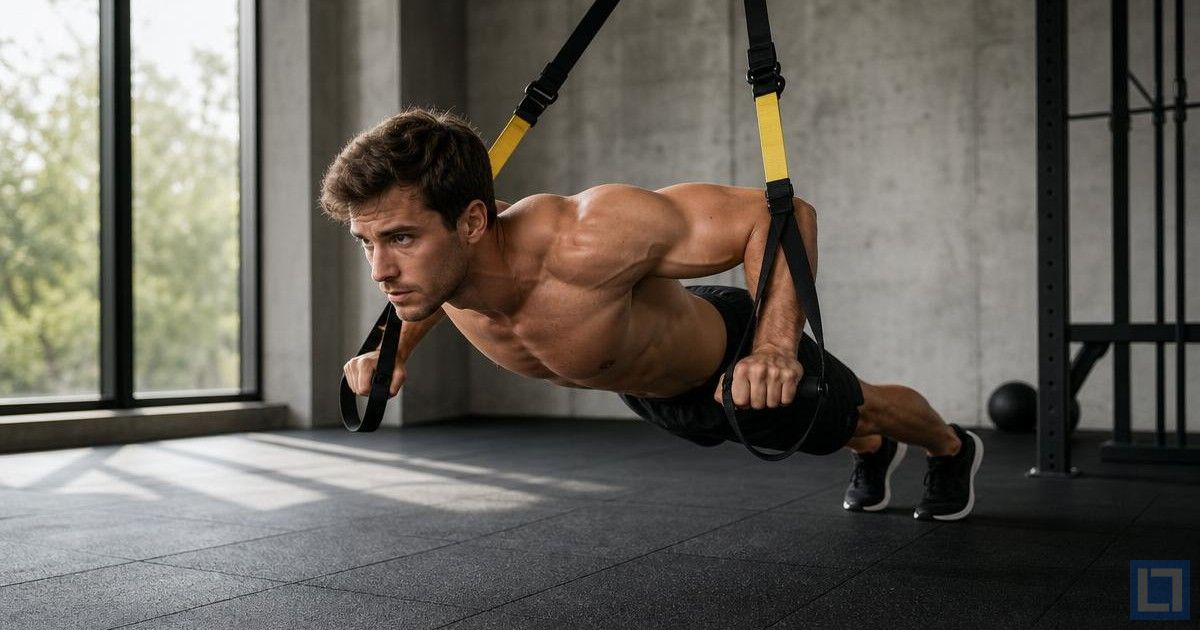
TRX chest training produces real chest development through suspension trainer loading that engages the entire chest while challenging stability throughout every rep. The format works particularly well for chest training because the unstable straps require constant chest and shoulder stabilization, which means the chest gets strong stimulus that traditional fixed-equipment training rarely produces. The TRX also enables chest exercises through positions that fixed equipment cannot match: suspended dips for combined chest and tricep loading, fly variations through full range of motion, and push-up variations with adjustable difficulty. Most lifters who consistently train TRX chest 1 to 2 times per week see measurable chest strength and muscle development within 6 to 10 weeks.
Below are ten effective TRX chest exercises that cover horizontal pressing (suspension chest press, suspender chest press, suspender push-up), advanced pressing (chest dip, self-assisted chest dip), chest isolation (ring chest fly, suspension fly), accessible variations (incline push-up), and varied push-up patterns (star push-up, split fly). Together they form a complete TRX chest training program that hits every major chest movement pattern. A 30 to 40-minute session pulled from this list produces strong combined chest development across pressing and isolation work.
Ring Chest Fly

The Ring Chest Fly holds gymnastic rings or TRX handles with arms extended in front of the chest, then opens the arms out to the sides in a fly motion before bringing them back together. The pattern produces direct chest loading through pure shoulder horizontal adduction.
For TRX chest training, the ring chest fly is one of the most direct chest isolation exercises that exists. The pattern hits the chest through pure horizontal adduction without elbow extension demand. Run it for 3 sets of 10 to 12 reps as direct chest isolation work.
Set up TRX or rings with handles at chest height. Hold the handles and lean forward, putting body weight on the arms. Start with arms extended in front at chest height. Open the arms out to the sides in a fly motion until the chest stretches. Squeeze the chest to bring the arms back together. Adjust body angle to scale difficulty.
Suspension Chest Press

The Suspension Chest Press holds TRX handles with the body angled forward and presses the body away from the handles by extending the arms. The pattern produces strong horizontal pressing motion under unstable suspension load.
For TRX chest training, the suspension chest press is the foundational pressing exercise. The pattern hits the chest, shoulders, and triceps through bodyweight horizontal pressing. Run it for 4 sets of 8 to 12 reps as primary heavy chest work in any TRX chest session.
Set up TRX with handles at chest height. Hold the handles and lean forward with the body angled. Lower the chest toward the handles by bending at the elbows. Press back to arm extension by driving through the chest, shoulders, and triceps. Lower under control. Adjust body angle to scale difficulty.
Suspender Chest Dip

The Suspender Chest Dip holds TRX handles in a dip position with the body suspended between the handles, then bends the arms to lower the body and presses back up. The pattern produces strong combined chest and tricep loading through dip motion.
For TRX chest training, the suspender chest dip is one of the most demanding pressing exercises that exists with the format. The pattern combines chest and tricep loading with the unstable suspension position. Run it for 3 sets of 6 to 12 reps as advanced chest and tricep work.
Set up TRX with handles at hip height. Grip the handles and support body weight on the arms with the body suspended between the handles. Lower the body by bending the elbows back and lean the torso forward to emphasize the chest. Press back to lockout by driving through the chest and triceps. Maintain control throughout.
Suspender Chest Press

The Suspender Chest Press performs horizontal chest press motion with TRX handles, similar to the suspension chest press but with slight technique variations. The pattern produces strong chest loading through bodyweight horizontal pressing.
For TRX chest training, the suspender chest press provides varied pressing work that complements the suspension chest press. The pattern hits the chest, shoulders, and triceps through horizontal pressing. Run it for 3 to 4 sets of 8 to 12 reps as varied pressing work.
Set up TRX with handles at chest height. Hold the handles with both hands and lean forward, putting body weight on the arms. Lower the chest toward the handles by bending at the elbows back and out at roughly 45 degrees from the body. Press back to arm extension. Lower under control. Adjust body angle to scale difficulty.
Suspender Self Assisted Chest Dip

The Suspender Self Assisted Chest Dip performs dip motion with TRX handles where the legs partially support body weight to scale the difficulty down. The pattern allows lifters to build dip strength progressively.
For TRX chest training, the self-assisted dip is the foundational dip-building exercise. The pattern allows for progressive overload toward unsupported dips by reducing leg assistance over time. Run it for 3 sets of 8 to 12 reps as dip strength building work.
Set up TRX with handles at hip height. Grip the handles and support some body weight on the arms while keeping feet on the floor for partial assistance. Lower the body by bending the elbows back and leaning forward. Press back to lockout. As strength builds, progressively reduce leg assistance until performing unsupported dips.
Suspension Fly

The Suspension Fly performs chest fly motion with TRX handles, holding the handles with arms extended in front and opening them out to the sides. The pattern produces direct chest isolation through horizontal adduction.
For TRX chest training, the suspension fly is one of the most direct chest isolation exercises that exists. The pattern hits the chest through pure horizontal adduction motion. Run it for 3 sets of 10 to 12 reps as direct chest isolation work.
Set up TRX with handles at chest height. Hold the handles and lean forward with arms extended in front of the chest. Open the arms out to the sides in a fly motion, lowering the body toward the floor as the arms separate. Squeeze the chest to bring the arms back together to the start position. Adjust body angle to scale difficulty.
Suspender Incline Push-Up

The Suspender Incline Push-Up performs push-ups with the hands on TRX handles and the body in an incline position (feet lower than hands). The pattern reduces difficulty compared to standard suspension push-ups while still producing strong chest loading.
For TRX chest training, the incline push-up is the foundational accessible chest pressing exercise. The pattern hits the chest with reduced difficulty for beginners or for high-volume work. Run it for 3 sets of 10 to 15 reps as accessible chest work or volume training.
Set up TRX with handles at hip-to-chest height (higher position equals easier). Grip the handles and position the body in an incline plank with feet on the floor and hands on the handles. Lower the chest toward the handles by bending the elbows. Press back to lockout. The unstable handles produce strong chest engagement throughout.
Suspender Star Push-Up

The Suspender Star Push-Up performs push-ups with hands on TRX handles in a wide spread position (forming a star shape with arms wide). The wide-arm position emphasizes the chest over the triceps through stretched horizontal adduction.
For TRX chest training, the star push-up provides varied chest work with wide-arm emphasis. The wider hand position increases chest stretch and chest loading. Run it for 3 sets of 8 to 12 reps as varied chest work emphasizing the outer chest.
Set up TRX with handles at hip height. Grip the handles with arms in a wide star position. Lower the chest by bending the elbows out wide while spreading the hands further apart. Press back to lockout while bringing the hands closer together. Maintain tight body position throughout the rep.
Suspender Push Up

The Suspender Push Up performs standard push-ups with hands on TRX handles instead of the floor. The unstable handle position produces stronger chest and stabilizer loading than traditional floor push-ups.
For TRX chest training, the suspension push-up is one of the foundational chest exercises. The unstable handles produce stronger chest engagement than standard push-ups. Run it for 4 sets of 8 to 12 reps as primary chest work in TRX chest sessions.
Set up TRX with handles at hip height. Grip the handles with hands shoulder-width and the body in a tight plank position from head to heels. Lower the chest toward the handles by bending the elbows back at roughly 45 degrees from the body. Press back to lockout. The unstable handles produce strong chest engagement throughout.
Suspender Split Fly

The Suspender Split Fly performs chest fly motion with the legs in a split stance for additional balance and stability demand. The pattern produces strong combined chest and core loading through the split-stance fly.
For TRX chest training, the split fly produces strong combined chest and core loading. The split stance adds stability demand that bilateral fly motion lacks. Run it for 3 sets of 10 to 12 reps as combined chest and stability work.
Set up TRX with handles at chest height. Stand with one foot forward and one foot back in a split stance. Hold the handles and lean forward with arms extended in front. Open the arms out to the sides in a fly motion while maintaining the split stance and balance. Squeeze the chest to bring the arms back together.
How To Program These Workouts
A productive TRX chest session pulls 6 to 8 exercises from the list above. A balanced session includes one heavy press (suspension chest press), one secondary press (suspender push-up or chest press), one demanding press (chest dip or self-assisted chest dip), one isolation exercise (ring chest fly or suspension fly), one accessible volume exercise (incline push-up), and one varied chest work (star push-up or split fly). Run primary presses and dips for 4 sets of 6 to 12 reps; isolation work for 3 sets of 10 to 12 reps; volume work for 3 sets of 10 to 15 reps. Total session covers 17 to 22 working sets.
Train TRX chest sessions 1 to 2 times per week as part of broader chest or upper-body programming. The chest recovers within 48 to 72 hours of moderate training. Most successful programs include 1 to 2 weekly TRX chest sessions, which works well as either a complete chest program (for travelers, home gym setups) or as supplementary work alongside traditional barbell chest training. The format works particularly well as a stability-focused chest session paired with a heavier bench press session for complete chest development.
For broader TRX programming, see our best trx workouts and best full body trx workouts. For specific TRX work, see our best upper body trx workouts.
Final Thoughts
The best TRX chest workouts deliver real chest development through suspension trainer loading that engages the deep stabilizer muscles traditional chest training rarely reaches. The combination of horizontal pressing, advanced dipping, chest isolation, and varied push-up patterns covers every major chest function and produces broader development than single-modality chest training. For lifters who want functional chest strength, want advanced chest training stimulus, or have plateaued on traditional barbell chest work, dedicated TRX chest training is one of the most effective options available.
Stay focused on body angle and chest engagement throughout every rep. The most common TRX chest training mistake is letting the body angle stay too vertical (which makes the exercise too easy) or letting the shoulders take over the work from the chest. The fix: adjust body angle to find an appropriate challenge level (more horizontal body equals harder reps), and consciously squeeze the chest at peak contraction on every rep. Quality reps with strict body position and active chest engagement produce stronger chest development than higher rep counts with rushed execution.
Frequently Asked Questions
Can TRX build a big chest?
Yes for beginners through intermediate lifters. The combination of progressive overload (changing body angle to make exercises harder), appropriate volume, and consistent nutrition produces real chest muscle development for the first 12 to 24 months of training. Advanced lifters chasing maximum chest size typically benefit from adding heavier resistance training (barbell bench press, dumbbell press), but TRX continues to provide useful supplementary stimulus and stability development.
How long should TRX chest workouts be?
Thirty to forty minutes per session works for most lifters. The format includes 6 to 8 exercises across pressing, dipping, and isolation work, which requires 30 to 40 minutes for proper sets and rest. Shorter sessions (20 to 25 minutes) work for HIIT-style TRX chest circuits but limit per-exercise volume.
How often should I do TRX chest workouts?
One to two times per week works for most lifters. The chest recovers within 48 to 72 hours of moderate training. Most successful programs include 1 to 2 weekly TRX chest sessions, which works well as either a complete chest program or supplementary work alongside traditional gym training. Beginners should start with 1 weekly session and progress to 2 as recovery capacity builds.
Can TRX replace bench press?
For beginners through intermediate lifters, yes for general chest development goals. TRX produces real chest strength and muscle development for the first 12 to 18 months of consistent training, especially through suspension chest press and dips that build toward heavier pressing strength. Advanced lifters chasing maximum chest strength typically benefit from adding traditional bench press, but TRX continues to provide useful supplementary stimulus and stability work.
Are TRX push-ups effective for chest?
Yes very effectively. TRX push-ups produce stronger chest engagement than standard floor push-ups due to the unstable handle position requiring constant stabilization throughout every rep. The pattern is one of the most effective bodyweight chest exercises available, and most lifters can train chest productively with TRX push-ups alone for the first 6 to 12 months of training. Adjusting body angle (more horizontal equals harder) provides plenty of progressive overload runway for continued development.