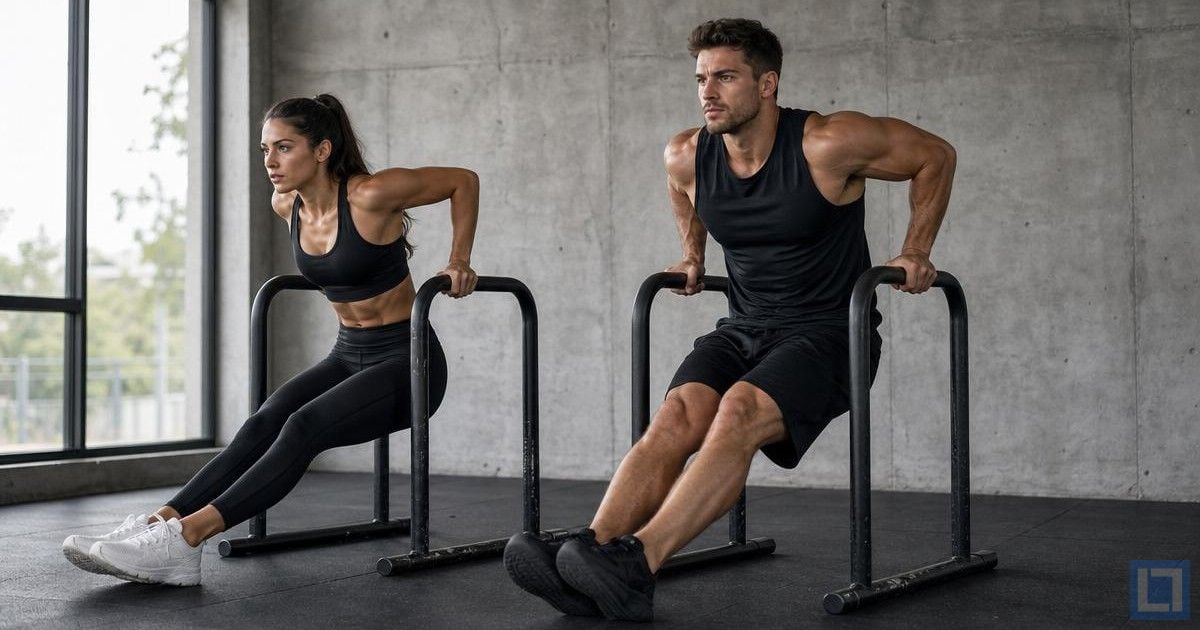
Calisthenics tricep training produces real tricep development through equipment-free exercises that hit the triceps from multiple angles and loading patterns. The format works particularly well for tricep development because the triceps respond strongly to bodyweight loading combined with progressive overload through harder variations (diamond push-ups → close grip push-ups → triceps dips → Korean dips → pseudo planche push-ups). Most lifters can build serious tricep development through 3 to 6 months of consistent calisthenics tricep training, especially when the program includes both pressing variations (diamond push-ups, pike push-ups) for foundational tricep strength and dip variations (triceps dips, Korean dips) for the deepest stretch loading that the triceps respond strongly to.
Below are ten effective calisthenics tricep exercises that cover dip variations (triceps dip, bench dip, Korean dips, push-up + dip combination), tricep-focused push-ups (diamond push-up, close grip push-up), shoulder-and-tricep pressing (pike push-up, pseudo planche push-up), explosive work (plyo push-up), and direct isolation (bodyweight overhead triceps extension). Together they form a complete calisthenics tricep training program that hits every major tricep function. A 30 to 40-minute session pulled from this list produces strong tricep development across all three tricep heads (long, lateral, medial) through varied loading patterns.
Triceps Dip

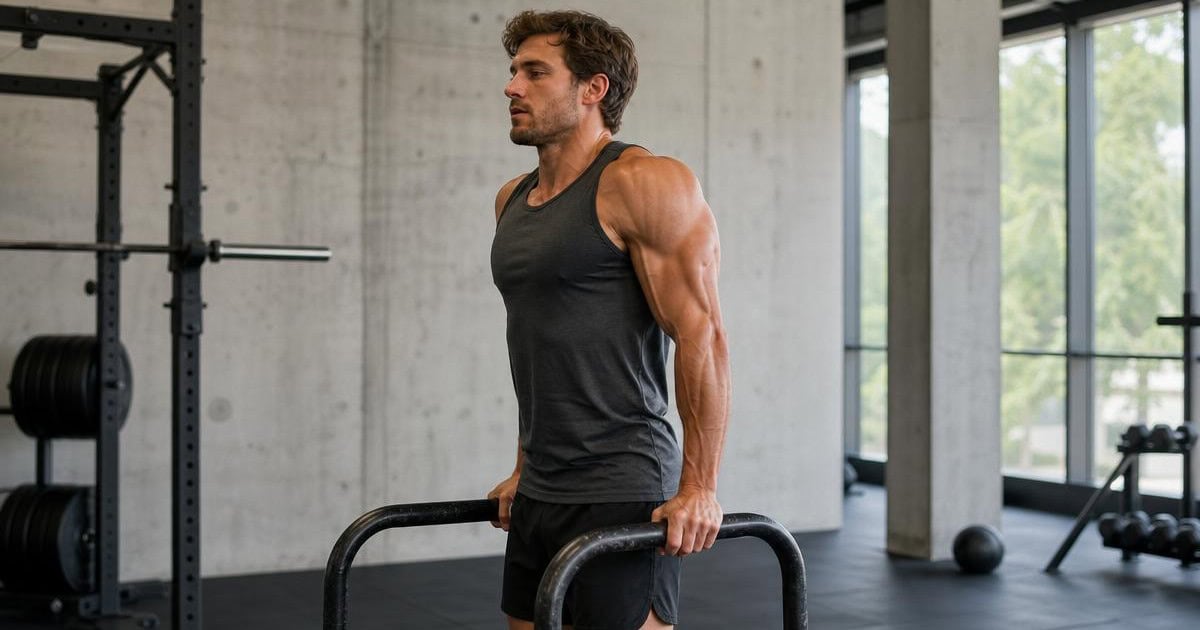
The Triceps Dip grips parallel bars with arms extended and lowers the body by bending the elbows, keeping the body upright (rather than leaned forward) to emphasize the triceps. The pattern produces extreme tricep loading through deep stretch and lockout.
For calisthenics tricep training, the tricep dip is non-negotiable. The pattern is one of the most demanding tricep exercises that exists at bodyweight. The deep stretch at the bottom drives tricep development. Run it for 4 sets of 6 to 12 reps as primary heavy tricep work in any calisthenics tricep session.
Grip parallel dip bars with arms extended and the body suspended between them. Keep the torso upright (perpendicular to the floor) with elbows tucked at the sides. Lower the body by bending the elbows until the upper arms reach parallel to the floor. Press back to lockout while maintaining the upright torso position.
Diamond Push Up

The Diamond Push Up performs push-ups with the hands placed close together under the chest, forming a diamond shape with the thumbs and index fingers touching. The narrow hand position emphasizes the triceps significantly more than standard push-ups.
For calisthenics tricep training, the diamond push-up is the foundational tricep-focused push-up variation. The pattern hits the triceps through narrow-grip pressing motion. Run it for 3 to 4 sets of 8 to 15 reps as primary tricep-focused push-up work.
Set up in a high push-up position with hands placed close together under the chest. Touch the thumbs and index fingers to form a diamond shape. Lower the chest toward the diamond by bending the elbows back along the sides of the body. Press back to lockout. Maintain tight body position throughout.
Close Grip Push Up

The Close Grip Push Up performs push-ups with the hands placed roughly 6 inches apart (closer than diamond push-ups but tighter than standard push-ups). The close hand position emphasizes the triceps with slightly less wrist demand than diamond push-ups.
For calisthenics tricep training, the close grip push-up provides accessible tricep-focused pressing work. The pattern produces strong tricep loading with reduced wrist strain compared to diamond push-ups. Run it for 3 to 4 sets of 10 to 15 reps as accessible tricep push-up work.
Set up in a high push-up position with hands placed roughly 6 inches apart under the chest. Lower the chest toward the hands by bending the elbows back along the sides of the body (rather than flaring out). Press back to lockout. Maintain tight body position throughout.
Pike Push Up

The Pike Push Up sets up in a downward-dog position with hips piked up and performs push-ups by lowering the head toward the floor. The vertical body position shifts loading from the chest to the shoulders and triceps.
For calisthenics tricep training, the pike push-up produces strong combined shoulder and tricep loading through the vertical pressing pattern. The pattern hits the triceps through pressing motion that builds toward handstand push-ups. Run it for 3 sets of 6 to 10 reps as advanced shoulder and tricep work.
Set up in a downward-dog yoga position with hands and feet on the floor and hips piked up high. The body forms an inverted V shape. Lower the head toward the floor by bending the elbows. Press back to the start position by extending the arms. Maintain the piked hip position throughout.
Bench Dip on Floor

The Bench Dip on Floor sits on the floor with hands behind the body and feet planted forward, then lowers the body by bending the elbows. The pattern produces moderate tricep loading and works well as accessible tricep work.
For calisthenics tricep training that includes accessible work, the bench dip on floor produces moderate tricep loading without requiring elevated equipment. The pattern works well as a beginner tricep exercise or as accessory work for advanced lifters. Run it for 3 sets of 12 to 20 reps as accessible tricep work.
Sit on the floor with knees bent and feet planted forward. Place hands behind the body shoulder-width apart with fingers pointing toward the heels. Lift the hips off the floor by extending the arms. Lower the body by bending the elbows back. Press back to the start by extending the arms. Keep the hips lifted throughout the set.
Korean Dips

The Korean Dips perform dips on parallel bars with the hands placed behind the body (rather than at the sides), which produces extreme shoulder mobility demand combined with deep tricep loading. The pattern is one of the most advanced calisthenics tricep exercises that exists.
For advanced calisthenics tricep training, Korean dips produce some of the most demanding tricep loading available at bodyweight. The pattern requires advanced shoulder mobility and produces extreme tricep stretch. Run it for 3 sets of 4 to 8 reps as advanced tricep specialty work for lifters with adequate mobility.
Set up at parallel bars facing forward with hands placed behind the body on the bars (palms facing back and fingers pointing toward the feet). Lower the body deeply by bending the elbows back, allowing the upper body to rotate slightly forward as the elbows extend back. Press back to lockout. Use only with adequate shoulder mobility.
Plyo Push Up

The Plyo Push Up performs explosive push-ups with enough force to lift the hands off the floor at the top. The plyometric loading produces strong fast-twitch fiber recruitment in the chest, shoulders, and triceps.
For calisthenics tricep training that includes explosive work, the plyo push-up produces strong combined tricep and pressing power development. The pattern hits the triceps through explosive concentric loading. Run it for 3 sets of 5 to 8 reps as explosive tricep and pressing work.
Set up in a high push-up position with hands shoulder-width apart. Lower the chest to the floor by bending the elbows. Press back up explosively with enough force to lift the hands off the floor at the top. Land softly with bent elbows. Reset before the next rep.
Pseudo Planche Push-up

The Pseudo Planche Push-up performs push-ups with the hands placed near the hips (rather than at the chest) and fingers pointing back. The forward-leaning body position produces extreme tricep, shoulder, and core loading.
For advanced calisthenics tricep training, the pseudo planche push-up produces some of the most demanding combined tricep, shoulder, and core loading available at bodyweight. The pattern builds toward full planche work. Run it for 3 sets of 4 to 8 reps as advanced tricep and shoulder work.
Set up in a high push-up position with hands placed near the hips (rather than at the chest level). Fingers point back toward the feet. Lean the body forward over the hands. Lower the body by bending the elbows while maintaining the forward-leaning position. Press back to the start. The hand position produces extreme tricep loading.
Push Up and Triceps Dip on Parallel Bars

The Push Up and Triceps Dip on Parallel Bars combines a push-up motion at the top of dip bars with a tricep dip in a continuous motion. The pattern produces combined chest, shoulder, and tricep loading per rep.
For calisthenics tricep training that combines exercises, the push-up + dip combination produces strong combined upper-body loading. The pattern hits the triceps through both motion patterns. Run it for 3 sets of 6 to 10 reps as combined tricep and pressing work.
Set up at parallel bars with arms extended and the body suspended between them. Lower the body into a dip by bending the elbows until the upper arms reach parallel to the floor. Press back to the top. From the top, kick the legs back to a horizontal position and perform a push-up motion at the top of the bars. Reset to the dip position.
Bodyweight Overhead Triceps Extension

The Bodyweight Overhead Triceps Extension uses bodyweight loading by leaning forward with the arms overhead and lowering the body by bending the elbows behind the head. The pattern produces direct tricep isolation without equipment.
For calisthenics tricep training that includes direct isolation, the bodyweight overhead extension produces direct tricep loading through pure elbow extension. The pattern hits the long head of the triceps through the overhead position. Run it for 3 sets of 8 to 12 reps as direct tricep isolation work.
Stand facing a wall or sturdy surface at arm’s length. Place the hands on the surface overhead with arms extended. Lean the upper body forward at an angle. Lower the body toward the surface by bending the elbows behind the head (the elbows stay overhead). Press back to the start by extending the arms. Adjust body angle to scale difficulty.
How To Program These Workouts
A productive calisthenics tricep session pulls 5 to 7 exercises from the list above. A balanced session includes one heavy dip exercise (triceps dip or Korean dips), one tricep-focused push-up (diamond or close grip push-up), one combined shoulder-and-tricep exercise (pike push-up), one accessory exercise (bench dip on floor or overhead extension), and optionally one explosive exercise (plyo push-up). Run primary dip exercises for 4 sets of 6 to 12 reps; tricep push-ups for 3 to 4 sets of 8 to 15 reps; pike push-ups for 3 sets of 6 to 10 reps; isolation work for 3 sets of 8 to 12 reps. Total session covers 14 to 18 working sets focused on tricep development.
Train calisthenics tricep sessions 1 to 2 times per week as part of broader push-day or upper-body programming. The triceps recover within 48 to 72 hours of moderate training and get significant indirect work from any pressing exercise (push-ups, bench press, overhead press). Most successful programs include 1 to 2 dedicated tricep sessions per week alongside chest pressing days that produce secondary tricep loading. The format works particularly well as a varied tricep day paired with weighted tricep training, or as a complete tricep program for lifters preferring bodyweight-only training.
For broader tricep programming, see our how to build bigger triceps and best long head tricep exercises. For at-home tricep work, see our best at home tricep workouts.
Final Thoughts
The best calisthenics tricep workouts deliver real tricep development through equipment-free exercises that hit the triceps from multiple angles and loading patterns. The combination of dip variations, tricep-focused push-ups, shoulder-and-tricep pressing, and direct isolation work covers every major tricep function and produces broader development than single-exercise tricep training. For lifters who want effective tricep training without equipment, want to add varied stimulus to existing programs, or prefer bodyweight training as a primary modality, dedicated calisthenics tricep training is one of the most accessible and effective options available.
Stay focused on elbow position throughout every rep. The most common calisthenics tricep training mistake is letting the elbows flare out during dips and tricep push-ups, which shifts loading from the triceps to the chest and shoulders. The fix: keep the elbows tucked at the sides of the body throughout dips and tricep push-ups (rather than flared at 90 degrees). Quality reps with strict elbow position produce stronger tricep development than higher rep counts with flared elbows. The triceps respond to the specific elbow tracking that maintains pure tricep loading.
Frequently Asked Questions
Can calisthenics build big triceps?
Yes for beginners through advanced lifters. Calisthenics tricep training produces real tricep development through dip variations, tricep-focused push-ups, and bodyweight pressing. Most lifters can build the tricep development of someone training with weights using only calisthenics through varied progressions and progressive overload. Advanced lifters chasing maximum tricep size typically benefit from adding weighted tricep work, but calisthenics produces strong development for years of consistent training.
How often should I train triceps with calisthenics?
One to two times per week works for most lifters. The triceps recover within 48 to 72 hours of moderate training and get significant indirect work from any pressing exercise. Most successful programs include 1 to 2 dedicated tricep sessions per week alongside chest pressing days. Higher frequencies (3+ tricep sessions per week) typically produce accumulated fatigue without proportional growth benefit.
Diamond push-ups or triceps dips for triceps?
Both produce strong tricep development with different emphases. Diamond push-ups hit the triceps through narrow-grip pressing with the body in a horizontal plane. Triceps dips hit the triceps through the deepest possible stretch position with vertical body loading. Most successful programs include both: triceps dips as the heavy primary exercise (4 sets of 6 to 12 reps) and diamond push-ups as the higher-volume secondary exercise (3 sets of 8 to 15 reps).
Are pseudo planche push-ups too advanced for me?
Pseudo planche push-ups require strong baseline pushing strength but progress is achievable for most intermediate lifters. The progression: start with hands closer to the chest (standard push-up position) and gradually move them down toward the hips over 4 to 8 weeks. Each hand position downward increases the leverage demand significantly. Most lifters can perform full pseudo planche push-ups within 8 to 16 weeks of consistent progression from standard push-ups.
Do I need parallel bars for calisthenics triceps?
Parallel bars significantly expand the exercise selection but aren’t strictly required. Without parallel bars, the exercise selection is limited to push-up variations, bench dips on floor, and overhead extension work. Adding parallel bars enables the most effective bodyweight tricep exercises (triceps dips, Korean dips, push-up + dip combinations) for stronger tricep development. Most home gym setups benefit significantly from parallel bars or a dip station for the expanded tricep training options.