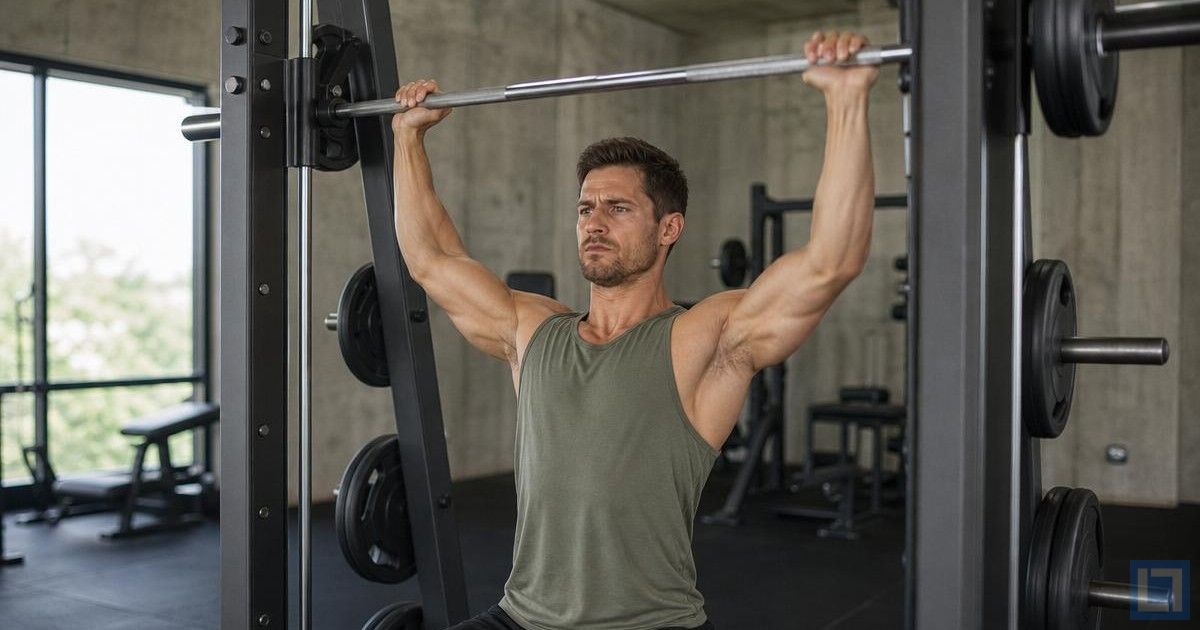
Smith machine shoulder training produces strong shoulder development through the fixed-bar-path machine that allows lifters to focus on pressing strength without the stabilization demands of free-weight bars. The format works particularly well for shoulder pressing because the fixed bar path enables heavier loads than free-weight pressing (most lifters can press 10 to 15 percent more weight on Smith machines than free-weight barbells), produces strong direct shoulder loading, and reduces the injury risk associated with bar imbalance during heavy pressing. The Smith machine’s versatility also enables varied pressing angles (seated, standing, behind-neck, behind-head) plus shoulder-area work for the side delts (upright row, raises) and upper traps (shrugs).
Below are ten effective Smith machine shoulder exercises that cover foundational overhead pressing (shoulder press, standing press, seated press), military and strict pressing (military press, behind-head military press), side and rear delt emphasis (behind-neck press, upright row), front delt isolation (incline shoulder raises), and upper trap work (back shrug, wide shrug). Together they form a complete Smith machine shoulder training program that hits every aspect of shoulder development. A 35 to 45-minute session pulled from this list produces strong shoulder loading across all delt heads and the upper traps.
Smith Shoulder Press

The Smith Shoulder Press performs overhead pressing with the bar fixed to the Smith machine vertical rails. The fixed bar path allows lifters to focus on pressing strength without bar stabilization demands.
For Smith machine shoulder training, the standard shoulder press is the foundational pressing exercise. The fixed bar path enables heavier loads than free-weight pressing because lifters don’t need to balance the bar through the press. Run it for 4 sets of 6 to 10 reps as primary heavy shoulder pressing work.
Set up at a Smith machine with a bench positioned under the bar. Sit with the back supported. Hold the bar at shoulder width slightly above the shoulders. Unrack the bar by rotating the wrists to release the safety hooks. Press the bar overhead to lockout. Lower under control to the start position.
Smith Standing Shoulder Press

The Smith Standing Shoulder Press performs overhead pressing while standing, with the bar fixed to the Smith machine vertical rails. The standing position adds core stability demand to the pressing motion.
For Smith machine shoulder training, the standing shoulder press combines pressing strength with core stability work. The pattern hits the shoulders through full pressing range while engaging the core for upright stability. Run it for 4 sets of 6 to 10 reps as primary standing pressing work.
Set up at a Smith machine. Stand under the bar with feet shoulder-width. Hold the bar at shoulder width slightly above the shoulders. Unrack the bar by rotating the wrists. Press the bar overhead to lockout while keeping the body upright and core braced. Lower under control. Maintain stable upright position throughout.
Smith Seated Shoulder Press

The Smith Seated Shoulder Press performs overhead pressing with the back supported on a vertical bench. The supported position eliminates core stability demands and allows pure pressing focus.
For Smith machine shoulder training that maximizes pressing strength, the seated shoulder press is the foundational mass-building exercise. The back support eliminates core stability concerns, which means lifters can focus entirely on pressing strength. Run it for 4 sets of 6 to 10 reps as primary seated pressing work.
Set up at a Smith machine with a vertical bench positioned under the bar. Sit with the back fully supported against the bench. Hold the bar at shoulder width slightly above the shoulders. Unrack the bar. Press the bar overhead to lockout. Lower under control to the start position.
Smith Incline Shoulder Raises

The Smith Incline Shoulder Raises lies on an incline bench facing the Smith machine and performs raises by lifting the bar from below shoulder level using the front delts. The pattern produces strict front delt isolation.
For Smith machine shoulder training that includes front delt isolation, the incline shoulder raise produces direct front delt loading. The fixed bar path enables strict isolation that free-weight raises struggle to maintain. Run it for 3 sets of 10 to 12 reps as front delt isolation work.
Set up an incline bench facing the Smith machine. Lie face-up on the bench with the head toward the bar. Hold the bar with shoulder-width grip and arms extended toward the bar. Lift the bar by raising the arms forward and up using the front delts. Lower under control. Maintain extended-arm position throughout.
Smith Standing Military Press

The Smith Standing Military Press performs strict overhead pressing while standing in a military stance (feet together or near-together). The narrow stance increases core stability demand throughout the press.
For Smith machine shoulder training, the military press combines overhead pressing with strict standing form. The narrow stance and fixed bar path produce strong pressing loading combined with stability demand. Run it for 4 sets of 5 to 8 reps as strict standing pressing work.
Set up at a Smith machine. Stand under the bar with feet together or hip-width apart in a military stance. Hold the bar at shoulder width slightly above the shoulders. Unrack the bar. Press strictly overhead to lockout while maintaining the narrow stance and braced core. Lower under control.
Smith Standing Behind Head Military Press

The Smith Standing Behind Head Military Press performs overhead pressing with the bar starting and ending behind the head (rather than in front of the chest). The behind-the-head path emphasizes the side and rear delts.
For Smith machine shoulder training that emphasizes side and rear delts, the behind-head press shifts loading away from the front delts. The pattern hits the often-neglected side and rear delt heads. Run it for 3 sets of 8 to 10 reps as advanced side and rear delt work. Use moderate loads to protect shoulder health.
Set up at a Smith machine. Stand under the bar with feet shoulder-width and the bar positioned behind the head at neck level. Hold the bar with shoulder-width grip. Press the bar overhead to lockout. Lower under control to the start position behind the head. Maintain upright torso throughout.
Smith Behind Neck Press

The Smith Behind Neck Press performs overhead pressing with a wider grip and the bar moving behind the neck. The pattern emphasizes the side delts more than standard front pressing.
For Smith machine shoulder training that emphasizes side delts through pressing, the behind-neck press is one of the most direct side delt pressing exercises that exists. Run it for 3 sets of 6 to 10 reps as side delt pressing work. Use moderate loads.
Set up at a Smith machine with a vertical bench. Sit with the back supported. Hold the bar with wider-than-shoulder-width grip and the bar positioned behind the neck at upper-shoulder level. Press the bar overhead to lockout. Lower under control to the start position behind the neck.
Smith Upright Row

The Smith Upright Row pulls the bar from hip level up to chest or chin level by raising the elbows out and up. The pattern hits the side delts, traps, and rear delts.
For Smith machine shoulder training, the upright row is the foundational side delt exercise. The fixed bar path makes upright rows safer than free-weight versions because the bar travels in a perfect vertical line. Run it for 3 sets of 8 to 12 reps as side delt and trap work.
Set up at a Smith machine. Stand with feet shoulder-width facing the bar at hip level. Hold the bar with shoulder-width grip and palms facing the body. Pull the bar up close to the body to chin or chest level by raising the elbows out and up. Lower under control to hip level.
Smith Back Shrug

The Smith Back Shrug holds the bar behind the body at thigh level and performs trap shrugs by elevating the shoulders straight up. The behind-body bar position emphasizes the upper traps without front-delt or chest involvement.
For Smith machine shoulder training that includes upper trap work, the back shrug isolates the upper traps with reduced front-shoulder involvement compared to standard front shrugs. Run it for 3 sets of 10 to 15 reps as direct upper trap work.
Set up at a Smith machine. Stand with the bar behind the body at thigh level. Hold the bar with shoulder-width or wider overhand grip. Shrug the shoulders straight up by elevating the traps as high as possible. Hold the contracted position briefly. Lower under control.
Smith Wide Shrug

The Smith Wide Shrug performs shrugs with a wide grip on the bar held in front of the body at thigh level. The wider grip emphasizes different trap fibers than standard-grip shrugs.
For Smith machine shoulder training that completes upper-back development, the wide shrug provides varied trap loading that complements standard-grip shrugs. The pattern hits the traps through a slightly different angle. Run it for 3 sets of 10 to 15 reps as varied trap work.
Set up at a Smith machine. Stand facing the bar with feet shoulder-width. Hold the bar with significantly wider-than-shoulder-width grip and palms facing the body. Shrug the shoulders straight up by elevating the traps. Hold the contracted position briefly. Lower under control.
How To Program These Workouts
A productive Smith machine shoulder session pulls 5 to 7 exercises from the list above. A balanced session includes one heavy primary press (shoulder press or seated press), one strict press variation (military press or behind-neck press), one front delt exercise (incline shoulder raises), one side delt exercise (upright row), and one trap exercise (back shrug or wide shrug). Run primary heavy presses for 4 sets of 5 to 8 reps; secondary pressing variations for 3 to 4 sets of 8 to 10 reps; isolation work for 3 sets of 10 to 12 reps; trap shrugs for 3 sets of 10 to 15 reps. Total session covers 14 to 18 working sets.
Train Smith machine shoulder sessions 1 to 2 times per week as part of broader shoulder or push-day programming. The shoulders recover within 48 to 72 hours of moderate training and get significant indirect work from any pressing exercise. Most successful programs include 1 to 2 dedicated shoulder sessions per week alongside chest pressing days that produce secondary shoulder loading. The format works particularly well as a heavy shoulder pressing session paired with a higher-volume free-weight or dumbbell shoulder day for complete shoulder development.
For broader shoulder programming, see our best dumbbell shoulder workouts and how to build bigger shoulders. For specific delt heads, see our best side delt exercises.
Final Thoughts
The best Smith machine shoulder workouts deliver real shoulder development through the fixed-bar-path machine that enables heavier pressing loads with reduced stabilization demands. The combination of foundational overhead pressing, strict press variations, side and rear delt emphasis, front delt isolation, and upper trap work covers every major shoulder function and produces broader development than single-exercise shoulder training. For lifters with Smith machine access who want serious shoulder mass, want to add varied pressing work to existing programs, or have shoulder issues that benefit from fixed-bar-path safety, Smith machine shoulder training is one of the most effective options available.
Stay focused on shoulder positioning and bar path awareness. The most common Smith machine shoulder training mistake is letting the body drift forward or back relative to the bar during pressing, which forces awkward shoulder positioning under heavy loads. The fix: position the body so the bar travels straight up and down through the natural pressing path (typically the bar should travel directly above the shoulder joint, not in front or behind). Quality reps with proper body position relative to the fixed bar path produce stronger shoulder development with reduced injury risk.
Frequently Asked Questions
Is the Smith machine good for shoulder workouts?
Yes, very effectively. The fixed bar path enables heavier loads than free-weight pressing (most lifters press 10 to 15 percent more weight on Smith machines), produces strong direct shoulder loading, and reduces injury risk from bar imbalance during heavy pressing. Most successful shoulder programs include both Smith machine and free-weight pressing for varied stimulus. Smith machine work excels for heavy strength building; free-weight work develops stabilizers and natural pressing patterns.
How heavy should I Smith machine shoulder press?
Most lifters can Smith machine shoulder press roughly 10 to 15 percent more weight than free-weight overhead press. For strength training, work in the 5 to 8 rep range with weights that allow strict form throughout. For hypertrophy, work in the 8 to 12 rep range. The Smith machine’s fixed bar path means lifters can safely push closer to maximum effort than they could on free-weight pressing, which makes it well-suited to heavy progressive overload.
How often should I train shoulders on Smith machine?
One to two times per week works for most lifters. The shoulders recover within 48 to 72 hours of moderate training and get significant indirect work from any pressing exercise. Most successful programs include 1 to 2 dedicated shoulder sessions per week alongside chest pressing days. The Smith machine works well as the heavy shoulder day with free-weight or dumbbell work as the higher-volume secondary shoulder day.
Smith machine or barbell for shoulder press?
Different equipment serves different goals. Smith machine pressing enables heavier loads with reduced stabilization demands, which makes it well-suited to heavy strength building. Barbell pressing develops stabilizers and produces more functional pressing strength. Most successful shoulder programs include both: Smith machine pressing for heavy primary work (4 sets of 5 to 8 reps) and barbell pressing for secondary stability and pattern work. The combination produces stronger results than relying on either alone.
Is behind the neck press safe on Smith machine?
For most healthy lifters with adequate shoulder mobility, yes when programmed appropriately. The Smith machine’s fixed bar path makes behind-neck pressing safer than free-weight versions because the bar travels in a controlled path. Lifters with shoulder issues, limited overhead mobility, or rotator cuff problems should avoid behind-neck pressing entirely. Most successful programs use behind-neck pressing at moderate loads (8 to 12 rep ranges with weights that allow strict form) rather than maximum strength loads.