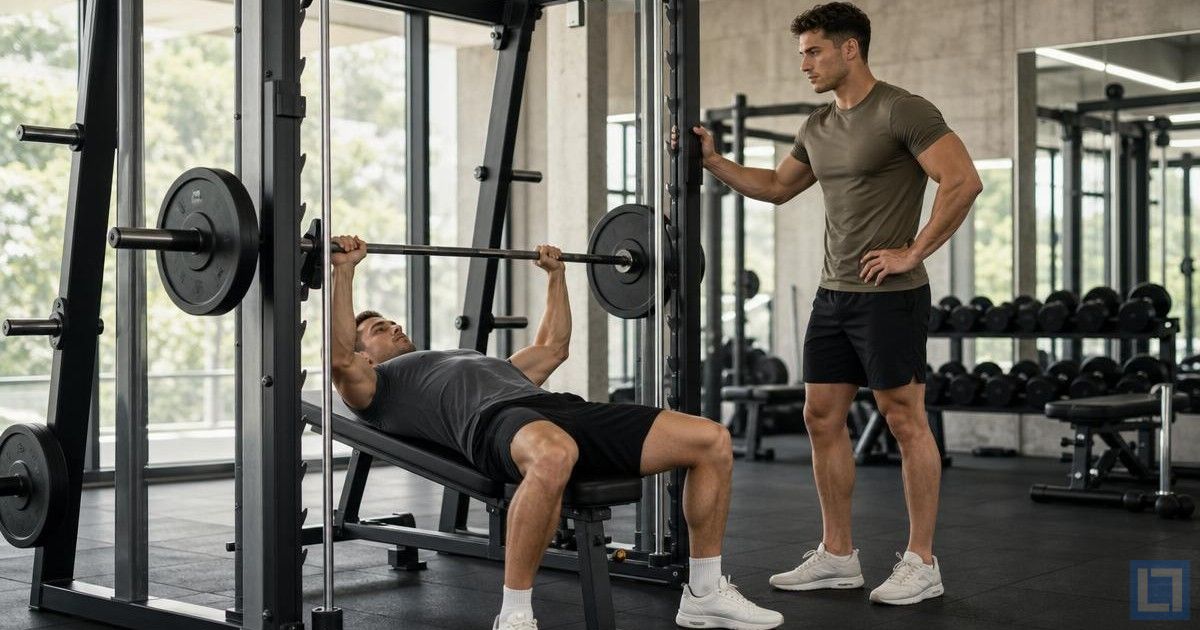
Smith machine chest training produces real chest development through guided-bar pressing that removes stabilization demand and allows lifters to focus purely on chest loading. The fixed bar path makes Smith machine pressing particularly valuable for lifters training without spotters (the safety hooks allow safe failure), beginners learning bench press technique (the fixed path simplifies the motion), and lifters wanting to push hard sets to failure with reduced injury risk. The Smith machine also enables grip variations (wide, close, reverse) that produce unique chest loading angles, and angle variations (flat, incline, decline) that target specific chest regions.
Below are ten effective Smith machine chest exercises that cover foundational pressing (Smith bench press, incline bench press, decline bench press), grip variations (wide grip, close grip), inner-chest specialization (hex press), reverse-grip variations (incline reverse grip, decline reverse grip, flat reverse grip), and combined patterns (wide-grip decline). Together they form a complete Smith machine chest training program for lifters with Smith machine access. A 45 to 60-minute session pulled from this list produces strong chest stimulus across upper, mid, and lower chest regions.
Smith Bench Press

The Smith Bench Press performs a flat bench press on a Smith machine, where the barbell travels in a fixed vertical path through guided rails. The fixed bar path eliminates side-to-side stabilization demand and allows lifters to focus purely on pressing strength.
For Smith machine chest training, the flat bench press is the foundational exercise. The fixed path makes the exercise accessible for lifters without spotters and allows pressing closer to failure safely. Run it for 4 sets of 6 to 10 reps as primary heavy chest work in any Smith machine session.
Set up a flat bench under a Smith machine bar. Lie back with eyes under the bar. Grip the bar slightly wider than shoulder-width. Unrack by twisting the bar forward to release the safety hooks. Lower the bar to mid-chest under control. Press back to lockout. Re-rack by twisting the bar back into the safety hooks.
Smith Incline Bench Press

The Smith Incline Bench Press performs an incline press on a Smith machine with the bench set to 30 to 45 degrees. The fixed bar path and incline angle bias loading toward the upper chest while removing stabilization demand.
For Smith machine upper-chest training, the incline bench press is the standard exercise. The pattern produces strong upper-chest loading with the safety benefits of the Smith machine. Run it for 3 to 4 sets of 8 to 12 reps as primary upper-chest work.
Set an incline bench (30 to 45 degrees) under a Smith machine bar. Lie back with eyes under the bar. Grip slightly wider than shoulder-width. Unrack the bar. Lower the bar to upper chest under control. Press back to lockout. Re-rack by twisting the bar.
Smith Decline Bench Press

The Smith Decline Bench Press performs a decline press on a Smith machine with the bench set to a decline angle. The fixed bar path and decline angle bias loading toward the lower chest while removing stabilization demand.
For Smith machine lower-chest training, the decline bench press is the standard exercise. The pattern produces strong lower-chest loading. The fixed path makes decline pressing safer than barbell decline pressing because the bar cannot drift forward toward the face. Run it for 3 sets of 8 to 12 reps as lower-chest specific work.
Set a decline bench under a Smith machine bar. Lie back with feet hooked at the top and eyes under the bar. Grip slightly wider than shoulder-width. Unrack the bar. Lower the bar to lower chest under control. Press back to lockout. Re-rack by twisting the bar.
Smith Wide Grip Bench Press

The Smith Wide Grip Bench Press performs a flat bench press with hands placed wider than shoulder-width on the Smith machine bar. The wider grip emphasizes the chest more heavily by reducing tricep involvement.
For Smith machine chest-focused training, the wide-grip bench press biases loading toward the chest specifically. The wider grip increases chest stretching at the bottom and reduces tricep contribution. Run it for 3 sets of 8 to 10 reps as chest-emphasis pressing work.
Set up a flat bench under a Smith machine bar. Lie back with eyes under the bar. Grip the bar significantly wider than shoulder-width (roughly 1.5 to 1.7 times shoulder-width). Unrack the bar. Lower to mid-chest. Press back to lockout. Re-rack by twisting the bar.
Smith Close Grip Bench Press

The Smith Close Grip Bench Press performs a flat bench press with hands placed close together on the Smith machine bar. The narrower grip biases loading toward the triceps and inner chest.
For Smith machine training that includes inner-chest and tricep work, the close-grip bench press produces strong combined loading. The pattern fits naturally as supplementary work after primary chest pressing. Run it for 3 sets of 8 to 12 reps as inner-chest and tricep work.
Set up a flat bench under a Smith machine bar. Lie back with eyes under the bar. Grip the bar with hands shoulder-width apart or slightly closer. Unrack the bar. Lower the bar to mid-chest while keeping the elbows tucked close to the body. Press back to lockout, focusing on tricep extension.
Smith Hex Press
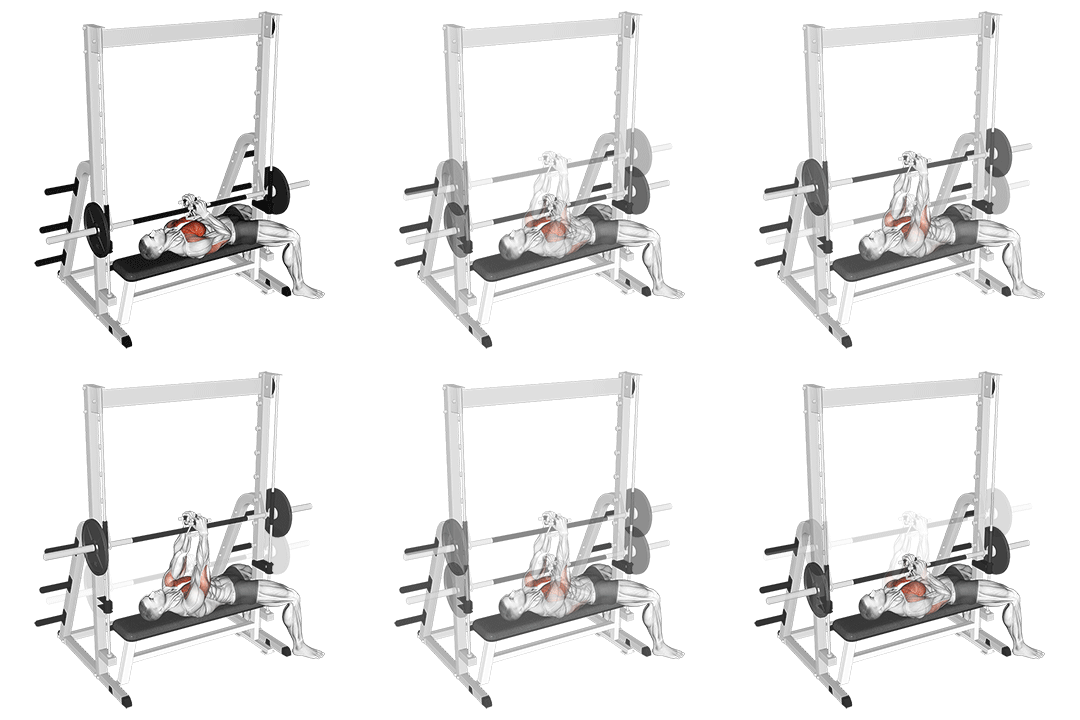
The Smith Hex Press performs a bench press with hands very close together (palms pressed against each other on the bar) and intentional inward squeezing throughout the press. The pattern produces extreme inner-chest loading through continuous chest adduction.
For Smith machine inner-chest specialization, the hex press is one of the most direct inner-chest exercises that exists. The continuous inward squeezing produces stronger inner-chest contraction than any other Smith machine variation. Run it for 3 sets of 10 to 12 reps as direct inner-chest work.
Set up a flat bench under a Smith machine bar. Lie back with eyes under the bar. Grip the bar with hands placed together (palms touching or as close as the bar allows). Unrack the bar. Lower to mid-chest while squeezing the hands inward toward each other throughout the rep. Press back to lockout while maintaining the inward squeeze.
Smith Incline Reverse Grip Press

The Smith Incline Reverse Grip Press performs an incline press with palms facing the body (underhand grip) instead of the standard overhand grip. The reverse grip biases loading even more heavily toward the upper chest than standard incline pressing.
For maximum upper-chest loading, the incline reverse grip press is one of the most direct upper-chest exercises that exists. Research suggests reverse-grip pressing produces stronger upper-chest activation than standard grip variations. Run it for 3 sets of 8 to 12 reps as advanced upper-chest work.
Set an incline bench (30 to 45 degrees) under a Smith machine bar. Lie back with eyes under the bar. Grip the bar with palms facing the body (underhand grip), hands slightly wider than shoulder-width. Unrack the bar. Lower to upper chest under control. Press back to lockout. Re-rack by twisting the bar.
Smith Decline Reverse Grip Press

The Smith Decline Reverse Grip Press performs a decline press with palms facing the body (underhand grip). The combination of decline angle and reverse grip produces unique chest loading from a different angle than standard variations.
For varied-angle Smith machine chest training, the decline reverse grip press produces unique loading that complements standard decline and incline pressing. Most lifters benefit from including varied grip and angle work for complete chest development. Run it for 3 sets of 8 to 10 reps as variation chest work.
Set a decline bench under a Smith machine bar. Lie back with feet hooked and eyes under the bar. Grip the bar with palms facing the body (underhand grip). Unrack the bar. Lower to lower chest under control. Press back to lockout. Re-rack by twisting the bar.
Smith Reverse Grip Press

The Smith Reverse Grip Press performs a flat bench press with palms facing the body (underhand grip). The reverse grip on flat bench biases loading toward the upper chest more heavily than standard flat pressing.
For Smith machine training that includes upper-chest emphasis on flat bench, the reverse grip press produces unique loading. The pattern shifts upper-chest emphasis from incline to flat positioning. Run it for 3 sets of 8 to 12 reps as upper-chest emphasis variation work.
Set up a flat bench under a Smith machine bar. Lie back with eyes under the bar. Grip the bar with palms facing the body (underhand grip), hands shoulder-width or slightly wider. Unrack the bar. Lower the bar to upper chest (lower than standard grip due to grip orientation). Press back to lockout.
Smith Wide Grip Decline Bench Press

The Smith Wide Grip Decline Bench Press performs a decline press with hands placed wider than shoulder-width. The combination of decline angle and wide grip produces extreme lower-chest stretch loading.
For Smith machine lower-chest specialization, the wide-grip decline press is one of the most direct lower-chest exercises that exists. The wider grip and decline angle combine to produce strong lower-chest stretch and contraction. Run it for 3 sets of 8 to 10 reps as advanced lower-chest specialty work.
Set a decline bench under a Smith machine bar. Lie back with feet hooked at the top and eyes under the bar. Grip the bar significantly wider than shoulder-width. Unrack the bar. Lower the bar to lower chest under control with the wide grip. Press back to lockout. Re-rack by twisting the bar.
How To Program These Workouts
A productive Smith machine chest session pulls five to seven exercises from the list above. A balanced session includes one foundational press (flat bench press), one upper-chest exercise (incline bench press or incline reverse grip press), one lower-chest exercise (decline bench press or wide-grip decline), one chest-specific variation (wide grip bench or hex press), and one tricep-emphasis exercise (close grip bench press). Run primary heavy compounds for 4 sets of 6 to 10 reps; secondary exercises for 3 to 4 sets of 8 to 12 reps; specialty variations for 3 sets of 10 to 12 reps.
Train Smith machine chest sessions 1 to 2 times per week as part of broader chest or upper-body programming. The chest recovers within 48 to 72 hours of moderate training. Most successful programs include 1 to 2 chest sessions per week with appropriate volume distributed across pressing variations. The Smith machine works particularly well for the second chest session of the week (volume-focused) when the first session uses free-weight bench pressing for primary stability development.
For other chest programming, see our best dumbbell chest workouts and best barbell chest workouts. For specific inner-chest work, see our best inner chest exercises.
Final Thoughts
The best Smith machine chest workouts deliver real chest development through guided-bar pressing that removes stabilization demand and enables varied grip and angle work. The combination of foundational pressing variations, grip variations, angle variations, and specialty exercises covers every major chest region and produces complete development. For lifters with Smith machine access who want safe heavy pressing, beginners learning bench press technique, or anyone wanting to add Smith machine variety to existing chest programs, this format is one of the most effective options available.
Stay focused on the controlled descent. The most common Smith machine chest training mistake is taking advantage of the fixed bar path to bounce the bar off the chest, which reduces the actual chest stimulus and increases sternum injury risk. The fix: lower the bar under control to the chest with brief contact (not a bounce), then press back to lockout. The Smith machine’s safety benefits enable harder training; respect that by emphasizing strict eccentric control rather than reps powered by chest bounces.
Frequently Asked Questions
Is Smith machine bench press as good as barbell bench press?
Different exercises serve different goals. Free-weight bench press produces stronger overall chest and shoulder development through bilateral stabilization demand. Smith machine bench press allows safer training to failure, reduces stabilization fatigue, and enables training without spotters. Most successful chest programs include both: free-weight pressing for foundational strength and stabilization, Smith machine pressing for additional volume, training to failure, and specialty grip variations.
How heavy should I Smith machine bench press?
Most lifters can Smith machine press slightly more than free-weight bench press (typically 5 to 15 percent more) due to the eliminated stabilization demand. For training, work in the 6 to 10 rep range with 70 to 85 percent of Smith machine bench press max. Beginners should start lighter than they’d expect because the fixed path can mask form issues that free-weight pressing reveals; quality form matters more than load progression early on.
Are Smith machines bad for chest growth?
No, this is a myth. Research shows Smith machine pressing produces comparable chest activation to free-weight pressing. The reduced stabilization demand allows lifters to focus more force on the chest specifically. Most successful chest programs include both Smith machine and free-weight pressing for complete development. Programs that completely avoid Smith machines miss out on safer training to failure and useful grip variations.
How often should I do Smith machine chest workouts?
One to two times per week as part of broader chest training. The chest recovers within 48 to 72 hours of moderate training. Most successful programs include 1 to 2 chest sessions per week with appropriate volume distributed across pressing variations. The Smith machine works particularly well for the volume-focused chest session of the week when paired with free-weight pressing in another session.
Can beginners use the Smith machine for chest?
Yes, the Smith machine is one of the best bench press introductions for beginners. The fixed bar path eliminates the side-to-side stabilization that beginners often struggle with, which allows them to focus on the basic pressing motion. Most beginners can build to a moderately heavy Smith machine bench press (1x bodyweight) within 8 to 12 weeks of consistent practice. The Smith machine pattern translates well to free-weight bench press technique once the fundamentals are established.