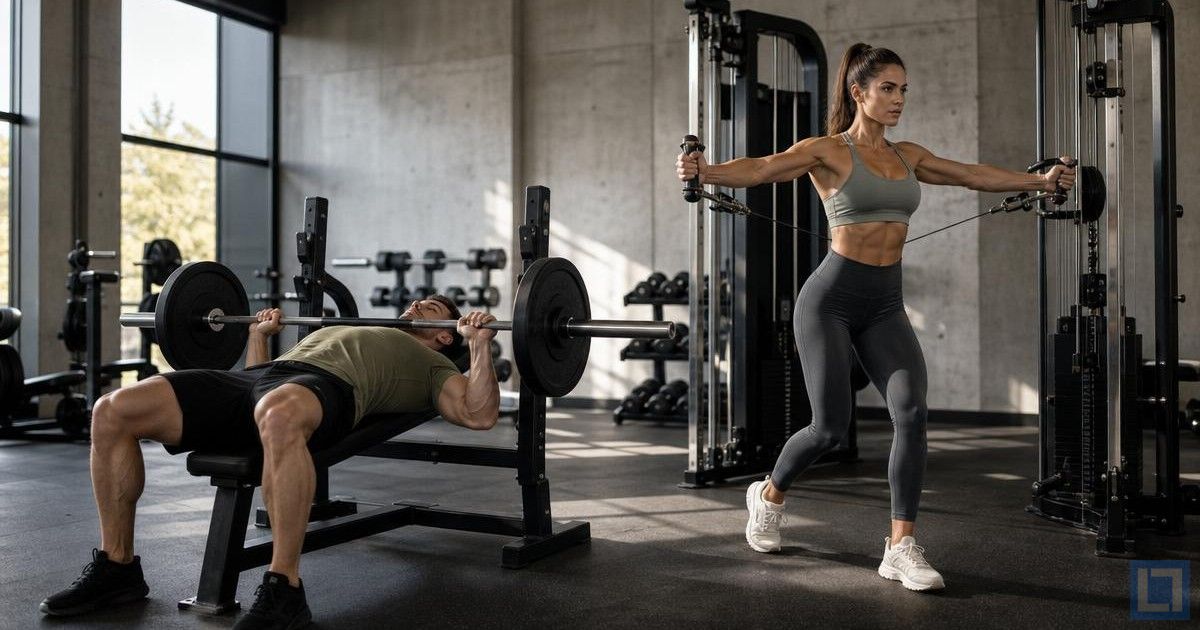
The inner chest (also called the medial pec or sternal chest) is the area of the pectoral muscles closest to the sternum. Visible inner chest development produces the defined gap and separation that gives the chest a sculpted appearance, particularly visible in tight-fitting shirts and at lower body fat percentages. The inner chest activates during nearly every chest exercise but loads most heavily when the hands come together (or the arms cross the midline) at the contracted position. The best inner chest exercises emphasize this midline crossing through fly variations, narrow-grip pressing, and isometric squeezes.
Below are ten effective inner chest exercises that cover machine pressing, fly variations across multiple equipment types (cable, band, ring, dumbbell on stability ball), bodyweight chest activation, and complementary chest stretching. Together they form a complete inner chest training program that fits in commercial gyms, well-equipped home gyms, and minimal-equipment setups (several exercises require only bodyweight or a band).
Machine Inner Chest Press

The Machine Inner Chest Press uses a chest press machine with the handles set close together to emphasize the inner chest fibers during the press. The narrow grip and machine path force the hands to come together at the top of the press, which produces strong inner chest contraction.
For lifters with gym access, the inner chest press machine is one of the most direct exercises for the inner pec fibers that exists. The machine handles guide the path and produce consistent loading throughout the rep, which makes it particularly useful for high-rep training (10 to 15 reps) that drives metabolic stress alongside strength gains. Run it for 3 to 4 sets of 10 to 12 reps.
Sit at the inner chest press machine with the handles set close together. Press the handles forward to extend the arms, focusing on squeezing the chest fibers together at the lockout. Lower under control to the starting position. Maintain elbow position throughout; do not flare the elbows out.
Isometric Chest Squeeze

The Isometric Chest Squeeze stands or sits and presses the palms together hard at chest level, holding the squeeze for time. The continuous isometric pressure produces extreme inner chest contraction without any movement.
For inner chest training without equipment, the isometric chest squeeze is the most direct exercise that exists. The continuous tension produces stronger inner pec activation than many movement-based exercises. Use it as a warm-up activation drill before chest training or as a finisher for additional volume. Run it for 3 to 4 sets of 30 to 60-second holds with maximum effort.
Stand or sit with the spine tall. Bring the palms together at chest level with the fingers pointing up. Press the palms together hard, contracting the chest muscles maximally. Hold the squeeze while breathing normally. The arms should not move; all the work is isometric pressure.
Ring Chest Fly

The Ring Chest Fly uses gymnastic rings or suspension trainer straps to perform a fly motion at body angle. The unstable rings increase the stability demand throughout the rep, which produces stronger total chest engagement than stable fly variations.
For lifters with rings or a suspension trainer, the ring fly produces some of the most demanding chest training that exists. The unstable surface forces the chest, shoulders, and core to work continuously, and the unilateral grip handles allow each arm to move independently. Run it for 3 sets of 8 to 10 reps as a chest finisher.
Set up rings or a suspension trainer at appropriate height. Hold the handles with arms straight and lean forward into the angle. Lower the body by spreading the arms out into a fly motion. Squeeze the chest to bring the arms back together at the top. Adjust the body angle to scale difficulty.
Band Chest Fly

The Band Chest Fly anchors a resistance band behind the body at chest height and performs a fly motion by bringing the arms together against the band tension. The band format makes the exercise accessible at home with minimal equipment.
For at-home inner chest training, the band fly is one of the most effective exercises that exists. The accommodating resistance pattern (lighter at the start, heavier at the contracted position) produces stronger inner chest contraction than constant-load variations. Run it for 3 sets of 12 to 15 reps as inner-chest focused work.
Anchor a resistance band at chest height behind the body. Hold the band ends with arms extended out to the sides. Bring the arms together in front of the body in a fly motion against the band tension. Squeeze the chest at the contracted position. Return under control.
Cable Fly with Chest Supported

The Cable Fly with Chest Supported uses a chest-supported pad or bench position and performs a cable fly motion. The chest support eliminates body sway and lower back loading, which forces the chest to do all the work during the fly motion.
For chest isolation in cable-equipped gyms, the chest-supported fly is one of the most effective inner chest exercises that exists. The eliminated body sway produces stronger isolation than standing cable flies, and the cable provides constant tension that free-weight flies lose at the top of the rep. Run it for 3 sets of 10 to 12 reps as primary inner chest work.
Set up at a cable station with a chest-support pad or seated position. Hold the cable handles with arms extended out to the sides. Bring the arms together in front of the body in a fly motion. Squeeze the chest at the contracted position. Return under control. Keep the body firmly supported throughout.
Dumbbell One Arm Chest Fly on Exercise Ball

The Dumbbell One Arm Chest Fly on Exercise Ball lies on a stability ball with the upper back supported and performs unilateral fly motions with one dumbbell at a time. The unilateral loading and unstable surface produce extreme chest isolation alongside core stability demand.
For lifters who want maximum chest isolation, the unilateral fly on a ball produces stronger per-rep stimulus than bilateral variations. The unilateral loading catches strength imbalances, and the unstable ball surface forces continuous core engagement throughout the set. Run it for 3 sets of 10 to 12 reps per arm.
Lie with the upper back on a stability ball, feet planted on the floor in a glute-bridge position. Hold a dumbbell in one hand above the chest. Lower the dumbbell out to the side in a fly motion. Squeeze the chest to bring the dumbbell back to the start. Maintain the bridge position throughout. Switch arms after each set.
Suspender Close Grip Chest Press

The Suspender Close Grip Chest Press uses a suspension trainer with the handles set close together and performs a chest press motion at body angle. The narrow grip emphasizes the inner chest fibers while the suspension trainer adds significant stability demand.
For lifters with a suspension trainer, the close-grip suspended press produces unique inner chest stimulus that few other exercises can match. The combination of narrow grip and instability forces the chest fibers to work harder than standard suspended pressing. Run it for 3 sets of 8 to 12 reps as accessory work.
Set up a suspension trainer with handles close together. Hold the handles with body straight and lean forward into the angle. Lower the body by bending the elbows, keeping the elbows tucked close to the body. Press back to the start by extending the elbows. Adjust the body angle to scale difficulty.
Seated Chest Clam

The Seated Chest Clam sits with elbows pulled back and pulses the elbows together in front of the body, mimicking a clam shell opening and closing motion. The exercise activates the inner chest fibers through continuous controlled motion.
The seated chest clam is one of the most underrated inner chest activation exercises that exists. The continuous pulsing motion produces strong inner pec engagement without any external loading, which makes it useful as a warm-up activation drill or as a high-rep finisher. Run it for 3 sets of 20 to 30 controlled pulses.
Sit tall with the spine upright. Pull the elbows back behind the body with the palms facing each other in front of the chest. Pulse the elbows together in front of the body, focusing on squeezing the chest. Open back to the starting position and continue pulsing.
Chest Tap Push-up

The Chest Tap Push-up performs a push-up and adds a chest tap with one hand at the top of each rep. The added tap requires shifting weight to the supporting arm, which produces strong unilateral loading on the chest, shoulders, and core.
For combined chest and core training in bodyweight format, the chest tap push-up adds significant unilateral loading to the standard push-up pattern. The weight shift to the supporting arm produces stronger inner chest stimulus per rep than standard push-ups. Run it for 3 sets of 8 to 12 reps per side.
Set up in a standard push-up position. Lower the chest to within an inch of the floor. Press back to lockout. At the top, lift one hand off the floor and tap the opposite shoulder. Lower the hand back to the floor and immediately drop into the next push-up. Alternate the tapping hand on each rep.
Kneeling Chest Stretch
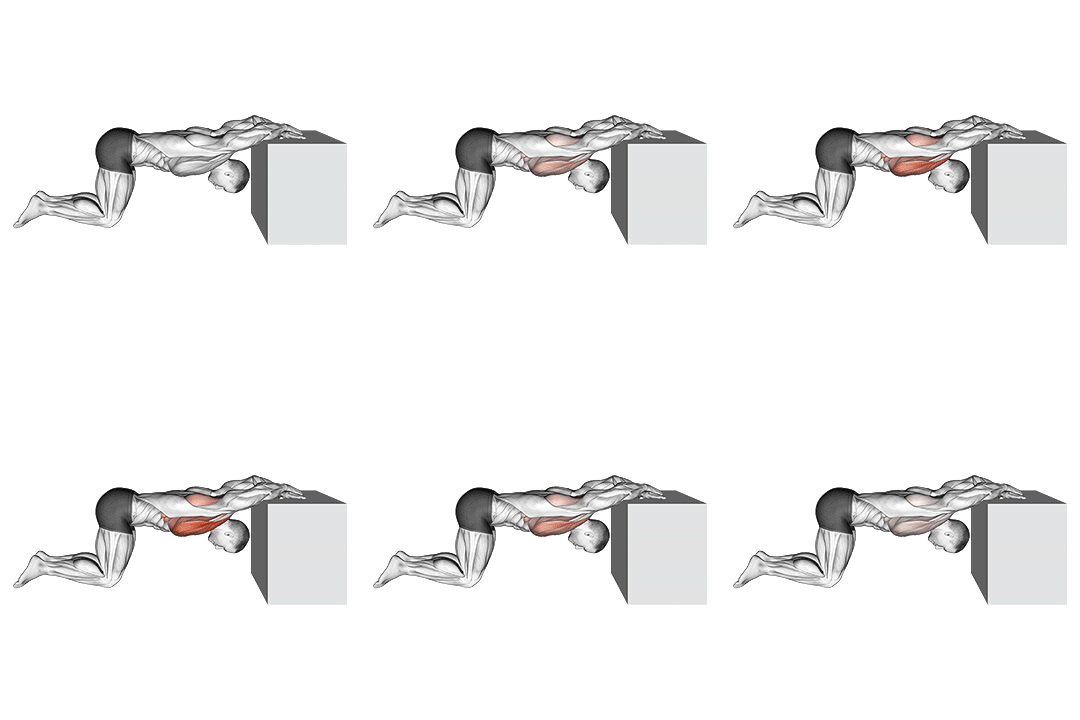
The Kneeling Chest Stretch kneels on the floor and uses a sturdy object (chair, low table) to elevate the elbows while leaning the chest forward. The position produces strong chest and shoulder stretching that complements heavy chest training.
Heavy inner chest training produces significant chest tightness, which can limit range of motion and reduce performance over time. Daily chest stretching for 30 to 60 seconds counteracts this directly with measurable mobility improvements within 4 to 6 weeks. Run it as cool-down after chest training or as a daily mobility habit.
Kneel on the floor in front of a sturdy chair or low table. Place both elbows on the elevated surface with palms facing each other. Lean the chest forward toward the floor while keeping the elbows planted. Hold the stretch for 30 to 60 seconds, breathing normally. The stretch should be felt across the entire chest.
How To Program These Workouts
A productive inner chest session pulls four to six exercises from the list above. A balanced session includes one heavy press (machine inner chest press or close-grip suspended press), one fly variation (cable fly or band fly), one isolation exercise (isometric chest squeeze or seated chest clam), and one bodyweight exercise (chest tap push-up). Run pressing for 3 to 4 sets of 8 to 12 reps; fly variations for 3 sets of 10 to 12 reps; isometric work for 3 to 4 sets of 30 to 60-second holds.
Train inner chest as part of regular chest training. The inner chest is not a separate muscle group; it is the medial portion of the pectoralis major. Most well-designed chest programs include one to two dedicated inner chest exercises (like fly variations or close-grip pressing) per chest session, alongside primary heavy pressing that hits the entire chest. Train chest one to two times per week with this approach.
For broader chest programming, see our best dumbbell chest workouts and how to build a bigger chest. For at-home chest work, see our best at home chest workouts.
Final Thoughts
The best inner chest exercises produce visible inner pec development through fly variations, narrow-grip pressing, and isometric squeezes that emphasize the midline-crossing motion that loads the inner chest most heavily. The combination of machine work, cable and band variations, bodyweight loading, and isolation training covers every major inner chest function. For lifters chasing the defined chest separation that comes from inner pec development, these exercises are one of the most effective options available.
Stay focused on the squeeze at the contracted position. The most common inner chest training mistake is rushing through reps without holding the contracted position where the inner chest works hardest. The fix: pause briefly at the squeeze position of every fly and press, focusing on contracting the chest muscles together. Slower tempos with strong contractions produce stronger inner chest development than faster reps with the same weight.
Frequently Asked Questions
Can you target the inner chest specifically?
Partially yes. The inner chest is not a separate muscle from the rest of the pectoralis major, but it does activate more during exercises that bring the hands together (or the arms across the midline) at the contracted position. Fly variations, close-grip pressing, and isometric squeezes produce stronger inner chest activation than wide-grip pressing, which emphasizes the outer chest fibers more heavily. A complete chest program includes both patterns for full chest development.
What’s the best inner chest exercise?
Cable flies and machine inner chest presses are the most effective inner chest exercises for most lifters. The combination of constant tension (from cables) and consistent path of motion (from machines) produces stronger inner chest contraction than free-weight variations that lose tension at the contracted position. For lifters without cable or machine access, band flies and isometric chest squeezes produce nearly identical stimulus.
How often should I train inner chest?
Once or twice per week as part of regular chest training. The inner chest is part of the chest muscle and recovers along with the rest of the chest. Most well-designed chest programs include one to two inner chest exercises per session alongside primary heavy pressing. Dedicated inner-chest-only sessions are unnecessary; integrating inner chest work into regular chest training is more efficient.
Will inner chest exercises give me chest separation?
Partially yes, when combined with appropriate body fat. Visible inner chest separation requires both inner chest development (built through fly variations and squeezes) and low body fat (typically 12 to 15 percent for men, 18 to 22 percent for women). The training builds the muscle definition; nutrition reveals it. Both are required for the visible chest separation most lifters want.
Are push-ups good for inner chest?
Standard push-ups produce moderate inner chest activation; close-grip and diamond push-ups produce stronger inner chest emphasis. The hands-together position of diamond push-ups loads the inner chest similarly to close-grip bench pressing. For at-home inner chest training, diamond push-ups and chest tap push-ups produce strong inner chest stimulus without any equipment.