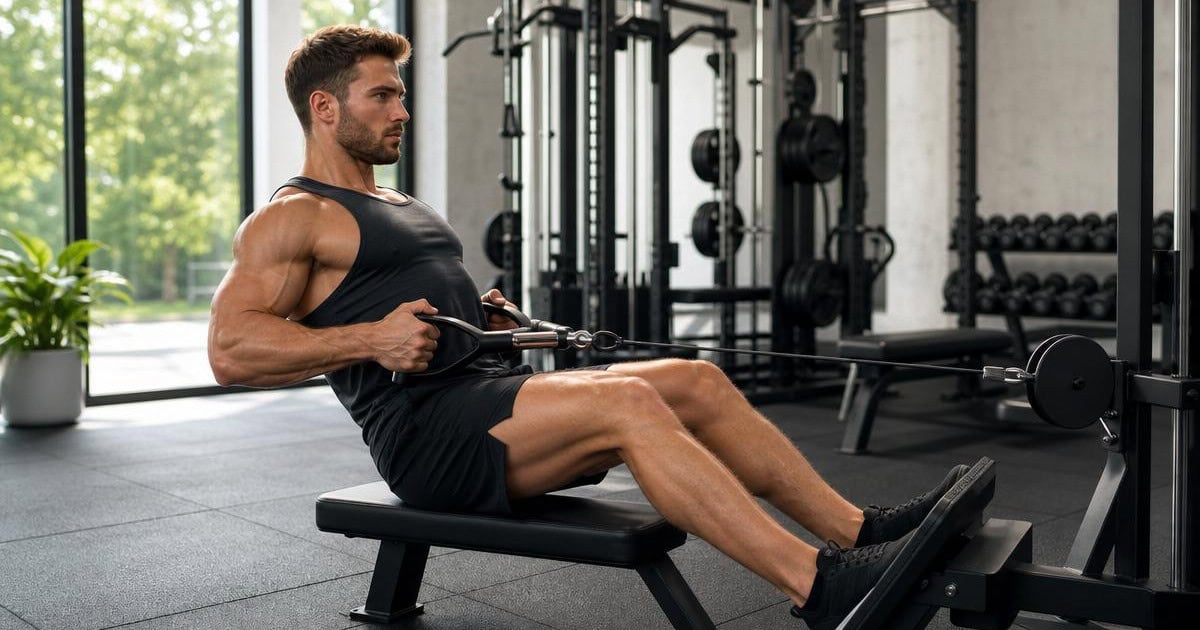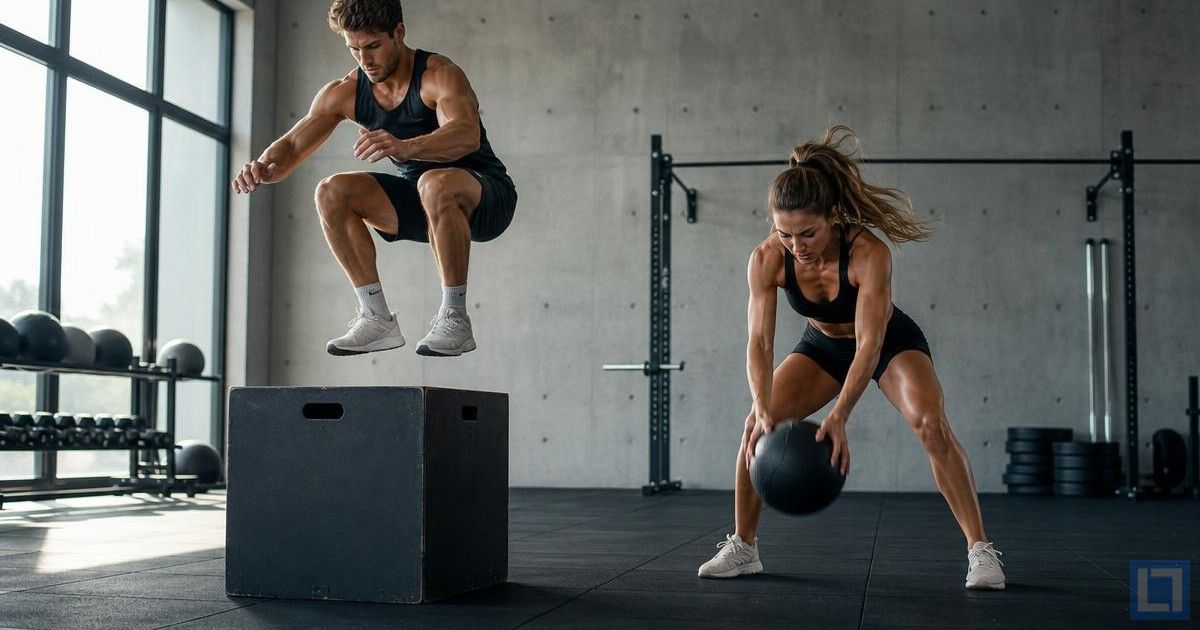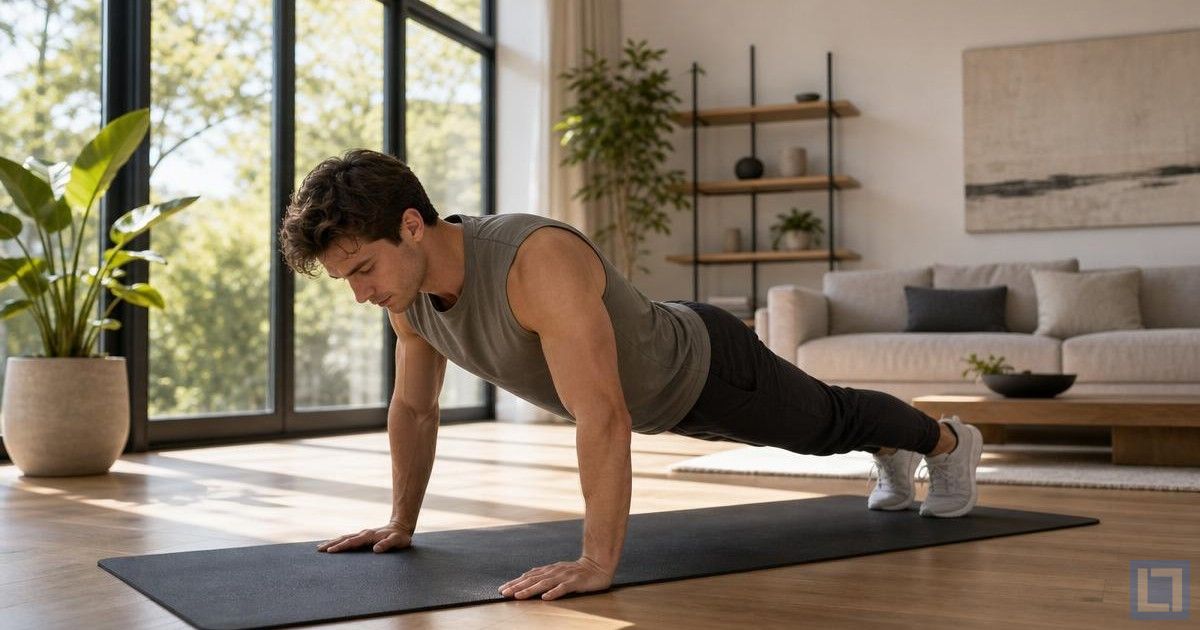
A complete chest workout does not require a barbell, a bench, or a gym membership. The best at home chest workouts use bodyweight, a resistance band, and a sturdy doorway or parallel bars to deliver the full range of chest training: heavy compound pressing, isolation work, and the mobility drills that make all of it work better.
Below are ten effective at-home chest exercises ranging from foundational mass-builders like push-ups and dips to band-loaded presses, plyometric variations, and the chest mobility work that supports every pressing pattern. Together they form a complete chest program that runs anywhere.
Push Ups

Push Ups are the foundational at-home chest exercise. Hands set roughly shoulder-width apart on the floor, body in a straight line from head to heels, you lower the chest to nearly touch the floor and press back to lockout. They train the chest, shoulders, triceps, and core simultaneously.
No at-home chest program is complete without push-ups. The progression from kneeling push-ups (beginner) to standard push-ups to elevated decline push-ups, plyometric push-ups, and one-arm push-ups covers the entire span of pressing strength bodyweight can develop. Most lifters who can do 30+ clean push-ups have built a strong chest and shoulders.
Body stays straight from head to heels, no sagging hips, no piking up. Lower until the chest is roughly an inch off the floor and press back without locking out hard. Tight elbows (45 to 60 degrees from the torso) is generally better than flared elbows for shoulder health.
Chest Dip

The Chest Dip is a parallel-bar dip with a deliberate forward lean and wider elbow flare. The forward lean shifts emphasis from the triceps to the pectoralis major, making it one of the most effective bodyweight chest mass-builders.
Dips are the most effective at-home chest mass-builder available because the load (your full bodyweight) is significant and the range of motion is full. Combined with push-ups, they form the core of any serious at-home chest program. Adding weight via a dip belt extends the progression for years.
Lean the chest forward through the dip rather than staying upright. Lower until the upper arms reach parallel with the floor or slightly below, then press back to lockout. Wider elbows emphasize the chest more; keeping them tight shifts emphasis to the triceps.
Chest Tap Push-up

The Chest Tap Push-up is a plyometric push-up variation where you push up explosively, lift your hands off the floor, quickly tap your chest with both hands, and land back in the push-up position. It is a strong upper-body power developer that goes well beyond what standard push-ups can build.
Plyometric push-ups train the chest to produce force quickly, which is the function the muscle has during athletic activities like throwing, punching, or pushing off the ground. They also build a level of explosive control that translates back to better strength on regular push-ups.
This is an advanced movement. Build a base of 20+ clean push-ups before attempting any plyometric variation. Land softly and absorb the impact with bent elbows rather than locking out hard on the catch.
Band Low Chest Press

The Band Low Chest Press uses a resistance band anchored low to perform a press that arcs upward and across the body. The low-to-high movement path emphasizes the upper chest fibers, making it a strong band-based incline press alternative.
For at-home upper chest work, the band low chest press fills a gap that standard push-ups cannot. Push-ups load the chest at a fixed angle; the band low press changes the angle to specifically target the upper fibers. The combination of push-ups and band low presses covers the chest much more completely.
Anchor the band low. Stand with feet staggered for balance and the band held at hip level with palms forward. Press the bands up and across the body until the hands meet at chest height. Squeeze the chest at the top, then lower under control.
Band Standing Alternate Chest Press

The Band Standing Alternate Chest Press performs alternating presses with a resistance band looped around the back. The alternating pattern adds an anti-rotation core demand that bilateral pressing does not have, and the band provides constant tension throughout the rep.
For lifters who train at home and want a chest pressing pattern that works the core too, the alternating band press is excellent. The single-arm pressing forces the trunk to brace against the rotational pull of the band, which builds core strength alongside chest development.
Loop the band across the upper back and grip the ends near the shoulders. Press one arm forward to lockout, return, then press the other. Keep the body square; do not let the trunk rotate with each press.
Band Chest Fly

The Band Chest Fly is a chest isolation exercise where you perform a fly motion against a resistance band anchored behind you. The band provides increasing tension as your hands come together, creating the strongest contraction at the most contracted position.
Cable flies and dumbbell flies are gym staples; the band fly is the at-home equivalent. The constant band tension produces stronger contractions than dumbbell flies, which lose tension at the top. Combined with band pressing, the fly completes the at-home chest session.
Anchor the band behind you at chest height. Step forward into the band tension. Hold the handles with arms outstretched and a slight bend in the elbows. Arc the arms forward and squeeze the chest until the hands meet in front. Reverse under control.
Isometric Chest Squeeze

The Isometric Chest Squeeze is a chest activation exercise where you press your palms together in front of your chest as hard as possible, contracting the pectorals isometrically. It is a strong activation drill before heavier pressing work or as a standalone chest exercise on rest days.
Isometric work has been shown to build muscle when done at sufficient intensity. More practically, the isometric squeeze before push-ups primes the chest to fire harder during the actual working sets that follow. It is also a useful daily exercise that requires no equipment whatsoever.
Press the palms together as hard as you possibly can for 5 to 10 seconds, then release. Repeat for several rounds. The harder the squeeze, the more useful the exercise. There is no benefit to pressing softly.
Dynamic Chest Stretch

The Dynamic Chest Stretch swings both arms backward and forward in a controlled motion to dynamically open the chest and front shoulders. Unlike static stretches, the dynamic version warms up the muscles while stretching them, which prepares them for heavier work.
Dynamic stretches are the right choice immediately before training. Two to three minutes of this drill noticeably improves push-up and bench press range of motion compared to going in cold. It is one of the simplest pre-workout drills you can do at home.
Swing the arms back rhythmically rather than holding any one position. Each rep should reach slightly further than the last. Stop at whatever range feels active without forcing.
Kneeling Chest Stretch
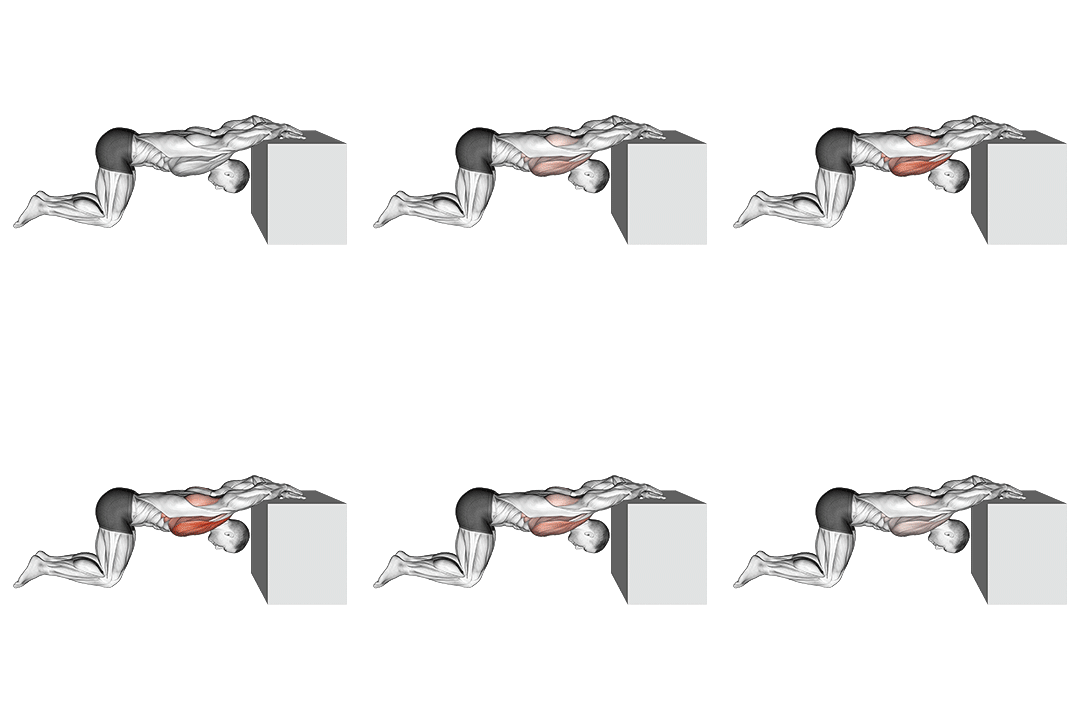
The Kneeling Chest Stretch is a deep chest-opening stretch performed from a kneeling position. With arms extended behind you or placed on an elevated surface, you lean forward to stretch the pectoralis major. It is one of the most thorough chest stretches in any program.
For lifters with significant chest tightness (almost everyone who sits at a desk), the kneeling stretch hits a deeper range than the standing fly or dynamic stretch. Done daily for 30 to 60 seconds per side, it noticeably improves shoulder mobility within a few weeks.
Move into the stretch slowly. Push the chest forward and down rather than just dropping the body. Hold for 30 to 60 seconds and breathe deeply throughout. Repeat for several rounds before pressing-heavy training or as part of a daily mobility routine.
Standing Chest Stretch Against Door

The Standing Chest Stretch Against Door uses a doorway to lengthen the chest and front shoulder. With the forearm pressed into the door frame, stepping forward opens the chest in a deep, controlled stretch. It is one of the most accessible chest mobility drills available.
Doorway stretches let you stretch the chest deeper than any unsupported stretch can manage because the doorframe gives you something to push against. Done for one to two minutes per side, daily, this exercise alone can dramatically improve chronic chest tightness from desk work or pressing-heavy training.
Press the forearm flat into the doorframe at roughly shoulder height. Step forward through the doorway until the chest stretches noticeably. Hold for 30 to 60 seconds, switch sides, and repeat for several rounds.
How To Program These Workouts
A productive at-home chest session starts with mobility (the dynamic stretch and standing fly), moves into heavy compound work (push-ups and dips for 4 to 5 sets), continues with band pressing (low chest press or alternating press for 3 to 4 sets), and finishes with isolation (band fly and isometric squeeze for 2 to 3 sets each).
Train at-home chest two to three sessions per week with at least one rest day between heavier ones. At-home chest work recovers reasonably quickly because the loads are smaller than barbell work, but plyometric push-ups and weighted dips still need recovery time to deliver muscle growth.
For broader at-home programming, see our best bodyweight chest workouts and best full body calisthenics workout. To browse the equipment-free library, explore our bodyweight exercises collection.
Final Thoughts
The best at home chest workouts deliver real chest development with no equipment beyond bodyweight, a band, and a doorway. Push-ups, dips, and band pressing form the foundation, with mobility and isolation work filling in the gaps. The exercises here scale from beginner to advanced through angle, tempo, band tension, and added load.
Stay consistent. At-home chest progress is slower to show up than heavy gym work, but it requires no equipment investment and produces durable, transferable strength. Three sessions per week for three months will produce visible changes in chest size and shape for most lifters.
Frequently Asked Questions
Can I build a big chest training only at home?
Yes, especially for beginners and intermediates. Push-ups, dips, and band-loaded pressing variations cover most of the patterns the chest needs. Advanced lifters chasing absolute maximum chest size eventually benefit from heavy barbell work, but consistent at-home training produces real chest development for years before that ceiling becomes meaningful.
What equipment do I need?
A set of resistance bands and a sturdy doorway covers the essentials. Add parallel bars or a dip station for full chest development; a doorway pull-up bar handles the back work that pairs with chest training. Most committed at-home lifters end up with bands, a pull-up bar, and a dip station as their core kit.
How often should I train chest at home?
Two to four sessions per week works for most lifters. At-home chest work tends to be slightly less taxing than heavy barbell pressing, which lets you train more frequently. Plyometric variations and weighted dips still need at least one rest day between sessions for proper recovery.
Are bands enough to build chest mass?
When combined with push-ups and dips, yes. Bands deliver constant tension and accommodating resistance that loads the chest in patterns free weights cannot replicate. The combination of band pressing and bodyweight pressing covers most of the chest stimulus most lifters need.
How long until I see results from at-home chest training?
Strength improvements show up within 2 to 4 weeks as the nervous system gets more efficient. Visible muscle growth typically takes 8 to 12 weeks of consistent training combined with adequate sleep and sufficient protein intake. Three sessions per week with progressive overload reliably produces results.