Quick at-home ab workouts produce real core development through high-density training that fits in 10 to 15 minutes with zero equipment. The format works because the ab muscles respond particularly well to high-frequency moderate-volume training, and the bodyweight format means no setup time, no equipment changes, no transitions between exercises. A focused 10 to 15-minute session 4 to 5 times per week produces stronger core development than longer infrequent sessions for most general fitness goals.
Below are ten effective bodyweight ab exercises that cover trunk flexion (opposite crunch, lying ab press, bicycle twisting crunch, jack split crunch, seated alternate crunch), lower-ab loading (ab tuck), isometric holds (boat pose, power point plank), combined patterns (bear plank kickback), and recovery (backward abdominal stretch). Together they form a complete quick at-home ab training program. Pull 5 to 7 exercises per session and rotate the selection across sessions for complete training.
Boat Yoga Pose
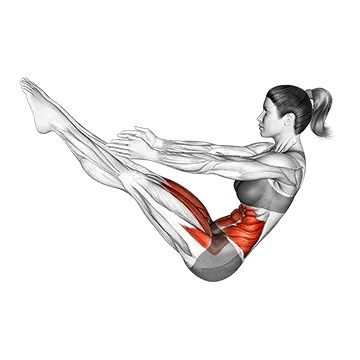
The Boat Yoga Pose sits on the floor with knees bent and feet lifted, balancing on the sit bones while extending the legs and arms forward. The isometric hold produces extreme abdominal demand throughout the position.
For quick at-home ab workouts, the boat pose fits naturally as the isometric hold that builds abdominal endurance in minimal time. The pattern requires no equipment and produces strong continuous ab tension. Run it for 2 to 3 holds of 20 to 45 seconds as primary static ab work.
Sit on the floor with knees bent and feet flat. Lean back slightly to balance on the sit bones. Lift the feet off the floor and extend the legs toward the ceiling. Extend the arms forward toward the feet. Hold the position while breathing normally. End the set when form breaks down.
Opposite Crunch

The Opposite Crunch lies on the back and performs a crunch motion while bringing one elbow toward the opposite knee. The cross-body pattern hits the obliques along with the upper abs through combined flexion and rotation.
For quick at-home ab sessions, the opposite crunch is one of the most efficient single exercises that exists. The cross-body motion produces broader development than straight-line crunches alone in the same time. Run it for 2 to 3 sets of 12 to 15 reps per side.
Lie flat on the back with hands behind the head and knees bent. Lift the shoulder blades off the floor. Bring one elbow across the body toward the opposite knee while curling the upper trunk. Lower under control. Switch sides on each rep.
Ab Tuck

The Ab Tuck lies on the back with knees bent and feet lifted, then pulls the knees toward the chest by contracting the lower abs. The pattern targets the lower abdominal region directly.
For quick at-home sessions that need lower-ab work, the ab tuck is one of the most direct lower-ab exercises that exists. The pattern hits the lower abs without requiring equipment. Run it for 2 to 3 sets of 12 to 15 reps as primary lower-ab work.
Lie flat on the back with hands at the sides. Bend the knees with feet slightly off the floor. Pull the knees toward the chest by contracting the lower abs while lifting the hips slightly off the floor. Lower under control to the start.
Bear Plank Kickback

The Bear Plank Kickback sets up in a bear plank (hands and knees with knees lifted slightly off the floor) and kicks one leg back into a glute extension. The combination of plank stability and posterior leg work produces strong full-body demand.
For quick at-home ab sessions that combine core and glute work, the bear plank kickback is one of the most efficient single exercises. The pattern translates to athletic positions and produces broader development per minute. Run it for 2 to 3 sets of 8 to 10 reps per leg.
Set up on hands and knees with the knees lifted slightly off the floor (bear plank position). Kick one leg back into a glute extension, squeezing the glute at the top. Return under control. Switch sides on each rep or set.
Seated Alternate Crunch

The Seated Alternate Crunch sits balanced on the floor with feet lifted and alternates bringing one knee toward the chest while extending the opposite leg. The seated position with lifted feet keeps the abs under continuous tension.
For quick at-home sessions, the seated alternate crunch produces extreme upper-rectus tension because the abs hold the upper body upright throughout the entire set. Run it for 2 to 3 sets of 16 to 20 total reps.
Sit on the floor with knees bent and feet lifted slightly off the floor. Lean back to balance on the sit bones. Alternate bringing one knee toward the chest while extending the opposite leg. Maintain the lifted-feet position throughout. Continue alternating.
Jack Split Crunches

The Jack Split Crunches lie on the back and perform a crunch motion while simultaneously kicking one leg out to the side and extending the opposite arm overhead in a split jack pattern. The combination produces strong ab demand alongside full-body engagement.
For quick at-home sessions with full-body coordination, the jack split crunch combines ab loading with conditioning demand in minimal time. The combined arm and leg motion produces strong upper-ab loading per rep. Run it for 2 to 3 sets of 10 to 12 reps.
Lie flat on the back with arms at the sides. Crunch the upper body up while simultaneously bringing one knee toward the chest and extending the opposite arm overhead in a split-jack pattern. Lower under control. Switch sides on each rep.
Lying Ab Press

The Lying Ab Press lies on the back with knees bent and feet planted, pressing the lower back into the floor while lifting the head and shoulder blades slightly. The pattern produces strong abdominal contraction without requiring full sit-up motion.
For quick at-home sessions that need foundational ab activation, the lying ab press is one of the most accessible exercises that exists. The shortened range produces strong upper-ab loading without neck strain. Run it for 2 to 3 sets of 12 to 15 reps as foundational ab work.
Lie flat on the back with knees bent and feet planted. Press the lower back firmly into the floor by contracting the abs. Lift the head and shoulder blades slightly off the floor. Hold briefly at the contracted position. Lower under control to the start.
Bicycle Twisting Crunch

The Bicycle Twisting Crunch lies on the back and alternates bringing one knee toward the chest while rotating the trunk to bring the opposite elbow toward the knee. The combined flexion and rotation hits the abs and obliques simultaneously.
For quick at-home sessions, the bicycle crunch is the most efficient single exercise that exists for hitting both the abs and obliques. The continuous tempo produces strong metabolic stress in minimal time. Run it for 2 to 3 sets of 16 to 20 total reps.
Lie flat on the back with hands behind the head and knees bent. Lift the shoulder blades off the floor. Bring one knee toward the chest while rotating the trunk to bring the opposite elbow toward the knee. Switch sides in a continuous bicycle motion.
Backward Abdominal Stretch

The Backward Abdominal Stretch kneels on the floor and reaches the arms back overhead, arching the back to stretch the abdominal region. The pattern provides ab recovery and restores neutral spine after intense ab work.
For quick at-home ab sessions, the backward abdominal stretch fits naturally as the recovery exercise that prevents the spine-flexion fatigue that comes with extended crunch work. Hold it for 2 to 3 sets of 20 to 30 seconds as ab session recovery.
Kneel on the floor with knees hip-width. Reach the arms back overhead, arching the back gently while pressing the hips forward. Hold the position while breathing into the stretch. Avoid forcing the position; allow the stretch to deepen gradually.
Power Point Plank

The Power Point Plank sets up on hands and feet (high plank) and balances on alternating limbs while maintaining the plank position. The unstable variation produces extreme core demand throughout the set.
For quick at-home sessions that include advanced core stability, the power point plank produces stronger anti-rotation and anti-extension demand than standard planks. Run it for 2 to 3 sets of 30 to 45 seconds as advanced plank work.
Set up in a high plank position on hands and feet. Lift one arm and the opposite leg simultaneously, balancing on the remaining two limbs while maintaining a strong plank position. Hold briefly. Switch limbs. Continue alternating throughout the set.
How To Program These Workouts
A productive quick at-home ab workout uses circuit-style organization. A standard 10 to 12-minute structure: 5 to 7 exercises performed for 30 to 40 seconds each with 10 to 15 seconds rest between exercises, repeated for 2 to 3 rounds. The continuous pacing produces strong metabolic stress alongside the direct ab loading. The format works particularly well as a morning routine before showering or as a post-workout finisher attached to other training.
Train quick at-home ab workouts 4 to 5 times per week. The bodyweight format produces moderate ab fatigue per session, which allows higher frequency than weighted ab training. Most lifters do well with daily or near-daily quick ab sessions because the short duration and bodyweight format limit cumulative fatigue. The format also fits naturally into busy schedules because no gym access or extended time commitment is required.
For longer ab sessions, see our best 30 minute ab workouts and 15 minute ab workouts. For broader at-home training, see our best at home core workouts.
Final Thoughts
The best quick ab workouts at home deliver real core development through equipment-free training that fits any schedule and lifestyle. The combination of trunk flexion, lower-ab work, isometric holds, combined patterns, and recovery exercises covers every major core function in 10 to 15 minutes. For lifters who want consistent ab training without the time barrier of longer gym-based sessions, the quick at-home format is one of the most effective and sustainable options available.
Stay focused on quality over speed. The most common quick ab workout mistake is rushing through reps to fit the time format, which produces sloppy form and reduced ab activation. The fix: pick rep counts that allow strict form within the time intervals. If 30-second intervals only allow 8 strict reps, use those 8 strict reps. Quality reps in less time produce stronger ab development than rushed sloppy reps. The format works because of consistent execution, not rep maximization.
Frequently Asked Questions
Are quick ab workouts effective?
Yes for general core development. The combination of high-density training and frequent sessions (4 to 5 times per week) produces strong ab stimulus when done consistently. Most lifters who follow quick ab routines for 8 to 12 weeks see meaningful core strength improvements. The format works particularly well as a supplement to broader strength training for visible core development.
How long should a quick ab workout be?
10 to 15 minutes works for most lifters. Shorter sessions (under 8 minutes) often miss enough volume for meaningful stimulus; longer sessions (over 20 minutes) move beyond the quick format. Most successful quick ab workouts include 5 to 7 exercises performed for 30 to 40 seconds each across 2 to 3 rounds with minimal rest between exercises.
Can I do quick ab workouts every day?
Yes, the bodyweight format produces moderate ab fatigue that allows daily training for most lifters. Daily quick ab workouts work because the short duration limits cumulative fatigue and the bodyweight format prevents the lower-back strain that heavy weighted ab training can produce. Most lifters do well with 4 to 6 quick ab sessions per week.
Will quick ab workouts give me a six-pack?
Ab training builds the muscle that gives the stomach its shape; reducing body fat through nutrition reveals that shape. Both are required for visible abs. Most lifters need to be at 12 to 18 percent body fat for abs to show clearly. Quick at-home training handles the muscle-building side; sustainable nutrition handles the body fat side. The combination produces visible results over 12 to 16 weeks for most lifters.
Do I need equipment for quick ab workouts?
No equipment required for the exercises in this list. The bodyweight format means lifters can train anywhere with floor space (home, hotel rooms, parks, offices) without setup time or equipment cost. Most successful quick ab routines run with zero equipment, which makes them sustainable long-term because there are no barriers to starting a session.