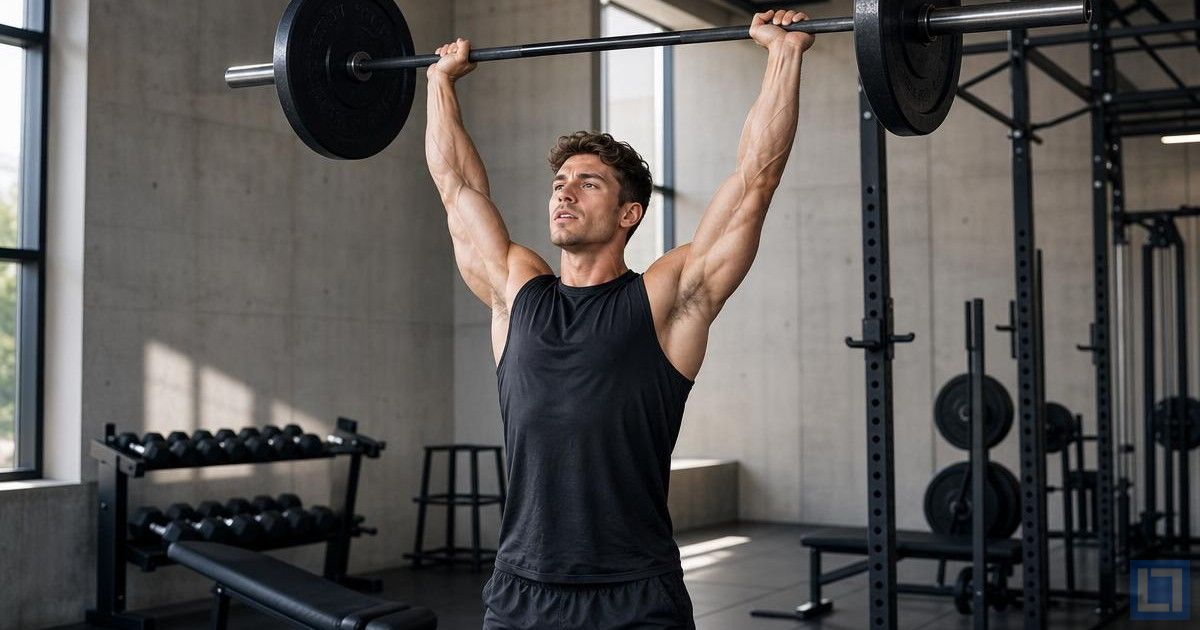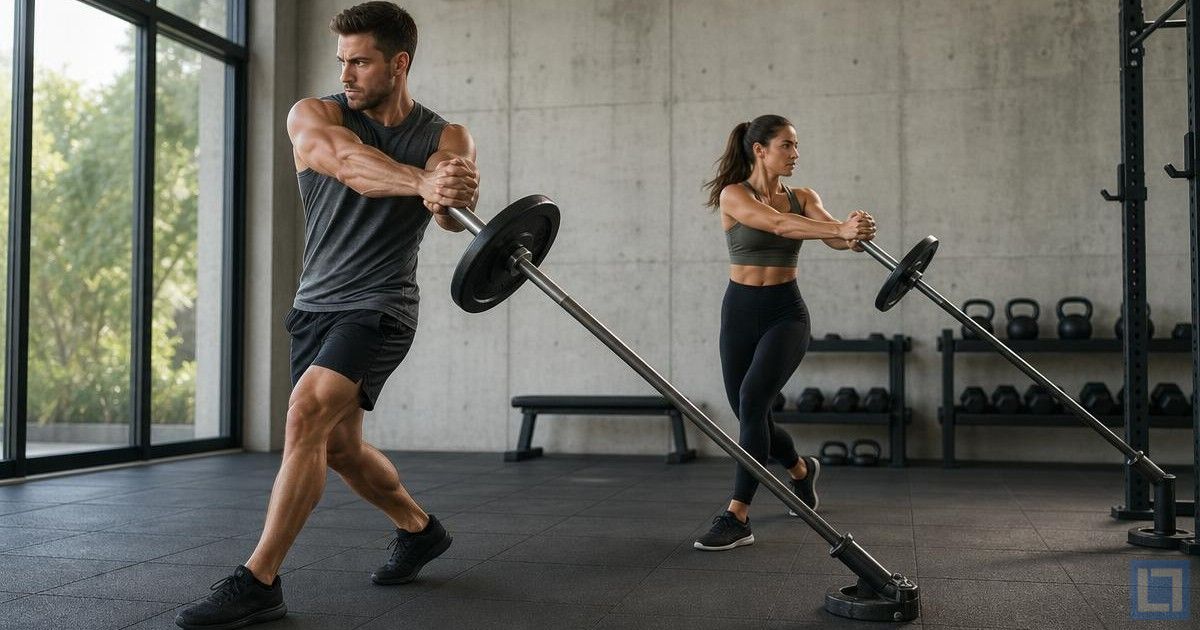
Landmine training uses a barbell with one end anchored to the floor (in a landmine attachment or wedged in a corner) to produce angled loading patterns that complement standard free-weight training. The angled bar path hits muscles from different angles than vertical or horizontal loading, which produces unique adaptations and broader development per session. Landmine training also fits naturally for unilateral exercises (one-arm rows, one-arm presses) where the angled path provides natural loading that pure dumbbell training cannot match. The format is particularly valuable for lifters with shoulder limitations because the angled press path is often more shoulder-friendly than vertical pressing.
Below are ten effective landmine exercises that cover lower-body work (rear lunge, Romanian deadlift, one-leg stiff-leg deadlift), upper-body pressing (kneeling thruster press, kneeling one-arm shoulder press, band-loaded press), pulling and rowing (one-arm bent-over row, bench row), chest isolation (floor fly), and full-body conditioning (stand-up high knee). Together they form a complete landmine training program that fits in any gym with a landmine attachment or available corner. A 45 to 60-minute session pulled from this list produces strong full-body stimulus across every major movement pattern.
Landmine Rear Lunge

The Landmine Rear Lunge holds the end of a landmine bar at the chest and steps backward into a reverse lunge, dropping the back knee toward the floor. The combination of front-loaded core demand and unilateral leg work produces strong lower-body development.
For landmine leg training, the rear lunge is one of the most accessible loaded lunge variations. The front-loaded position emphasizes upright torso and core bracing, which produces broader development than back-loaded lunges. Run it for 3 to 4 sets of 8 to 10 reps per leg.
Hold the end of the landmine bar at the chest with both hands. Stand tall facing away from the landmine pivot. Step backward into a reverse lunge, dropping the back knee toward the floor. Drive through the front foot to step back to standing. Alternate sides on each rep or set.
Landmine Kneeling Thruster Press

The Landmine Kneeling Thruster Press kneels on the floor holding the landmine bar at the chest and drives the bar up and away from the body in a pressing motion. The kneeling position eliminates leg drive and isolates the upper body for pure pressing strength.
For landmine upper-body training, the kneeling thruster press hits the shoulders, chest, and triceps simultaneously through the angled landmine path. The kneeling position prevents leg drive compensation. Run it for 3 to 4 sets of 8 to 10 reps as primary upper-body landmine work.
Kneel on the floor with one knee up and the other down (or both knees down). Hold the end of the landmine bar at the chest. Press the bar up and away from the body through its angled path. Lower under control to the chest. Maintain upright torso throughout.
Landmine Stand Up High Knee

The Landmine Stand Up High Knee starts kneeling with the landmine bar held at the chest, then stands up while driving one knee high toward the chest, then returns to kneeling. The transition produces strong full-body conditioning along with hip flexor work.
For landmine HIIT or full-body conditioning, the stand-up high-knee combines lower-body loading, core demand, and hip flexor work in one explosive motion. The pattern translates to athletic movements that require quick transitions. Run it for 3 sets of 6 to 8 reps per side.
Kneel on both knees holding the end of the landmine bar at the chest. Drive up to a one-knee kneeling position by lifting one knee high toward the chest while standing through the other foot. Return to kneeling. Switch sides between sets.
Landmine Kneeling One Arm Shoulder Press

The Landmine Kneeling One Arm Shoulder Press kneels on one knee and presses the landmine bar overhead with the same-side arm. The kneeling position with one arm pressing produces strong shoulder isolation along with significant core demand.
For landmine shoulder training, the kneeling one-arm press is one of the most direct shoulder exercises available. The kneeling position eliminates leg drive while the unilateral pressing produces strong shoulder development per rep. Run it for 3 to 4 sets of 8 to 10 reps per side.
Kneel on one knee (typically the same side as the pressing arm). Hold the end of the landmine bar at the shoulder of that side. Press the bar up and away from the body through its angled path until the arm is fully extended. Lower under control. Switch sides between sets.
Landmine One Leg Stiff Leg Deadlift

The Landmine One Leg Stiff Leg Deadlift performs a single-leg stiff-legged deadlift while holding the landmine bar end at one shoulder. The combined unilateral hinge and offset loading produces strong glute, hamstring, and core demand.
For landmine unilateral posterior-chain training, the one-leg stiff-leg deadlift produces unique loading that bilateral exercises cannot match. The offset weight forces the core to brace asymmetrically throughout the rep. Run it for 3 sets of 8 to 10 reps per leg.
Stand on one leg holding the end of the landmine bar at the same-side shoulder. Hinge at the hips with the standing leg relatively straight, lifting the lifted leg behind the body. Drive through the standing leg to return to standing. Switch sides between sets.
Landmine One Arm Bent Over Row

The Landmine One Arm Bent Over Row hinges over and rows the end of the landmine bar to the rib with one hand. The rowing motion through the angled landmine path produces strong upper-back and lat development.
For landmine back training, the one-arm bent-over row is one of the most direct horizontal pulling exercises that exists. The angled bar path hits the lats from a slightly different angle than free-weight rowing. Run it for 3 to 4 sets of 8 to 10 reps per side.
Stand with feet hip-width and the landmine bar in front. Hinge at the hips and grip the end of the bar with one hand. Row the bar up to the rib by pulling the elbow back. Lower under control. Maintain a flat back throughout. Switch sides between sets.
Landmine Floor One Arm Chest Fly

The Landmine Floor One Arm Chest Fly lies on the floor and performs a fly motion with the end of the landmine bar held in one hand. The floor limits elbow drop, which keeps the shoulder safe while the chest works through its full contraction range.
For landmine chest training that emphasizes pure chest isolation, the floor fly is one of the most direct chest exercises that exists. The angled landmine path produces unique pec loading throughout the rep. Run it for 3 sets of 10 to 12 reps per side.
Lie flat on the floor with the landmine bar end held in one hand at the chest. Press the bar up to extension above the chest. Lower the bar out to the side in a fly motion until the elbow touches the floor. Squeeze the chest to bring the bar back to the start.
Landmine One Arm Bent Over Bench Row

The Landmine One Arm Bent Over Bench Row braces one hand on a bench while rowing the end of the landmine bar with the other hand. The bench-supported position eliminates lower-back demand and isolates the rowing muscles.
For maximum landmine back isolation, the bench-supported one-arm row eliminates lower-back limitations and lets the lifter row heavier loads with strict form. Run it for 3 to 4 sets of 8 to 10 reps per side as primary horizontal pull work.
Place one hand on a bench with the back roughly parallel to the floor. Hold the end of the landmine bar in the other hand with the arm fully extended. Row the bar up to the rib by pulling the elbow back. Lower under control. Switch sides between sets.
Landmine Resistance Band One Arm Shoulder Press

The Landmine Resistance Band One Arm Shoulder Press combines a landmine press with a resistance band attached to the bar end, adding accommodating resistance to the standard pressing motion. The combination produces stronger lockout loading than either method alone.
For landmine pressing with accommodating resistance, the band-loaded variation hits the shoulders harder at the lockout where the band stretches tightest. The combination produces stronger triceps and shoulder development. Run it for 3 sets of 8 to 10 reps per side.
Anchor a resistance band to the floor near the landmine pivot. Loop the band around the landmine bar end. Stand holding the bar end at the shoulder. Press the bar up and away from the body through its angled path against both the bar weight and band tension. Lower under control. Switch sides.
Landmine Romanian Deadlift

The Landmine Romanian Deadlift holds the end of the landmine bar with both hands and performs a Romanian deadlift hip-hinge. The angled landmine path produces unique loading on the hamstrings and glutes throughout the rep.
For landmine posterior-chain training, the Romanian deadlift produces strong hamstring and glute loading through the hip-hinge motion. The angled landmine path provides slightly different loading than free-weight Romanian deadlifts. Run it for 3 to 4 sets of 8 to 12 reps as primary hamstring work.
Stand tall holding the end of the landmine bar with both hands at the chest. Hinge at the hips with a slight knee bend, lowering the bar in an arc until the hamstrings stretch. Drive the hips forward to stand back up. Keep the back flat throughout.
How To Program These Workouts
A productive landmine session pulls six to eight exercises from the list above. A balanced session includes one lower-body compound (rear lunge or Romanian deadlift), one pressing exercise (kneeling thruster press or shoulder press), one rowing exercise (one-arm bent-over row), one isolation exercise (floor fly), one unilateral exercise (one-leg stiff-leg deadlift), and one full-body movement (stand-up high knee). Run primary compounds for 3 to 4 sets of 8 to 10 reps; isolation work for 3 sets of 10 to 12 reps; conditioning movements for 3 sets of 6 to 8 reps per side.
Train landmine sessions 2 to 3 times per week as a complete program, or attach landmine exercises to existing strength training sessions as accessory work. The angled loading produces moderate fatigue, which allows higher frequency than barbell-heavy programs. Most successful programs include 1 to 2 dedicated landmine sessions per week alongside free-weight strength training, with landmine exercises serving as accessories or alternatives when free-weight options aggravate shoulder or back issues.
For more equipment-based programming, see our best smith machine leg workouts and best barbell leg workouts. For full-body alternatives, see our best full body kettlebell workouts.
Final Thoughts
The best landmine workouts deliver real full-body development through angled loading patterns that complement standard free-weight training. The combination of lower-body compounds, pressing variations, rowing exercises, isolation work, and conditioning patterns covers every major movement function with unique loading angles that produce broader development than any single training modality alone. For lifters with access to landmine equipment, particularly those with shoulder limitations or those wanting variety in their training, landmine work is one of the most effective options available.
Stay focused on the angled bar path. The most common landmine training mistake is treating landmine exercises like standard barbell exercises, which misses the unique angled loading that makes landmine training effective. The fix: respect the natural arc of the landmine path. The bar should travel up and away from the body during pressing motions and through angled arcs during rowing motions. Following the natural bar path produces stronger development than fighting against it.
Frequently Asked Questions
What is a landmine workout?
Landmine training uses a barbell with one end anchored to the floor (in a landmine attachment or wedged in a corner) to produce angled loading patterns. The other end of the bar is loaded with weight plates or held empty for lighter work. The angled bar path produces unique adaptations that vertical and horizontal loading patterns cannot match, which makes landmine training particularly valuable for variety and for lifters with shoulder or back limitations.
Are landmine workouts effective?
Yes, particularly for variety and shoulder-friendly upper-body training. The angled loading patterns produce real strength and muscle development, and the natural bar path is often easier on the shoulders than vertical pressing. Most lifters who add landmine work to existing programs see broader development through the unique loading angles.
Can I build muscle with only landmine workouts?
Yes for general strength and physique development. The combination of progressive landmine training, appropriate volume, and consistent nutrition produces real muscle development for years of consistent practice. Advanced lifters chasing maximum strength eventually benefit from heavy free-weight squatting and pressing that landmine training cannot fully replicate, but consistent landmine training produces measurable development at every level.
Do I need a landmine attachment?
A landmine attachment is helpful but not required. The barbell can be wedged into the corner of a power rack, into a corner of the gym, or into a heavy plate that prevents the end from sliding. Most commercial gyms have dedicated landmine attachments; home gym lifters can purchase landmine attachments that bolt to power racks or use the corner-wedge approach.
How heavy should landmine weights be?
Most beginners start with 25 to 45 pounds added to the bar end (the bar itself contributes 15 to 45 pounds depending on type). Intermediates work with 45 to 90 pounds added. The right weight is whatever allows clean reps in your target range with strict form. Landmine exercises typically use lighter total loads than equivalent free-weight exercises because the angled loading produces unique demands that limit raw weight capacity.