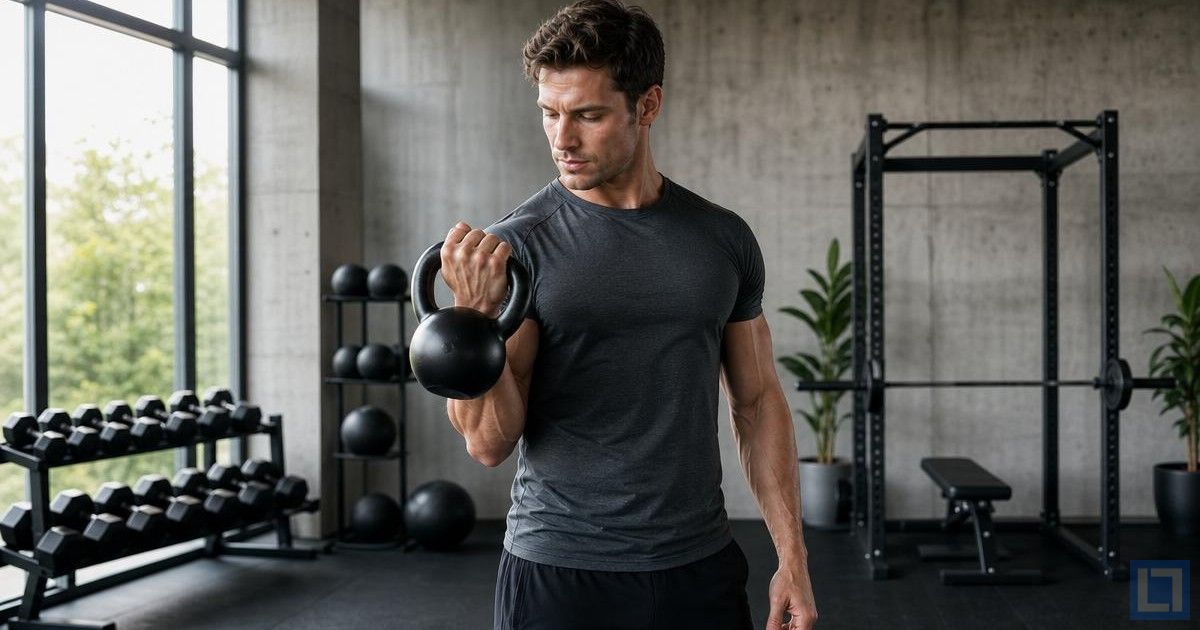
Kettlebell bicep training produces real bicep development through a combination of direct curling exercises, pulling movements that load the biceps as the primary elbow flexor, and ballistic exercises (cleans, swings) that load the biceps during the deceleration catch. The unique kettlebell handle distribution also shifts loading slightly toward the forearms compared to dumbbells, which produces broader arm development per rep. The combination of direct curl work, rowing patterns, and ballistic loading gives kettlebell training unique advantages that pure dumbbell or barbell curl programs cannot match.
Below are ten effective kettlebell bicep exercises that cover direct curling (biceps curl, concentration curl), bicep-loaded rowing (alternating row, one-arm row, two-arm row, renegade row), ballistic loading (clean and press, single arm clean), grip-focused work (overhand grip swing), and full-body patterns that load the biceps as stabilizers (thruster). Together they form a complete kettlebell bicep training program that fits in any home gym with one or two kettlebells. A 25 to 35-minute session pulled from this list produces strong bicep stimulus across every major loading pattern.
Kettlebell Biceps Curl

The Kettlebell Biceps Curl holds kettlebells at the sides and curls them up toward the shoulders by bending at the elbows. The pattern hits the biceps directly through their primary elbow flexion function, with the unique kettlebell shape adding grip and forearm work compared to dumbbell curls.
For kettlebell bicep training, the standard biceps curl is the cornerstone exercise. The kettlebell handle distribution shifts loading slightly toward the forearms compared to dumbbells, which produces broader arm development per rep. Run it for 3 to 4 sets of 8 to 12 reps as primary bicep work.
Stand tall with kettlebells held at the sides, palms facing forward. Curl the kettlebells up toward the shoulders by bending at the elbows. Squeeze the biceps at the top. Lower under control to full extension. Keep the elbows pinned at the sides throughout.
Kettlebell Concentration Curl

The Kettlebell Concentration Curl sits on a bench with the elbow braced against the inner thigh and curls a single kettlebell up toward the shoulder. The braced position eliminates body sway and isolates the biceps for pure curling strength.
For maximum bicep isolation in kettlebell training, the concentration curl is the most direct exercise that exists. The braced elbow eliminates compensation and produces stronger bicep development per rep than standing curls. Run it for 3 sets of 10 to 12 reps per side as accessory bicep work.
Sit on a bench with feet planted wide. Hold a kettlebell in one hand with the elbow braced against the inner thigh of that side. Curl the kettlebell up toward the shoulder by bending at the elbow. Squeeze the biceps at the top. Lower under control. Switch sides on the next set.
Kettlebell Alternating Row

The Kettlebell Alternating Row hinges over with kettlebells held at the sides and rows them to the ribs by alternating elbows. The bilateral hold with alternating row produces strong upper-back development plus heavy bicep loading throughout the row pattern.
For kettlebell bicep training that includes pulling-pattern strength, the alternating row produces strong bicep loading because the biceps work as the primary elbow flexor during every row rep. The pattern hits the back, biceps, and forearms simultaneously. Run it for 3 to 4 sets of 8 to 10 reps per side.
Stand with feet hip-width holding kettlebells at the sides. Hinge over by pushing the hips back and bending the knees slightly. Row one kettlebell to the rib while the other holds at extension. Lower and row the opposite side. Continue alternating throughout the set.
Kettlebell One Arm Row

The Kettlebell One Arm Row hinges over with one hand braced on a bench and rows a kettlebell with the free hand to the rib. The single-arm pattern allows heavier loading per arm and produces strong lat and bicep development.
For kettlebell bicep training, the single-arm row produces stronger bicep loading per rep than bilateral rowing because the focused unilateral pattern allows heavier loads per arm. The pattern translates directly to bicep development through the rowing motion. Run it for 3 to 4 sets of 8 to 10 reps per arm.
Place one hand on a bench with the back roughly parallel to the floor. Hold a kettlebell in the other hand with the arm fully extended toward the floor. Row the kettlebell to the rib by pulling the elbow back. Lower under control. Complete all reps on one side before switching.
Kettlebell Alternating Renegade Row

The Kettlebell Alternating Renegade Row gets into a push-up position with hands gripping kettlebells and alternates rowing one kettlebell at a time while maintaining the plank position. The combination of plank stability and rowing produces strong bicep, back, and core demand.
For combined bicep, back, and core training, the renegade row is one of the most efficient kettlebell exercises that exists. The plank position adds extreme core demand throughout the rowing pattern. Run it for 3 sets of 6 to 8 reps per side as combined upper-body and core work.
Set up in a push-up position with hands gripping two kettlebells on the floor. Maintain a strong plank position. Row one kettlebell to the rib, then lower and row the other side. Continue alternating while keeping the hips level throughout.
Kettlebell Two Arm Row

The Kettlebell Two Arm Row hinges over with kettlebells held at the sides and rows both kettlebells to the ribs simultaneously by pulling the elbows back. The bilateral pattern produces strong upper-back development plus significant bicep loading.
For kettlebell bicep training through bilateral rowing, the two-arm row produces strong simultaneous loading on both biceps. The pattern is more time-efficient than alternating rows for getting through training volume. Run it for 3 to 4 sets of 8 to 10 reps as primary horizontal pull work.
Stand with feet hip-width holding kettlebells at the sides. Hinge over by pushing the hips back and bending the knees slightly. Row both kettlebells to the ribs by pulling the elbows back. Lower under control. Keep the back flat throughout.
Kettlebell Clean and Press

The Kettlebell Clean and Press lifts a kettlebell from between the legs to the rack position (the “clean”) and presses overhead in one continuous motion. The catch portion of the clean produces strong bicep loading as the kettlebell decelerates at the rack.
For kettlebell bicep training that includes ballistic work, the clean-and-press loads the biceps significantly during the clean catch. The dynamic loading produces strong bicep adaptations that static curls cannot match. Run it for 3 sets of 5 to 8 reps per side.
Stand with feet shoulder-width and a kettlebell between the legs. Hinge at the hips, then drive the hips forward to swing the kettlebell up to the rack position. Catch with the elbow bent and palm facing the body. Press the kettlebell overhead. Lower to the rack, then back to the start.
Kettlebell Single Arm Clean

The Kettlebell Single Arm Clean lifts a kettlebell from between the legs to the rack position with one arm in a single explosive motion. The clean catch produces strong bicep loading as the kettlebell decelerates at the rack position.
For ballistic bicep loading in kettlebell training, the single-arm clean produces unique bicep adaptations. The explosive lifting and decelerated catch hit the biceps with loads that pure curl exercises cannot match. Run it for 3 sets of 5 to 8 reps per arm.
Stand with feet shoulder-width and a kettlebell between the legs. Grip the bell with one hand. Hinge at the hips, then drive the hips forward explosively to swing the bell up. Catch in the rack position with the elbow bent and palm facing the body. Lower under control through the legs.
Kettlebell Overhand Grip Swing

The Kettlebell Overhand Grip Swing performs the kettlebell swing with both hands gripping the bell overhand (palms down) rather than the standard double-overhand grip. The grip variation increases forearm and bicep involvement throughout the swing motion.
For grip and bicep training within kettlebell ballistic work, the overhand-grip swing produces stronger forearm and bicep loading than standard swings. The grip variation works the brachioradialis (a bicep-supporting muscle) heavily throughout the swing. Run it for 3 sets of 12 to 15 reps as accessory grip-and-bicep conditioning.
Stand with feet shoulder-width and a kettlebell between the legs. Grip the bell with both hands using an overhand grip. Hinge at the hips and let the bell swing back between the legs. Drive the hips forward to swing the bell up to chest height. Maintain the overhand grip throughout. The bell should swing to chest level, not overhead.
Kettlebell Thruster

The Kettlebell Thruster combines a front squat (with kettlebells in the rack position) and an overhead press in one continuous motion. The catch position at the top of the squat loads the biceps as part of the rack position bracing.
For full-body kettlebell training that loads the biceps, the thruster works the biceps as a stabilizer throughout the rack position. The full-body pattern also produces strong cardiovascular conditioning. Run it for 3 sets of 8 to 10 reps as combined leg, shoulder, and bicep work.
Stand with kettlebells in the rack position at the shoulders. Squat down to a deep front squat. Drive up explosively while pressing the kettlebells overhead in one continuous motion. Lower the kettlebells to the rack position. Repeat immediately into the next squat.
How To Program These Workouts
A productive kettlebell bicep session pulls five to seven exercises from the list above. A balanced session includes one direct curl exercise (biceps curl or concentration curl), one rowing exercise (one-arm row or alternating row), one ballistic exercise (single arm clean or clean and press), and one or two accessory exercises (overhand grip swing, thruster). Run direct curls for 3 to 4 sets of 8 to 12 reps; rowing work for 3 to 4 sets of 8 to 10 reps per side; ballistic work for 3 sets of 5 to 8 reps per side.
Train kettlebell biceps 1 to 2 times per week as part of broader pulling and arm training. The biceps recover within 48 to 72 hours of moderate training, but they get significant indirect work from any kettlebell rowing or pulling exercise. Most well-designed kettlebell programs include 1 to 2 dedicated bicep-focused exercises per pull or arm session alongside rowing and pulling work that produces indirect bicep loading.
For more arm programming, see our best kettlebell arm workouts and best kettlebell tricep workouts. For other bicep training approaches, see our best dumbbell bicep workouts.
Final Thoughts
The best kettlebell bicep workouts produce real bicep development through the combination of direct curling, pulling-pattern loading, and ballistic deceleration work that pure dumbbell training cannot match. The unique kettlebell handle distribution adds forearm involvement that produces broader arm development per rep. For lifters with kettlebell access who want serious bicep training, this format is one of the most effective options available.
Stay focused on full range of motion. The most common kettlebell bicep training mistake is shortening the range of motion to use heavier kettlebells, which produces weaker bicep development than full-range work with appropriate weight. The fix: use kettlebells light enough to perform full range curls and rows with strict form. The biceps respond best to the full stretch at the bottom of every rep; cutting the range short eliminates the stretch loading that drives growth.
Frequently Asked Questions
Are kettlebells good for bicep training?
Yes, particularly for combined bicep and grip development. The unique kettlebell handle distribution produces stronger forearm involvement than dumbbells, and the ballistic exercises (cleans, swings) produce bicep loading patterns that pure curl exercises cannot match. Most lifters who add kettlebell bicep work to their training see broader arm development including improved grip strength and forearm size.
How heavy should kettlebells be for bicep curls?
Most beginners start with 8 to 12 kg kettlebells (18 to 26 pounds) for direct bicep curls; intermediates work with 12 to 16 kg (26 to 35 pounds) for primary curls and lighter bells (8 kg) for concentration curls. The right weight is whatever allows clean strict reps in your target range. Heavier weight with poor form produces weaker bicep development than moderate weight with strict technique.
Can I build big biceps with only kettlebells?
Yes for general arm development. The combination of progressive kettlebell training, appropriate volume, and consistent nutrition produces real bicep development for years of consistent practice. Advanced lifters chasing maximum bicep size eventually benefit from heavy barbell curling that allows loads kettlebells cannot match (one-arm kettlebells typically cap out around 32 kg for bicep work), but consistent kettlebell bicep training produces measurable development at every level.
How often should I train kettlebell biceps?
One to two times per week works for most lifters. The biceps recover within 48 to 72 hours of moderate training, and they get significant indirect work from any kettlebell rowing or pulling exercise. Most successful programs include one dedicated bicep-focused session per week or 1 to 2 bicep exercises attached to pull or arm days.
Are kettlebell rows good for biceps?
Yes, very effectively. Rowing exercises load the biceps as the primary elbow flexor throughout every rep; the biceps work continuously as the bell pulls toward the body. Most successful bicep training programs include rowing exercises as primary or secondary bicep work alongside direct curls. The combination of curling and rowing produces broader bicep development than curls alone.