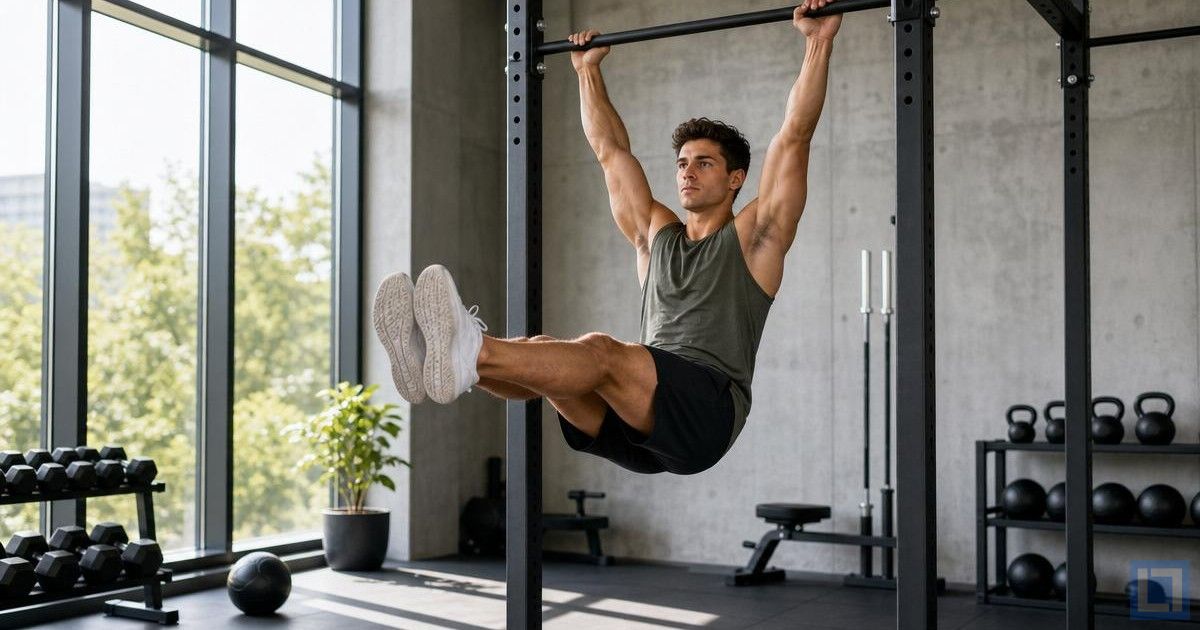
Hanging ab workouts produce some of the strongest core stimulus available in any training program. The combination of full-body suspension, anti-extension demand, and lower-ab loading through hip flexion creates ab training intensity that floor-based exercises cannot match. The hanging position also adds significant grip and shoulder demand on top of the core work, which produces broader athletic development per rep than isolated ab training. The best hanging ab workouts use a pull-up bar (or any sturdy overhead grip point) and progress through difficulty levels as core strength builds.
Below are ten effective hanging ab exercises that cover foundational hanging mechanics (scapular shrug), beginner exercises (flutter kicks, knee circles), intermediate work (leg raises, half windmills), and advanced training (straight leg raises, pikes, toes-to-bar, hollow holds). Together they form a complete hanging ab progression from absolute beginner through elite-level core training that fits in any home with a pull-up bar.
Hanging Flutter Kick

The Hanging Flutter Kick hangs from a pull-up bar with arms straight and alternates kicking the legs in a flutter motion. The continuous lower-body movement produces strong lower-ab loading along with grip and shoulder demand from the hang.
For lower-ab development with simultaneous grip work, the hanging flutter kick is one of the most efficient exercises that exists. The hang position eliminates body sway and forces strict isolation, while the flutter motion produces continuous lower-ab tension. Run it for 3 sets of 30 to 45-second intervals.
Hang from a pull-up bar with arms straight and feet off the floor. Keep the legs straight and slightly raised in front of the body. Alternate raising and lowering each leg in a flutter motion, keeping the knees straight throughout. Maintain steady tempo. Drop from the bar when grip gives out.
Hanging Scapular Shrug

The Hanging Scapular Shrug hangs from a pull-up bar and pulls the shoulder blades down and back without bending the elbows. The exercise is a foundational shoulder-and-back drill that all hanging ab exercises depend on for shoulder stability.
For lifters new to hanging ab work, the scapular shrug is the foundational exercise that teaches the shoulder mechanics required for harder hanging movements. The pattern engages the lats and lower traps, which produces the shoulder stability that protects the joint during longer hangs. Run it for 3 sets of 8 to 12 reps as warm-up before harder hanging work.
Hang from a pull-up bar with arms straight and shoulders relaxed. Pull the shoulder blades down and back without bending the elbows; the body should rise slightly as the lats engage. Pause briefly at the top of the contraction. Release the lats to return to the relaxed hang. Repeat.
Hanging Deadbug

The Hanging Deadbug hangs from a pull-up bar and performs the dead bug pattern with the legs, alternately lowering one leg while keeping the other in a tucked position. The hang adds extreme grip and shoulder demand to the standard dead bug pattern.
For advanced core training, the hanging deadbug combines the demanding hang position with the anti-extension demand of dead bugs. The combination produces stronger total core development per rep than either exercise alone. Run it for 3 sets of 6 to 10 reps per side.
Hang from a pull-up bar with arms straight. Lift both knees toward the chest into a tucked position. Slowly extend one leg straight down while keeping the other leg tucked. Return to the tucked position and switch sides. Maintain shoulder engagement (lats pulled down) throughout.
Hanging Half Windmill

The Hanging Half Windmill hangs from a pull-up bar and rotates the legs in a half-circle motion (from one side to the other) by raising and rotating the legs. The combined motion hits the obliques and lateral core stabilizers heavily.
For oblique development from a hanging position, the half windmill is one of the most effective exercises that exists. The lateral rotation combined with the leg-raise pattern produces stronger oblique loading than standard hanging leg raises, which target primarily the lower abs. Run it for 3 sets of 6 to 10 reps per side.
Hang from a pull-up bar with arms straight. Lift the legs up to one side in a controlled motion, ending with the legs angled to that side. Lower under control to the start. Repeat to the opposite side. Maintain shoulder engagement throughout. The motion is slow and controlled, not swung.
Hanging Pike

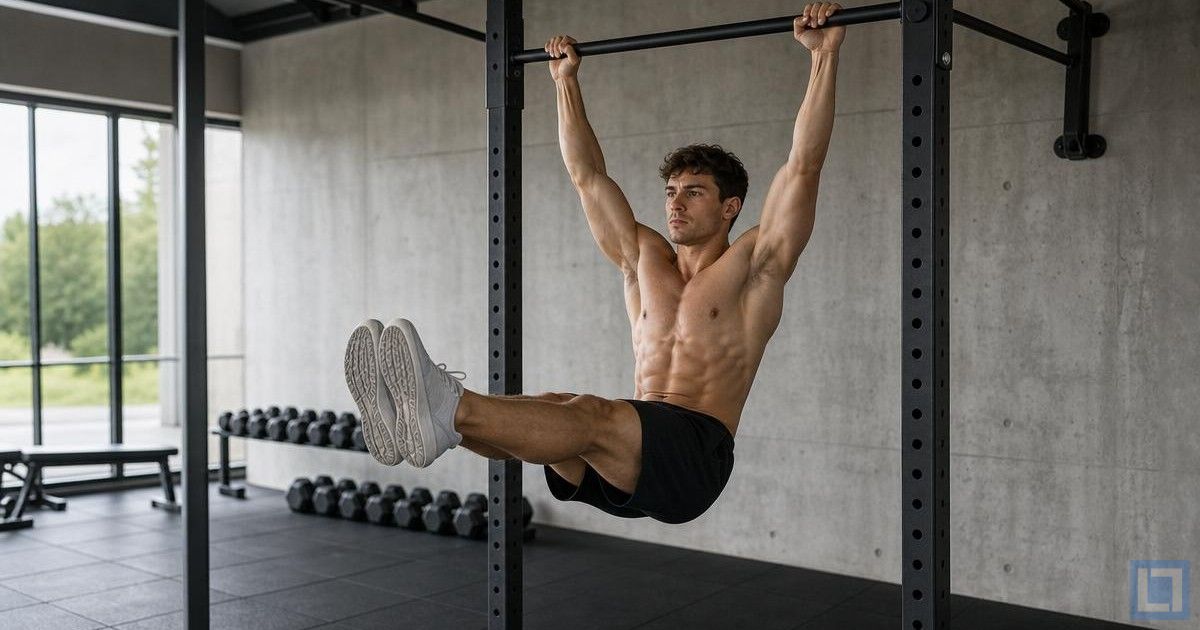
The Hanging Pike hangs from a pull-up bar and lifts the legs straight up in front of the body to form an L-sit or pike position. The exercise loads the lower abs and hip flexors through a long lever motion.
For lower-ab development, the hanging pike is one of the most demanding bodyweight exercises that exists. The straight-leg position creates a long lever arm that significantly increases the demand on the lower abs compared to bent-knee variations. Build to 3 sets of 6 to 10 strict reps before progressing to the toes-to-bar variation.
Hang from a pull-up bar with arms straight. Keep the legs straight (do not bend at the knees). Lift the legs up in front of the body to form an L-sit position with the legs roughly parallel to the floor. Hold briefly. Lower under control to the hanging position. Avoid swinging.
Hanging Leg Raise

The Hanging Leg Raise hangs from a pull-up bar and lifts the legs in front of the body using lower-ab strength. The exercise can be performed with bent or straight legs depending on strength level.
The hanging leg raise is the foundational hanging ab exercise. Most lifters should start with bent-knee leg raises (knees lifted toward the chest) before progressing to straight-leg variations. Build to 3 sets of 12 to 15 strict bent-knee reps before progressing to straight-leg variations. Run it for 3 sets of 8 to 12 reps.
Hang from a pull-up bar with arms straight. Lift the legs in front of the body using lower-ab strength. For bent-knee variations, lift the knees toward the chest. For straight-leg variations, keep the legs straight and lift them to roughly parallel with the floor. Lower under control. Avoid swinging.
Hanging Hollow Hold

The Hanging Hollow Hold hangs from a pull-up bar and holds the hollow body position (legs slightly raised, ribs tucked, lower back rounded slightly) for time. The static hold builds extreme core endurance under maximum hanging load.
For advanced core endurance, the hanging hollow hold is one of the most demanding isometric exercises that exists. The combination of grip endurance, shoulder stability, and continuous core contraction produces stronger total core development per second than nearly any other exercise. Build to 30-second clean holds before progressing to longer durations.
Hang from a pull-up bar with arms straight. Pull the shoulders down (engage the lats). Lift the legs slightly in front of the body and tuck the ribs down toward the pelvis (round the lower back slightly into the hollow position). Hold while breathing shallow but consistent breaths.
Hanging Knee Circle Raise

The Hanging Knee Circle Raise hangs from a pull-up bar and rotates the knees in a circular motion (clockwise or counter-clockwise). The rotational pattern hits the obliques and rotational core stabilizers heavily.
For oblique training from a hanging position, the knee circle raise produces unique stimulus through the continuous rotation. The pattern fits between basic hanging leg raises (lower-ab focus) and full hanging windmills (advanced rotation). Run it for 3 sets of 8 to 10 circles in each direction.
Hang from a pull-up bar with arms straight. Lift the knees toward the chest into a tucked position. Move the knees in a circular path: forward, to one side, down, to the other side, and back to the start. Continue for the prescribed reps. Reverse direction on the next set.
Hanging Straight Leg Raise

The Hanging Straight Leg Raise hangs from a pull-up bar and lifts the legs straight up to parallel with the floor without bending the knees. The straight-leg position creates a longer lever arm than bent-knee variations and produces stronger lower-ab loading.
For advanced lower-ab development, the hanging straight leg raise is one of the most demanding bodyweight exercises that exists. The straight-leg lever arm significantly increases the demand on the lower abs compared to bent-knee variations. Most lifters need 4 to 8 weeks of bent-knee leg raise practice before strict straight-leg raises become feasible.
Hang from a pull-up bar with arms straight. Keep the legs completely straight throughout the rep. Lift the legs in front of the body to roughly parallel with the floor by contracting the lower abs. Lower under control. Do not let the legs swing or use momentum.
Hanging Toes to Bar

The Hanging Toes to Bar hangs from a pull-up bar and lifts the legs all the way up to touch the bar with the toes. The full-range lift is one of the most demanding hanging ab exercises that exists, requiring strong abs, hip flexors, and grip simultaneously.
For elite-level core training, toes-to-bar is the gold standard. The combination of full-range hanging leg raise, hip flexor strength, and grip endurance produces stronger core development per rep than nearly any other exercise. Most lifters need years of progressive hanging ab training before strict toes-to-bar becomes achievable. Run it for 3 sets of 6 to 10 reps once accessible.
Hang from a pull-up bar with arms straight. Lift the legs up by contracting the abs and hip flexors, continuing the motion until the toes touch the bar above. Lower under control. Avoid swinging or using momentum; strict toes-to-bar requires pure ab and hip flexor strength.
How To Program These Workouts
A productive hanging ab session pulls four to six exercises from the list above based on current strength level. Beginners should start with scapular shrugs (foundation), flutter kicks, and bent-knee leg raises. Intermediates can add knee circles, half windmills, and straight-leg raises. Advanced lifters can include pikes, toes-to-bar, and hollow holds. Run hanging exercises for 3 sets of 6 to 12 reps per exercise; isometric holds for 20 to 45 seconds per set.
Train hanging abs 2 to 3 times per week. The combination of ab loading, grip demand, and shoulder loading produces broad fatigue that requires appropriate recovery; daily hanging ab training often produces grip soreness that limits other training. Most successful programs run hanging ab sessions every 2 to 3 days alongside regular strength training that uses the developed grip and core strength.
For broader ab programming, see our best ab roller workouts and best dead bug ab workouts. For pull-up specific training that complements hanging abs, see our how to do a pull-up guide.
Final Thoughts
The best hanging ab workouts deliver elite-level core training through progressive variations that build from foundational hanging mechanics to advanced toes-to-bar and hollow holds. The combination of anti-extension demand, lower-ab loading, grip endurance, and shoulder stability produces ab stimulus and visible core development that few other training approaches can match. For lifters who want serious core training that translates to better performance on every athletic and gymnastic skill, hanging ab workouts are one of the most effective options available.
Stay focused on strict form over rep count. The most common hanging ab training mistake is using body swing or momentum to complete reps that would otherwise be too difficult. The fix: prioritize strict reps with controlled motion over higher rep counts with swing. A set of 6 strict hanging leg raises produces stronger ab development than 12 swung reps. Build slowly through the progression; lifters who progress patiently develop genuinely strong cores while lifters who chase rep counts develop the appearance of core strength without the substance.
Frequently Asked Questions
What’s the easiest hanging ab exercise to start with?
The hanging scapular shrug is the foundational exercise that builds the shoulder mechanics for all other hanging ab work. The hanging flutter kick and bent-knee hanging leg raise are the easiest dynamic exercises for absolute beginners. Most lifters can perform these within their first hanging ab session; harder variations require 4 to 8 weeks of progressive practice to access.
How often should I do hanging ab workouts?
Two to three times per week works for most lifters. The combination of ab loading, grip demand, and shoulder loading produces broad fatigue. Daily hanging ab training often produces grip and shoulder soreness that limits other training. Most successful programs run hanging ab sessions every 2 to 3 days with rest periods between.
Do I need a pull-up bar for hanging ab workouts?
Yes, or any sturdy overhead grip point. A standard pull-up bar (door-mounted or fixed) is the most common option. Gymnastic rings work as well and add additional stability demand. Some lifters use sturdy tree branches, playground equipment, or rafters as alternatives. The grip surface should be secure enough to support full bodyweight under dynamic loading.
What if I cannot hang from the bar very long?
Build the hang first. Most beginners can hold a dead hang for 10 to 30 seconds initially; build to 60-second hangs before adding dynamic ab exercises. Grip strength builds quickly with consistent practice; most lifters can hold 60 to 90-second hangs within 2 to 4 weeks. The grip strength is the limiting factor for most beginners; hanging ab progression often outpaces ab strength once grip catches up.
Will hanging ab workouts give me a six-pack?
Hanging ab training builds the muscle that gives the stomach its shape; reducing body fat through nutrition reveals that shape. Both are required for visible abs. Most lifters need to be at 12 to 18 percent body fat for abs to show clearly. The training handles the muscle-building side; sustainable nutrition handles the body fat side. Consistent training combined with appropriate calorie management produces visible results over 12 to 16 weeks.