Barbell tricep training produces serious tricep development through bilateral barbell loading that allows heavier total weight than dumbbell or cable variations. The combination produces particularly strong tricep growth because the bilateral loading drives heavier compound work (close-grip bench press, JM press) alongside heavier isolation work (skull crushers, overhead extensions). The format also enables specialized variations that target specific tricep heads: lying skull crushers for the long head, close-grip bench press for the medial head, reverse-grip variations for medial-head emphasis, and overhead variations for stretched-position long-head loading.
Below are ten effective barbell tricep exercises that cover heavy compound work (close-grip bench press, JM press), foundational isolation (lying triceps extension, skull crusher, lying close-grip extension), advanced variations (incline skull crusher, reverse-grip skull crusher), and overhead long-head specialization (standing overhead extension, seated overhead extension, Olympic barbell extension). Together they form a complete barbell tricep training program. Pull 5 to 7 exercises per session and rotate the selection across sessions for complete development across all three tricep heads.
Barbell Lying Triceps Extension

The Barbell Lying Triceps Extension lies flat on a bench and lowers a barbell behind the head by bending only at the elbows, then extends back to lockout. The pattern isolates the triceps through pure elbow extension under barbell load.
For barbell tricep training, the lying triceps extension is the foundational tricep isolation exercise. The pattern hits all three tricep heads with significant loading. Run it for 3 to 4 sets of 8 to 12 reps as primary tricep isolation work in any barbell tricep session.
Lie flat on a bench holding a barbell with overhand grip slightly narrower than shoulder-width. Press the bar to lockout above the chest. Lower the bar behind the head by bending only at the elbows, keeping the upper arms vertical. Extend back to lockout by contracting the triceps. Maintain elbow position throughout.
Barbell Lying Triceps Extension Skull Crusher

The Barbell Lying Triceps Extension Skull Crusher lies flat on a bench and lowers a barbell toward the forehead (skull crusher position) by bending at the elbows, then extends back to lockout. The pattern emphasizes the long head of the triceps through the lower endpoint position.
For long-head tricep development, the skull crusher is one of the most effective exercises that exists. The pattern hits the long head specifically through the deep elbow flexion position. Run it for 3 to 4 sets of 8 to 12 reps as primary long-head tricep work.
Lie flat on a bench holding a barbell with overhand grip slightly narrower than shoulder-width. Press the bar to lockout above the chest. Lower the bar toward the forehead by bending at the elbows. Extend back to lockout by contracting the triceps. Avoid letting the bar drift back over the face during the descent.
Barbell Incline Triceps Extension Skull Crusher

The Barbell Incline Triceps Extension Skull Crusher performs skull crushers on an incline bench (set to 30 to 45 degrees), with the bar lowered behind the head. The incline angle increases the long-head stretch loading at the bottom of the rep.
For maximum long-head tricep loading, the incline skull crusher produces stronger stretch loading than flat bench variations. The pattern hits the long head through extreme stretch at the bottom of every rep. Run it for 3 sets of 8 to 12 reps as advanced long-head tricep work.
Set an incline bench (30 to 45 degrees). Lie back holding a barbell with overhand grip slightly narrower than shoulder-width. Press the bar to lockout above the chest. Lower the bar behind the head by bending at the elbows. Extend back to lockout by contracting the triceps.
Barbell Reverse Grip Skullcrusher
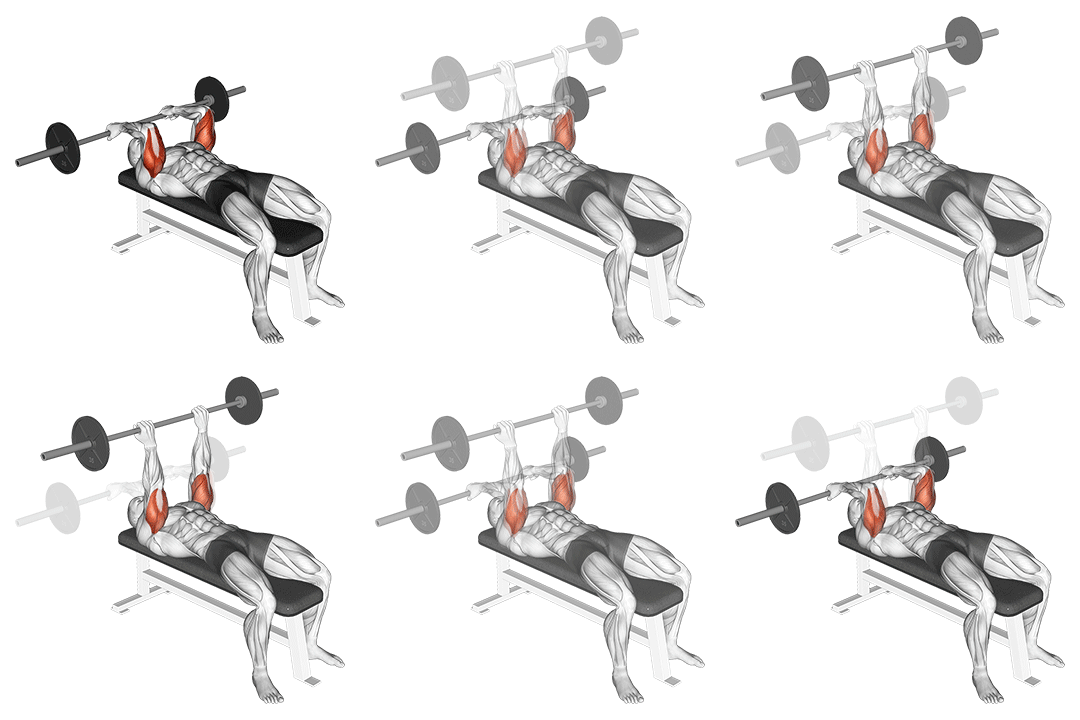
The Barbell Reverse Grip Skullcrusher performs skull crushers with palms facing up (underhand grip) instead of the standard overhand grip. The reverse grip biases loading toward the medial head of the triceps.
For medial-head tricep development, the reverse-grip skull crusher produces unique loading that complements standard skull crusher variations. Most successful tricep programs include reverse-grip work for complete tricep development. Run it for 3 sets of 8 to 12 reps as variation tricep work.
Lie flat on a bench holding a barbell with palms facing up (underhand grip), hands slightly narrower than shoulder-width. Press the bar to lockout above the chest. Lower the bar toward the forehead by bending at the elbows. Extend back to lockout. The reverse grip changes the loading angle on the triceps.
Barbell JM Bench Press

The Barbell JM Bench Press combines a close-grip bench press with a tricep extension into a single hybrid movement. The pattern (popularized by powerlifter JM Blakley) produces extreme tricep loading through the combined elbow flexion and extension pattern.
For advanced barbell tricep training, the JM press is one of the most demanding tricep exercises that exists. The pattern combines the loading benefits of close-grip bench press with the isolation of skull crushers. Run it for 3 sets of 6 to 10 reps as advanced tricep work.
Lie flat on a bench holding a barbell with overhand grip slightly narrower than shoulder-width. Press the bar to lockout. Lower the bar toward the upper chest while bending at the elbows (combining a close-grip bench press path with a skull crusher). Push back to lockout by contracting the triceps. Maintain controlled tempo.
Barbell Close Grip Bench Press

The Barbell Close Grip Bench Press performs a flat bench press with hands placed close together (typically shoulder-width or slightly closer). The narrower grip biases loading toward the triceps more heavily than standard bench press grip.
For combined tricep and chest strength training, the close-grip bench press is the foundational compound tricep exercise. The pattern allows heavier total loading than tricep isolation exercises and produces strong tricep mass development. Run it for 4 sets of 6 to 10 reps as primary heavy tricep work.
Lie flat on a bench with feet planted firmly on the floor. Grip the barbell at shoulder-width (or slightly closer). Lower the bar to mid-chest under control while keeping the elbows tucked close to the body. Press back to lockout, focusing on tricep extension. Maintain tight upper back position throughout.
Barbell Standing Overhead Triceps Extension

The Barbell Standing Overhead Triceps Extension stands tall holding a barbell overhead and lowers the bar behind the head by bending at the elbows, then extends back to lockout. The standing overhead position emphasizes the long head of the triceps under stretched loading.
For long-head tricep development through overhead pressing variations, the standing overhead extension is one of the most direct exercises that exists. The overhead position fully stretches the long head at the bottom of every rep. Run it for 3 sets of 8 to 10 reps as primary long-head work.
Stand tall holding a barbell overhead with shoulder-width grip, arms extended fully. Lower the bar behind the head by bending at the elbows while keeping the upper arms vertical. Extend back to lockout by contracting the triceps. Brace the core hard to maintain upright posture throughout.

Barbell Seated Overhead Triceps Extension

The Barbell Seated Overhead Triceps Extension sits on a bench (with or without back support) and performs the overhead tricep extension. The seated position eliminates leg drive and produces stricter tricep loading than standing variations.
For strict long-head tricep training, the seated overhead extension produces stronger isolation than standing variations. The pattern eliminates body sway and focuses loading purely on the triceps. Run it for 3 sets of 8 to 12 reps as strict long-head tricep work.
Sit on a bench holding a barbell overhead with shoulder-width grip, arms extended fully. Lower the bar behind the head by bending at the elbows while keeping the upper arms vertical. Extend back to lockout by contracting the triceps. Maintain upright posture throughout.
Barbell Lying Close Grip Triceps Extension

The Barbell Lying Close Grip Triceps Extension lies flat on a bench and performs tricep extensions with a narrow grip on the barbell. The narrower grip increases tricep isolation by reducing the involvement of the surrounding muscles.
For maximum tricep isolation in barbell training, the close-grip lying extension produces stronger tricep loading than standard-grip variations. The narrow grip biases loading even more heavily toward the triceps. Run it for 3 sets of 8 to 12 reps as direct tricep isolation work.
Lie flat on a bench holding a barbell with hands placed close together (4 to 6 inches apart). Press the bar to lockout above the chest. Lower the bar behind the head by bending at the elbows while maintaining the close grip. Extend back to lockout by contracting the triceps.
Olympic Barbell Triceps Extension
The Olympic Barbell Triceps Extension performs tricep extensions with an Olympic barbell (45-pound bar). The longer Olympic bar provides different mechanics than standard tricep extension setups and allows for varied grip positioning.
For barbell tricep training with Olympic bar mechanics, the Olympic barbell extension produces unique loading. The longer bar allows for various grip widths and angles. Run it for 3 sets of 8 to 10 reps as variation tricep work.
Set up with an Olympic barbell on a flat bench. Lie back and grip the bar with hands at desired width (typically shoulder-width or slightly narrower). Press the bar to lockout. Lower the bar behind the head by bending at the elbows. Extend back to lockout by contracting the triceps.
How To Program These Workouts
A productive barbell tricep session pulls five to seven exercises from the list above. A balanced session includes one heavy compound (close-grip bench press), one foundational isolation (lying triceps extension or skull crusher), one long-head emphasis (incline skull crusher or overhead extension), one variation exercise (reverse-grip skull crusher or JM press), and one isolation finisher (lying close-grip extension). Run heavy compounds for 4 sets of 6 to 10 reps; foundational isolation for 3 to 4 sets of 8 to 12 reps; specialty variations for 3 sets of 8 to 12 reps. Total session covers 14 to 18 working sets.
Train barbell tricep sessions 1 to 2 times per week as part of broader push or arm programming. The triceps recover within 48 to 72 hours of moderate training and get significant indirect work from any chest pressing exercise. Most successful programs include 1 to 2 dedicated tricep sessions per week alongside chest pressing that produces secondary tricep loading. The format works particularly well as the second tricep session of the week (volume-focused) when the first session emphasizes compound chest pressing with secondary tricep work.
For broader tricep programming, see our best dumbbell tricep workouts and how to build bigger triceps. For long-head specific work, see our best long head tricep exercises.
Final Thoughts
The best barbell tricep workouts deliver real tricep development through heavy bilateral barbell loading that produces strong mass-building stimulus across all three tricep heads. The combination of heavy compound exercises, foundational isolation, and specialty long-head variations covers every major tricep function and produces complete development. For lifters who want serious tricep growth, want to add heavy barbell work to existing tricep programs, or need productive tricep training with barbell-only equipment, dedicated barbell tricep training is one of the most effective approaches available.
Stay focused on elbow position throughout every rep. The most common barbell tricep training mistake is allowing the elbows to flare outward during skull crushers and close-grip bench press, which shifts loading away from the triceps and increases shoulder injury risk. The fix: keep the elbows pointed straight up (not flared outward) on skull crushers and tucked close to the body on close-grip bench press. Quality reps with strict elbow position produce stronger tricep development than higher-weight reps with flared elbows.
Frequently Asked Questions
Are barbell tricep exercises better than dumbbells?
Different exercises serve different goals. Barbell tricep work allows heavier total loading through bilateral training, which produces stronger overall tricep development. Dumbbell tricep work catches strength imbalances through unilateral loading and allows more comfortable wrist positioning on overhead variations. Most successful tricep programs include both: barbells for heavy mass-building work, dumbbells for unilateral and varied-angle isolation. Programs relying only on one or the other miss out on complementary stimulus.
How heavy should I barbell skull crusher?
Most lifters can skull crusher roughly 30 to 40 percent of their close-grip bench press max for strict reps. For training, work in the 8 to 12 rep range with weights that allow strict form throughout. Beginners should start light (45 to 70 pounds) and progress gradually. The skull crusher is form-sensitive; quality reps with moderate loads produce stronger tricep development than heavier reps with deteriorating form.
How often should I train triceps with barbells?
One to two times per week works for most lifters. The triceps recover within 48 to 72 hours of moderate training, and they get significant indirect work from any chest pressing. Most successful programs include 1 to 2 dedicated tricep sessions per week alongside chest pressing that produces secondary tricep loading. Daily tricep training typically produces accumulated fatigue without proportional growth benefit.
Skull crushers or close grip bench press for triceps?
Both work; the choice depends on goals. Skull crushers produce stronger isolation through pure elbow extension and emphasize the long head through the overhead position. Close-grip bench press produces stronger overall tricep mass through compound loading and allows heavier total weight. Most successful programs include both: close-grip bench press for foundational mass, skull crushers for direct isolation. The combination produces broader development than either alone.
What’s the best barbell tricep exercise?
The lying triceps extension (skull crusher) is the foundational barbell tricep exercise. The pattern hits all three tricep heads with significant loading and produces strong direct isolation. Most successful barbell tricep programs include skull crushers as the cornerstone exercise alongside close-grip bench press for compound loading and overhead extensions for long-head emphasis. The combination produces broader development than any single exercise alone.