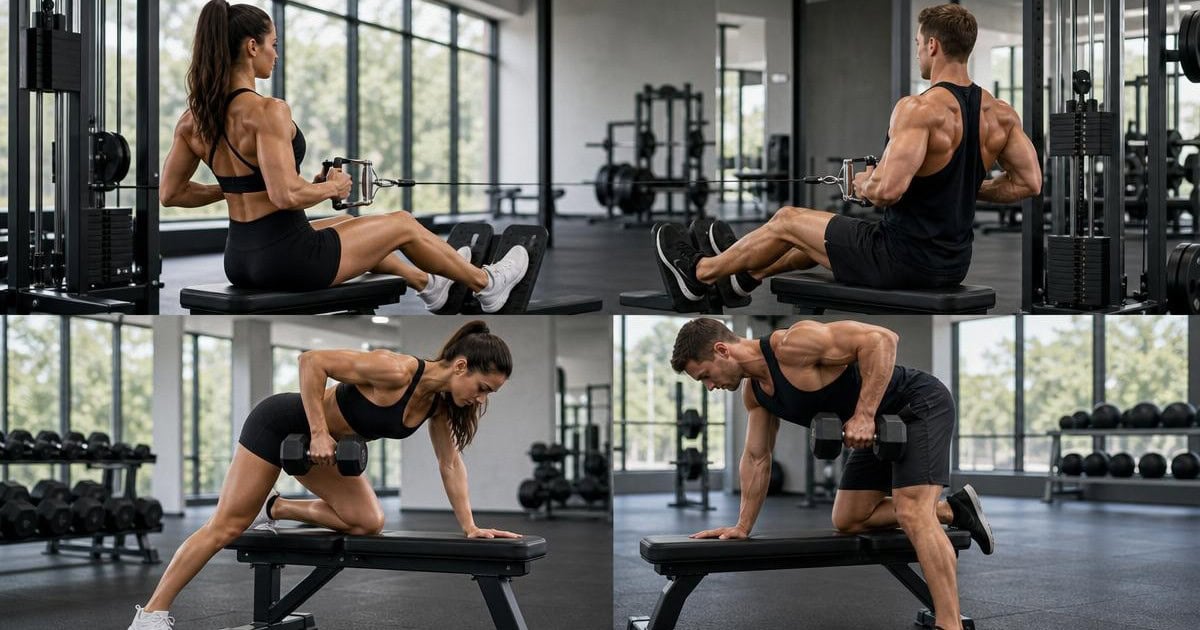
Building a stronger row requires understanding the row’s specific demands (the bent-over row requires integrated back strength for the lat and rhomboid-driven pull, posterior chain strength for maintaining proper torso angle, grip strength for holding the bar, lower back strength for spinal support during the hinged position, balanced shoulder development including rear delts and upper traps, core stability for proper bracing throughout the movement, and the technical mastery of row mechanics including bar path, scapular positioning, and torso angle) and the training principles that develop a stronger row: regular row training as the foundation (the row itself is the most important exercise for building row strength), row variations (dumbbell rows, cable rows) for asymmetry and volume, complementary deadlifting for compound posterior chain development, complementary vertical pulling (pull-ups) for balanced back development, dedicated rear delt work for shoulder balance, dedicated grip work for grip capacity, dedicated lower back work for postural support, and adequate volume across these patterns.
Below are ten of the most effective exercises for building a stronger row, covering the primary lift (barbell bent-over row), row variations (dumbbell bent-over row, cable front seated row), foundational compound work (barbell deadlift, barbell Romanian deadlift), complementary vertical pulling (pull-up), shoulder support (dumbbell rear delt fly, barbell shrug), grip work (farmers walk), and lower back support (superman). Together they form a complete row program. A 60 to 75-minute row-focused session pulled from this list, performed 1 to 2 times per week (or as primary pulling work in upper-body sessions), produces strong row development for any lifter focused on building maximum rowing strength.
Barbell Bent Over Row

The Barbell Bent Over Row performs barbell rows. The pattern is the row itself – the foundational lift to train.
For a stronger row, the row itself is the most important exercise. Run it for 4 sets of 5 to 8 reps as primary row training, with progressive overload over time.
Stand with feet hip-width holding a barbell at the front of the thighs with overhand grip. Hinge forward at the hips with a flat back so the torso is at about 45 degrees. Pull the bar to the lower chest by retracting the shoulder blades and pulling the elbows back. The lats, rhomboids, mid traps, and rear delts work hard. Squeeze the shoulder blades hard at peak. Lower under control. The pattern IS the row – direct row training is the most important thing for building row strength. Most successful row programs prioritize regular bent-over row training with progressive overload, varying intensity (heavy 5-8 rep work, moderate 8-12 rep work) and using row variations for specific weaknesses.
Dumbbell Bent Over Row

The Dumbbell Bent Over Row performs dumbbell rows. The pattern produces variation work and addresses asymmetries.
For a stronger row, dumbbell rows address left/right asymmetries. Run it for 3 sets of 8 to 12 reps as variation/asymmetry work.
Stand with feet hip-width holding dumbbells in each hand at the sides. Hinge forward at the hips with a flat back so the torso is parallel to the floor. Pull the dumbbells up to the lower chest by retracting the shoulder blades and pulling the elbows back. The lats, rhomboids, mid traps, and rear delts work hard. Squeeze the shoulder blades hard at peak. Lower under control. The pattern produces variation work that addresses left/right asymmetries common in barbell rowing – dumbbells force each side to work independently, eliminating the stronger side compensation. Excellent for building balanced row strength.
Barbell Deadlift

The Barbell Deadlift performs barbell deadlifts. The pattern produces extreme posterior loading supporting rows.
For a stronger row, the deadlift produces extreme compound posterior chain loading. Run it for 3 to 4 sets of 5 to 8 reps as posterior chain work.
Stand with feet hip-width with a barbell on the floor over the mid-foot. Hinge at the hips and bend the knees to grip the bar. Drive through the heels while extending the hips and knees to lift the bar from the floor. Stand fully tall at the top. Lower under control. The pattern produces extreme compound loading on the entire posterior chain – the deadlift trains hamstrings, glutes, erector spinae, lats, traps, and grip simultaneously. Critical for row strength because deadlifts build the lower back, hip, and lat strength that supports the bent-over row position and prevents the lower back fatigue that often limits row strength.
Pull Up

The Pull Up performs bodyweight pull-ups. The pattern complements rowing through vertical pulling.
For a stronger row, pull-ups build vertical pulling strength that complements horizontal rowing. Run it for 3 to 4 sets of 6 to 10 reps as vertical pulling.
Hang from a pull-up bar with hands shoulder-width apart and palms facing away. Pull the body up by retracting the shoulder blades and pulling the elbows down toward the ribs until the chin reaches over the bar. Lower under control to full hang. The pattern complements rowing through balanced upper-body pulling development – rowing is horizontal pulling, and pull-ups balance this with vertical pulling. Strong vertical pulling supports row strength through the integrated lat and back muscle development that contributes to all pulling movements.
Cable Front Seated Row

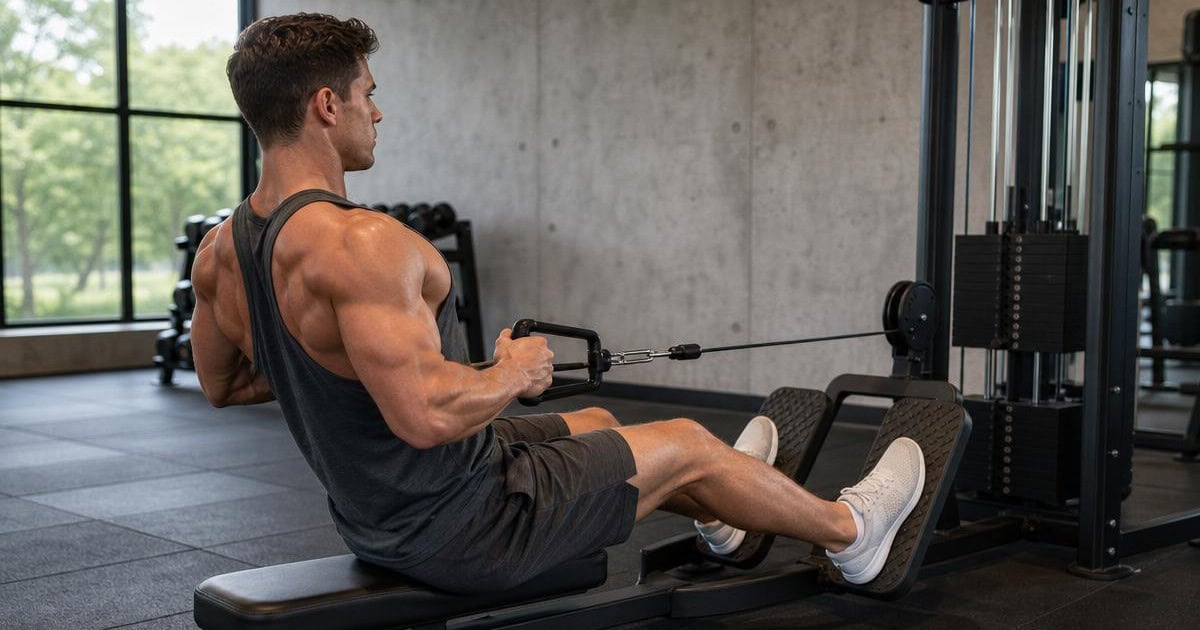
The Cable Front Seated Row performs cable rows. The pattern produces controlled rowing with constant tension.
For a stronger row, the cable row produces rowing volume with constant tension. Run it for 3 sets of 8 to 12 reps as variation rowing.
Sit at a cable row station with feet braced and a handle attached to a low pulley. Grip the handle with both hands and sit tall with arms extended forward. Pull the handle to the lower chest by retracting the shoulder blades and pulling the elbows back. The lats, rhomboids, mid traps, and rear delts work hard. Squeeze the shoulder blades hard at peak. Allow the handle to extend forward under control to full stretch. The pattern produces controlled rowing with constant cable tension – excellent variation work alongside heavy barbell rowing, providing more time under tension and removing some of the lower back fatigue that limits barbell row volume.
Barbell Romanian Deadlift

The Barbell Romanian Deadlift performs Romanian deadlifts. The pattern builds posterior chain supporting rows.
For a stronger row, the RDL builds posterior chain strength supporting the bent-over row position. Run it for 3 sets of 6 to 10 reps as posterior chain work.
Stand with feet hip-width holding a barbell at the front of the thighs. Hinge at the hips by sending them backward while keeping the back flat and legs nearly straight. Lower the barbell along the legs until the hamstrings stretch deeply. Drive back to standing by extending the hips. The pattern builds posterior chain strength critical for rowing – the bent-over row position depends on hamstring and lower back strength to maintain proper torso angle. Strong posterior chain supports heavier rowing without the lower back fatigue that often limits row capacity.
Dumbbell Rear Delt Fly
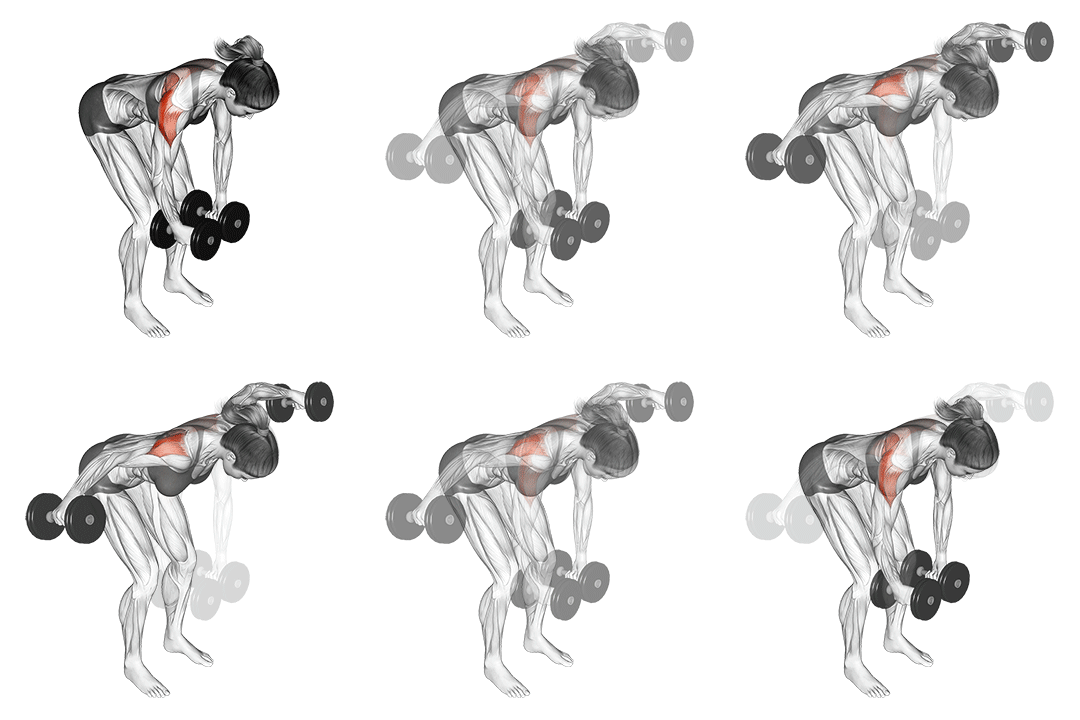
The Dumbbell Rear Delt Fly performs rear delt flies. The pattern provides shoulder support for rows.
For a stronger row, the rear delt fly builds rear delt strength supporting row mechanics. Run it for 3 sets of 12 to 15 reps as rear delt work.
Stand with feet hip-width holding dumbbells. Hinge forward at the hips with a flat back so the torso is parallel to the floor. Hold the dumbbells underneath the chest with palms facing each other. Lift the dumbbells out to the sides by raising the arms straight out to shoulder height. The rear delts and rhomboids work hard through horizontal abduction. Squeeze hard at peak. Lower under control. The pattern provides direct rear delt isolation – critical for row strength because the rear delts contribute substantially to the rowing motion, and dedicated rear delt strengthening supports row capacity through balanced shoulder development.
Barbell Shrug

The Barbell Shrug performs barbell shrugs. The pattern builds upper trap strength for rows.
For a stronger row, the barbell shrug builds upper trap strength supporting the row. Run it for 3 sets of 8 to 12 reps as upper trap work.
Stand with feet hip-width holding a barbell at the front of the thighs with overhand grip. Lift the shoulders straight up toward the ears by elevating the scapulae. The upper traps work hard through pure scapular elevation. Squeeze the upper traps hard at peak. Lower under control. The pattern produces direct upper trap loading – critical for row strength because strong upper traps support proper scapular positioning during rows and contribute to the integrated back development that supports rowing capacity.
Farmers Walk
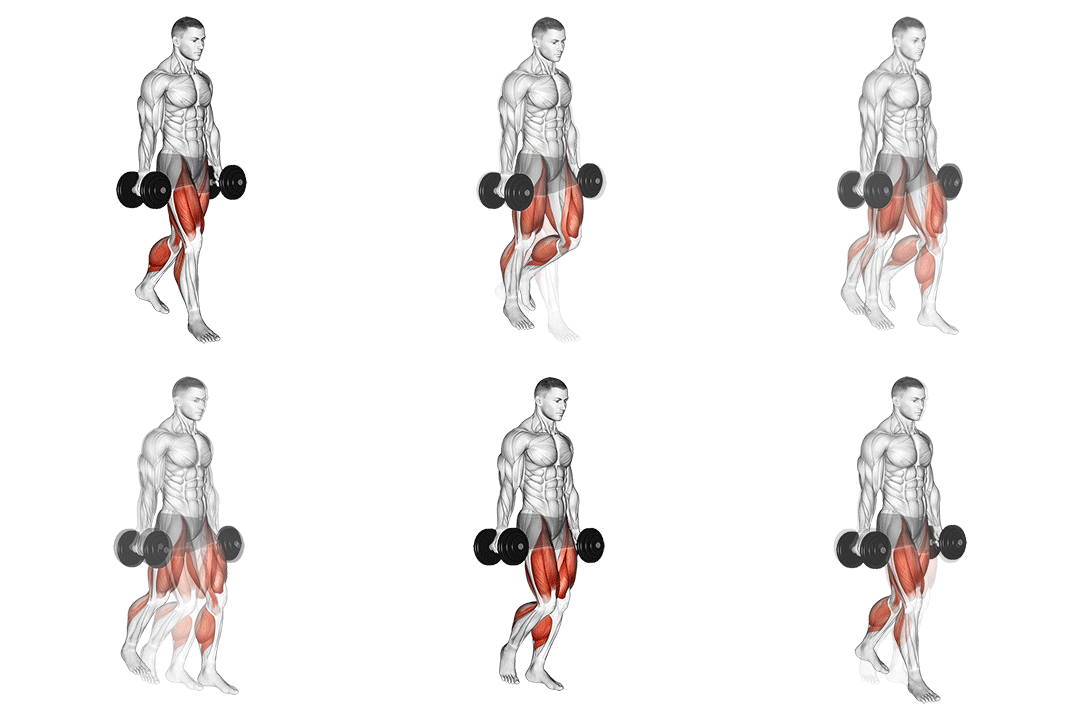
The Farmers Walk performs loaded carries. The pattern builds grip strength for rows.
For a stronger row, farmers walks build the grip strength supporting heavier rowing. Run it for 3 sets of 30 to 45-second carries as grip work.
Stand holding heavy weights (dumbbells, kettlebells, or trap bar) in each hand at the sides. Walk forward with controlled steps, maintaining tall posture and tight core. Continue for the working interval. The grip works hard isometrically. The pattern produces excellent grip strength – critical for row strength because grip can become a limiting factor during heavy rowing, especially with thick bars or after high-volume work. Strong grip ensures the back muscles can fully contribute to the row before grip fails.
Superman

The Superman performs the superman exercise. The pattern produces direct erector spinae work for row support.
For a stronger row, the superman builds erector spinae strength supporting the bent-over row position. Run it for 3 sets of 10 to 15 reps as lower back work.
Lie face-down on the floor with arms extended overhead. Lift the arms, chest, and legs off the floor simultaneously by contracting the lower back and glutes. Hold briefly at peak. Lower under control. The pattern produces direct erector spinae and glute activation – critical for row strength because the erector spinae work isometrically to maintain proper torso position throughout the bent-over row. Strong erector spinae prevents the lower back fatigue that limits row capacity, especially during heavy or high-volume rowing.
How To Program These Workouts
A productive row session pulls 5 to 7 exercises from the list above. A common balanced session: barbell bent-over row (heavy primary), dumbbell bent-over row (variation), cable front seated row (volume), barbell deadlift (compound posterior), dumbbell rear delt fly (rear delt), farmers walk (grip), superman (lower back). For row volume focus: barbell bent-over row, dumbbell bent-over row, cable front seated row, pull-up. For weak points: address rear delt weakness with rear delt flies; address grip weakness with farmers walks and dead hangs; address lower back weakness with supermans and RDLs. Run heavy row work for 3 to 4 sets of 5 to 8 reps with progressive overload, variation row work for 3 sets of 8 to 12 reps, isolation work for 3 sets of 10 to 15 reps, accessory back work for 3 to 4 sets of 6 to 12 reps.
Train rows 1 to 2 times per week with proper periodization. Most successful row programs structure work as: 1) primary row day (heavy rows plus 4 to 5 supporting exercises), 2) optional secondary upper-body day (variations like dumbbell rows or cable rows plus accessories), 3) integrated row-supporting work (deadlifts, pull-ups, rear delts, grip) in regular training. Beginners often progress with 1 weekly heavy row session. Advanced lifters benefit from 2 weekly row sessions (one heavy, one technical/volume). Total weekly row-related volume should be 12 to 20 working sets including the row and its variations, plus extensive accessory work. Combined with progressive overload over time and adequate recovery, dedicated row training produces measurable strength improvements within 8 to 12 weeks for most lifters.
For broader programming, see our how to grow your back and how to build a thicker back. For specific work, see our how to build a stronger pull up.
Final Thoughts
Building a stronger row requires applying the right training principles consistently over time: regular row training as the foundation, row variations for asymmetry and volume, complementary deadlifting for compound posterior chain development, complementary vertical pulling for balanced back development, dedicated rear delt work for shoulder balance, dedicated grip work for grip capacity, dedicated lower back work for postural support, and adequate volume across all these patterns. The combination of bent-over rows, dumbbell rows, deadlifts, pull-ups, cable rows, RDLs, rear delt flies, shrugs, farmers walks, and supermans covers every functional pattern of row development and produces broader back, posterior chain, grip, and upper-body strength than row-only training would suggest. Most lifters who consistently apply these principles see measurable row strength improvements within 8 to 12 weeks – including heavier row weights, better row technique, addressed weak points, and the integrated back strength that supports long-term row progression. For lifters seeking maximum rowing strength, dedicated comprehensive row training is one of the most effective interventions available.
Stay focused on regular heavy row practice plus posterior chain support as the priority. The most common mistake lifters make in row training is over-emphasizing rowing variations at the expense of foundational deadlifting and lower back support. The fix: prioritize regular heavy bent-over row training (1 to 2 times per week with progressive overload) plus supporting deadlifting (which builds the posterior chain strength critical for the bent-over position) plus dedicated lower back work (supermans, RDLs). Rows are built primarily by rowing plus addressing the most common weaknesses (lower back fatigue, grip, rear delt strength) through targeted accessory work. Combined with appropriate variations and grip work, focused row plus posterior chain training produces the row strength that variation-focused training alone never achieves.
Frequently Asked Questions
How can I increase my barbell row?
Regular heavy row training plus deadlift work plus rear delt isolation. The bent-over row itself is the most important exercise for building row strength – regular row practice with progressive overload produces the most efficient row improvement possible. Combined with dumbbell rows (asymmetry), barbell deadlifts (compound posterior), pull-ups (vertical pulling), cable rows (volume), RDLs (posterior chain), rear delt flies (shoulder), shrugs (upper trap), farmers walks (grip), and supermans (lower back), these form the foundation of row development. The fastest gains come from regular row practice plus deadlift support.
How long does it take to build a stronger row?
8 to 12 weeks for measurable improvement, ongoing for elite strength. Most lifters who consistently apply regular row training plus accessories see measurable improvements within 8 to 12 weeks – typically 20 to 50+ pounds added to their bent-over row in this timeframe. Beginners often see faster initial gains. Advanced lifters need years of consistent training plus precise periodization for continued progression. The mechanism: row builds through skill practice plus muscle development plus addressed weak points.
What’s the best accessory for the row?
Heavy deadlifts plus dumbbell rows. Heavy deadlifts produce extreme compound posterior chain loading that builds the lower back, hip, and lat strength supporting heavy rowing. Dumbbell rows address left/right asymmetries common with barbell-only training. Combined with pull-ups (vertical pulling), cable rows (volume), RDLs (posterior chain), rear delt flies (shoulder), shrugs (upper trap), farmers walks (grip), and supermans (lower back), these accessories support row strength.
How often should I row?
1 to 2 times per week with proper periodization. Beginners typically progress with 1 weekly heavy row session. Advanced lifters benefit from 2 weekly row sessions (one heavy, one technical/volume). Most successful programs include: 1) primary row day (heavy rows plus accessories), 2) optional secondary upper-body day (variations like dumbbell rows or cable rows plus accessories), 3) integrated row-supporting work in regular training. Total weekly row-related work should be 12 to 20 working sets.
Why is my row weak?
Most commonly weak posterior chain or weak grip. Common row weakness causes: 1) weak lower back fatiguing during the bent-over position, 2) weak grip limiting bar holding capacity, 3) weak rear delts limiting pulling capacity, 4) poor technique limiting efficient rowing, 5) insufficient row volume preventing adaptation, 6) weak hamstrings affecting torso angle. The fix: address weak points through specific accessories – lower back (deadlifts, RDLs, supermans), grip (farmers walks, dead hangs), rear delts (rear delt flies), plus regular row practice with proper technique.